Questions

5 Marks Questions

🎯

Test yourself on this topic

12 questions · timed · auto-graded

Question 15 Marks
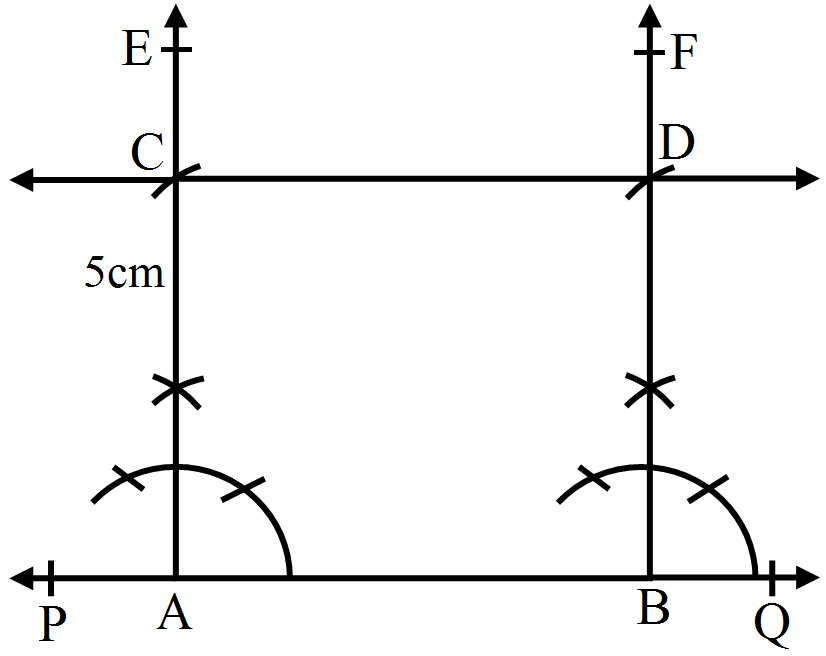
Draw a line $PQ$. Draw another line parallel to $PQ$ at a distance of $3\ cm$ from it.
Answer
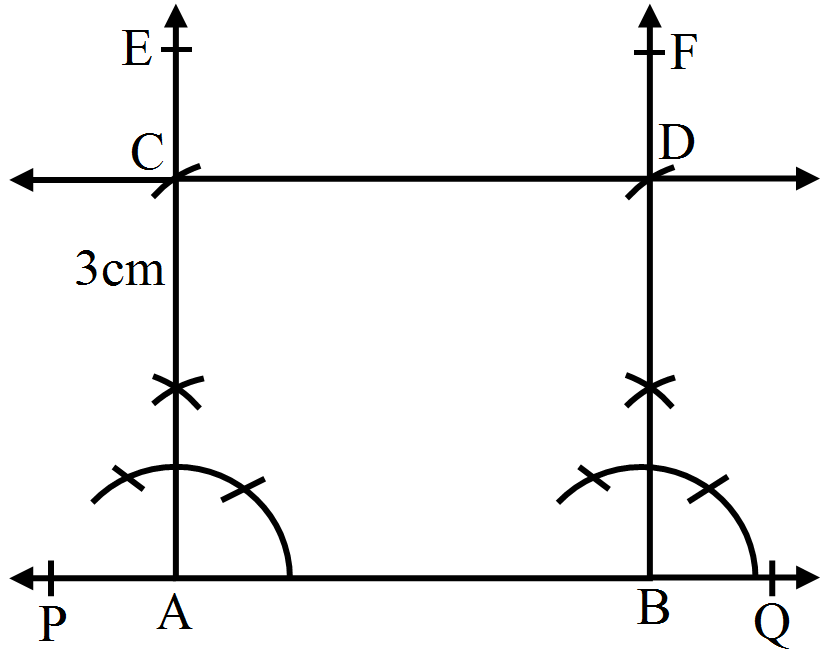
Steps of construction: Step I: Draw a line $PQ.$
Step II: Take any two points $A$ and $B$ on the line.
Step III: Construct $\angle\text{PBF}=90^\circ$ and $\angle\text{QAE}=90^\circ$
Step IV: With $A$ as centre and radius $3cm$ cut $AE$ at $C.$​​​​​​​
Step V: With $B$ as centre and radius $3cm$ cut $BF$ at $D.$​​​​​​​
Step VI: Join $CD$ and produce it on either side to get the required line parallel to $AB$ and at a distance of $5cm$ from it.
View full question & answer
Question 25 Marks
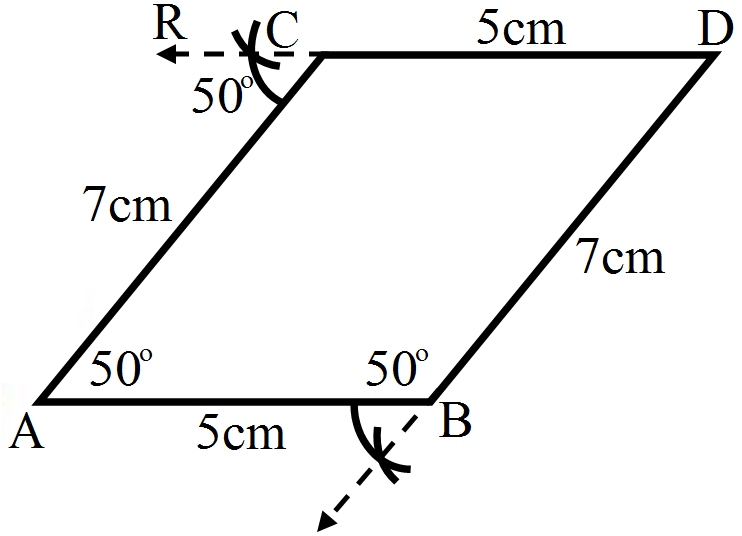
Draw an $\angle\text{BAC}$ of measure $50^\circ $ such that $AB = 5cm$ and $AC = 7cm$. Through $C$ draw a line parallel to $AB$ and through $B$ draw a line parallel to $AC$, intersecting each other at $D$. Measure $BD$ and $CD.$
Answer

Steps of construction:
Step I: Draw angle $BAC = 50^\circ $ such that $AB = 5cm$ and $AC = 7cm.$
Step II: Cut an arc through $C$ at an angle of $50^\circ $
Step III: Draw a straight line passing through $C$ and the arc. This line will be parallel to $AB$ since $\angle\text{CAB}=\angle\text{RCA}=50^\circ$
Step IV: Alternate angles are equal; therefore the line is parallel to $AB.$
Step V: Again through $B$, cut an arc at an angle of $50^\circ $ and draw a line passing through $B$ and this arc and say this intersects the line drawn parallel to $AB$ at $D.$
Step VI: $\angle\text{SBA}=\angle\text{BAC}=50^\circ,$ since they are alternate angles. Therefore $BD$ parallel to $AC.$
Step VII: Also we can measure $BD = 7cm$ and $CD = 5cm.$
View full question & answer
Question 35 Marks
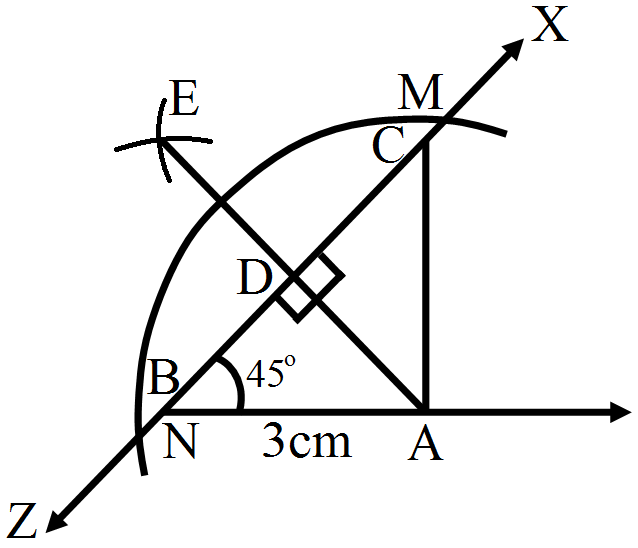
Draw a triangle $ABC$ in which $BC = 4\ cm, AB = 3\ cm$ and $\angle\text{B}=45^\circ.$ Also, draw a perpendicular from $A$ on $BC.$
Answer

Steps of construction:
Step I: Draw a line segment $AB$ of length $3\ cm.$
Step II: Draw an angle of $45^\circ $ and cut an arc at this angle at a radius of $4\ cm$ at $C.$
Step III: Join $AC$ to get the required triangle.
Step IV: With $A$ as centre, draw intersecting arcs at $M$ and $N.$
Step V: With centre $M$ and radius more than half of $MN$, cut an arc on the opposite side of $A.$
Step VI: With $N$ as centre and radius the same as in the previous step, cut an arc intersecting the previous arc at $E.$
Step VII: Join $AE$, it meets $BC$ at $D$, then $AE$ is the required perpendicular.
View full question & answer
Question 45 Marks
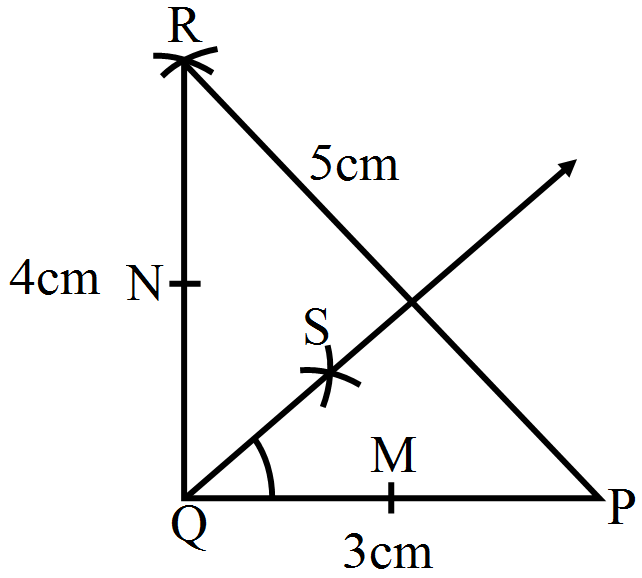
Draw $\triangle\text{PQR}$ in which $PQ = 3\ cm, QR. 4cm$ and $RP = 5\ cm$. Also, draw the bisector of $\angle\text{Q}.$
Answer
 
Steps of construction:
Step I: Draw a line segment $PQ$ of length $3 cm .$
Step II: With $Q$ as centre and radius $4 cm$ , draw an arc.
Step III: With $P$ as centre and radius $5 cm$ , draw an arc intersecting the previously drawn arc at $R.$
Step IV: Join $PR$ and $OR$ to obtain the required triangle.
Step V: From $Q$, cut arcs of equal radius intersecting $P Q$ and $Q R$ at $M$ and $N$, respectively.
Step VI: From $M$ and $N$, cut arcs of equal radius intersecting at point $S.$
Step VII: Join $QS$ and extend to produce the angle bisector of angle $PQR.$
Step VIII: Verify that $\angle PQS$ and $\angle SQR$ are equal to $45^{\circ}$ each.
View full question & answer
Question 55 Marks
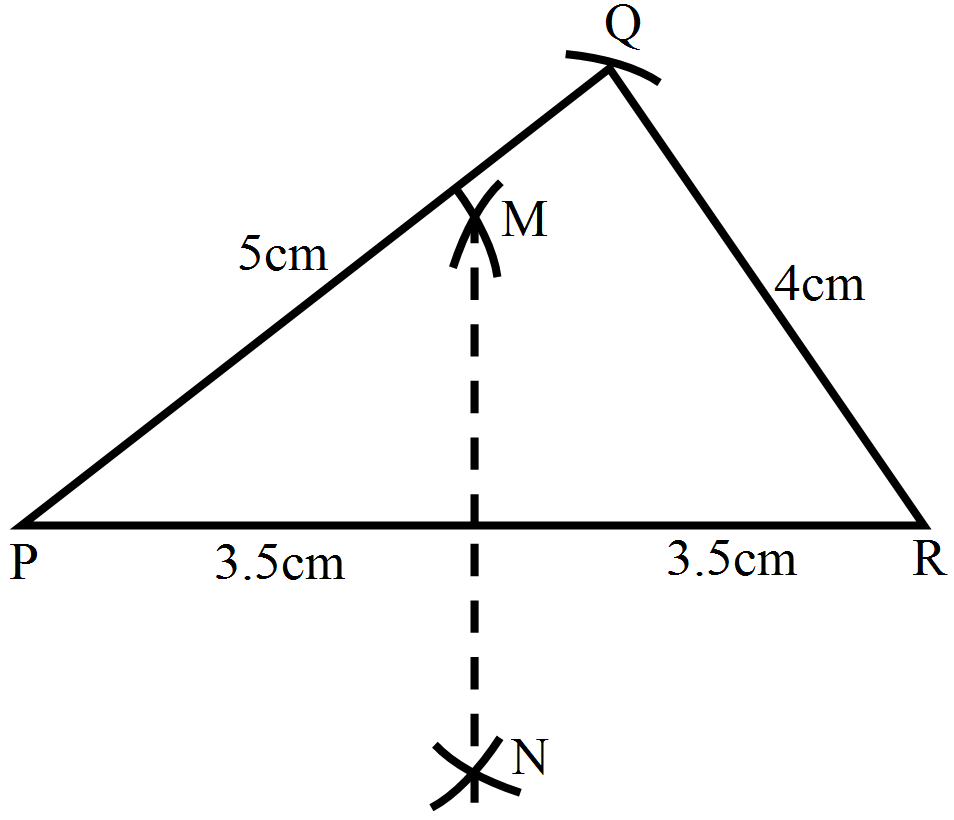
Draw a triangle whose sides are of lengths $4\ cm, 5\ cm$ and $7\ cm$. Draw the perpendicular bisector of the largest side.
Answer

Steps of construction:
Step I: Draw a line segment $PR$ of length $7\ cm.$
Step II: With centre $P$, draw an arc of radius $5\ cm.$
Step III: With centre $R$, draw an arc of radius $4\ cm$ intersecting the previously drawn arc at $Q.$
Step IV: Join $PQ$ and $QR$ to obtain the required triangle.
Step V: From $P$, draw arcs with radius more than half of $PR$ on either side.
Step VI: With the same radius as in the previous step, draw arcs from $R$ on either sides of $PR$ intersecting the arcs drawn in the previous step at $M$ and $N.$
Step VII: $MN$ is the required perpendicular bisector of the largest side.
View full question & answer
Question 65 Marks
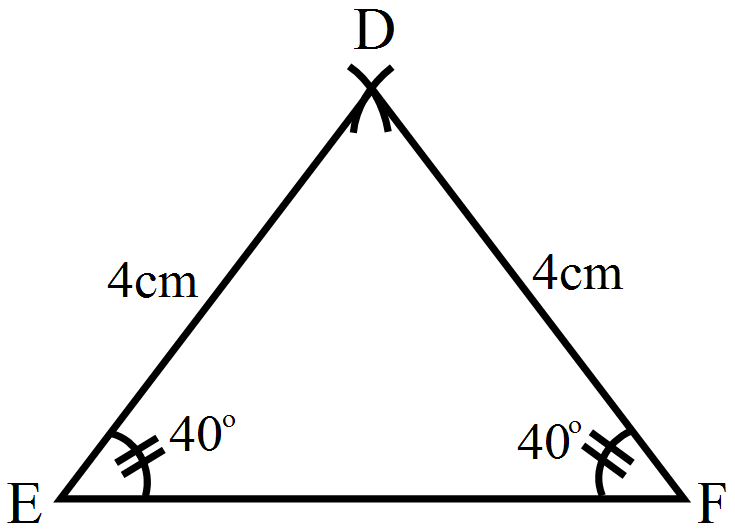
Draw $\triangle\text{DEF}$ such that $DE= DF= 4\ cm$ and $EF = 6\ cm$. Measure $\angle\text{E}$ and $\angle\text{F}.$
Answer

Steps of construction:
Step I: Draw a line segment $EF$ of length $6\ cm$.
Step II: With $E$ as centre, draw an arc of radius $4\ cm$.
Step III: With $F$ as centre, draw an arc of radius $4\ cm$ intersecting the previous arc at $D.$
Step IV: Join $DE$ and $DF$ to get the desired triangle $DEF.$​​​​​​​
Step V: By measuring we get, $\angle\text{E}=\angle\text{F}=40^\circ.$
View full question & answer
Question 75 Marks
Draw two parallel lines at a distance of $5\ cm$ apart.
Answer

Steps of construction:
Step I: Draw a line $PQ$.
Step II: Take any two points $A$ and $B$ on the line.
Step III: Construct $\angle\text{PBF}=90^\circ$ and $\angle\text{QAE}=90^\circ$
Step IV: With $A$ as centre and radius $5\ cm$ cut $AE$ at $C.$
Step V: With $B$ as centre and radius $5\ cm$ cut $BF$ at $D.$​​​​​​​
Step VI: Join $CD$ and produce it on either side to get the required line parallel to $AB$ and at a distance of $5\ cm$ from it.
View full question & answer
Question 85 Marks
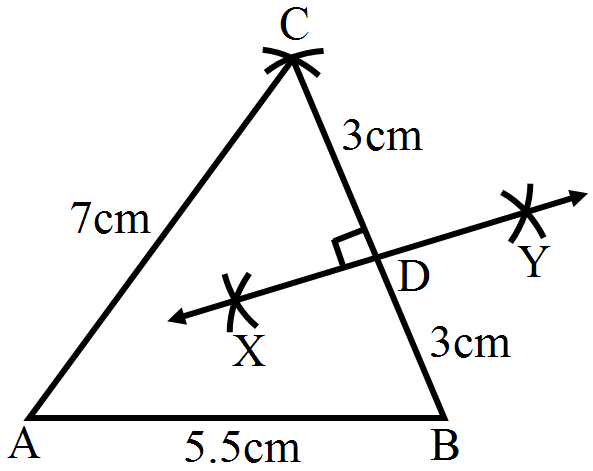
Draw $\triangle\text{ABC}$ in which $AB = 5.5\ cm. BC = 6\ cm$ and $CA = 7\ cm$. Also, draw perpendicular bisector of side $BC.$
Answer

Steps of construction:
Step I: Draw a line segment $AB$ of length $5.5\ cm.$
Step II: From $B$, cut an arc of radius $6\ cm.$
Step III: With centre $A$, draw an arc of radius $7\ cm$ intersecting the previously drawn arc at $C.$
Step IV: Join $AC$ and $BC$ to obtain the desired triangle.
Step V: With centre $B$ and radius more than half of $BC$, draw two arcs on both sides of $BC$.
Step VI: With centre $C$ and the same radius as in the previous step, draw two arcs intersecting the arcs drawn in the previous step at $X$ and $Y.$
Step VII: Join $XY$ to get the perpendicular bisector of $BC$.
View full question & answer
Question 95 Marks
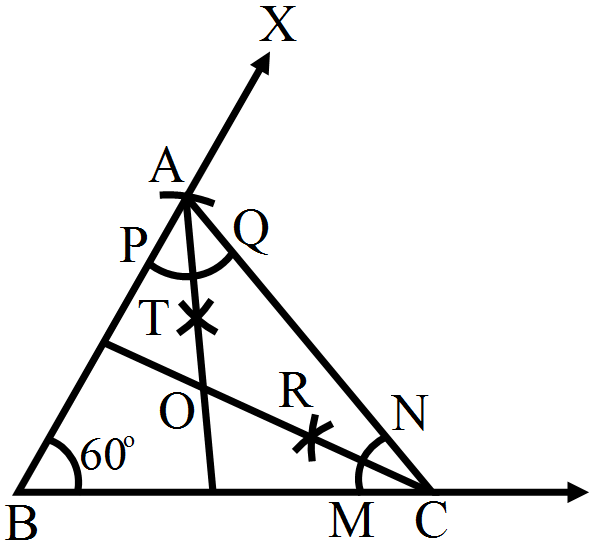
Draw a triangle $ABC$ with $AB = 3\ cm, BC = 4\ cm$ and $\angle\text{B}=60^\circ.$ Also, draw the bisector of angles $C$ and $A$ of the triangle, meeting in a point $O$. Measure $\angle\text{COA}.$
Answer

Steps of construction: Step I: Draw a line segment $B C=4 cm$.
Step II: Draw $\angle CBX =60^{\circ}$.
Step III: Draw an arc on $BX$ at a radius of $3 cm$ cutting $B X$ at $A$.
Step IV: Join $AC$ to get the required triangle.
Angle bisector for angle A:
Step I: With $A$ as centre, cut arcs of the same radius cutting $A B$ and $A C$ at $P$ and $Q$, respectively.
Step II: From $P$ and $Q$ cut arcs of same radius intersecting at $R$.
Step II: Join AR to get the angle bisector of angle$ A.$
Angle bisector for angle C:
Step I: With A as centre, cut arcs of the same radius cutting $CB$ and $CA$ at $M$ and $N$, respectively.
Step II: From $M$ and $N$, cut arcs of the same radius intersecting at $T$
Step III: Join $CT$ to get the angle bisector of angle $C.$
Step IV: Mark the point of intersection of $CT$ and $AR$ as $0 .$
Step V: Angle $\angle COA =120^{\circ}$.
View full question & answer
Question 105 Marks
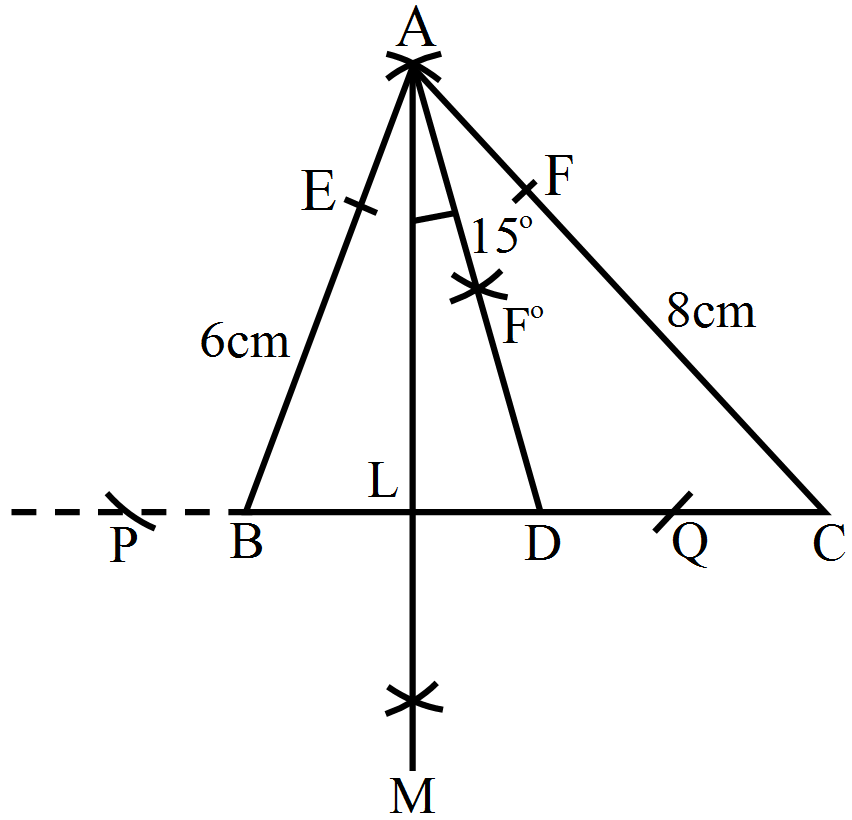
Draw a $\triangle\text{ABC}$ with $AB = 6cm, BC = 7cm$ and $CA = 8cm.$ Using ruler and compass alone, draw $(i)$ the bisector $AD$ of $\angle\text{A}$ and $(ii)$ perpendicular $AL$ from A on $BC$. Measure $LAD.$
Answer

Steps of construction: Step I: Draw a line segment $BC$ of length $7 cm .$
Step II: With centre $B$, draw an arc of radius $6 cm$ .
Step III: With centre $C$, draw an arc of radius $8 cm$ intersecting the previously drawn arc at $A.$
Step IV: Join $A C$ and $B C$ to get the required triangle.
Angle bisector steps: Step I: From $A$, cut arcs of equal radius intersecting $A B$ and $A C$ at $E$ and $F$ respectively.
Step II: From $E$ and $F,$ cut arcs of equal radius intersecting at point $H.$
Step III: Join $AH$ and extend to produce the angle bisector of angle $A$, meeting line $B C$ at $D$.
View full question & answer
Question 115 Marks
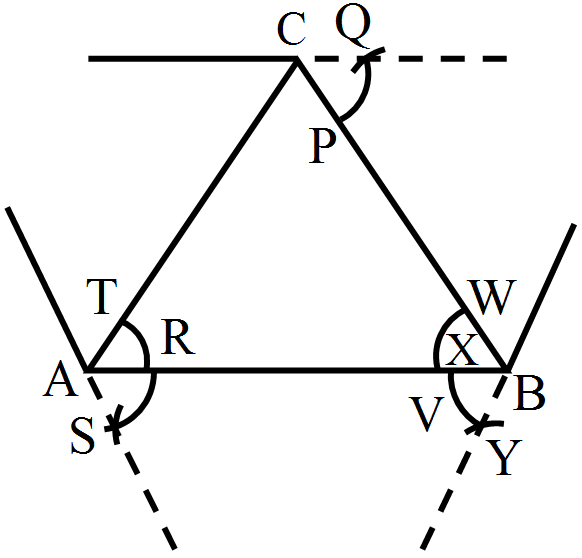
Take any three non-collinear points $A, B, C$ and draw $\angle\text{ABC}.$ Through each vertex of the triangle, draw a line parallel to the opposite side.
Answer

Steps of construction: Step I: Mark three non collinear points $A, B$ and $C$ such that none of them lie on the same line.
Step II: Join $A B, B C$ and $C A$ to form triangle $A B C$.
Step III: Parallel line to $A C$
Step IV: With $A$ as centre, draw an arc cutting $A C$ and $A B$ at $T$ and $U$, respectively.
Step V: With centre $B$ and the same radius as in the previous step, draw an arc on the opposite side of $A B$ to cut $A B$ at $X .$
Step VI: With centre $X$ and radius equal to $T U$, draw an arc cutting the arc drawn in the previous step at $Y$.
Step VII: Join $B Y$ and produce in both directions to obtain the line parallel to $A C$.
Parallel line to AB: Step I: With $B$ as centre, draw an arc cutting $B C$ and $B A$ at $W$ and $V$, respectively.
Step II: With centre $C$ and the same radius as in the previous step, draw an arc on the opposite side of $B C$ to cut $B C$ at $P .$
Step III: With centre $P$ and radius equal to $W V$, draw an arc cutting the arc drawn in the previous step at $Q .$
Step IV: Join $CQ$ and produce in both directions to obtain the line parallel to $A B$.
View full question & answer
Question 125 Marks
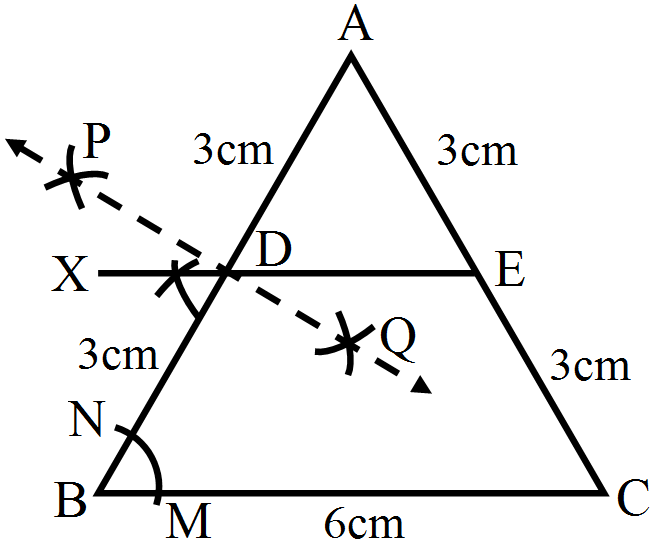
Draw any $\triangle\text{ABC}.$ Bisect side $AB$ at $D$. Through $D$, draw a line parallel to $BC$, meeting $AC$ in $E.$ Measure $AE$ and $EC.$
Answer

Steps of construction:
Step I: We first draw a triangle $A B C$ with each side $=6 cm$.
Steps to bisect line $AB:$
Step I: Draw an arc from $A$ on either side of line $A B$.
Step II: With the same radius as in the previous step, draw an arc from $B$ on either side of $AB$ intersecting the arcs drawn in the previous step at $P$ and $Q $.
Step III: Join $PQ$ cutting $A B$ at $D . P Q$ is the perpendicular bisector of $A B$.
Parallel line to $B C$ :
Step I: With $B$ as centre, draw an arc cutting $B C$ and $B A$ at $M$ and $N$, respectively.
Step II: With centre $D$ and the same radius as in the previous step, draw an arc on the opposite side of $A B$ to $c u t ~ A B$ at $Y$.
Step II: With centre $Y$ and radius equal to $MN$ , draw an arc cutting the arc drawn in the previous step at $X$ .
Step III: Join $XD$ and extend it to intersect $AC$ at $E.$
Step IV: $DE$ is the required parallel line.
View full question & answer