Question 11 Mark
$\frac{-3}{7}\div\big(\frac{-7}{3}\big)=$ _______.
Answer$\frac{-3}{7}\div\big(\frac{-7}{3}\big)=\frac{9}{49}.$ Solution: $\because$ Reciprocal of $\frac{-7}{3}$ is $\frac{3}{-7}.$ $\therefore\frac{-3}{7}+\big(\frac{3}{-7}\big)$ Product of rational numbers, $=\frac{\text{Product of numerators}}{\text{Product of denominators}}$ $=\frac{(-3\times3)}{7\times(-7)}=\frac{-9}{-49}=\frac{9}{49}$ Hence, $\frac{-3}{7}\div\big(\frac{-7}{3}\big)=\frac{9}{49}.$
View full question & answer→Question 21 Mark
$\frac{3}{4}\times\big(\frac{-2}{3}\big )=$ _____.
AnswerGIven,
$\frac{3}{4}\times\big(\frac{-2}{3}\big )$
Product of rational numbers,
$=\frac{\text{Product of numerators}}{\text{Product of denominators}}$
$=\frac{3\times(-2)}{4\times3}=\frac{-6}{12}$
$=\frac{-6+6}{12+6} [$dividing numerator and denominator by $6]$
$=\frac{-1}{2}$
View full question & answer→Question 31 Mark
The rational number $\frac{-12}{15}$ and $\frac{-7}{17}$ are on the opposite sides of zero on the number line.
AnswerTure. Solution: Given rational numbers are $\frac{-12}{-15}$ i.e. $\frac{12}{15}$ and $\frac{-7}{17}.$ Hence, it is true, that rational nmbers $\frac{12}{15}$ and $\frac{-7}{17}$ are on the opposite side of zero on the number line as one is negative and one is postive.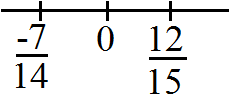
View full question & answer→Question 41 Mark
The quotient of two rationales is always a rational number.
AnswerFalse. Solution: The quotient of two rationales is not always a rational number. $\text{e.g.}\frac{1}{0}.$
View full question & answer→Question 51 Mark
Write each of the following numbers in the form $\frac{\text{q}}{\text{p}},$ where $p$ and $q$ are integers. Six-eighths.
AnswerSix-eighths $=\frac{6}{8}$
View full question & answer→Question 61 Mark
_______ $\times\big(\frac{-2}{5}\big)=1.$
Answer$\frac{-5}{2}\times\big(\frac{-2}{5}\big)=1.$ Solution: Let $\text{x}\times\big(\frac{-2}{5}\big)=1.$ $\Rightarrow\frac{-2\text{x}}{5}=1$ $\Rightarrow-2\text{x}=5$ $\Rightarrow\text{x}=\frac{-5}{2}$ Hence, $\frac{-5}{2}\times\big(\frac{-2}{5}\big)=1.$
View full question & answer→Question 71 Mark
Write each of the following numbers in the form $\frac{\text{q}}{\text{p}},$ where $p$ and $q$ are integers.
Opposite of $1$
AnswerOppostie of $1=\frac{1}{1}$
View full question & answer→Question 81 Mark
Write each of the following numbers in the form $\frac{\text{q}}{\text{p}},$ where p and q are integers. Zero.
View full question & answer→Question 91 Mark
Given that, $\frac{\text{P}}{\text{q}}$ and $\frac{\text{r}}{\text{s}}$ are two rational numbers with different denominators and both of them are in standard form. To compare these rational numbers, we say that.
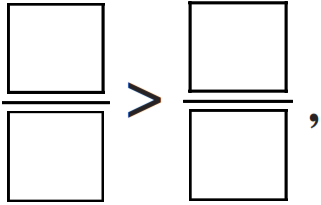
if $p \times s > r \times q$ AnswerGiven, $\text{p}\times\text{s}> \text{r}\times\text{q}$
$\Rightarrow\frac{\text{p}}{\text{q}}>\frac{\text{r}}{\text{s}} [$by tranfrring sides$]$
View full question & answer→MCQ 101 Mark
Find the odd one out of the following and give reason.
- A
$\frac{4}{-9}$
- B
$\frac{-16}{36}$
- ✓
$\frac{-20}{-45}$
- D
$\frac{28}{-63}$
AnswerCorrect option: C. $\frac{-20}{-45}$
From the above given rational numbers, $\frac{-20}{-45}$ is odd mong others, because $\frac{-20}{-45}$ can be witten as $\frac{20}{45}$ which is only postive rational number among all.
View full question & answer→Question 111 Mark
In a rational number, denominator always has to be a non-zero integer.
AnswerTrue.Solution:
Basic definition of the rational number is that, it is in the form of $\frac{\text{P}}{\text{q}},$ where $\text{q}\neq0.$ It is because any number divided by zero is not defined.
View full question & answer→Question 121 Mark
$\frac{-5}{3}\times\big(\frac{-3}{5}\big )=$ _____.
Answer$\frac{-5}{3}\times\big(\frac{-3}{5}\big )=1.$Solution:
GIven,
$\frac{-5}{3}\times\big(\frac{-3}{5}\big )$
$\therefore$ Product of rational numbers,
$=\frac{\text{Product of numerators}}{\text{Product of denominators}}$
$=\frac{(-5)\times(-3)}{3\times5}=\frac{15}{15}=1$
Hence,
$\frac{-5}{3}\times\big(\frac{-3}{5}\big)=1$
View full question & answer→Question 131 Mark
Given that, $\frac{\text{P}}{\text{q}}$ and $\frac{\text{r}}{\text{s}}$ are two rational numbers with different denominators and both of them are in standard form. To compare these rational numbers, we say that.
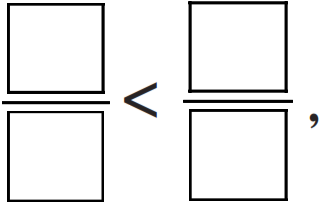
if $P \times s < r \times q.$ AnswerGiven, $\text{P}\times\text{s}<\text{r}\times\text{q}$
$\Rightarrow\frac{\text{P}}{\text{q}}<\frac{\text{r}}{\text{s}} [$by transferring sides$]$
View full question & answer→Question 141 Mark
In the following cases, write the rational number whose numerator and denominator are respectively as under: $35 ÷ (-7)$ and $35 - 18$
AnswerGiven, $35 ÷ (-7)$ and $35 - 18$
Let numerator, $\text{p}=35+(-7)=\frac{35}{-7}=-5$ and denominator,
$\text{q}=35-18=17$
Hence, rational number $=\frac{\text{P}}{\text{q}}=\frac{-5}{17}$
View full question & answer→Question 151 Mark
Fill in the boxes with the correct symbol >, < or =. $\frac{3}{7}\Box\frac{-5}{6}$
Answer$\frac{3}{7}>\frac{-5}{6}.$ Solution:Given rational numbers are $\frac{3}{7}$ and $\frac{-5}{6}.$
Since, $\frac{-5}{6}$ is a negative rational number and $\frac{3}{7}$ is a postive number. Also, every postive rational number is greater than negative rational number.
Hence, $\frac{3}{7}>\frac{-5}{6}.$
View full question & answer→Question 161 Mark
$\frac{4}{6}$ is equivalent to $\frac{2}{3}$
AnswerTrue. Solution: Givne, $\frac{4}{6}=\frac{4+2}{6+2}=\frac{2}{3}$
View full question & answer→Question 171 Mark
In the following cases, write the rational number whose numerator and denominator are respectively as under: $(- 4) \times 6$ and $8 ÷ 2$
AnswerGiven, $(- 4) \times 6$ and $8 ÷ 2$
Let numerator, $p = (- 4) \times 6 = -24$ and denominator, $\text{q}=8\div2=\frac{8}{2}=2=4$
Hence, rational number $=\frac{\text{p}}{\text{q}}=\frac{-3=24}{4}$
View full question & answer→Question 181 Mark
All decimal numbers are also rational numbers.
AnswerTrue. Solution: All decimal numbers are also rational numbers, it is true. $0.6=\frac{6}{10}=\frac{3}{5}$
View full question & answer→Question 191 Mark
Every natural number is a rational number, but every rational number need not be a natural number.
AnswerTrue.Solution:
e.g. $\frac{1}{2}$ is a rational number, but not a natural number.
View full question & answer→Question 201 Mark
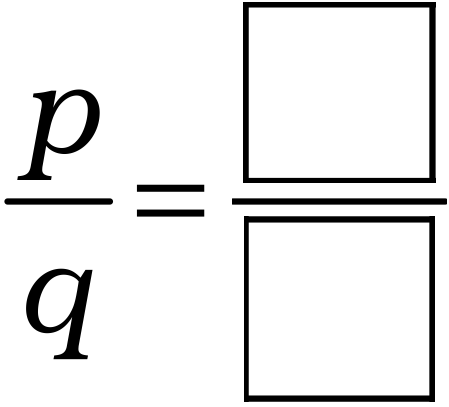
If $\frac{\text{P}}{\text{q}}$ is a rational number, then $q$ cannot be _____________.
AnswerBy definition, if $B$ is a rational number, then $q$ cannot be zero.
View full question & answer→Question 211 Mark
Every rational number is a whole number.
Answere.g. $\frac{-7}{8}$ is a rational number, but it is not a whole number, because whole numbers are $0, 1, 2,...$
View full question & answer→Question 221 Mark
The reciprocal of _______ does not exist.
AnswerThe reciprocal of zero does not exist, as reciprocal of $0$ is $\frac{1}{0},$ which is not defined.
View full question & answer→Question 231 Mark
AnswerGiven, $P = m$
$t$ and $q = n \times t$
$\therefore\frac{\text{P}}{\text{q}}=\frac{\text{m}\times\text{t}}{\text{n}\times\text{t}}=\frac{\text{m}}{\text{n}}$
View full question & answer→Question 241 Mark
Fill in the boxes with the correct symbol >, < or =. $\frac{7}{-8}\Box\frac{8}{9}$
Answer$\frac{7}{-8}<\frac{8}{9}$ Solution:Given rational numbers are $\frac{7}{-8}$ and $\frac{8}{9}.$
Since, $\frac{7}{-8}=\frac{-7}{8}$ is a negative rational number and $\frac{8}{9}$ is a postive number. Also, every postive rational number is greater than negative rational number.
Hence, $\frac{7}{-8}<\frac{8}{9}.$
View full question & answer→Question 251 Mark
Every fraction is a rational number.
AnswerTrue. Solution:Every fraction is a rational number but vice-versa is not true.
View full question & answer→Question 261 Mark
Write each of the following numbers in the form $\frac{\text{q}}{\text{p}},$ where $p$ and $q$ are integers.Three and half.
AnswerThere and half $=3\frac{1}{2}=\frac{3\times2+1}{2}=\frac{7}{2}$
View full question & answer→Question 271 Mark
If $\frac{\text{P}}{\text{q}}$ is a rational number and $m$ is a non-zero integer, then $\frac{\text{P}\times\text{m}}{\text{q}\times\text{m}}$ is a rational number not equivalent to $\frac{\text{P}}{\text{q}}.$
AnswerLet $m = 1, 2, 3,...$
When $m = 2,$ then,
$\frac{\text{P}\times\text{m}}{\text{q}\times\text{m}}=\frac{\text{P}\times1}{\text{q}\times1}=\frac{\text{P}}{\text{q}}$
When $m = 2,$
then, $\frac{\text{P}\times\text{m}}{\text{q}\times\text{m}}=\frac{\text{P}\times2}{\text{q}\times2}=\frac{\text{P}}{\text{q}}$For any non-zero value of $m,$
$\frac{\text{P}\times\text{m}}{\text{q}\times\text{m}}$ is always equivalent to $\frac{\text{P}}{\text{q}}.$
View full question & answer→Question 281 Mark
Insert $3$ equivalent rational numbers between. $0$ and $-10$
Answerthree equivalent rational numbers between $0$ and $-10$ are, $-2,\frac{-10}{5},\frac{-20}{10}.$
Note: In this question, stident should note that answer can vary.
View full question & answer→Question 291 Mark
Additive inverse of $\frac{2}{3}$ is _____.
AnswerAdditive inverse of $\frac{2}{3}$ is $\frac{-2}{3}$. Solution: Since, additive inverse is the negative of a number. Hence, additive inverse of $\frac{2}{3}$ is $\frac{-2}{3}.$ Note: Additive inverse is a number, which when added to a given number, we get result as zero.
View full question & answer→Question 301 Mark
The reciprocal of $1$ is ______.
AnswerThe reciprocal of $1=\frac{1}{1}$ Hence, the reciprocal of $1$ is $1.$
View full question & answer→Question 311 Mark
On a number line, $\frac{-1}{2}$ is to the ______ of Zero$(0).$
AnswerOn a number line, $\frac{-1}{2}$ is to the left of zero $(0).$
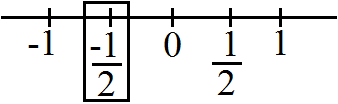
Note: All the negative numbers lie on the left side of zero on the number line. View full question & answer→Question 321 Mark
$\frac{-5}{6}+\frac{-1}{6}=$ ______.
Answer$\frac{-5}{6}+\frac{-1}{6}=-1$.Solution:
GIven,
$\frac{-5}{6}+\frac{-1}{6}=\frac{-5}{6}-\frac{1}{6}=\frac{-5-1}{6}$
$=\frac{-6}{6}$
$=-1$
Hence, $\frac{-5}{6}+\frac{-1}{6}={-1}$
View full question & answer→Question 331 Mark
The rational number $\frac{-3}{4}$ lies to the right of zero on the number line.
Answer False. Solution: Because every negative rationl number lies to the left of zero on the number line. 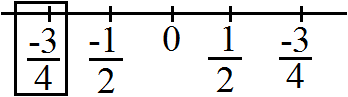
View full question & answer→Question 341 Mark
$1$ is a ____ rational number.
AnswerThe given rational number $1$ is positive number, because its numerator and denominator are positive integer.
Hence, $1$ is a positive rational number.
View full question & answer→Question 351 Mark
Every negative integer is not a negative rational number.
Answer False. Solution:
Because all the integers are rational numbers, whether it is negative/ positive but vice-versa is not true. View full question & answer→Question 361 Mark
Fill in the boxes with the correct symbol >, < or =. $\frac{5}{6}\Box\frac{8}{4}.$
Answer$\frac{5}{6}<\frac{8}{4}.$ Solution:Given rational numbers are $\frac{5}{6}$ and $\frac{8}{4}.$
We convert the rational numbers with the same denominators. $\therefore\frac{5\times2}{6\times2}=\frac{10}{12}$ and $\frac{8\times3}{4\times3}=\frac{24}{12}$ i.e. $24>10\Rightarrow\frac{24}{12}>\frac{10}{12}$ Hence, $\frac{5}{6}<\frac{8}{4}.$
View full question & answer→Question 371 Mark
Write each of the following numbers in the form $\frac{\text{q}}{\text{p}},$ where $p$ and $q$ are integers.
One-fourth.
AnswerOne-fourth $=\frac{1}{4}$
View full question & answer→Question 381 Mark
Two rational numbers are said to be equivalent or equal, if they have the same _______ form.
AnswerTwo rational numbers are said to be equivalent or equal, if they have the same simplest form. Solution:Two rational numbers are said to be equivalent or equal, if they have the same simplest form.
View full question & answer→Question 391 Mark
Write the following as rational numbers in their standard forms. $-6\frac{3}{7}$
AnswerHere, $-6\frac{3}{7}=-\Big(\frac{6\times7\div3}{7}\Big)=\frac{-45}{7}$
View full question & answer→Question 401 Mark
In the following cases, write the rational number whose numerator and denominator are respectively as under: $5 - 39$ and $54 - 6$
AnswerGiven, $5 - 39$ and $54 - 6$
Let numerator, $p = 5 - 39 = -34$ and denominator, $q = 54 - 6 = 48$
Hence, rational number $=\frac{\text{p}}{\text{q}}=\frac{-34}{48}$
View full question & answer→Question 411 Mark
Given that, $\frac{\text{P}}{\text{q}}$ and $\frac{\text{r}}{\text{s}}$ are two rational numbers with different denominators and both of them are in standard form. To compare these rational numbers, we say that. $\frac{\text{P}}{\text{q}}=\frac{\text{r}}{\text{s}},$ if ______ = ____.
AnswerGiven, $\frac{\text{P}}{\text{q}}=\frac{\text{r}}{\text{s}}$ $\Rightarrow\text{p}\times\text{s}= \text{e}\times\text{q}$ [by cross-multiplication]
View full question & answer→Question 421 Mark
$\frac{-6}{7}=\frac{}{42}$
Answer$\frac{-6}{7}=\frac{-36}{42}.$ Solution: Let given exprssion is written as, $\frac{-6}{7}=\frac{\text{x}}{42}$ $\Rightarrow\text{x}=\frac{42\times(-6)}{7}=6\times(-6)$ $\Rightarrow\text{x}=-36$ Hence, $\frac{-6}{7}=\frac{-36}{42}$
View full question & answer→Question 431 Mark
If $m$ is a common divisor of $a$ and $b,$ then $\frac{\text{a}}{\text{b}}=\frac{\text{a}\div\text{m}}{}$
AnswerIf m is a common divisor of $a$ and $b,$
then, $\frac{\text{a}}{\text{b}}=\frac{\text{a}\div\text{m}}{\text{b}\div\text{m}}$
View full question & answer→Question 441 Mark
$0\div\big(\frac{-5}{6}\big)=$ _______.
AnswerHere, $0+\big(\frac{-5}{6}\big)=0$
Because, $0$ divided by any number is zero.
View full question & answer→Question 451 Mark
$0\times\big(\frac{-5}{6}\big)=$ _______.
Answer $0\times\big(\frac{-5}{6}\big)=0$
Solution:
Hence, $0\times\big(\frac{-5}{6}\big)=0$
Because, zero miltiplies by any number result is zero.
View full question & answer→Question 461 Mark
$8$ can be written as a rational number with any integer as denominator.
Answer$8$ can be written as a rational number with any integer as denominator,
it is false because $8$ can be written as a rational number with $1$ as denominator $\text{i.e.}\frac{8}{1}.$
View full question & answer→MCQ 471 Mark
Find the odd one out of the following and give reason.
- A
$\frac{-4}{3}$
- ✓
$\frac{-7}{6}$
- C
$\frac{-10}{-3}$
- D
$\frac{-8}{7}$
AnswerCorrect option: B. $\frac{-7}{6}$
From the above given rational numbers, $\frac{-7}{6}$ is odd mong others, because all the three except $-\frac{7}{6}$ has even numerator and denominator.
View full question & answer→Question 481 Mark
Two rationales with different numerators can never be equal.
Answer False.
Solution:
Let $\frac{2}{3}$ and $\frac{4}{6}$ be two rational numbers, then $\frac{4}{6}$ can be written as $\frac{2}{3}$ in its lowest form.
$\because\frac{4}{6}=\frac{4+2}{6+2}=\frac{4}{2}+\frac{6}{2}=\frac{2}{3}$
Hence, two rational numbers with different numerators can be equal.
View full question & answer→Question 491 Mark
$\frac{-27}{45}$ and $\frac{-3}{5}$ reoresent _____ rational numbers.
Answer$\frac{-27}{45}$ and $\frac{-3}{5}$ reoresent same rational numbers. Solution: Given numbers are, $\frac{-27}{45}=\frac{-9}{15}=\frac{-3}{5}$ and $\frac{-3}{5}$ Hence, $\frac{-27}{45}$ and $\frac{-3}{5}$ represent same rational numbers.
View full question & answer→Question 501 Mark
Every integer is a rational number but every rational number need not be an integer.
AnswerIntegers$...\ -3, -2, -1, 0, 1, 2, 3,...$
Rational numbers: $1\frac{-1}{2}, 0,\frac{1}{2}1, \frac{3}{2},\ ...$
Hence, every integer is rational number, but every rational number is not an integer.
View full question & answer→