Question 15 Marks
Find the volume, lateral surface area and the total surface area of the cuboid whose dimensions are:
Length $= 24m,$ breadth $= 25\ cm$ and height $= 6m$
AnswerLength of cuboid $(l) = 24m$
Breadth $(b) = 25\ cm$
$=\frac{1}{4}\text{m}$
Height $(h) = 6m$
$a.$ Volume $= lbh =24\times\frac{1}{4}\times6=36\text{cm}^3$
$b.$ Lateral surface area $= 2[l + b] × h,$
$=2\Big(24+\frac{1}{4}\Big)\times6\text{m}^2$
$=2\times\frac{97}{4}\times6=291\text{m}^2$
$c.$ Total surface area $= 2(lb + bh + hb)$
$=2\Big(24\times\frac{1}{4}+\frac{1}{4}\times6+6\times24\Big)\text{m}^2$
$=2\Big(6+\frac{3}{2}+144\Big)\text{m}^2$
$=2\Big(\frac{12+3+288}{2}\Big)\text{m}^2$
$=2\times\frac{203}{2}$
$=303\text{m}^2$
View full question & answer→Question 25 Marks
A wooden cylindrical pole is $7\ m$ high and its base radius is $10\ cm$. Find its weight if the wood weighs $225\ kg$ per cubic metre.
AnswerRadius of the base of pole $(r) =10\text{dm}$
$=\frac{10}{100}\text{m}$
$=\frac{1}{10}\text{m}$ And height $(h) = 7m.$
$\therefore$ Volume of wood $=\pi\text{r}^2\text{h}$
$=\frac{22}{7}\times\frac{1}{10}\times\frac{1}{10}\times7\text{m}^3$
$=\frac{22}{100}\text{m}^3$
Weight of $1$ cubic metre $= 225\ kg.$
$\therefore$ Total weight $=\frac{22}{100}\times225=\frac{4950}{100}$
$=49.5\text{kg.}$
View full question & answer→Question 35 Marks
A milk tank is in the form of a cylinder whose radius is $1.5\ m$ and height is $10.5\ m$. Find the quantity of milk in litres that can be stored in the tank.
AnswerRadius of cylindrical tank $(r) = 1.5\ m$ And height $(h) = 10.5\ m$
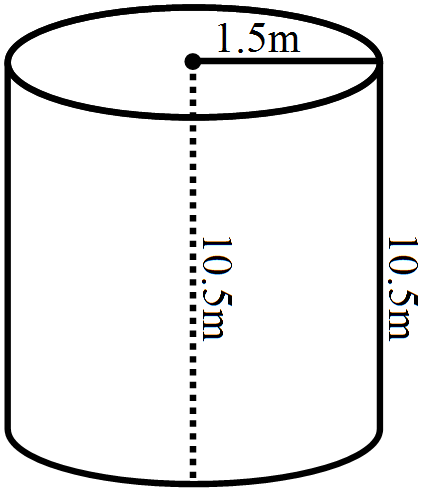
$\therefore$ Volume of the tank $=\pi\text{r}^2\text{h}$
$=\frac{22}{7}\times1.5\times1.5\times1.5\text{m}^3$
$=\frac{22\times15}{10}\times\frac{15}{100}\times\frac{15}{10}\times\frac{15}{10}=\frac{297}{4}\text{m}^3$
$=74.25\text{m}^3$
$\therefore$ Quantity of milk in litre, $= 74.25 \times 1000$ litre $= 74250$ litre View full question & answer→Question 45 Marks
Find the volume, curved surface area and total surface area of the cylinders whose dimensions are: Radius of the base $= 14\ dm$ and height $= 15\ m$
AnswerRadius of the base of a cylinder $(r), = 14\ dm = 1.4\ m$. Height $(h) = 15\ m$
$a.$ Volume:
$=\pi\text{r}^2\text{h}=\frac{22}{7}\times(1.4)^2\times15\text{m}^3$
$=\frac{22}{7}\times1.4\times1.4\times15\text{m}^3=92.4\text{m}^3$
$b.$ Lateral surface area $=2\pi\text{rh}$
$=2\times\frac{22}{7}\times1.4\times15\text{m}^2=132\text{m}^2$
$c.$ Total surface area $=2\pi\text{r}(\text{h}+\text{r})$
$=2\times\frac{22}{7}\times1.4\times15\text{m}^2=132\text{m}^2$
$=8.8(16.4)\text{m}^2=144.32\text{m}^2$
View full question & answer→Question 55 Marks
Find the volume, lateral surface area and the total surface area of the cuboid whose dimensions are:
Length $= 15\ m$, breadth $= 6\ m$ and height $= 9\ dm.$
AnswerLength of cuboid $(l) = 15m$
Breadth$(b) = 6m$
Height $(h) = 9dm = 0.9m$
$a.$ Volume $= lbh = 15 \times 6 \times 0.9 = 81m^3$
$b.$ Lateral surface area $= 2(l + b) \times h$
$= 2(15 + 6) \times 0.9m^2$
$= 2 \times 21 \times 0.9 $
$= 37.8m^2$
$c.$ Total surface area $= 2[lb + bh + hl]$
$= 2(15 \times 6 + 6 \times 0.9 + 0.9 \times 15]m^2$
$= 2[90 + 5.4 + 13.5]m^2$
$= 2 \times 108.9$
$= 217.8m^2$
View full question & answer→Question 65 Marks
A cylinder is open at both ends and is made of $1.5\ cm$-thick metal. Its external diameter is $12\ cm$ and height is $84\ cm$. What is the volume of metal used in making the cylinder? Also, find the weight of the cylinder if $1cm^3$ of the metal weighs $7.5g.$
AnswerThickness of the metal $= 1.5\ cm.$
External diameter $= 12\ cm.$
$\therefore$ External radius (R) $=\frac{12}{2}=6\text{cm}.$
And then internal radius $(r) = 6 - 1.5$
$= 4.5\ cm.$
Height $(h) = 84\ cm.$
$\therefore$ Volume of metal used $=\pi\text{r}^2\text{h}-\pi\text{r}^2\text{h}$
$=\pi\text{h}\big(\text{R}^2-\text{r}^2\big)$
$=\pi\text{h}(\text{R}+\text{r})(\text{R}-\text{r})$
$=\frac{22}{7}\times84(6+4.5)(6-4.5)\text{cm}^2$
$=264(10.5)(1.5)\text{cm}^3=4158\text{cm}^3$
Weight of $1cm^3 = 7.5g$
$\therefore$ Total weight $= 7.5 \times 4158g$
$= 31185g = 31.185\ kg.$
View full question & answer→Question 75 Marks
Find the volume of wood used to make a closed box of outer dimensions $60\ cm \times 45 \ cm \times 32\ cm$, the thickness of wood being $2.5\ cm$ all around.
AnswerOuter length of wooden box $(L) = 60\ cm$
Width $(B) = 45\ cm$ And height $(H) = 32\ cm$
Thickness of wood used $= 2.5\ cm.$
Inner length $(l) = 60 - 2 \times 2.5$
$= 60 - 5$
$= 55\ cm.$
Width $(b) = 45 - 2 \times 2.5 = 45 - 5 = 40\ cm$
And height $(h) = 32 - 2 \times 2.5 = 32 - 5 = 27\ cm$
Now outer volume $= L \times B \times H = 60 \times 45 \times 32\ cm^3$
Inner volume $= l \times b \times h = 55 \times 40 \times 27$
$\therefore$ Volume of wood $= 60 \times 45 \times 32 - 55 \times 40 \times 27$
$= 86400 - 59400 = 27000\ cm^3$
View full question & answer→Question 85 Marks
The length of a metallic tube is $1$ metre, its thickness is $1\ cm$ and its inner diameter is $12\ cm$. Find the weight of the tube if the density of the metal is $7.7$ grams per cubic centimetre.
AnswerInner diameter of tube $= 12\ cm.$
Inner radius (r) $=\frac{12}{2}=6\text{cm}.$
Thickness of metal $= 1\ m.$
$\therefore$ Outer radius $(R) = 6 + 1 = 7\ cm.$
Length of the tube $(h) = 1m = 100\ cm.$
$\therefore$ Volume of metal used $=\pi\text{R}^2-\pi\text{r}^2\text{h}$
$=\pi\text{h}\big(\text{R}^2-\text{r}^2\big)=\pi\text{h}(\text {R}+\text{r})(\text{R}-\text{r})$
$=\frac{22}{7}\times100(7+6)(7-6)\text{cm}^3$
$=\frac{2200}{7}\times13\times1\text{cm}^3=\frac{28600}{7}\text{cm}^3$
Weight of $1cm^3$ metal $= 7.7g.$
$\therefore$ Total weight,
$=\frac{28600}{7}\times7.7\text{g}=31460\text{g}$
$=31.46\text{kg}.$
View full question & answer→Question 95 Marks
The external dimensions of a closed wooden box are $62\ cm, 30\ cm$ and $18\ cm$. If the box is made of $2\ cm$-thick wood, find the capacity of the box.
AnswerOuter length of box $= 62cm.$
Outer width $= 30cm.$
Outer height $= 18cm.$
Thickness of wood $= 2cm.$
$\therefore$ Inernal length $= 62 - 2 \times 2$
$= 58cm. I$
nternal width $= 30 - 2 \times 2$
$= 26cm.$
Inernal height $= 18 - 2 \times 2$
$= 14cm.$
Capacity of the box $= lbh$
$= 58 \times 26 \times 14cm^3$
$= 21112cm^3$
View full question & answer→Question 105 Marks
Find the volume, curved surface area and total surface area of the cylinders whose dimensions are: Radius of the base $= 5.6\ m$ and height $= 1.25\ m.$
AnswerRadius of the base of the cylunder $(r), = 5.6m$ Height $(h) = 1.25m$
$a. \therefore$ Volume $=\pi\text{r}^2\text{h}$
$=\frac{22}{7}\times(5.6)^2\times1.25\text{cm}^3$
$=\frac{22}{7}\times5.6\times5.6\times1.25\text{m}^3$
$=123.2\text{m}^3$
$b.$ Lateral surface area $=2\pi\text{rh}$
$=2\times\frac{22}{7}\times5.6\times1.25\text{m}^2$
$=44\text{m}^2$
$c.$ Total surface area $=2\pi\text{r}(\text{h}+\text{r})$
$=2\times\frac{22}{7}\times5.6(1.25+5.6)$
$=44\times0.8(6.85)\text{m}^2$
$=241.12\text{m}^2$
View full question & answer→Question 115 Marks
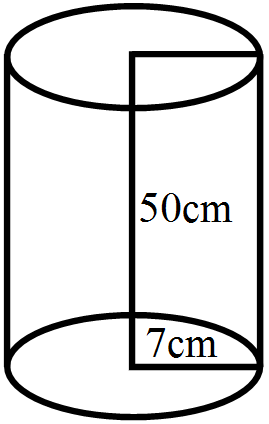
Find the volume, curved surface area and total surface area of the cylinders whose dimensions are:
Radius of the base $= 7\ cm$ and height $= 50\ cm.$
AnswerRadius of the base of the cylinder $(r) = 7\ cm.$
Height $(h) = 50\ cm.$
$a. \therefore$ Volume $=\pi\text{r}^2\text{h}$
$=\frac{22}{7}\times(7)^2\times50\text{cm}^3$
$=\frac{22}{7}\times7\times7\times50\text{cm}^3$
$=7700\text{cm}^3$
$b.$ Lateral surface area $=2\pi\text{rh}$
$=2\times\frac{22}{7}\times7\times50$
$=2200\text{cm}^2$
$c.$ Total surface area $=2\pi\text{r}(\text{h}+\text{r})$
$=2\times\frac{22}{7}\times7(50+7)\text{cm}^2$
$=44\times57$
$=2508\text{cm}^2$ View full question & answer→Question 125 Marks
The volume of a cylinder of height $8\ cm$ is $1232cm^3$. Find its curved surface area and the total surface area.
AnswerVolume of cylinder = $1232cm^3$.
Height $(h) = 8cm$
Let r be the radius, then
$\pi\text{r}^2\text{h}=1232$
$=\frac{22}{7}\times\text{r}^2\times8=1232$
$\Rightarrow\text{r}^2=\frac{1232\times7}{22\times8}$
$\Rightarrow\text{r}^2=49=(7)^2$
$\Rightarrow\text{r}=7\text{cm}$
$\therefore$ Curved surface area $=2\pi\text{rh}$
$=2\times\frac{22}{7}\times(7+8)\text{cm}^2$
$=44\times15=660\text{cm}^2$
View full question & answer→Question 135 Marks
How many planks of size $2\ m × 25\ cm × 8\ cm$ can be prepared from a wooden block $5\ m$ long, $70\ cm$ broad and $32\ cm$ thick, assuming that there is no wastage?
AnswerLength of one plank $= 2m$
$= 200\ cm$
Breadth $(b) = 25\ cm,$
Thickesss $(h) = 8\ cm$
$\therefore$ Volume of plank $= l × b × h = 200 × 25 × 8\ cm^3$
$= 40000\ cm^3$
Length of block $(l) = 5m = 500\ cm,$
Width $(b) = 70\ cm$
and thickness $(h) = 32\ cm$
$\therefore$ Volume of block $= 500 × 70 × 32\ cm^3$
Number of planks $=\frac{\text{Volume of black}}{\text{Volume of plank}}$
$=\frac{500\times70×32}{40000}$
$=\frac{1120000}{40000}=28$
View full question & answer→Question 145 Marks
Find the volume of iron required to make an open box whose external dimensions are $36\ cm \times 25\ cm \times 16.5\ cm$, the box being $1.5\ cm $thick throughout. If $1cm^3$ of iron weighs $8.5$ grams, find the weight of the empty box in kilograms.
AnswerOuter length of open box $= 36\ cm$
Breadth $= 25\ cm$
And height $= 16.5\ cm$
Thickness of iron $= 1.5cm.$
$\therefore$ Inner length $= 36 - 2 \times 1.5 = 36 - 3$
$= 33cm,$
Breadth $= 25 - 2 \times 1.5$
$= 25 - 3$
$= 22\ cm$ And height $= 16.5 - 1.5$
$= 15\ cm$
$\therefore$ Volume of iron used in it = Out volume - inner volume
$=36 \times 25 \times 16.5 cm^3-33 \times 22 \times 15 cm^3$
$= 14850 - 10890$
$=3960 cm^3$
Weight of $1cm^3 = 8.5$ gram
$\therefore$ Total weight
$= 3960 \times 8.5g$
$= 33660g$
$=33.660\ kg$
$= 33.66\ kg$
View full question & answer→Question 155 Marks
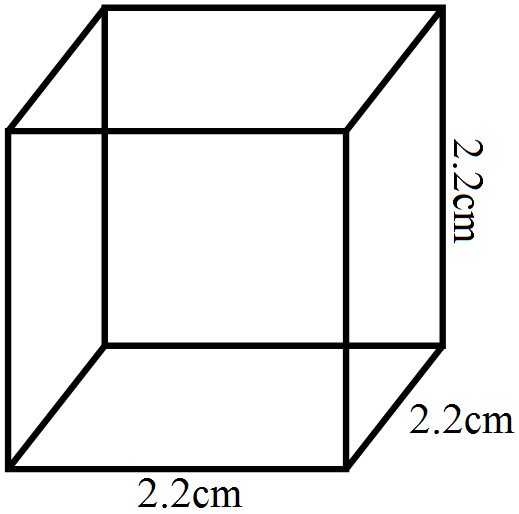
A solid cube of metal each of whose sides measures $2.2\ cm$ is melted to form a cylindrical wire of radius $1\ mm$. Find the length of the wire so obtained.
AnswerSide of a solid cube $= 2.2cm.$
Volume $=(\text { side })^3$
$=(2.2)^3$
$= 10.648cm^3$
$\therefore$ Volume of cylinderdrical wire = $10.648cm^3$
Radius $= 1mm =\frac{1}{10}\text{cm}$
$\therefore\text{Length}=\frac{\text{Volume}}{\pi\text{r}^2}$
$=\frac{10.648\times7\times10\times10}{22\times1\times1}$
$=\frac{10648\times7\times100}{1000\times22}=\frac{484\times7}{10}\text{cm}$
$=\frac{3388}{10}=338.8\text{cm}$ View full question & answer→Question 165 Marks
A wall $15\ m$ long, $30\ cm$ wide and $4\ m$ high is made of bricks, each measuring $22cm \times 12.5cm \times 7.5cm$. If $\frac{1}{12}$ of the total volume of the wall consists of mortar, how many bricks are there in the wall?
AnswerLength of wall $(l) = 15\ m.$
Width $(b) = 30\ cm = 0.3\ m$
Height $(h) = 4\ m$
$\therefore$ Volume of the wall $= lbh$
$=15 \times 0.3 \times 4 m^3=18 m^3$
$\therefore$ Volume of bricks $= 18 - 1.5 = 16.5m^3$
Volume of one brick,
$= 22cm. \times 12.5cm. \times 7.5cm.$
$=22 \times 12.5 \times 7.5 cm^3$
$=2062.5\text{cm}^3=\frac{2062.5}{100\times100\times100}\text{m}^3$
$=0.0020625\text{m}^3$
No. of bricks $=\frac{\text{Total volume of bricks}}{\text{Volume of one brick}}$
$=\frac{16.5}{0.0020625}=\frac{165\times10000000}{10\times20625}$
$=8000$
View full question & answer→Question 175 Marks
Find the capacity of a rectangular cistern in litres whose dimensions are $11.2\ m \times 6\ m \times 5.8\ m$. Find the area of the iron sheet required to make the cistern.
AnswerLength of rectangular cistern $(l) = 11.2\ m$
Breadth $(b) = 6\ m$
Height $(h) = 5.8\ m$
$a.$ Volume $= lbh = 11.2 \times 6 \times 5.8m^3$
$= 389.76\ m^3$
$\therefore$ Capacity in litres,
$= 389.76 \times 1000$ litres
$= 389760$ litres.
$b.$ Total surface area $= 2[lb + bh + hl]$
$=2[11.2 \times 6+65.8+5.8 \times 11.2] m ^2$
$=2 \times 166.96$
$=333.92 m^2$
View full question & answer→Question 185 Marks
Find the volume, lateral surface area and the total surface area of the cuboid whose dimensions are: Length $= 22\ cm$, breadth $= 12\ cm$ and height $= 7.5\ cm.$
Answer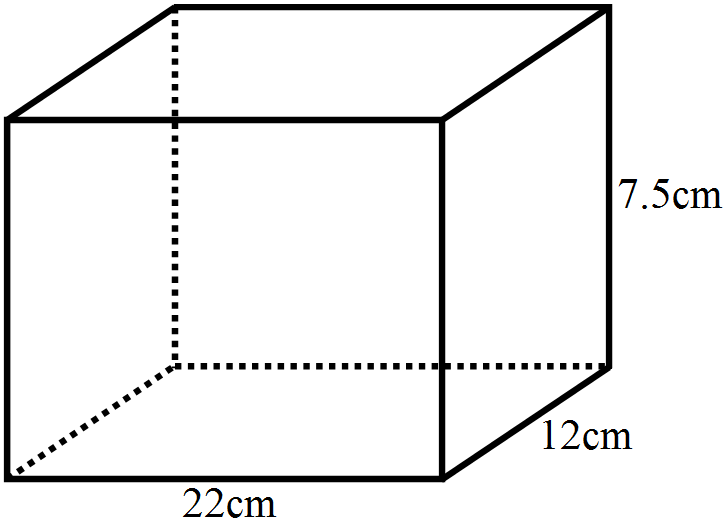
Length of cuboid $(l) = 22\ cm.$
Breadth $(b) = 12\ cm$
and height $(h) = 7.5\ cm.$
$a.$ Volume $= lbh =22 \times 12 \times 7.5 \ cm^3$
$=1980cm^3$
$b.$ Lateral surface area $= 2(l + b) \times h$
$=2(22+12) \times 7.5 \ cm^2$
$=2 \times 34 \times 7.5$
$=510 \ cm^2$
$c.$ Total surface area $= 2[lb + bh + hl]$
$=2[22 \times 12+12 \times 7.5+7.5 \times 22] \ cm ^2 $
$=2 \times 34 \times 7.5$
$=510 \ cm^2 $
$ =2 \times 519$
$=1038 \ cm^2$ View full question & answer→Question 195 Marks
The curved surface area of a cylinder is $4400 \ cm^2$ and the circumference of its base is $110\ cm$. Find the volume of the cylinder.
AnswerCurved surface area = $4400 \ cm^2$
Circumference of base $= 110\ cm$
Let r be the radius,
$\Rightarrow2\pi\text{r}=110$
$\Rightarrow2\times\frac{22}{7}\times\text{r}=110$
$\Rightarrow\text{r}=\frac{110\times7}{2\times22}=\frac{35}{2}\text{cm}$
Now, curved surface area $=2\pi\text{rh}$
$\therefore2\pi\text{rh}=4400$
$\Rightarrow2\times\frac{22}{7}\times\frac{35}{2}\times\text{h}=4400$
$110.\text{h}=4400$
$\Rightarrow\text{h}=\frac{4400}{110}$
$\Rightarrow\text{h}=40\text{cm}$
Hence volume of cylinder $=\pi\text{r}^2\text{h}$
$=\frac{22}{7}\times\frac{35}{2}\times\frac{35}{2}\times40\text{cm}^3$
$=38500\text{cm}^3$
View full question & answer→Question 205 Marks
Find the volume, lateral surface area and the total surface area of the cuboid whose dimensions are:
Length $= 48\ cm$, breadth $= 6\ dm$ and height $= 1\ m.$
AnswerLength of cuboid $(l) = 48\ cm.$
Breadth $(b) = 6dm = 60\ cm.$
Height $(h) = 1m = 100\ cm.$
$a.$ Volume $= lbh = 48 \times 60 \times 100$
$= 288000\ cm^3$
$b.$ Lateral surface area $= 2(l + b) \times h$
$=2(48+60) \times 100 \ cm^2 $
$=2 \times 108 \times 100$
$=21600 \ cm^2$
$c.$ Total surface area $= 2[lb + bh + hl]$
$=2[48 \times 60+60 \times 100+100 \times 48] \ cm ^2 $
$ =2[2880+6000+4800] \ cm ^2$
$ =2[13680]$
$=27360 \ cm^2$
View full question & answer→Question 215 Marks
A piece of ductile metal is in the form of a cylinder of diameter $1\ cm$ and length $11\ cm.$ It is drawn out into a wire of diameter $1\ mm.$ What will be the length of the wire so obtained?
AnswerDiameter of cylindrical metal $= 1\ cm.$
Radius $(r) =\frac{1}{2}\text{cm}.$
Length. $(A) = 11\ cm.$
Volume $=\pi\text{r}^2\text{h}$
$=\frac{22}{7}\times\Big(\frac{1}{2}\Big)^2\times11\text{cm}^3=\frac{22}{7}\times\frac{1}{4}\times11$
$=\frac{22}{7}\times\frac{11}{4}=\frac{121}{14}\text{cm}^3$
$\therefore$ Volume of wire $=\frac{121}{14}\text{cm}^3$
Diameter of wire $= 1mm$
$\therefore\text{Radius}=\frac{1}{2}\text{mm}=0.5\text{mm}=0.05\text{cm}.$
Let lenght of wire $= h$
Then $\pi\text{r}^2\text{h}=\frac{22}{70}\times(0.05)^2\times\text{h}$
$\Rightarrow\frac{22}{7}\times0025\times\text{h}\frac{121}{14}$
$\Rightarrow\text{h}=\frac{121\times7}{14\times22\times0025}$
$=\frac{121\times7\times10000}{\ 14\times22\times25}=1100\text{cm}$
$\therefore$ Length of wire $= 11\ m.$
View full question & answer→Question 225 Marks
A closed wooden box $80\ cm$ long, $65\ cm$ wide and $45\ cm$ high, is made of $2.5\ cm$-thick wood. Find the capacity of the box and its weight if $100cm^3$ of wood weighs $8g.$
AnswerOuter length $= 80\ cm.$
Outer width $= 65\ cm.$
Outer height $= 45\ cm.$
Total volume $=80 \times 65 \times 45 cm^3$
$=234000 cm^3$
Thickness of wood $= 2.5\ cm.$
$\therefore$ Inner length $= 80 - 2 \times 2.5 = 75cm.$
Inner width $= 65 - 2 \times 2.5 = 60cm.$
Inner height $= 45 - 2 \times 2.5 = 40cm.$
$\therefore$ Inner capacity (volume)
=$75 \times 60 \times 40 cm^3$
$= 180000cm^3$
Volume of wood $= 234000 - 180000$
$= 54000cm^3$
$\therefore$ Weight of wood $=\frac{54000\times8}{100}\text{g}$
$= 4320g = 4.320kg.$
View full question & answer→Question 235 Marks
How many cubic metres of earth must be dug out to sink a well which is $20\ m$ deep and has a diameter of $7$ metres? If the earth so dug out is spread over a rectangular plot $28\ m$ by $11\ m$, what is the height of the platform so formed?
AnswerDiameter of a well $= 7m.$
Radius (r) $=\frac{7}{2}\text{m}$
Depth $(h) = 20m$
$\therefore$ Volume of earth dug out $=\pi\text{r}^2\text{h}$
$=\frac{22}{7}\times\Big(\frac{7}{2}\Big)^2\times20\text{m}^3$
$=\frac{22}{7}\times\frac{7}{2}\times\frac{7}{2}\times20\text{m}^3=770\text{m}^3$
Now volume of platform = $770m^3$
Length $(l) = 28m$
Breadth $(b) = 11m$
Let height $= h$
$\therefore\text{lbh}=770$
$\Rightarrow11\times\text{h}=770$
$\Rightarrow\text{h}=\frac{770}{28\times11}=\frac{5}{2}=2.5\text{m}$
$\therefore$ Height of the platform $= 2.5\ m.$
View full question & answer→Question 245 Marks
The radius and height of a cylinder are in the ratio $7 : 2$. If the volume of the cylinder is $8316 cm^3$, find the total surface area of the cylinder.
AnswerRatio in radius and height of a cylinder $= 7 : 2$
Let radius$ = 7x$
Then height $= 2x$
$\therefore\text{Volume}=\pi\text{r}^2\text{h}=\frac{22}{7}\times7\text{x}\times7\text{x}\times2\text{x}$
$=308\text{x}^3$
$\therefore308\text{x}^3=8316$
$\text{x}^3=\frac{8316}{308}=27=(3)^3$
$\therefore\text{x}=3$
$\therefore$ Radius of cylinder $(r) = 7x = 7 × 3 = 21cm,$
And height $(h) = 2x = 2 \times 6cm$
Now, total surface area $=2\pi\text{r}(\text{r}+\text{h})$
$=2\times\frac{22}{7}\times21(21+6)\text{cm}^2$
$=132\times27\text{cm}^2$
$=3564\text{cm}^2$
View full question & answer→Question 255 Marks
A well of inner diameter $14\ m$ is dug to a depth of $12\ m$. Earth taken out of it has been evenly spread all around it to a width of $7\ m$ to form an embankment. Find the height of the embankment so formed.
Answer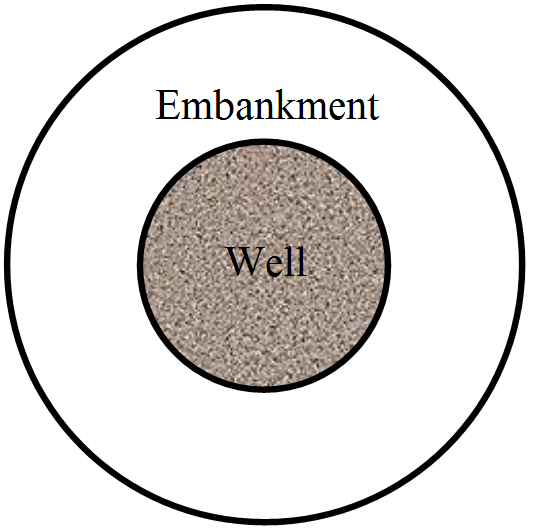
Inner diameter of well $= 14m$ Inner radius $=\frac{14}{2}=7\text{m}$ Depth $(h) = 12m$
$\therefore$ Volume of earth dig out $=\pi\text{r}^2\text{h}$
$=\frac{22}{7}\times(7)^2\times12\text{m}^3$
$=\frac{22}{7}\times7\times7\times12\text{m}^3=1848\text{m}^3$ Width of the embankment of the well $= 7m$
$\therefore$ Outer radius $(R) = 7 + 7 = 14m$.
Let height of the embankment $= h$
$\therefore$ Volume $\pi\text{r}^2\text{h}-\pi\text{r}^2\text{h}$
$=\pi\text{h}\big(\text{R}^2-\text{r}^2\big)=\frac{22}{7}\text{h}\big(\text{R}^2-\text{r}^2\big)$
$\therefore\frac{22}{7}\text{h}\big(14^2-7^2\big)=1848$
$\Rightarrow\frac {22}{7}\text{h}(14+7)(14-7)=1848$
$\Rightarrow\frac{22}{7}\text{h}\times21\times7=1848$
$\Rightarrow462\text{h}=1848$
$\therefore\text{h}=\frac{1848}{462}=4$
$\therefore$ Height of embankment $= 4m.$ View full question & answer→