MCQ 1511 Mark
Write the correct answer in the following: The quadrilateral formed by joining the mid-points of the sides of a quadrilateral $PQRS$, taken in order, is a rhombus, if:
- A
$PQRS$ is a rhombus.
- B
$PQRS $is a parallelogram.
- C
Diagonals of $PQRS $are perpendicular.
- ✓
Diagonals of $PQRS $are equal.
AnswerCorrect option: D. Diagonals of $PQRS $are equal.
If diagonals of $PQRS$ are equal.
Hence, $(d)$ is the correct answer.
View full question & answer→MCQ 1521 Mark
Write the correct answer in the following:
The quadrilateral formed by joining the mid-points of the sides of a quadrilateral $PQRS$, taken in order, is a rectangle, if:
- A
$PQRS$ is a rectangle.
- B
$PQRS$ is a parallelogram.
- ✓
Diagonals of $PQRS$ are perpendicular.
- D
Diagonals of $PQRS$ are equal.
AnswerCorrect option: C. Diagonals of $PQRS$ are perpendicular.
If diagonals of $PQRS $are perpendicular.
Hence, $(c) $ is the correct answer.
View full question & answer→MCQ 1531 Mark
In a Quadrilateral $ABCD, AB = BC$ and $CD = DA$, then the quadrilateral is a:
AnswerA quadrilateral having equal adjacent sides is called Kite. $AB$ and $BC$ are adjacent sides and $AD$ and $DC$ are also adjacent sides which are equal.
View full question & answer→MCQ 1541 Mark
In a parallelogram $ABCD$, if $\text{DAB} = 75^\circ$ and $\angle\text{DBC} = 60^\circ,$ then $\angle\text{BDC} =\ ?$
- A
$50^\circ$
- ✓
$45^\circ$
- C
$65^\circ$
- D
$75^\circ$
AnswerCorrect option: B. $45^\circ$
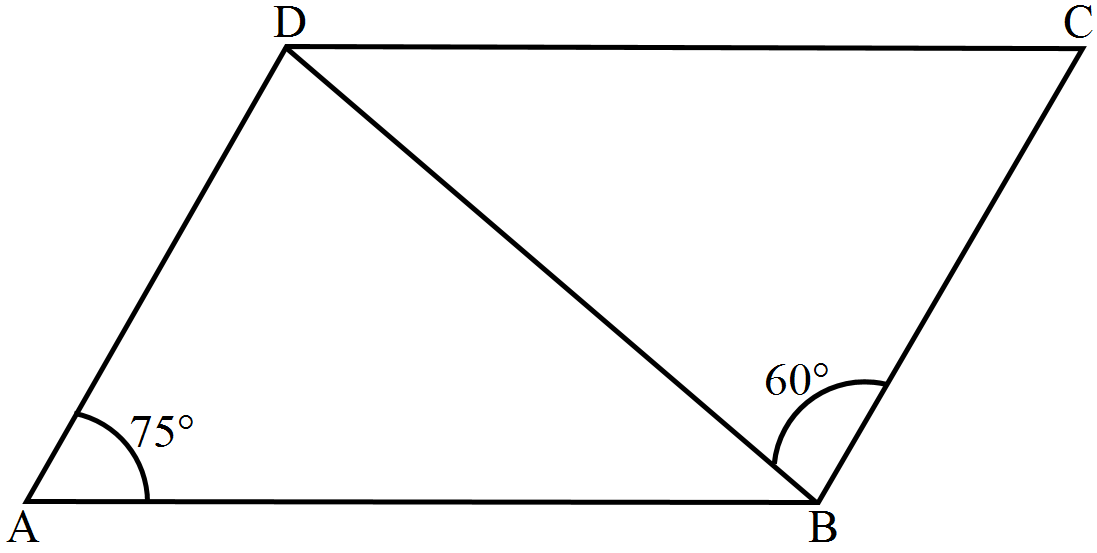
We know that the opposite angles of a parallelogram are equal.
Therefore, $\angle\text{BCD} = \angle\text{BAD} = 75^\circ...\ \text{(i)}$
$(i)$ Now, in $\triangle\text{BCD},$
We have,
$\angle\text{CDB} + \angle\text{DBC} + \angle\text{BCD} = 180^\circ$ [Since, sum of the angles of a triangle is $180^\circ ]$
$\Rightarrow \angle\text{CDB} + 60^\circ + 75^\circ = 180^\circ$
$\Rightarrow \angle\text{CDB} + 135^\circ = 180^\circ$
$\Rightarrow \angle\text{CDB} = (180^\circ - 135^\circ) = 45^\circ$
View full question & answer→MCQ 1551 Mark
The figure formed by joining the mid-points of the adjacent sides of a rhombus is a:
Answer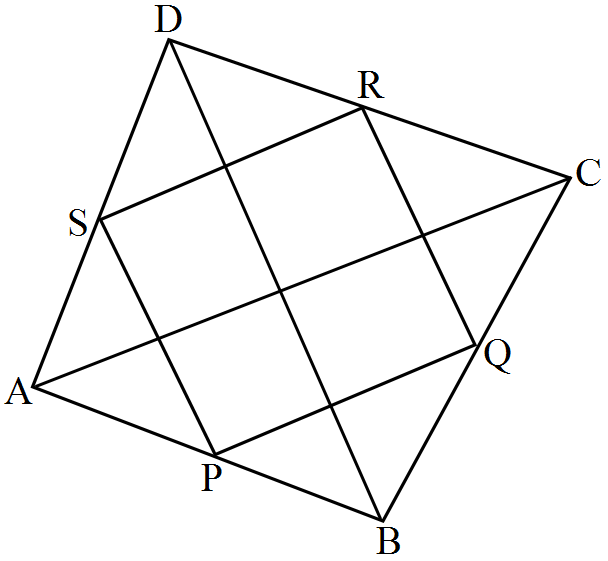
Let $ABCD$ be a rhombus and $P,Q,R$ and $S$ be the mid-points of sides $AB, BC, CD$ and $DA$ respectively.
In $\triangle {ABD} $ and $\triangle {BDC} $
we have,
$ {SP || BD}$ and $ {SP}=\frac{1}{2} {BD}\ ...\ {(1)}$ [By mid-point and theorem]
$ {RQ || BD}$ and $ {RQ}=\frac{1}{2} {BD}\ ...\ {(2)}$ [By mid-point and theorem]
rom $(1)$ and $(2)$ we get,
$ {SP || RQ}$
$PQRS$ is a parallelogram
As diagonals of a rhombus bisect each other at right angles.
$\therefore {AC\perp BD}$
Since, $ {SP || BD, PQ || AC}$ and $ {AC\perp BD}$
$\therefore {SP\perp PQ}$
$\therefore \angle {QPS} = 90^\circ$
$\therefore {PQRS}$ is a rectangle.
View full question & answer→MCQ 1561 Mark
The angles of the quadrilateral are in the ratios $3 : 5 : 9 : 13$. Find all the angles of the Quadrilateral.
- A
$40^\circ , 50^\circ , 80^\circ , 150^\circ$
- B
$100^\circ , 60^\circ , 36^\circ , 156^\circ$
- C
$36^\circ , 60^\circ , 108^\circ , 154^\circ$
- ✓
$36^\circ , 60^\circ , 108^\circ , 156^\circ$
AnswerCorrect option: D. $36^\circ , 60^\circ , 108^\circ , 156^\circ$
Let $ABCD$ be a quadrilateral with $\angle\text{A} = 3\text{x}, \ \angle\text{B} = 5\text{x},\ \angle\text{C} = 9\text{x}$ and $\angle\text{D} = 13\text{x}$
$\angle\text{A} + \angle\text{B} + \angle\text{C} + \angle\text{D} = 360^\circ$ (angle sum property)
$3\text{x} + 5\text{x} + 9\text{x} + 13\text{x} = 360^\circ$
$30\text{x} = 360^\circ$
$\text{x} = 12^\circ$
$\angle\text{A} = 3 (12^\circ) = 36^\circ$
$\angle\text{B} = 5 (12^\circ) = 60^\circ$
$\angle\text{B} = 9 (12^\circ) = 1800^\circ$
$\angle\text{B} = 13 (12^\circ) = 156^\circ$
View full question & answer→MCQ 1571 Mark
In figure, $ABCD$ and $AEFG$ are both parallelograms if $\angle\text{C} = 80^\circ,$ then $\angle\text{DGF}$ is: 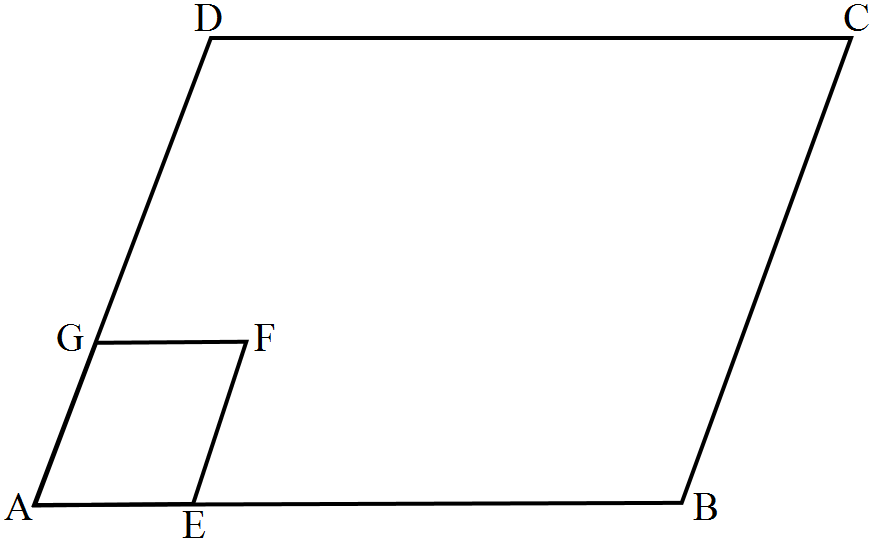
- A
$0^\circ$
- B
$60^\circ$
- C
$120^\circ$
- ✓
$80^\circ$
AnswerCorrect option: D. $80^\circ$
As $\angle\text{A} = 80^\circ$ opposite angles of a parallelogram are equal and $\angle\text{DGF} = 80^\circ$ as $GF$ is parallel to $AB$, corresponding angles are equal.
View full question & answer→MCQ 1581 Mark
In each of the questions one question is followed by two statements $I$ and $II$. Choose the correct option.Is quadrilateral $\text{ABCD}$ a parallelogram?
$i$.Diagonals $AC$ and $BD$ bisect each other.
$ii$.Diagonals $AC$ and $BD$ are equal.
- A
If the question cannot be answered by using both the statements together.
- ✓
If the question can be answered by one of the given statements alone and not by the other.
- C
If the question can be answered by both the statements together but not by any one of the two.
- D
If the question can be answered by either statement alone.
AnswerCorrect option: B. If the question can be answered by one of the given statements alone and not by the other.
Here, as we know that if the diagonals of a quadrilateral bisects each other, then it is a parallelogram.
But as per $II$, if the diagonals of a quadrilateral are equal, then it is not necessarily a parallelogram which is not true. Thus, $II$ does not give the answer.
So the question can be answered by the one of the given statement alone and not by the other.
View full question & answer→MCQ 1591 Mark
The bisectors of the angle of a parallelogram enclose a:
Answer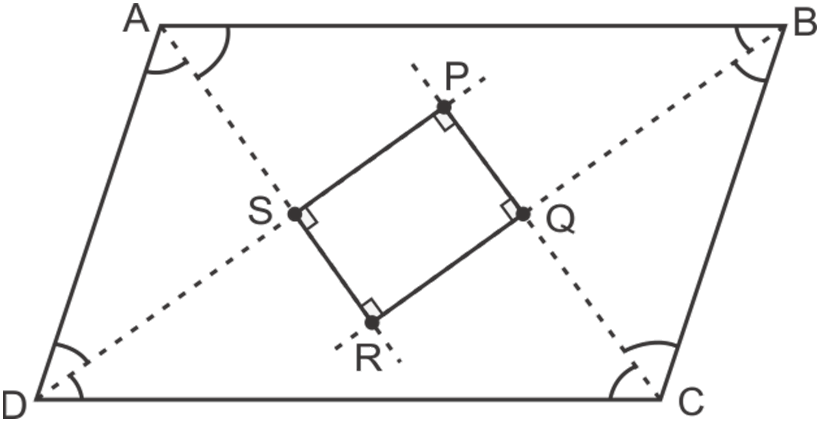
$A R, B R, C P, D P$ are the bisectors of angles of parallelogram.
Because two bisectors of adjacent angles make $90^{\circ}$ between them So $PQRS$ is a Rectangle
Because $DP$ and $BR$ are acute angle bisectors so the distance between them $PQ < PS$ (The distance between other two bisectors) So $PQ \neq PS$ (So $PQRS$ is not a square, but only a rectangle)
View full question & answer→MCQ 1601 Mark
Write the correct answer in the following: Which of the following is not true for a parallelogram?
- A
Opposite sides are equal.
- B
Opposite angles are equal.
- ✓
Opposite angles are bisected by the diagonals.
- D
Diagonals bisect each other.
AnswerCorrect option: C. Opposite angles are bisected by the diagonals.
We know that, in a parallelogram, opposite sides are equal, opposite angles are equal, opposite angles are not bisected by the diagonals and diagonals bisect each other.
View full question & answer→MCQ 1611 Mark
The bisectors of any two adjacent angles of a parallelogram intersect at:
- ✓
$90^\circ$
- B
$30^\circ$
- C
$45^\circ$
- D
$60^\circ$
AnswerCorrect option: A. $90^\circ$
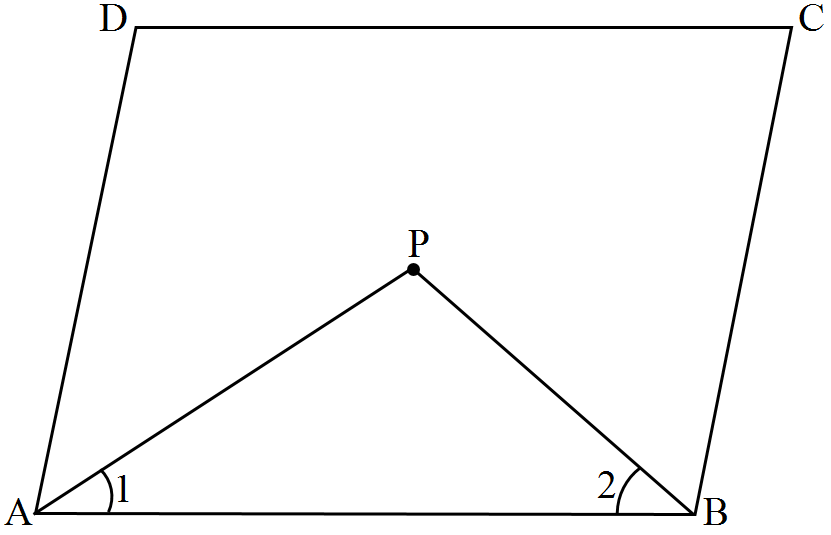
Given: A parallelogram $ABCD$ such that the bisectors of adjacent angles $A$ and $B$ intersect at $P.$
To prove: $\angle\text{APB} = 90^\circ$
Proof: Since $ABCD$ is a ||gm
$\therefore \ \text{AD || BC}$
$\Rightarrow \angle\text{A} + \angle\text{B} = 180^\circ$ [sum of consecutive interior angle]
$\Rightarrow \frac{1}{2}\angle\text{A}+\frac{1}{2}\angle\text{B}=90^\circ$
$\Rightarrow\angle1+\angle2=90^\circ\ ...\ \text{(i)}$
[$\because$ AP is the bisector of $\angle\text{A}$ and BP is the bisector of $\angle\text{B}$]
$\angle1=\frac{1}{2}\angle\text{A}$ and $\angle2=\frac{1}{2}\angle\text{B}$
Now, $\triangle\text{APB},$ we have
$\angle1 + \angle\text{APB} + \angle2 = 180^\circ$ [sum of three angles of a $\triangle$]
$\Rightarrow 90^\circ + \angle\text{APB} + \angle2 = 180^\circ$ [$\because \angle1 + \angle2 = 90^\circ$ from (i)]
Hence, $\angle\text{APB} = 90^\circ$
View full question & answer→MCQ 1621 Mark
Write the correct answer in the following: Three angles of a quadrilateral are $75^\circ , 90^\circ $ and $75^\circ $. The fourth angle is:
- A
$90^\circ$
- B
$95^\circ$
- C
$105^\circ$
- ✓
$120^\circ$
AnswerCorrect option: D. $120^\circ$
Fourth angle of the quadrilateral
$= 360^\circ - (75^\circ + 90^\circ + 75^\circ )$
$= 360^\circ - 240^\circ $
$= 120^\circ $
Hence, $(d)$ is the corrent answer.
View full question & answer→MCQ 1631 Mark
The parallel sides of a trapezium are a and b respectively. The line joining the mid-points of its non-parallel sides will be:
- A
$\frac{1}{2}(\text{a}-\text{b})$
- ✓
$\frac{1}{2}(\text{a}+\text{b})$
- C
$\frac{2\text{ab}}{(\text{a + b})}$
- D
$\sqrt{\text{ab}}$
AnswerCorrect option: B. $\frac{1}{2}(\text{a}+\text{b})$
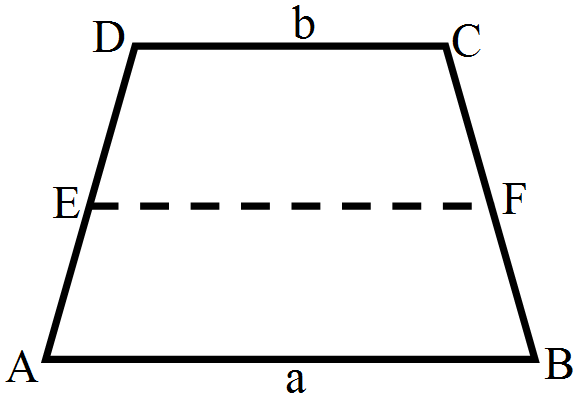
$E$ and $F$ are the given to be the mid-points of $AD$ and $BC$ respectively.
$\therefore\text{EF} = \frac{1}{2}(\text{AB + DC})$
$=\frac{1}{2}(\text{a + b})$
View full question & answer→MCQ 1641 Mark
Given a triangular prism, then what can we conclude about the lateral faces?
AnswerThere are five faces in triangular prism. two triangles and three quadrilaterals in which both pair of opposite sides equal. A quadrilateral with both pair of opposite sides equal is called parallelogram. So, lateral faces are parallelogram.
View full question & answer→MCQ 1651 Mark
In $\triangle\text{ABC},\angle\text{A}=30^\circ,\angle\text{B}=40^\circ$ $$and $\angle\text{C}=110^\circ.$ The angles of the triangle formed by joining the mid-points of the sides of this triangle are:
- A
$70^\circ , 70^\circ , 40^\circ$
- B
$60^\circ , 40^\circ , 80^\circ$
- ✓
$30^\circ , 40^\circ , 110^\circ$
- D
$60^\circ , 70^\circ , 50^\circ$
AnswerCorrect option: C. $30^\circ , 40^\circ , 110^\circ$
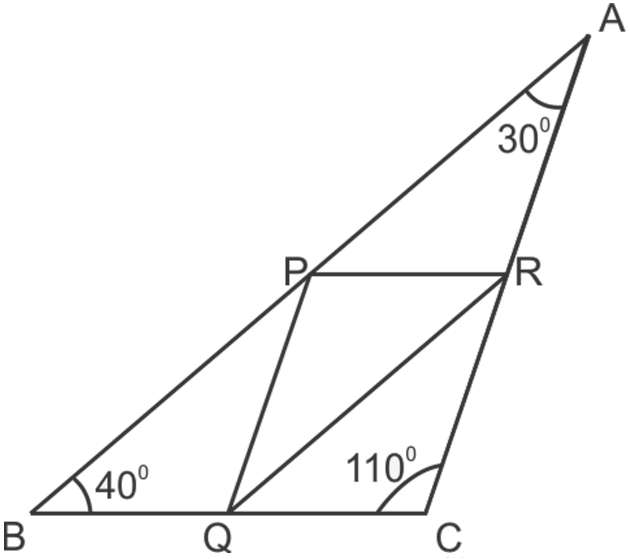
If in any triangle, all the mid-points (of each sides) are joined to form a triangle, then that triangle is similian to a parent triangle.
i.e.$\triangle\text{QPR}\sim\triangle\text{ABC}$
So angles of $\triangle\text{PQR}$ will be same as angles of $\triangle\text{ABC}.$
Thus, angles are $30^\circ , 40^\circ , 110^\circ $
View full question & answer→MCQ 1661 Mark
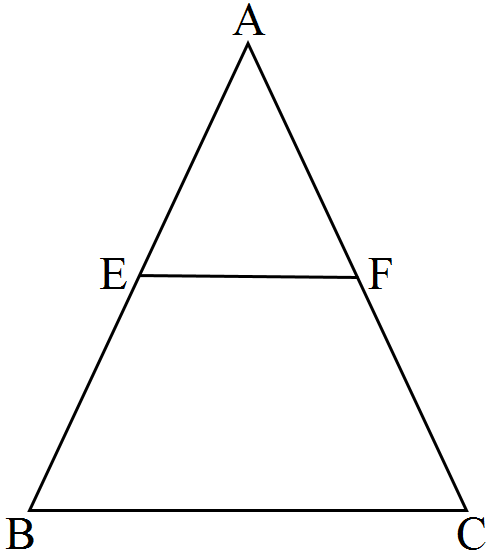
$E$ and $F$ are the mid-points of the sides $AB$ and $AC$ of a $\triangle\text{ABC}.$ If $AB = 6\ cm, BC = 5\ cm$ and $AC = 6\ cm, $ Then $EF$ is equal to:
- ✓
$2.5\ cm$
- B
$4\ cm$
- C
$3\ cm$
- D
AnswerCorrect option: A. $2.5\ cm$
since $E$ and $F$ are the mid points of sides $AB$ and $AC$ respectively.
according to mid-point theorem of triangle;
$\text{EF} = \frac{1}{2}×\text{BC}$
$\text{EF} = \frac{1}{2}×5$
View full question & answer→MCQ 1671 Mark
The figure formed by joining the mid-points of the adjacent sides of a quadrilateral is a:
AnswerLet $ABCD$ be a quadrilateral in which $P, Q, R$ and $S$ are the mid-points of $AB, BC, CD$ and $DA$ respectively.
Join $AC$
In $\triangle\text{ABC},$ the points $P$ and $Q$ are the mid-points of sides $AB$ and $BC$ respectively.
$\therefore\ \text{PQ || AC}$ and $\text{PQ}=\frac{1}{2}\text{AC}\ ...\ \text{(i)}$ [By mid-point theorem]
Again, in $\triangle\text{DAC},$ the points S and R are the mid-points of $AD$ and $DC$.
$\therefore\ \text{SR || AC}$ and $\text{SR}=\frac{1}{2}\text{AC}\ ...\ \text{(ii)}$
View full question & answer→MCQ 1681 Mark
Consecutive angles of a Parallelogram are:
AnswerIn parallelogram, both pair of opposite sides are parallel. So, consecutive angles form a pair of co-interior angles. Co-interior angles add up to $180$. It means they are supplementary.
View full question & answer→MCQ 1691 Mark
$ABCD$ is a parallelogram in which diagonal $AC$ bisects $\angle\text{BAD}.$ If $\angle\text{BAC} = 35^\circ,$ then $\angle\text{ABC} =\ ?$
- A
$70^\circ$
- ✓
$110^\circ$
- C
$90^\circ$
- D
$120^\circ$
AnswerCorrect option: B. $110^\circ$
Given,
$ABCD$ is a parallelogram
Diagonal AC bisects $\angle\text{BAD}$
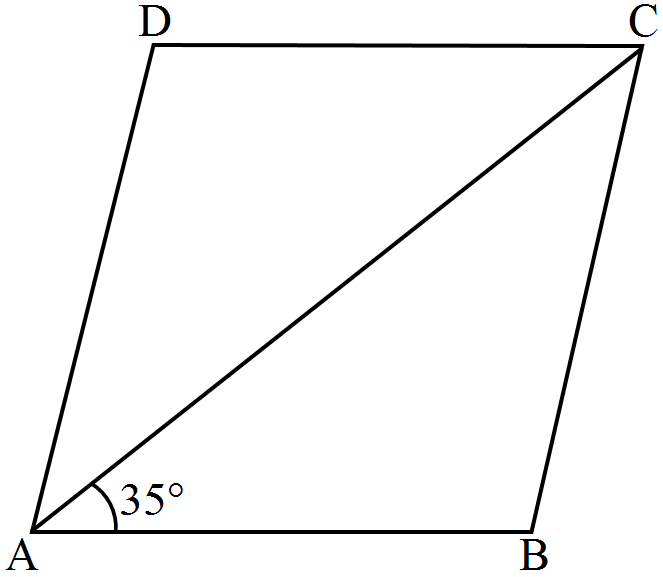
$\angle\text{BAC} = 35^\circ$
$∵ \angle\text{A} + \angle\text{B} = 180^\circ ...\text{(i)}$ [angle sum property of quadrilateral]
$\angle\text{A} = 2\angle\text{BAC} = 2 × 35^\circ = 70^\circ$
Putting value of $\angle\text{A}$ in equation (i)
$70^\circ + \angle\text{B} = 180^\circ$
$\angle\text{B} = 180^\circ - 70^\circ = 110^\circ$
$\angle\text{ABC} = 110^\circ$
View full question & answer→MCQ 1701 Mark
The figure formed by joining the mid-points of the adjacent sides of a quadrilateral is a:
AnswerThe figure formed by joining the mid points of the adjacent sides of a quadrilateral is a parallelogram.
View full question & answer→MCQ 1711 Mark
Write the correct answer in the following:
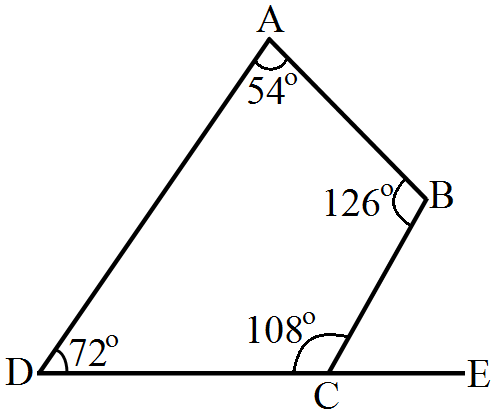
If angles $A, B, C$ and $D$ of the quadrilateral $ABCD$, taken in order, are in the ratio $3 : 7 : 6 : 4$, then $ABCD$ is a:
AnswerGiven, ratio of angles of quadrilateral $ABCD$ is $3 : 7 : 6 : 4.$
Let angles of quadrilateral $ABCD$ be $3x, 7x, 6x$ and $4x$, respectively. We know that, sum of all angles of a quadrilateral is $360^\circ .$
$3x + 7x + 6x + 4x = 360^\circ $
$\Rightarrow 20x = 360^\circ $
$\Rightarrow\frac{\text{x}=360^\circ}{20^\circ=18^\circ}$
$\therefore$ Angles of the quadrilateral are
$\angle\text{A}=3\times18=54^\circ$
$\angle\text{B}=7\times18=126^{\circ} $
$\angle\text{C}=6\times18=108^\circ$
$\angle\text{D}=4\times18=72^\circ$
From figure, $\angle\text{BCE}=180^\circ-\angle\text{BCD}$ [linear pair axiom]
$\Rightarrow\ \angle\text{BCE}=180^\circ-108^\circ=72^\circ$
Here, $\angle\text{BCE}=\angle\text{ADC}=72^\circ$
Since, the of cointerior angles,
$\therefore\ \text{BC}||AD$
Now, sum of cointerior angles,
$\angle\text{A}+\angle\text{B}=126^\circ+54^\circ=180^\circ$
$\angle\text{C}+\angle\text{D}=108^\circ+72^\circ=180^\circ$
Hence, $ABCD$ is a trapezium.
View full question & answer→MCQ 1721 Mark
The figure formed by joining the mid-points of the adjacent sides of a square is a:
Answer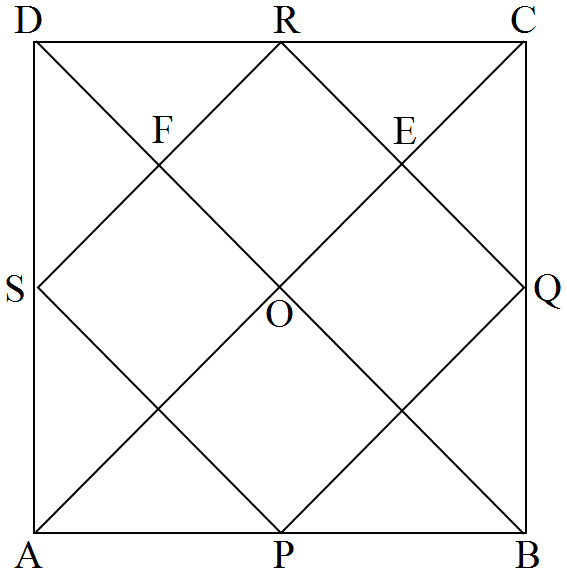
In a square $A B C D, P, Q, R$ and $S$ are the mid-points of $A B, B C, C D$ and $D A$ respectively. $\Rightarrow A B=B C=C D=A D \ldots$ [Sides of square are equal]
In $\triangle\text{ADC},$
$\text{SR || AC}$ and $\text{SR}=\frac{1}{2}\text{AC}$ ... [By mid-point theorem] $...(1)$
In $\triangle\text{ABC},$
$\text{PQ || AC}$ and $\text{PQ}=\frac{1}{2}\text{AC}$ ... [By mid-point theorem] $...(2)$
From equation $(1)$ and $(2)$
$\text{SR || PQ}$ and $\text{SR}=\text{PQ}=\frac{1}{2}\text{AC}\ ...\ (3)$
Similarly, $\text{SP || BD}$ and $\text{BD || RQ}$
$\therefore\ \text{SP || RQ}$ and $\text{SP}=\frac{1}{2}\text{BD}$
And $\text{RQ}=\frac{1}{2}\text{BD}$
$\therefore\ \text{SP}=\text{RQ}=\frac{1}{2}\text{BD}$
Since, diagonals of a square bisect each other at right angle.
$\text{AC = BD}$
$\text{SR}=\text{RQ}=\frac{1}{2}\text{AC}\ ...\ (4)$
From $(3)$ and $(4)$
$SR = PQ = SP = RQ$
We know that the diagonals of a square bisect each other at right angles.
$\angle\text{EOF} = 90^\circ.$
Now, $\text{RQ || DB}$
$\text{RE || FO}$
Also, $\text{SR || AC}$
$\Rightarrow\text{FR || OE}$
$\therefore$ OERF is a parallelogram.
So, $\angle\text{FRE} = \angle\text{EOF} = 90^\circ$ (Opposite angles are equal)
Thus, $PQRS$ is a parallelogram with $\angle\text{R} = 90^\circ$ and $SR = PQ = SP = RQ.$
$\therefore$ $PQRS$ is a square. View full question & answer→MCQ 1731 Mark
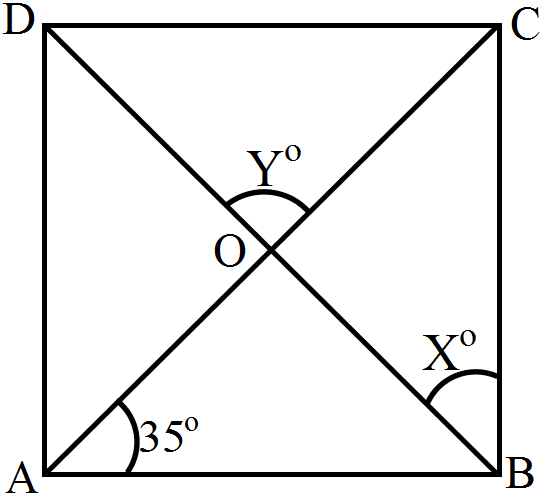
In the figure, $ABCD$ is a Rectangle. Find the values of $x$ and $y?$
- ✓
$x = 55^\circ $ and $y = 110^\circ $
- B
$x = 100^\circ $ and $y = 100^\circ $
- C
$x = 50^\circ $ and $y = 100^\circ $
- D
$x = 60^\circ $ and $y = 120^\circ $
AnswerCorrect option: A. $x = 55^\circ $ and $y = 110^\circ $
$ABCO$ is a rectangle The diagonals of a rectangle are congruent and bisect each other. Therefore, in
$\triangle\text{AOB},$ we have:
$OA = OB$
$\angle\text{OAB} = \angle\text{OBA} = 35^\circ$
$\text{x} = 90^\circ - 35^\circ = 55^\circ$ and $\angle\text{AOB} = 180^\circ - (35^\circ + 35^\circ) = 110^\circ$
$\text{y} = \angle\text{AOB} = 110^\circ$ [Vertically opposite angles]
Hence, $x = 55^\circ $ and $y = 110^\circ $
View full question & answer→MCQ 1741 Mark
The opposite sides of a quadrilateral have.
- A
- ✓
- C
Infinitely many common points.
- D
AnswerWe can look at a quadrilateral as:
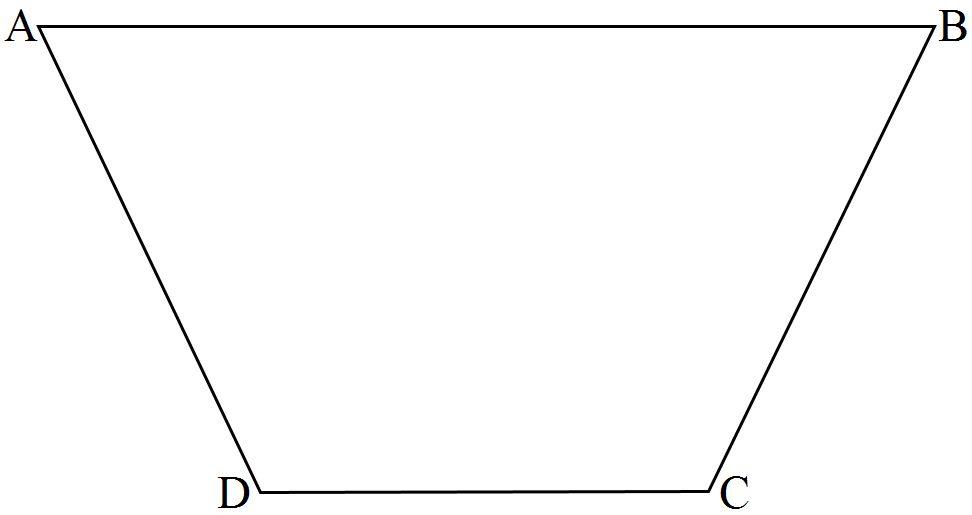
The opposite sides of the above quadrilateral $AB$ and $CD$ have no point in common.
View full question & answer→MCQ 1751 Mark
$ABCD$ is a parallelogram and $E$ and $F$ are the centroids of triangles $ABD$ and $BCD$ respectively, then $EF =$
Answer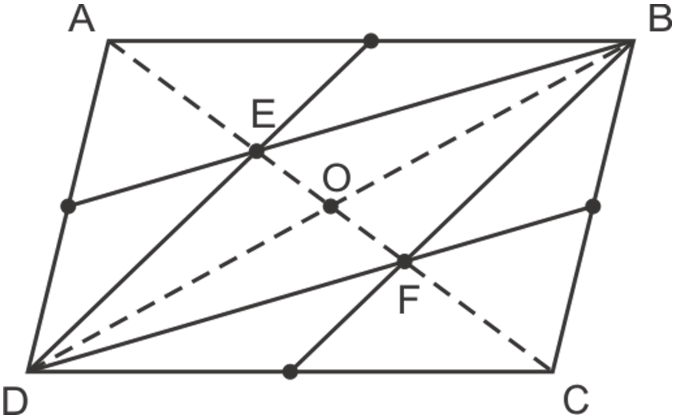
Centroid is the point where all medians of a meet.
In $\triangle\text{ABD}, E$ is the centroid,
And in $\triangle\text{BCD}, F$ is the centroid.
By the property of centroid, centroid divides a median in $2 : 1$
So from figure,
$\frac{\text{AE}}{\text{EO}}=\frac{2}{1}\Rightarrow\text{EO}=\frac{\text{AE}}{2}\ ...(1)$
Also $\frac{\text{CF}}{\text{FO}}=\frac{2}{1}\Rightarrow\text{FO}=\frac{\text{CF}}{2}\ ...(2)$
Because $AC$ is a digonal of a parallelogram, $O$ is its midpoint.
$\Rightarrow OA = OC$
$\Rightarrow AE = CF$
Adding equations $(1) \& (2),$
$\text{EO + FO} =\frac{\text{AE}+\text{CF}}{2}=\frac{\not2\text{AE}}{\not2}$
$\Rightarrow\text{EF}=\frac{\not2\text{AE}}{\not2}$
$\Rightarrow\text{EF}=\text{AE}$
View full question & answer→MCQ 1761 Mark
If $APB$ and $CQD$ are $2$ parallel lines, then the bisectors of the angles $APQ, BPQ, CQP$ and $PQD$ form, square only if:
AnswerCorrect option: C. Diagonals of $ABCD$ are equal.
The diagonals of a square bisect its angles. Opposite sides of a square are both parallel and equal in length. All four angles of a square are equal.
View full question & answer→MCQ 1771 Mark
The Diagonals $AC$ and $BO$ of a Parallelogram $ABCD$ intersect each other at the point $O$ such that $\angle\text{DAC} = 30^\circ$ and $\angle\text{AOB} = 70^\circ.$ Then $\angle\text{DBC}?$
- ✓
$40^\circ$
- B
$35^\circ$
- C
$45^\circ$
- D
$30^\circ$
AnswerCorrect option: A. $40^\circ$
$\angle\text{DAC} = \angle\text{ACB} = 30$ (alternate angles)
$\angle\text{BOA} = \angle\text{BOC} = 180$ (linear pair)
$\angle\text{BOC}= 180 - 70 = 110$
In $\triangle\text{BOC}, \ \angle\text{BOC} + \angle\text{OCB} + \angle\text{CBO} = 180$ (angle sum property)
$110 + 30 + \angle\text{CBO} = 180$
$\angle\text{CBO} = 180 - 140 =40$
$\Rightarrow \angle\text{DBC}=40^\circ$
View full question & answer→MCQ 1781 Mark
Diagonals of a Parallelogram $ABCD$ intersect at $O$. If $\angle\text{BOC}=90^\circ,\ \angle\text{BDC}=50^\circ$ then $\angle\text{OAB} $ is:
- A
$10^\circ$
- B
$50^\circ$
- ✓
$40^\circ$
- D
$90^\circ$
AnswerCorrect option: C. $40^\circ$
$\angle\text{BOC} + \angle\text{COD} = 180^\circ$ (linear pair).
$\angle\text{COD} = 180^\circ - 90^\circ = 90^\circ$
In $\angle\text{DOC} + \angle\text{DCO} + \angle\text{ODC} = 180^\circ$ (angle sum property).
$90^\circ + \angle\text{DCO} + 50^\circ = 90^\circ$
$\angle\text{DCO} = 180^\circ - 140^\circ = 40^\circ$
$\angle\text{DCO} = \angle\text{OAB} = 40^\circ$ (alternate angles).
View full question & answer→MCQ 1791 Mark
Write the correct answer in the following: $D$ and $E$ are the mid-points of the sides $A B$ and $A C$ respectively of $\triangle A B C$. $D E$ is produced to $F$. To prove that $C F$ is equal and parallel to $D A$, we need an additional information which is:
AnswerCorrect option: C. $\text{DE}=\text{EF}$
We need $\text{DE}=\text{EF}.$
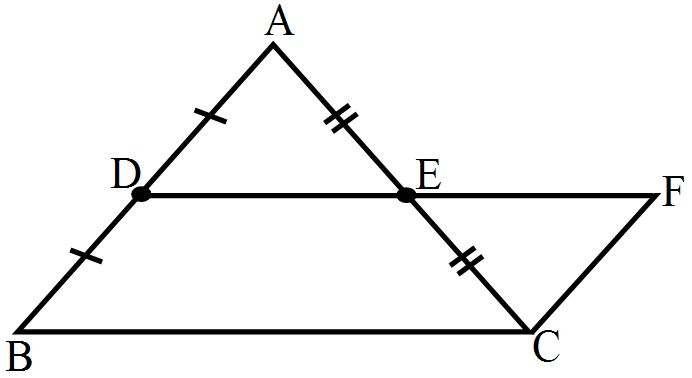
Hence, $(c)$ is the correct answer.
View full question & answer→MCQ 1801 Mark
The quadrilateral formed by joining the midpoints of the sides of a quadrilateral $ABCD$, taken in order, is a rhombus, if:
- A
$ABCD $is a Parallelogram.
- B
$ABCD $is rhombus.
- ✓
Diagonals of $ABCD $are equal.
- D
Diagonals of $ABCD $are perpendicular to each other.
AnswerCorrect option: C. Diagonals of $ABCD $are equal.
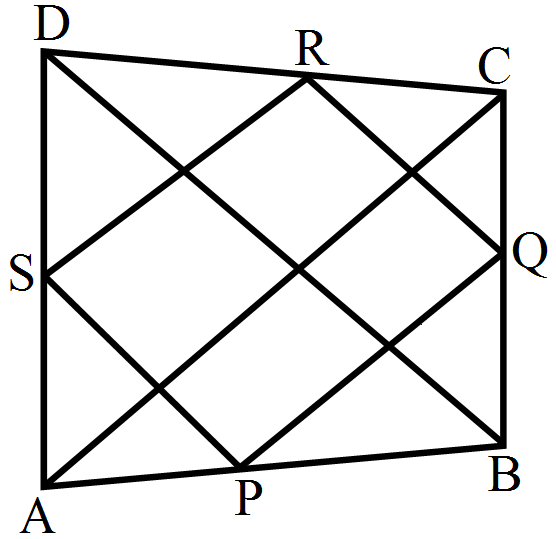
In $\triangle\text{ABC}, P$ and $Q$ are the mid-points of sides $AB$ and $BC$ respectively.
$\therefore\text{PQ || AC}$ and $\text{PQ}=\frac{1}{2}\text{AC ...(i)}$
In $\triangle\text{BCD},$ Q and R are the mid-points of sides $BC$ and $CD$ respectively.
$\therefore\text{QR || BD}$ and $\text{QR}=\frac{1}{2}\text{BD ...(ii)}$
In $\triangle\text{ADC},$ S and R are the mid-points of sides $AD$ and $CD$ respectively.
$\therefore\text{RS || AC}$ and $\text{RS}=\frac{1}{2}\text{AC ...(iii)}$
In $\triangle\text{ABD},$ P and S are the mid-points of sides $AB$ and $AD$ respectively.
$\therefore\text{SP || BD}$ and $\text{SP}=\frac{1}{2}\text{BD ... (iv)}$
$\Rightarrow\text{PQ ∥ RS}$ and $\text{QR ∥ SP}$ [From $(i), (ii), (iii)$ and $(iv)]$
Thus, $PQRS$ is a parallelogram.
Now, $AC = BD$ (given)
$\Rightarrow\frac{1}{2}\text{AC}=\frac{1}{2}\text{BD}$
$\Rightarrow\text{PQ = QR = RS = SP }$ [From $(i), (ii), (iii)$ and $(iv)]$
Hence, $PQRS$ is a rhombus if diagonals of $ABCD$ are equal.
View full question & answer→MCQ 1811 Mark
Write the correct answer in the following: The figure formed by joining the mid-points of the sides of a quadrilateral $ABCD$, taken in order, is a square only if,
- A
$ABCD$ is a rhombus.
- B
Diagonals of $ABCD $are equal.
- ✓
Diagonals of $ABCD $are equal and perpendicular.
- D
Diagonals of $ABCD $are perpendicular.
AnswerCorrect option: C. Diagonals of $ABCD $are equal and perpendicular.
If diagonal of $ABCD $are equal and perpendicular.
Hence, ($c$) is the correct answer.
View full question & answer→MCQ 1821 Mark
The figure formed by joining the mid-points of the adjacent sides of a rectangle is a:
AnswerHere, length of rectangle $A B C D=8 cm$ and breadth of rectangle $A B C D=6 cm$.
Let $E , F , G$ and H are the mid-points of the sides of rectangle $ABCD$ , then $EFGH $is a rhombus.
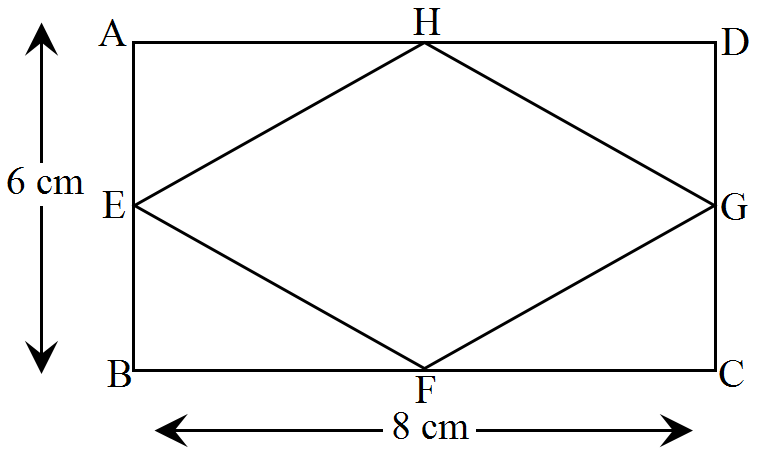
Here, length of rectangle $A B C D=8 cm$
and breadth of rectangle $A B C D=6 cm$
Let $E, F, G$ and $H$ are the mid-points of the sides of rectangle $A B C D$, then $E F G H$ is a rhombus. Then, diagonal of rhombus EFGH are EG and HF.
Here, $EG = BC =8 cm$
And $HF = AB =6 cm$
$\therefore\ \text{Area of rhombus}=\frac{\text{Product of diagonals}}{2}$
$=\frac{8\times6}{2}=4\times6=24\text{cm}^2$
Hence, joining the mid-points of the adjacent sides of a rectangle forms a rhombus of area $24cm^2$.
View full question & answer→MCQ 1831 Mark
$D$ and $E$ are the mid-points of the sides $A B$ and $A C$ res. Of $\triangle A B C$. $D E$ is produced to $F$. To prove that $C F$ is equal and parallel to $DA$ , we need an additional information which is:
AnswerCorrect option: B. $\text{DE = EF}$
If $DE= EF$ then $\triangle\text{AED}$ become congruent to $\triangle\text{CEF}$ by $SSS$ congruence rule.
By $CPCT,$ $\angle\text{ECF} = \angle\text{EAD}$ which forms a pair of an alternate angles.
Which proves that $AD$ is parallel to $CF$.
View full question & answer→MCQ 1841 Mark
The opposite sides of a quadrilateral have:
- ✓
- B
- C
- D
Infiniely many common points.
Answer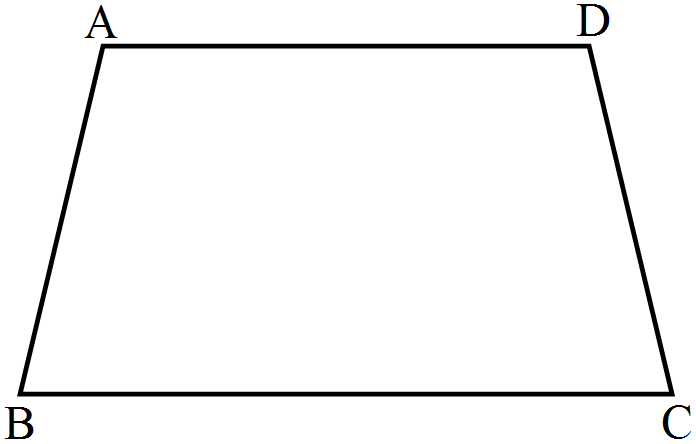
$ABCD$ is a Quadrilateral.
The opposite sides $AB$ and $DC, AD$ and $BC$ have no common point.
View full question & answer→MCQ 1851 Mark
In the given figure, $A D$ is a median of $\triangle A B C$ and $E$ is the mid-point of $A D$. If $B E$ is joined and produced to meet $A C$ in $F$, then $A F=$ ?
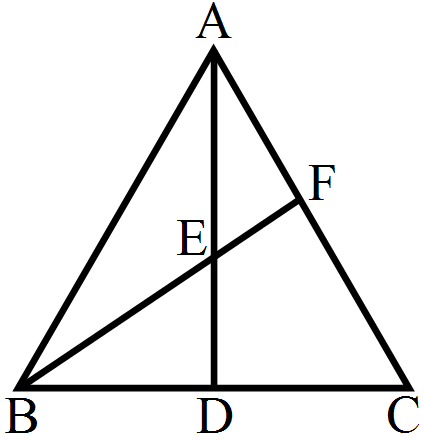
- A
$\frac{1}{2}\text{AC}$
- ✓
$\frac{1}{3}\text{AC}$
- C
$\frac{2}{3}\text{AC}$
- D
$\frac{3}{4}\text{AC}$
AnswerCorrect option: B. $\frac{1}{3}\text{AC}$
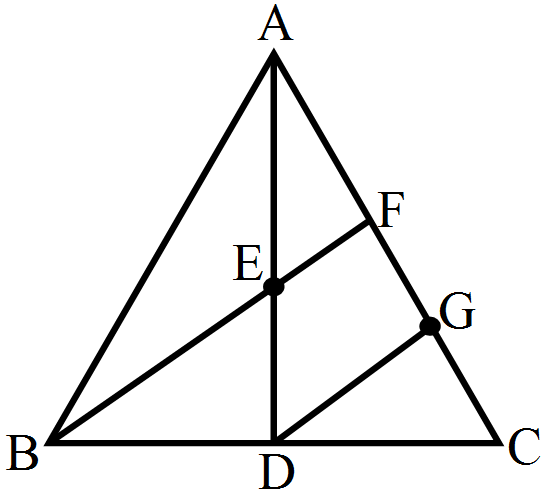
Construction: Join $DG$ and $G$ be the mid-point of $FC$.
Now,
In $\triangle\text{BCF, D}$ is the mid-point of $BC$ and $G$ is the mid-point of $FC$ and $F$ is the mid-point of $AG.$
$\Rightarrow\text{DG || BF}$
$\Rightarrow\text{DG || EF} ...(B - E - F)$
$\Rightarrow\text{AF}=\text{FG}=\text{GC}$ ...(Since $G$ is the mid-point.)
$\Rightarrow\text{AF}=\frac{1}{2}\text{AC}$
View full question & answer→MCQ 1861 Mark
$ABCD$ is a Rectangle, diagonals $AC$ and $BD$ intersect each other at $P$. If $\angle\text{APD} = 52^\circ,$ find $\angle\text{ACB}$ and $\angle\text{DBA}=\ ?$
- ✓
$64^\circ $ and $26^\circ $
- B
$20^\circ $ and $120^\circ $
- C
$100^\circ $ and $260^\circ $
- D
$25^\circ $ and $25^\circ $
AnswerCorrect option: A. $64^\circ $ and $26^\circ $
In Rectangle, diagonals are equal and bisect each other.
In $\triangle\text{APD, AP = PD}$
$\Rightarrow \angle\text{ADP} = \angle\text{PAD} = \text{x}$ (angle opposite to equal sides are equal)
In $\triangle\text{APD}, \angle\text{APD} + \angle\text{PDA} + \angle\text{DAP} = 180^\circ$ (angle sum property)
$52^\circ + \text{x} + \text{x} = 180^\circ$
$2\text{x} = 180^\circ - 52^\circ = 128^\circ$
$\text{x} = 64^\circ$
$\angle\text{DAC} = \angle\text{BCA} = 64^\circ$ (alternate angles)
In $\triangle\text{ADB}, \angle\text{ADB} + \angle\text{DBA} + \angle\text{BAD} = 180^\circ$ (angle sum property)
$64^\circ + \angle\text{DBA} + 90^\circ = 180^\circ$
$\angle\text{DBA} = 180^\circ - 154^\circ = 26^\circ$
View full question & answer→MCQ 1871 Mark
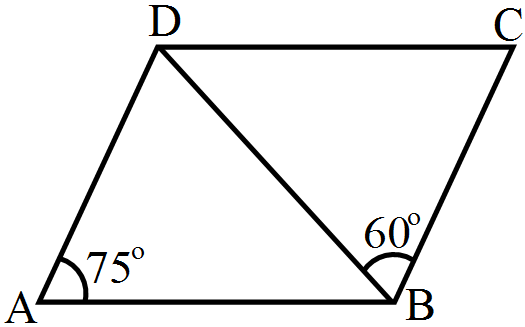
In the given figure, $ABCD$ is a parallelogram in which $\angle\text{BAD}=75{^\circ}$ and $\angle\text{CBD}=60^{\circ}.$ Then, $\angle\text{BDC}=?$
- A
$60^\circ$
- B
$75^\circ$
- ✓
$45^\circ$
- D
$50^\circ$
AnswerCorrect option: C. $45^\circ$
We know that, the opposite angles of a parallelogram are equal.
$\therefore\angle\text{C}=\angle\text{A}=75^{\circ}$
In $\triangle\text{BCD},$
$\angle\text{BCD}+\angle\text{BDC}+\angle\text{CBD}=180^{\circ}$ ...(Angle sum property)
$\Rightarrow75^{\circ}+\angle\text{BDC}+60^{\circ}=180^{\circ}$
$\Rightarrow\angle\text{BDC}=45^{\circ}$
View full question & answer→MCQ 1881 Mark
If the diagonals of a rhombus of a rhombus are $18\ cm$ and $24\ cm$ respectively, then its side is equal to:
- A
$16\ cm.$
- ✓
$15\ cm.$
- C
$20\ cm.$
- D
$17\ cm.$
AnswerCorrect option: B. $15\ cm.$
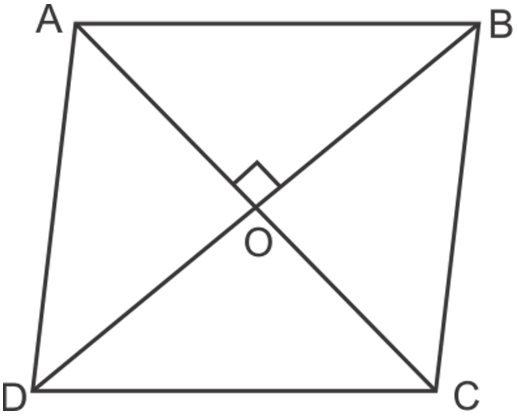
Let $BD = 24\ cm$ and $AC = 18\ cm$ (Given)
Now, $\frac{\text{AC}}{2}=\frac{18}{2}=9\text{cm}$ and $\text{BO}=\frac{\text{BD}}{2}=\frac{24}{2}=12\text{cm}$
Now, $\text{AB}=\sqrt{(\text{AO})^2+(\text{BO})^2}$ (Diagonals make $90^\circ $ between them)
$=\sqrt{9^2+12^2}$
$=\sqrt{81+144}$
$=\sqrt{225}$
$\text{AB}=15\text{cm}$ View full question & answer→MCQ 1891 Mark
Diagonals of a quadrilateral $ABCD$ bisect each other. If $\angle\text{A}=45^\circ,$ then $\angle\text{B}=$
- A
$115^\circ$
- B
$120^\circ$
- C
$125^\circ$
- ✓
$135^\circ$
AnswerCorrect option: D. $135^\circ$
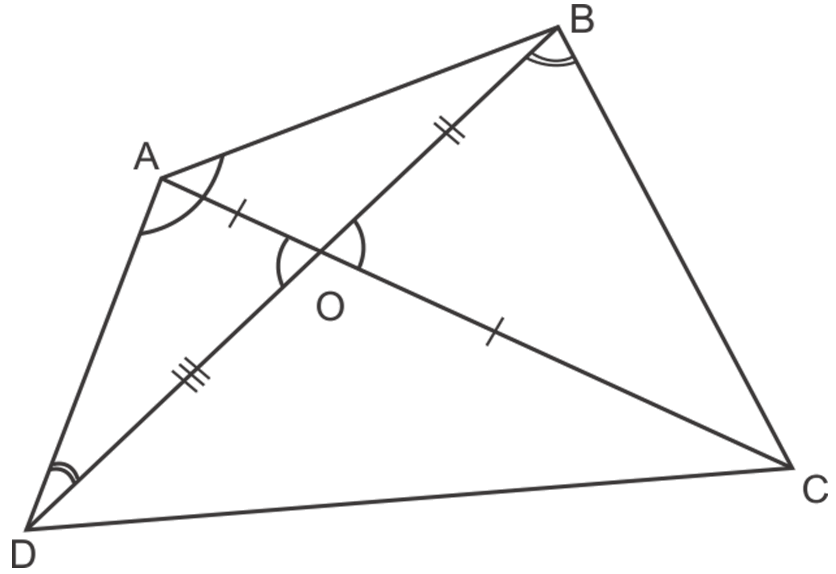
Consider $\triangle\text{AOD}\ \&\ \triangle\text{COB},$
$AO = CO$ {Diagonals bisects each other}
$OD = OB$ {Diagonals bisects each other}
$\angle\text{AOD}=\angle\text{COB}$ (Opposite angles)
So by SAS property, $\triangle\text{AOD}\cong\triangle\text{COB},$
$\Rightarrow\angle\text{ADO}=\angle\text{CBO}\dots(1)$
$\angle\text{ABD}=180^\circ-\angle\text{A}-\angle\text{ADO}$ $($in $\triangle\text{ADB})$
$=180^\circ-45^\circ-\angle\text{ADO}$
$\angle\text{ABD}=135^\circ-\angle\text{ADO}\dots(2)$
$\angle\text{B}=\angle\text{ABD}+\angle\text{CBO}$
Putting values From eq $(1)$ and $(2)$
$\angle\text{B}=135^\circ-\angle\text{ADO}+\angle\text{ADO}$
$\angle\text{B}=135^\circ$
View full question & answer→MCQ 1901 Mark
A diagonal of a parallelogram divides it into:
- ✓
- B
- C
- D
Two equilateral triangles.
AnswerBy SSS congruence condition, opposite sides are equal and common diagonal.
View full question & answer→MCQ 1911 Mark
The sum of all the four angles of a quadrilateral is:
- A
$270^\circ $
- B
$180^\circ $
- C
$90^\circ$
- ✓
$360^\circ$
AnswerCorrect option: D. $360^\circ$
One Diagonal divides it into two triangles and the sum of angles of one triangle is $180^\circ $ and $180 \times 2 = 360^\circ .$
View full question & answer→MCQ 1921 Mark
In each of the questions one question is followed by two statements $I$ and $II. $ Choose the correct option.Is $\|gm\ \text{ABCD}$ a square$?$
$i.$ Diagonals of $\|gm\ \text{ABCD}$ are equal.
$ii.$ Diagonals of $\|gm\ \text{ABCD}$ intersect at right angles.
- A
If the question cannot be answered by using both the statements together.
- B
If the question can be answered by either statement alone.
- ✓
If the question can be answered by both the statements together but not by any one of the two.
- D
If the question can be answered by one of the given statements alone and not by the other.
AnswerCorrect option: C. If the question can be answered by both the statements together but not by any one of the two.
We know that when the diagonals of a parallelogram are equal, it might be a square or a rectangle.
But if the diagonals of that parallelogram intersect at a right angle, then it is definitely the a square.
Thus, it can be concluded that both $I$ and $II$ together will give answer.
So, the question can be answered by both the statements together but not by any one of the two.
View full question & answer→MCQ 1931 Mark
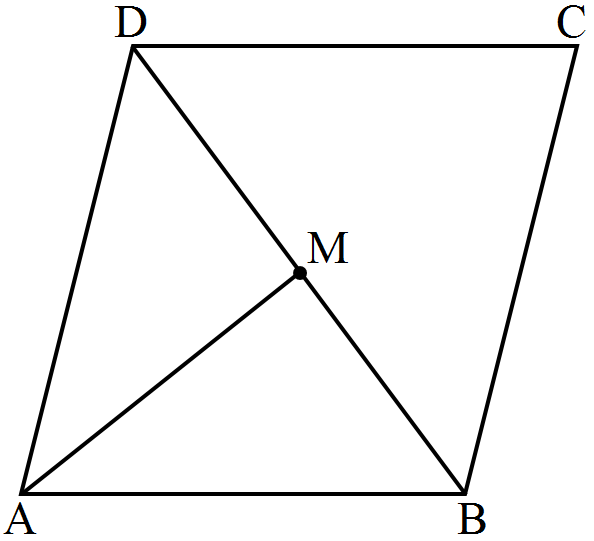
In given figure, $ABCD$ is a parallelogram, $M$ is the mid-point of $BD$ and $BM$ bisects $\angle\text{B}.$ Then, $\angle\text{AMB} =\ ?$
- ✓
$80^\circ $
- B
$10^\circ$
- C
$90^\circ$
- D
$100^\circ$
AnswerCorrect option: A. $80^\circ $
$ ABCD$ is a parallelogram. $BD$ is the diagonal and M is the mid point of $BD.\ BD$ is a bisector of $\angle\text{B}.$
We know that, diagonals of the parallelogram bisect each other.
$\therefore $ M is the mid point of $AC.$
$\text{AB || CD}$ and $BD$ is the transversal,
$\therefore \angle\text{ABD} = \angle\text{BDC}\ ...(1)$ (Alternate interior angles)
$\angle\text{ABD} = \angle\text{DBC}\ ...(2)$ (Given)
From $(1)$ and $(2),$ we get
$\angle\text{BDC} = \angle\text{DBC}$
In $\triangle\text{BCD},$
$\angle\text{BDC} = \angle\text{DBC}$
$\Rightarrow BC = CD ...(3) ($In a triangle, equal angles have equal sides opposite to them$)$
$AB = CD$ and $BC = AD ...(4) ($Opposite sides of the parallelogram are equal$)$
From $(3)$ and $(4),$ we get
$AB = BC = CD = DA$
$\therefore ABCD$ is a rhombus.
$\Rightarrow \angle\text{AMB} = 90^\circ ($Diagonals of rhombus are perpendicular to each other$)$
View full question & answer→MCQ 1941 Mark
Two parallelograms stand on same base and between the same parallels. The ratio of their areas is:
- A
$3 : 1$
- B
$2 : 1$
- ✓
$1 : 1$
- D
$1 : 2$
AnswerCorrect option: C. $1 : 1$
Parallelograms on the same base and between the same parallels are equal in area. Hence the ration of two parallelograms will be $1 : 1.$
View full question & answer→MCQ 1951 Mark
If bisector of $\angle\text{A}$ and $\angle\text{B}$ of a quadrilateral $ABCD$ intersect each other at $p, \angle\text{B}$ and $\angle\text{C} $at $Q, \angle\text{C}$ and $\angle\text{D}$ at $R$ and, $\angle\text{D}$ and $\angle\text{A}$ at $S$ then $PQRS$ is $a:$
- ✓
- B
- C
- D
Quadrilateral whose opposite angles are supplementary.
AnswerLet's assume our quadrilateral $ABCD$ as a parallelogram:
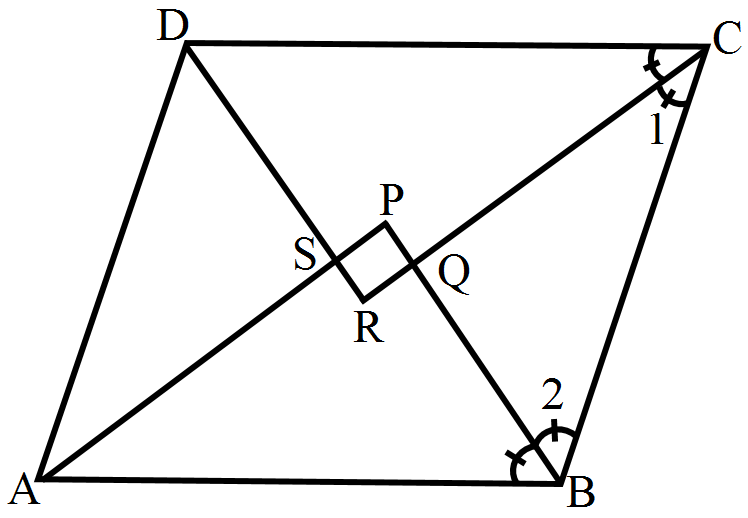
We know
$\angle\text{DCB} + \angle\text{ABC} = 180^\circ($ Co-interior angles of parallelogram are supplementary$)$
$\Rightarrow\frac{1}{2}\angle\text{DCB} + \angle\text{ABC} = 90^\circ ($Both sides divide by $2)$
$\Rightarrow \angle1+ \angle2 =90^\circ ... (1)$
In, $\triangle\text{CQB}$ we know
$\Rightarrow\angle1+ \angle2 +\angle\text{CQB} = 180^\circ ... (2)$
From eq. $(1)$ and eq. $(2),$ We get
$\Rightarrow\angle\text{CQB} = 180^\circ - 90^\circ$
$\Rightarrow\angle\text{CQB}= 90^\circ$
$\Rightarrow\angle\text{PQR}= 90^\circ$ (because $\angle\text{CQB} = \angle\text{PQR},$ vertically opposite angles)
Similarly, it can be shown
$\angle\text{QPS} = \angle\text{PSR} =\angle\text{SRQ} = 90^\circ$
So, quadrilateral $PQRS$ is a rectangle.
View full question & answer→MCQ 1961 Mark
In $\triangle\text{ABC},\ \angle\text{A} = 30^\circ, \ \angle\text{B} = 40^\circ$ and $\angle\text{C} = 110^\circ.$ The angles of the triangle formed by joining the mid-points of the sides of this triangle are:
- ✓
$30^\circ , 40^\circ , 110^\circ $
- B
$70^\circ , 70^\circ , 40^\circ$
- C
$60^\circ , 40^\circ , 80^\circ$
- D
$60^\circ , 70^\circ , 50^\circ$
AnswerCorrect option: A. $30^\circ , 40^\circ , 110^\circ $
Given,
In $\angle\text{ABC}$
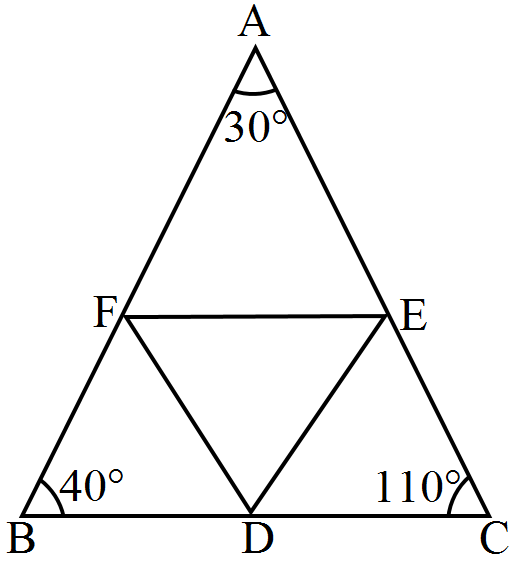
$\angle\text{A} = 30^\circ,\ \angle\text{B} = 40^\circ,\ \angle\text{C} = 110^\circ$
In figure, $BDEF, DCEF, DEAF$ are parallelograms so,
$\angle\text{B} = \angle\text{E} = 40^\circ [∵ \angle\text{B}$ & $\angle\text{E}$ are opposite angles of parallelogram $BDEF]$
$\angle\text{C} = \angle\text{F} = 110^\circ [∵ \angle\text{C}$ & $\angle\text{F}$ are opposite angles of parallelogram $DCEF]$
$\angle\text{A} = \angle\text{D} = 30^\circ [∵ \angle\text{A}$ & $\angle\text{D}$ are opposite angles of parallelogram $DEAF]$
Hence, $\angle\text{D} = 30^\circ$
$\angle\text{E} = 40^\circ$
$\angle\text{F} = 110^\circ$
View full question & answer→MCQ 1971 Mark
Write the correct answer in the following: The diagonals $AC$ and $BD$ of a parallelogram $ABCD$ intersect each other at the point $O$. If $\angle\text{DAC}=32^\circ$ and $\angle\text{AOC}=70^\circ,$ then $\angle\text{DBC}$ is equal to:
- A
$24^\circ $
- B
$86^\circ $
- ✓
$38^\circ $
- D
$32^\circ $
AnswerCorrect option: C. $38^\circ $
Given, $\angle\text{AOB}=70^\circ$ and $\angle\text{DAC}=32^\circ$
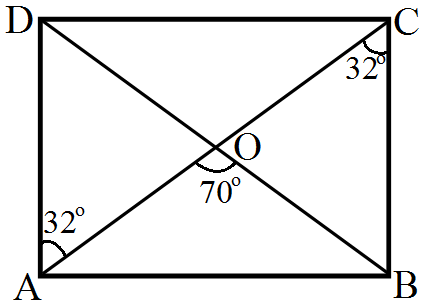
$\therefore\angle\text{ACB}=32^\circ [AD||BC$ and $AC$ is transver sal$]$
Now, $\angle\text{AOB}+\angle\text{BOC}=180^\circ [$linear pair axiom$]$
$\Rightarrow\ \angle\text{BOC}=180^\circ-\angle\text{AOB}=180^\circ-70^\circ=110^\circ$
Now, in $\Delta\text{BOC},$ we have
$\angle\text{BOC}+\angle\text{BCO}+\angle\text{OBC}=180^\circ[$by angle sum property of a tringle$]$
$\Rightarrow\ 110^\circ+32^\circ\angle\text{OBC}=180^\circ$ $[\because\angle\text{BCO}=\angle\text{ACB}=32^\circ]$
$\Rightarrow\ \angle\text{OBC}=180^\circ-(110^\circ+32^\circ)=38^\circ$
$\therefore\ \angle\text{DBC}-\angle\text{OBC}=38^\circ$ View full question & answer→MCQ 1981 Mark
In a parallelogram $ABCD$ if $\angle\text{A = (3x - 20)}, \ \angle\text{ B = (Y + 15)}, \ \angle\text{C = (x + 40)}$ then find the value of $x$ and $y?$
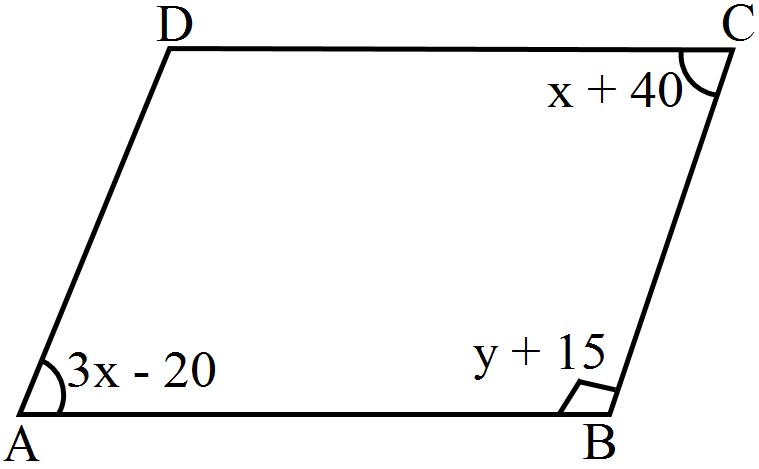
- A
$x = 30^\circ $ and $y = 65^\circ $
- ✓
$x = 30^\circ $ and $y = 95^\circ $
- C
$x = 32^\circ $ and $y = 95^\circ $
- D
$x = 38^\circ $ and $y = 85^\circ $
AnswerCorrect option: B. $x = 30^\circ $ and $y = 95^\circ $
Given, $ABCD$ is a parallelogram.
So,
$\angle\text{A} =\angle\text{C} ($Opposite angles of parallelogram are equal in size$)$
$\Rightarrow 3x - 20 = x + 40$
$\Rightarrow 3x - x = 40 + 20$
$\Rightarrow 2x = 60$
$\Rightarrow x = 30^\circ $
Thus, $\angle\text{A} = 3 \times 30 - 20 = 90 - 20 = 70^\circ$
Now, $\angle\text{A}+\angle\text{B}=180^\circ ($Sum of interior angles of parallelogram is $180^\circ )$
$\Rightarrow 70^\circ + \angle\text{B} = 180^\circ$
$\Rightarrow \angle\text{B}= 180^\circ - 70^\circ$
$\Rightarrow \angle\text{B}= 110^\circ$
$\Rightarrow y + 15 = 110^\circ $
$\Rightarrow y = 95^\circ $
Hence, $x = 30^\circ $ and $y = 95^\circ $
View full question & answer→MCQ 1991 Mark
The Diagonals $AC$ and $BO$ of a Parallelogram $ABCD$ intersect each other at point $0.$ If $\angle\text{DAC} = 32^\circ$ and $\angle\text{AOB} = 70^\circ,$ then $\angle\text{DBC}$ is equal to:
- A
$86^\circ $
- ✓
$38^\circ$
- C
$32^\circ$
- D
$24^\circ$
AnswerCorrect option: B. $38^\circ$
$\angle\text{OAC} = \angle\text{ACB} = 32^\circ$ (alternate angles)
$\angle\text{AOB} = \angle\text{COB} = 180^\circ$ (linear pair)
$\angle\text{COB} = 180 - 70 = 110^\circ$
In $\triangle\text{BOC}, \ \angle\text{BOC} + \angle\text{OCB} + \angle\text{CBO} = 180^\circ$ (angle sum property)
$110 + 32 + \angle\text{CBO} = 180^\circ$
$\angle\text{CBO} = 180 - 142 = 38^\circ$
View full question & answer→MCQ 2001 Mark
$ABCD$ is a parallelogram, $M$ is the mid-point of $BD$ and $BM$ bisects $\angle\text{B}.$ Then, $\angle\text{AMB}=$
- A
$45^\circ$
- B
$60^\circ$
- ✓
$90^\circ$
- D
$75^\circ$
AnswerCorrect option: C. $90^\circ$
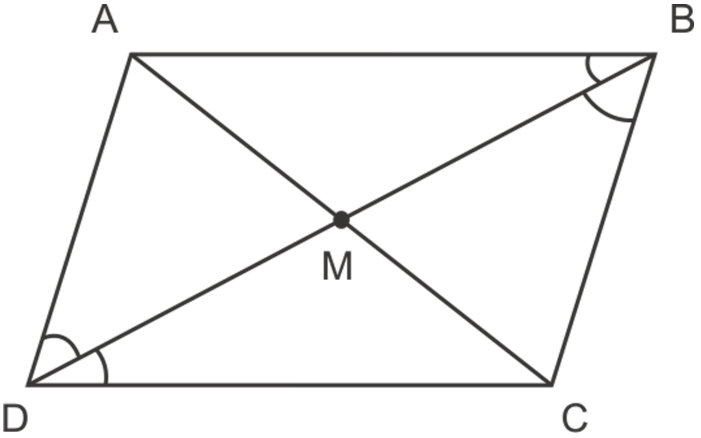
$\angle\text{ABM}=\angle\text{CBM}\ ...(1) (BM$ bisects $\angle\text{B})$
$\angle\text{ABM}=\angle\text{MDC}\ ...(2)($Alternate angles$)$
$\angle\text{CBM}=\angle\text{ADM}\ ...(3)($Alternate angles$)$
From equations $(1), (2)$ & $(3)$
$\angle\text{MDC}=\angle\text{ADM}...(4)$
Now, consider $\triangle\text{ABM}$ & $\triangle\text{CBD}$
$\angle\text{CBD}=\angle\text{ABD} \{$from eq $(1)\}$
$DB = DB ($Common$)$
$\angle\text{ADB}=\angle\text{CDB} \{$from eq $(4)\}$
Hence, by ASA property,
$\triangle\text{ADB}\cong\triangle\text{CBD}$
$⇒ AB = CB, AD = CD$
Hence, it becomes a Rhombus.
So now diagonals of a Rhombus bisect each other at $90^\circ .$
$\Rightarrow\angle\text{AMB}=90^\circ$
View full question & answer→