Questions

3 Marks Question

Take a timed test

31 questions · self-marked practice — reveal the answer and mark yourself.

Question 13 Marks
Find examples where the four daughter cells from meiosis are equal in size and where they are found unequal in size.
Answer
Examples are:
  1. During microsporogenesis, four daughter cells formed in flowering plants are equal in size while during megasporogenesis, four daughter cells formed in flowering plants are unequal in size.
  2. During Spermatogenesis or the formation of sperms in human beings occurs by the process of meiosis, four daughter cells formed are equal in size while during Oogenesis or the formation of ovum in human beings occurs by the process of meiosis, four daughter cells formed are unequal in size.
View full question & answer
Question 23 Marks
Distinguish anaphase of mitosis from anaphase I of meiosis.
Answer
Anaphase of mitosis Anaphase I of meiosis
Anaphase is the stage during which the centromere splits and the chromatids separate. The chromosomes move apart, toward the opposite poles. These chromosomes are genetically identical. During anaphase I, the homologous chromosomes separate, while the chromatids remain attached at their centromeres.
Hence, in anaphase I, the chromosomes of each bivalent pair separate, while the sister chromatids remain together.
View full question & answer
Question 33 Marks
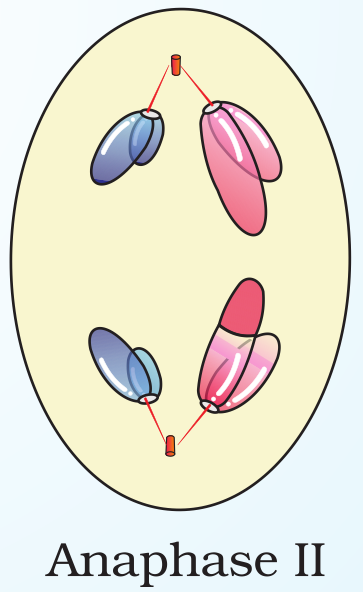
Analyse the events during every stage of cell cycle and notice how the following two parameters change. Amount of DNA content (C) per cell.
Answer
Amount of DNA content (C) per cell During anaphase II of the meiotic cycle, the chromatids separate as a result of the splitting of the centromere. It is the centromere that holds together the sister chromatids of each chromosome. As a result, the chromatids move toward their respective poles. Therefore, at each pole, a haploid number of chromosomes and a haploid amount of DNA are present. During mitosis, the number of chromosomes remains the same. The DNA duplicated in the S phase gets separated in the two daughter cells during anaphase. As a result, the DNA content (C) of the two newly-formed daughter cells remains the same.
View full question & answer
Question 43 Marks
Can there be DNA replication without cell division?
Answer
There can be DNA replication without cell division. During cell division, the parent cell gets divided into two daughter cells. However, if there is a repeated replication of DNA without any cell division, then this DNA will keep accumulating inside the cell. This would increase the volume of the cell nucleus, thereby causing cell expansion. An example of DNA duplication without cell division is commonly observed in the salivary glands of Drosophila. The chromosome undergoing repeated DNA duplication is known as polytene chromosome.
View full question & answer
Question 53 Marks
Analyse the events during every stage of cell cycle and notice how the following two parameters change. Number of chromosomes (N) per cell.
Answer
During meiosis, the number of chromosomes and the amount of DNA in a cell change. Number of chromosomes (N) per cell During anaphase I of the meiotic cycle, the homologous chromosomes separate and start moving toward their respective poles. As a result, the bivalents get divided into two sister chromatids and receive half the chromosomes present in the parent cell. Therefore, the number of chromosomes reduces in anaphase I.
View full question & answer
Question 63 Marks
Analyse the events during every stage of cell cycle and notice how the following two parameters change. Amount of DNA content (C) per cell 2018.
Answer
Amount of DNA content (C) per cell During anaphase II of the meiotic cycle, the chromatids separate as a result of the splitting of the centromere. It is the centromere that holds together the sister chromatids of each chromosome. As a result, the chromatids move toward their respective poles. Therefore, at each pole, a haploid number of chromosomes and a haploid amount of DNA are present. During mitosis, the number of chromosomes remains the same. The DNA duplicated in the S phase gets separated in the two daughter cells during anaphase. As a result, the DNA content (C) of the two newly-formed daughter cells remains the same.
View full question & answer
Question 73 Marks
Can there be mitosis without DNA replication in ‘S’ phase?
Answer
No, there cannot be mitosis without DNA replication in S phase because additional DNAs are required for the formation of new cells. DNA duplication is important as it maintains the chromosome number in the daughter cells and hence Mitosis is an equational division. Therefore, the duplication of DNA is an essential step and without it, no mitosis can take place.
View full question & answer
Question 83 Marks
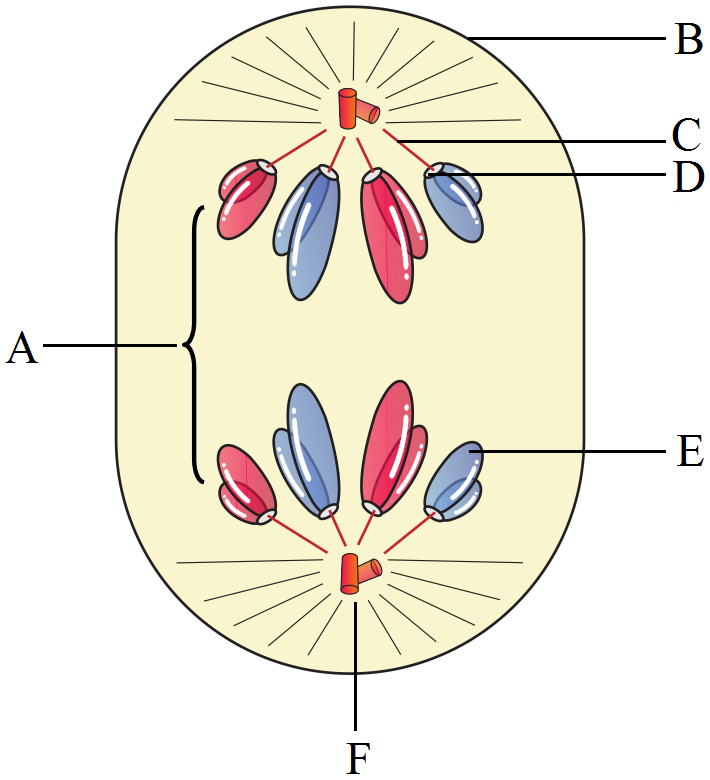
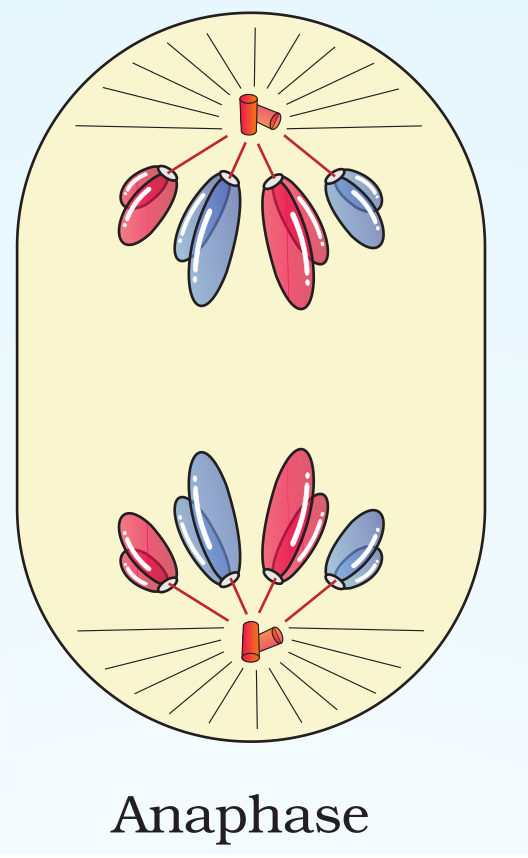
Label the following structures labelled as A-F in the diagram.
Answer
  1. Chromosomes
  2. Cell membrane
  3. Spindle fibre
  4. Centromere
  5. Chromatid
  6. Spindle organiser
View full question & answer
Question 93 Marks
Distinguish between cell membrane and cell wall.
Answer
Differences between cell membrane and cell wall are:
 
Cell Membrane
Cell Wall
1.
It is found in both prokaryotes and eukaryotes.
It is found in only plant cells as well as bacteria, fungi, algae and some archaea, i.e., absent in animal cells and Protozoa.
2.
Its function is to separate the components inside the cell from outside.
Its function is to provide barrier to understrable substains and attack of pathogen.
3.
It provides support to the cytoskeleton of the cell, give shape to the cell.
It provides strength and rigidity to the cell.
View full question & answer
Question 103 Marks
Distinguish between chloroplast arid chromoplast (any three).
Answer
Differences between chloroplast and chromoplast:
 
Chloroplasts
Chromoplasts
1.
They contain mainly chlorophylls and some amount of carotene and xanthophylls.
They contain mainly carotene and xanthophyll.
2.
They are present in the mesophyll of leaves.
They are present in the petals of flowers, skin of fruits, etc.
3.
Their main role is to prepare food by the process of photosynthesis.
Their main role is to impart colouration to plants.
View full question & answer
Question 113 Marks
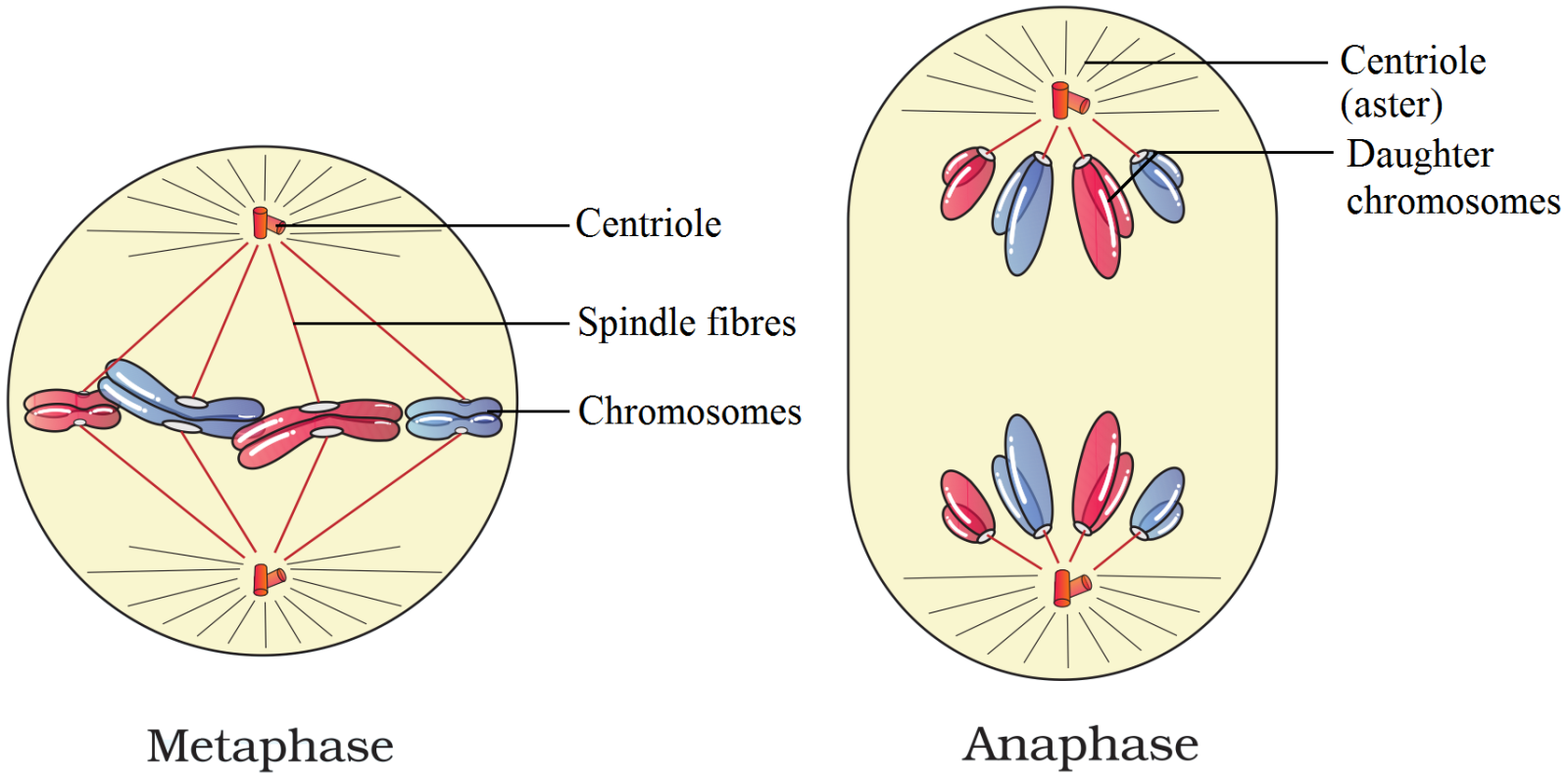
  1. Give the key features of metaphase and anaphase of mitosis. Also, draw diagrams of these stages.
  2. Write the name of the stages of cell division, which is best to study the morphology of a chromosome.
Answer
  1. Metaphase:
  1. Spindle fibres are attached to the kinetochores of chromosomes.
  2. Chromosomes are moved to spindle equator and get aligned along metaphase plate.
Anaphase:
  1. Centromeres split and chromatids separate.
  2. Chromatids move to opposite poles.
  1. Metaphase.
View full question & answer
Question 123 Marks
What are mitochondria? What is the basic morphology of these organelles and in which cell can they be found?
Answer
Mitochondria are the organelles in which the most important part of the cellular respiration occurs, i.e., the ATP production. Mitochondria are organelles bounded by two lipid membranes. The inner membrane infolded to the interior of the organelle forming cristae that defines the internal space known as mitochondrial matrix and where mitochondrial DNA (mtDNA), mitochondria) RNA (mtDNA), mitochondrial ribosomes and respiratory enzymes can be found. Mitochondria are found in eukaryotic cells in high number and are also more abundant in those cells that use more energy, like muscle cells. Because mitochondrion have their own DNA, RNA and ribosomes. They can even has the ability to self-replicate.
View full question & answer
Question 133 Marks
Describe the basis on which Gap-1 phase, Synthetic phase and Gap-2 phase of cell cycle are named.
Answer
Mention any two characteristics of telophase.
  1. G, phase corresponds to the interval between mitosis and initiation of DNA replication.
  2. S phase marks the synthesis or replication of DNA of the cell.
  3. In Gap-2 phase, proteins needed for mitosis are synthesised.
​​​​​​​​​​​​​​​​​​​​​​​​​​​​Telophase:
  1. Chromosomes cluster at opposite spindle poles and undergo uncoiling, i.e. they lose thar identity as discrete elements.
  2. Nuclear envelope assembles around the chromosome clusters.
  3. Nucleolus, endoplasmic reticulum and golgi complex are reformed.
View full question & answer
Question 143 Marks
The lysosomal enzyme does not destroy the cell's own cytoplasm. Why?
Answer
The lysosomal enzyme does not destroy its own cytoplasm, because of the following reasons,
  1. The enzymes are separated from the cytoplasm by the lysosomal membrane.
  2. The enzymes have the capability of recognising and digest only foreign matter.
  3. The lysosomal enzymes usually works in acidic medium of pH less than 7 and the medium is more than 7, i.e., around 7.4 or more.
View full question & answer
Question 153 Marks
Write brief note on the following Synaptonemal complex.
Answer
Centromere of all the chromosomes form a plate called metaphasic plate or equatorial plate. This plate is formed during metaphase stage of mitosis and meiosis. On this plate the small chromosomes come to lie towards the interior while the larger one are arranged towards the periphery. The centromeres of all the chromosomes lie on the equator while the limbs are placed variously according to their size and spatial arrangement.
View full question & answer
Question 173 Marks
It is always taught by our teachers and parents that we should not eat food or fruits without washing our hands as it contains thousands of germs and pathogens which we cannot see with our naked eyes.
  1. What are germs?
  2. What are the basic difference between the unicellular and multicellular organisms?
  3. Name the instrument that allow us to study the unicellular organisms.
  4. What values are taught by our teachers and parents?
Answer
  1. Germs are found all over the world and are generally unicellular organisms like viruses, bacteria, protozoans, etc. They can invade plants, animals and people and can sometime make us sick.
  2. Unicellular organisms are those which are made up of single cell that carry out all the life processes, e.g., Amoeba, Paramecium, etc., while Multicellular organisms are those which are made up of numerous cells and different cells are specialised to perform various functions, e.g., Fungi, plants and animals.
  3. Microscope is an instrument used to study the unicellular organisms.
  4. Values taught by teacher and parents are hygiene consciousness and healthcare.
View full question & answer
Question 183 Marks
Write brief note on the following: Synaptonemal complex.
Answer
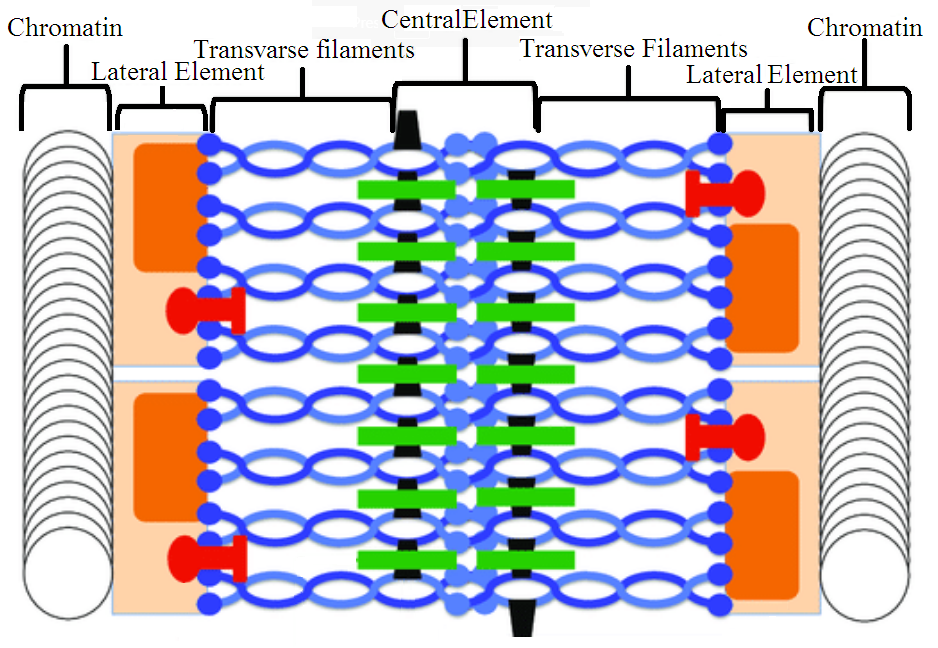
The synaptonemal complex is a tripartite, ribbon-like structure, and is sihiated between pairing homologous chromosomes. It consists of a dense central element, with a dense lateral element on either side. Each lateral element is attached on the inner side of a homologous chromosome. The space between the central and lateral elements is traversed by a series of transverse units of LC fibres (L for lateral and C for central), which connects the two. The synaptonemal complex is attached at both ends through its lateral elements to the inner surface of the nuclear membrane. The central element is not attached directly. Also arising from the lateral elements is another series of smaller loops. These loops fuse in the middle line to make up the central element. The transverse parts of the loops form the transverse units or LC fibres. The central element is simple in some organisms (e.g., frogs and mice) and tripartite in other (e.g., insects). Each lateral element consists of two protein filaments, one for each sister chromatid. Synaptonemal complex first appears during zygotene.
View full question & answer
Question 193 Marks
Amrita and her mother planted small seedling of plant in the soil in their garden. After few months, while playing with her friends Amrita observed that the seedlings which they planted had grown into a mature and flourishing plant. Amrita was curious to know this and asked her mother about this.
  1. Name the process that causes growth in living organisms.
  2. Discuss about the process that how growth occurs in living organisms.
  3. Analyse and write about the common sites of mitosis in plants as well as in animals.
  4. What values were shown by Smita?
Answer
  1. Mitosis.
  2. Mitosis brings about growth in multicellular organisms and multiplication in unicellular organisms. It occurs in the formation of somatic body cells and is, therefore often called somatic cell division.
  3. The common sites of mitosis cell division in plants are meristematic regions, e.g., stem tip, root tip, embryo, leaves, flowers, fruits, etc. In animals, mitosis occurs in skin epidermis, bone marrow and embryo.
  4. Amrita shows critical thinking, aesthetic values and concern for the development of plants and also about the physiological behaviour and growth in organisms.
View full question & answer
Question 203 Marks
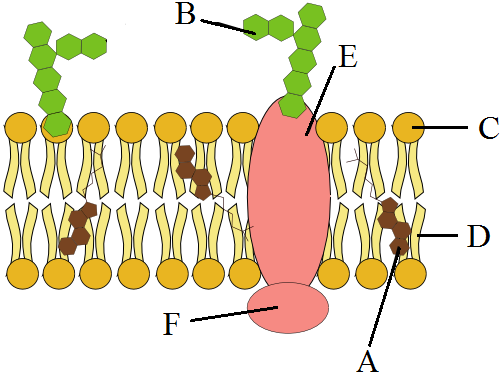
The diagram shows a section of cell membrane. Identify the components labelled A-F.
Answer
Following are the labelled sections of cell membrane:A - Cholesterol.
B - Glycolipid.
C - Hydrophilic head of phospholipid.
D - Hydrophobic tail of phospholipid.
E - Transmembrane protein.
F - Intrinsic protein.
View full question & answer
Question 213 Marks
Amrita's biology teacher taught in biology class that food helps in building the body and alsoprovides us energy to work. However, she was not able to understand the mechanisms involved. So, she discussed it with his father who is a professor of biology in a college. He answered that in living organisms certain structures, present in the cells and known as power houses of cells, which are responsible for conversion of food into energy. Read the above passage and answer the following questions.
  1. Which cell organelles are known as power house of cell? Why?
  2. List major components of mitochondrion.
  3. What values are displayed by Amrita's father?
Answer
  1. Mitochondria is known as the power house of the cell. It is called so, because it forms the cellular energy in the from of ATP.
  2. The major components of mitochondria are membranes, i.e., (inner and outer), cristae, oxysomes and matrix.
  3. He wanted to help his daughter in developing scientific aptitude and knowledge about structure and function of different organelles present in the cell.
View full question & answer
Question 223 Marks
Neha was walking in the garden early morning and observed many beautiful flowering plants. She got attracted by the brightly coloured flowers and their beautiful appearance. Neha was curious to know about the variation of colours in flowers and asked her biology teacher about this. Teacher told her about the plastids found in only plant cells.
  1. Which plastids are found in flowers and fruits?
  2. Which plastids are known as kitchen of the cell?
  3. Name the colourless plastids.
  4. What values are shown by Neha?
Answer
  1. Chromoplast, are the coloured plastids, which are of two subtypes. i.e., green and non-green chromoplast.
  2. Chloroplasts are coloured plastids which are green in colour due to the presence of chlorophyll. They trap solar energy for the, manufacturing of food. So, they are the main site for photosynthesis. Hence, known as kitchen of the cell.
  3. Leucoplasts are the colourless plastids of varied shapes and sizes.
  4. Neha has caring nature towards plants and concern about flowers and flowering plants. Values shown were awareness about plastids and their appearance and role in plants.
View full question & answer
Question 233 Marks
  1. Which stage of meiosis is characterised by the appearance of recombination nodules?
  2. List the significance of mitosis.
Answer
  1. Pachytene of prophase I of meiosis.
  2. Significance of Mitosis
  1. In multicellular organisms, body growth is by mitotic divisions of the cells.
  2. Replacement of worn out tissues/cells (e.g., blood cells, skin cells) and repair of the injured tissues is by mitoses.
  3. In unicellular organisms, mitoses are involved in asexual reproduction (multiplication of cells).
  4. In plants, vegetative propagation involves only mitotic divisions and genetically identical individuals are produced.
  5. Uncontrolled cell divisions in certain tissues/organs (cancer) result in tumours.
View full question & answer
Question 243 Marks
State the chief functions of mitochondria.
Answer
Mitochondria perform the following major functions:
  1. Mitochondria are the main site of aerobic respiration, where respiratory substrates are completely oxidised to carbon dioxide and water. The energy liberated in the process is utilised in the synthesis of energy rich molecules ATP.
  2. They have a group of enzymes that carry out elongation of fatty acids of adding acetyl Co-A and subsequently reducing the keto-acid and produced.
  3. The matrix of mitochondria has enzymes for the synthesis of fatty acids.
View full question & answer
Question 253 Marks
Differentiate between prophase and prophase I.
Answer
S.No.
Prophase
Prophase I
1.
There is no synaptic pairing of homologous chromosomes.
Pairing of homologous
chromosomes (synapsis) takes place.
2.
There is no crossing over or recombination.
Crossing over and recombination occur
3.
It is relatively a short phase.
It is comparatively a long phase.
View full question & answer
Question 263 Marks
Biology teacher was teaching cell cycle in the class. She taught that cell is the basis from which life exists. Also explained well about cell cycle. Robin who was a bright student was facing difficulties in understanding the topic he reached home and asked her sister who is a student of biology in a college about details of cell cycle and cell theory. She explained him that according to cell theory, cells arise from pre-existing cells and the process involved is cell division. Sexually reproducing organisms start their life from a single cell, called zygote, and cell divisions do not stop with the formation of a mature organism, but continue throughout the life.
  1. What is meant by cell cycle?
  2. Which is the actual phase of cell division?
  3. When (at what phase) do the cell organelles duplicate?
  4. What values are reflected from the Robin's concern?
Answer
  1. Cell cycle refers to the sequence of events by which a cell duplicates its genome, synthesises the other constituents of the cell and ultimately divides into two daughter cells.
  2. M-phase.
  3. During $\mathrm{G}_1$-phase of interphase.
  4. Values that reflect are Robin is interested and curious to know new things.
View full question & answer
Question 273 Marks
Name the two basic phases of cell cycle and differentiate between the two.
Answer
The two basic phases of cell cycle are:
  1. Interphase and
  2. M-phase (mitosis phase)
Interphase
M-Phase
It is the phase between two successive M (mitosis) division phases.
It is the actual phase of cell division.
It extends for a very long (5% of the cell cycle).
It is completed in a short time (95% of the cell duration cycle).
The chromosomes appear as chromatin material.
Chromosomes are distinct rod-like structures.
View full question & answer
Question 283 Marks
Explain, why a pair of homologous Doze chromosomes is genetically different, but a pair of sister chromatids is genetically identical before crossing over in meiosis.
Answer
A pair of homologous chromosomes is genetically different because in a set of homologous chromosomes, one of the chromosome belongs to the male parent and the other comes from the female parent. Therefore, one of a pair will contain paternal genes and the other will contain maternal genes. However, a pair of sister chromatids is genetically identical before crossing over as the chromatids are formed from the replication of DNA during the 'S' phase of interphase. DNA replication ensures that the DNA content is doubled with identical genes being copied from the original DNA. Therefore, there is no genetic variation because there EUW is no exchange of genetic material between sister chromatids. If crossing over occurs, then it would be possible for some genes to be exchanged between the chromatids of homologous chromosomes that have chiasmata, thus leading to genetic variation.
View full question & answer
Question 293 Marks
Are the different types of plastids interchangeable? If yes, give examples where they are getting converted from one type to another.
Answer
The different types of plastids leucoplasts (colourless), chromoplasts (coloured), chloroplasts (green coloured) such as are interchangeable. The transformation from chioroplasts is observed during ripening of fruits (e.g.,Tomato, chilli) when they change their colour from green to reddish orange. It takes place through loss of chlorophylls and degeneration of lamellae. The most common carotenoid of the fruit is lycopene. Petals of Calendula develop orange yellow colour due to the formation of chromoplasts from proplastids. Carrot root develops it characteristic colour because of the conversion of leucoplasts into chromoplasts. It is rich in carotene.
View full question & answer
Question 303 Marks
Describe in detail the events in Prophase I of meiosis.
Answer
  • Prophase I has been divided into the following five phases, based on the chromosomal behaviour;
  1. Leptotene
  2. Zygotene
  3. Pachytene
  4. Diplotene and
  5. Diakinesis
  • During leptotene, the compaction of chromosomes continues and the chromosomes become visible under light microscope.
  • During zygotene, the hormologous chromosomes start pairing, in the process, called synapsis; it is accompanied by the formation of synaptonemal complex and the pair of synapsed hormologous chromosomes, is called a bivalent.
  • During pachytene, the bivalents appear as tetrads and recombination nodules appear indicating the sites of crossing over.
  • Crossing over occurs between non-sister chromatids of homologous chromosomes; the process is catalysed by enzyme, recombinase.
  • Diplotene is marked by the dissolution of the synaptonemal complex and the tendency of the members of bivalents to separate except at sites of cross overs, called chiasmata.
  • Diakinesis is marked by terminalisation of chiasmata; the chromosomes are fully condensed and the nuclear envelope and nucleolus have disappeared.
View full question & answer
Question 313 Marks
While teaching cell division in the class, teacher told that during meiosis, the chromosome number is reduced to half of the parent, whereas during mitosis, the number remains the same. Seema was not able to recognise what teacher explained in the class and asked her elder brother, a botany student, the need of reducing chromosomes during gamete formation and what will happen if chromosome number will not reduced to its half. He explained the concept in detail to Seema.
  1. In which part of the organisms does meiosis occur?
  2. How does meiosis help in evolution?
  3. Give the significance of meiosis.
  4. What value is expressed in the behaviour of Seema's elder brother?
Answer
  1. Meiosis takes place in reproductive organs for the formation of gametes.
  2. It results in the production of recombinants and variation.
  3. Meiosis helps in maintaining constant chromosome number in the species and also plays important role in evolution.
  4. He is helpful, intelligent aware of scientific concepts and processes.
View full question & answer