Question 11 Mark
Justify that the following reactions are redox reactions:$4BCl_3(g) + 3LiAlH_4(s) → 2B_2H_6(g) + 3LiCl(s) + 3AlCl_3(s)$
Answer$4BCl_{3(g)} + 3LiAlH_{4(s)} → 2B_2H_{6(g)} + 3LiCl_{(s)} + 3AlCl_{3(s)}$The oxidation number of each element in the given reaction can be represented as:
$\stackrel{{+3\ -1}}{4\ \ \ \ \ \hbox{BCl}_{3(\text{g})}}+\stackrel{{+1\ \ +3\ -1}}{3\ \ \ \ \hbox{LiAlH}_{4(\text{s})}}\ \rightarrow\stackrel{{-3}}{2\ \ \hbox{B}_2}\stackrel{{+1}}{\ \ \ \ \ \hbox{H}_{6(\text{g})}}+\stackrel{{+1}}{3\hbox{Li}}\stackrel{{-1}}{\ \ \ \ \hbox{Cl}_{(\text{s})}}+\stackrel{{+3}}{3\hbox{Al}}\stackrel{{-1}}{\ \ \ \ \ \ \hbox{Cl}_{3(\text{s})}}$
In this reaction, the oxidation number of B decreases from +3 in $BCl_3$ to –3 in $B_2H_6.$ i.e., $BCl_3$ is reduced to $B_2H_6$. Also, the oxidation number of H increases from $–1 in LiAlH_4 to +1 in B_2H_6 i.e., LiAlH_4$ is oxidized to $B_2H_6.$ Hence, the given reaction is a redox reaction.
View full question & answer→Question 21 Mark
Write formula for the following compound:
Nickel(II) sulphate.
AnswerNickel(II) sulphate:
$\text{NiSO}_4$
View full question & answer→Question 31 Mark
Write formula for the following compound:
Iron(III) sulphate.
AnswerIron(III) sulphate:
$\mathrm{Fe}_2\left(\mathrm{SO}_4\right)_3$
View full question & answer→Question 41 Mark
Consider the elements:
Cs, Ne, I and F
Identify the element that exhibits only negative oxidation state.
AnswerF. Fluorine being the most electronegative element shows only a -ve oxidation state of -1.
View full question & answer→Question 51 Mark
Write formula for the following compound:
Tin(IV) oxide.
AnswerTin(IV) oxide:
$\text{SnO}_2$
View full question & answer→Question 61 Mark
Refer to the periodic table given in your book and now answer the following questions:
Select the possible non metals that can show disproportionation reaction.
AnswerIn disproportionation reactions, one of the reacting substances always contains an element that can exist in at least three oxidation states.
P, Cl, and S can show disproportionation reactions as these elements can exist in three or more oxidation states.
View full question & answer→Question 71 Mark
Write formula for the following compound:
Chromium(III) oxide.
AnswerChromium(III) oxide:
$\mathrm{Cr}_2 \mathrm{O}_3$
View full question & answer→Question 81 Mark
Justify that the following reactions are redox reactions:
$\mathrm{Fe}_2 \mathrm{O}_{3(\mathrm{~s})}+3 \mathrm{CO}_{(\mathrm{g})} \rightarrow 2 \mathrm{Fe}_{(\mathrm{s})}+3 \mathrm{CO}_{2(\mathrm{~g})}$
Answer$\mathrm{Fe}_2 \mathrm{O}_{3(\mathrm{~s})}+3 \mathrm{CO}_{(\mathrm{g})} \rightarrow 2 \mathrm{Fe}_{(\mathrm{s})}+3 \mathrm{CO}_{2(\mathrm{~g})}$
Let us write the oxidation number of each element in the given reaction as:
$\stackrel{+3}{\mathrm{Fe}}_2 \quad \stackrel{-2}{\mathrm{O}}_{3(\mathrm{~s})}+3 \stackrel{+2-2}{\mathrm{CO}}_{(\mathrm{g})} \rightarrow 2 \stackrel{0}{\mathrm{~F} \mathrm{e}_{(\mathrm{s})}}+3 \stackrel{+4-2}{\mathrm{CO}}_{2(\mathrm{~g})}$
Here, the oxidation number of Fe decreases from +3 in $\mathrm{Fe}_2 \mathrm{O}_3$ to 0 in Fe i.e., $\mathrm{Fe}_2 \mathrm{O}_3$ is reduced to Fe . On the other hand, the oxidation number of C increases from +2 in CO to +4 in $\mathrm{CO}_2$ i.e., CO is oxidized to $\mathrm{CO}_2$. Hence, the given reaction is a redox reaction.
View full question & answer→Question 91 Mark
Depict the galvanic cell in which the reaction $\mathrm{Zn}(\mathrm{s})+2 \mathrm{Ag}^{+}(\mathrm{aq}) \rightarrow \mathrm{Zn}^{2+}(\mathrm{aq})+2 \mathrm{Ag}(\mathrm{s})$ takes place, Further show:
Individual reaction at each electrode.
AnswerThe galvanic cell corresponding to the given redox reaction can be represented as:
$\text{Zn}|\text{Zn}^{2+}_{(\text{aq})}||\text{Ag}^{+}_{(\text{aq})}|\text{Ag}$
The reaction taking place at Zn electrode can be represented as:
$\text{Zn}_{(\text{s})}\rightarrow\text{Zn}^{2+}_{(\text{aq})}+2\text{e}^-$
And the reaction taking place at Ag electrode can be represented as:
$\text{Ag}^+_{(\text{aq})}+\text{e}^-\rightarrow\text{Ag}_{(\text{s})}.$
View full question & answer→Question 101 Mark
Consider the elements: Cs, Ne, I and FIdentify the element that exhibits only postive oxidation state.
AnswerCs. Alkali metals because of the presence of a single electron in the valence shell, exhibit an oxidation state of +1.
View full question & answer→Question 111 Mark
Refer to the periodic table given in your book and now answer the following questions:
Select three metals that can show disproportionation reaction.
AnswerIn disproportionation reactions, one of the reacting substances always contains an element that can exist in at least three oxidation states.
Mn, Cu, and Ga can show disproportionation reactions as these elements can exist in three or more oxidation states.
View full question & answer→Question 121 Mark
Consider the elements:
Cs, Ne, I and F
Identify the element which exhibits neither the negative nor does the positive oxidation state.
AnswerNe. It is an inert gas (with high ionization enthalpy and high positive electron gain enthalpy) and hence it neither exhibits -ve nor +ve oxidation states.
View full question & answer→Question 131 Mark
Write formula for the following compound:
Mercury(II) chloride.
AnswerMercury(II) chloride:
$\mathrm{HgCl}_2$
View full question & answer→Question 141 Mark
Justify that the following reactions are redox reactions:$2K(s) + F_2(g) → 2K^+F^-(s)$
Answer$2K_{(s)} + F_{2(g)} → 2K^+F^-_{(s)}$The oxidation number of each element in the given reaction can be represented as:
$\stackrel{{0}}{2\ \ \text{K}_{(\text{s})}}+\stackrel{{0}}{\ \ \ \ \ \text{F}_{2(\text{g})}}\ \rightarrow\stackrel{{+1}}{2\ \ \text{K}^+}\stackrel{{-1}}{\ \ \ \ \text{F}^-_{(\text{s})}}$ In this reaction, the oxidation number of K increases from 0 in K to +1 in KF i.e., K is oxidized to KF. On the other hand, the oxidation number of F decreases from 0 in $F_2$ to -1 in KF i.e., $F_2$ is reduced to KF. Hence, the above reaction is a redox reaction.
View full question & answer→Question 151 Mark
Write formula for the following compound:
Thallium(I) sulphate.
AnswerThallium(I) sulphate:
$\mathrm{Tl}_2\mathrm{SO}_4$
View full question & answer→Question 161 Mark
Justify that the following reactions are redox reactions:$CuO(s) + H_2(g) → Cu(s) + H_2O(g)$
Answer$CuO_{(s)} + H_{2(g)} → Cu_{(s)} + H_2O_{(g}$ Let us write the oxidation number of each element involved in the given reaction as:
$\stackrel{{+2}\ -2}{\hbox{Cu O}}_{(\text{s})}\ +\stackrel{{0}}{\ \ \ \ \ \ \hbox{H}_{2(\text{g})}}\ \rightarrow\stackrel{0}{\ \ \ \ \hbox{ Cu}_{(\text{s})}}+\stackrel{+1\ \ \ \ -2}{\ \ \ \hbox{H}_2\ \ \text{O}_{(\text{g})}}$ Here, the oxidation number of Cu decreases from +2 in CuO to 0in Cu i.e., CuO is reduced to Cu . Also, the oxidation number of H increases from 0 in $H _2$ to +1 in $H _2 O$ i.e., $H _2$ is oxidized to $H _2 O$. Hence, this reaction is a redox reaction.
View full question & answer→Question 171 Mark
Predict the products of electrolysis in the following:
An aqueous solution $\mathrm{AgNO}_3$ with platinum electrodes.
AnswerPt cannot be oxidized easily. Hence, at the anode, oxidation of water occurs to liberate $\mathrm{O}_2$. At the cathode, $\mathrm{Ag}^{+}$ions are reduced and get deposited.
View full question & answer→Question 181 Mark
Justify that the following reactions are redox reactions:$4NH_3(g) + 5O_2(g) → 4NO(g) + 6H_2O(g)$
Answer$4NH_{3(g)} + 5O_{2(g)} → 4NO_{(g)} + 6H_2O_{(g)}$
The oxidation number of each element in the given reaction can be represented as:
$\stackrel{{-3\ \ \ +1}}{\ \ \ \ 4\text{N H}_{3(\text{g})}}+\stackrel{{0}}{\ \ \ \ \ 5\text{O}_{2(\text{g})}}\ \rightarrow\stackrel{{+2-2}}{\ \ 4\text{NO}_{(\text{g})}}+\stackrel{+1\ \ \ \ \ -2}{ \ \ \ 6\text{H}_2\ \ \text{O}_{(\text{g})}}$
Here, the oxidation number of N increases from -3 in $NH _3$ to +2 in NO . On the other hand, the oxidation number of $O _2$ decreases from 0 in $O _2$ to -2 in NO and $H _2 O$ i.e., $O _2$ is reduced. Hence, the given reaction is a redox reaction.
View full question & answer→Question 191 Mark
Depict the galvanic cell in which the reaction $\mathrm{Zn}(\mathrm{s})+2 \mathrm{Ag}^{+}(\mathrm{aq}) \rightarrow \mathrm{Zn}^{2+}(\mathrm{aq})+2 \mathrm{Ag}(\mathrm{s})$ takes place, Further show:
Which of the electrode is negatively charged.
AnswerThe galvanic cell corresponding to the given redox reaction can be represented as:
$\text{Zn}|\text{Zn}^{2+}_{(\text{aq})}||\text{Ag}^{+}_{(\text{aq})}|\text{Ag}$
Zn electrode is negatively charged because at this electrode, Zn oxidizes to $\text{Zn}^{2+}$ and the leaving electrons accumulate on this electrode.
View full question & answer→Question 201 Mark
Depict the galvanic cell in which the reaction $\mathrm{Zn}(\mathrm{s})+2 \mathrm{Ag}^{+}(\mathrm{aq}) \rightarrow \mathrm{Zn}^{2+}(\mathrm{aq})+2 \mathrm{Ag}(\mathrm{s})$ takes place, Further show:The carriers of the current in the cell.
AnswerThe galvanic cell corresponding to the given redox reaction can be represented as:
$\text{Zn}|\text{Zn}^{2+}_{(\text{aq})}||\text{Ag}^{+}_{(\text{aq})}|\text{Ag}$
Ions are the carriers of current in the cell.
View full question & answer→Question 211 Mark
Write the name of cell in which chemical energy is converted into electrical energy.
Question 221 Mark
Why are positive ions called cations, whereas negative ions are called anions?
AnswerPositive ions are called cations because they are attracted towards cathode whereas negative ions are called anions because they are attracted towards anode.
View full question & answer→Question 231 Mark
Calculate oxidation number of O in $\mathrm{KO}_2 \mathrm{~Na}$ in $\mathrm{Na}_2 \mathrm{O}_2$
Answer$\stackrel{2+1}{\mathrm{KO}_2}$
$+1+2 \mathrm{x}=0$
$2 x=-1$
$\mathrm{x}=-\frac{1}{2}$
$\mathrm{Na}_2 \mathrm{O}_2$
$+2+2 \mathrm{x}=0$
$2 x=-2$
$x=-1$
View full question & answer→Question 241 Mark
At what concenration of $\mathrm{Cu}^{2+}(\mathrm{aq})$ will electrode potential become equal to its standard electrode potential?
Answer$1 \mathrm{M}\left(1 \mathrm{~mol} \mathrm{~L}^{-1}\right)$.
View full question & answer→Question 251 Mark
Out of aluminium and silver vessel, which one will be more suitable to store 1 M HCl solution and why?
$\text{E}^{\circ}_{\text{Al}^{3+}|\text{Al}}=-1.66\text{V, E}^{\circ}_{\text{Ag}^+|\text{Ag}}=+0.80\text{V}$
AnswerSince, reduction potential of silver is more than that of hydrogen $\Big(\text{E}^{\circ}_{\text{H}^+|\text{H}_2},\text{Pt}=0\Big)$ silver vessel will be suitable to store 1M HCl. On the other hand, $\text{E}^\circ_{\text{H}^+|\text{H}_2},$ is less than that of hydrogen $\text{E}^\circ_{\text{H}^+|\text{H}_2}$ so hydrogen will get liberated if stored in aluminium vessel.
View full question & answer→Question 261 Mark
Write formula for the following compound:
Nickel(II) sulphate.
AnswerNickel(II) sulphate:
$\mathrm{NiSO}_4$
View full question & answer→Question 271 Mark
Find the value of n in:
$4\text{MnO}^-_4+8\text{H}^++\text{ne}^-\xrightarrow{\ \ \ \ \ \ }\text{Mn}^{2+}+4\text{H}_2\text{O}$
Answer$\text{MnO}^-_4+8\text{H}^++\text{ne}^-\xrightarrow{\ \ \ \ \ }\text{Mn}^{2+}+4\text{H}_2\text{O}$
$-1+8+n=+2$
$-1-2+8+n=0$
$n=-5 \text { or } 5 e^{-}$
View full question & answer→Question 281 Mark
Does the oxidation number of an element in any molecule or any polyatomic ion represent the actual charge on it?
AnswerNo, The oxidation number of an element in any species is an apparent charge on the atom which it appears to have acquired when all other atoms in the species are removed as ions.
View full question & answer→Question 291 Mark
Name the indicator used in redox titration involving $\mathrm{K}_2 \mathrm{Cr}_2 \mathrm{O}_7$ as an oxidising agent.
AnswerDiphenyl amine is used as indicator which gives dark blue colour at end point.
View full question & answer→Question 301 Mark
Write formula for the following compound:
Iron(III) sulphate.
AnswerIron(III) sulphate:
$\mathrm{Fe}_2\left(\mathrm{SO}_4\right)_3$
View full question & answer→Question 311 Mark
Write the oxidation and reduction reactions separately from the following redox reaction.
$2\text{Fe}+2\text{H}_2\text{O}+\text{O}_2\xrightarrow{ \ \ \ \\ \ \ }2\text{Fe(OH)}_2$
Answer$\text{Fe}\xrightarrow{ \ \ \ \ \ \ }\text{Fe}^{2+}+2\text{e}^-\text{(Oxidation)}$
$\frac{1}{2}\text{O}_2+\text{H}_2\text{O}+2\text{e}^-\xrightarrow{ \ \ \ \ \ }2\text{OH}^-\text{(Reduction)}$
View full question & answer→Question 321 Mark
Consider the elements:
Cs, Ne, I and F
Identify the element that exhibits only negative oxidation state.
AnswerF. Fluorine being the most electronegative element shows only a -ve oxidation state of -1.
View full question & answer→Question 331 Mark
Can $\mathrm{Fe}^{3+}$ oxidise $\mathrm{Br}^{-}$to $\mathrm{Br}^2$ at 1 M concentrations?
$\mathrm{E}^{\circ}\left(\mathrm{Fe}^{3+} \mid \mathrm{Fe}^{2+}\right)=0.77 \mathrm{~V}$ and $\mathrm{E}^{\circ}\left(\mathrm{Br} \mid \mathrm{Br}^{-}\right)=1.09 \mathrm{~V}$
Answer$\mathrm{E}^{\circ}\left(\mathrm{Fe}^{3+} \mid \mathrm{Fe}^{2+}\right)$ is lower than that of $\mathrm{E}^{\circ}\left(\mathrm{Br}^{-} \mid \mathrm{Br}^{-}\right)$.
Therefore, $\mathrm{Fe}^{2+}$ can reduce $\mathrm{Br}^2$ but $\mathrm{Br}^{-}$cannot reduce $\mathrm{Fe}^{3+}$.
Thus, $\mathrm{Fe}^{3+}$ cannot oxidise $\mathrm{Br}^{-}$to $\mathrm{Br}^2$.
View full question & answer→Question 341 Mark
Write formula for the following compound:
Tin(IV) oxide.
AnswerTin(IV) oxide:
$\mathrm{SnO}_2$
View full question & answer→Question 351 Mark
Refer to the periodic table given in your book and now answer the following questions:
Select the possible non metals that can show disproportionation reaction.
AnswerIn disproportionation reactions, one of the reacting substances always contains an element that can exist in at least three oxidation states.
P, Cl, and S can show disproportionation reactions as these elements can exist in three or more oxidation states.
View full question & answer→Question 361 Mark
Write formula for the following compound:
Chromium(III) oxide.
AnswerChromium(III) oxide:
$\mathrm{Cr}_2\mathrm{O}_3$
View full question & answer→Question 371 Mark
What is the oxidation number of S in $\mathrm{Na}_2 \mathrm{S}_4 \mathrm{O}_6$ and $\mathrm{Na}_2 \mathrm{SO}_3$ ?
View full question & answer→Question 381 Mark
$\mathrm{Br}_2+2 \mathrm{Cl}^{-} \rightarrow \mathrm{Cl}_2+2 \mathrm{Br}^{-}$,
will this reaction take place or not?$\text{E}^0_\frac{\text{Br}_2}{\text{Br}^-}=+1.09\text{V}$
$\text{E}^0_\frac{\text{Cl}_2}{\text{Cl}^-}=+1.36\text{V}$
Answer$\text{E}^0_\text{cell}=\text{E}^0_\frac{\text{Br}_2}{\text{Br}^-}-\text{E}^0_\frac{\text{Cl}_2}{\text{Cl}^-}$
$=1.09\text{V}-1.36$
$=-0.27\text{V}$
Since $\text{E}^0$ cell is -ve, reaction will not take place.
View full question & answer→Question 391 Mark
Justify that the following reactions are redox reactions:$Fe_2O_3(s) + 3CO(g) → 2Fe(s) + 3CO_2(g)$
Answer$Fe_2O_{3(s)} + 3CO_{(g)} → 2Fe_{(s)} + 3CO_{2(g)}$ Let us write the oxidation number of each element in the given reaction as:
$\stackrel{{+3}}{\ \ \ \ \hbox{Fe}_2}\stackrel{{-2}}{\ \ \ \ \ \hbox{O}_{3(\text{s})}}+\stackrel{{+2-2}}{3\ \ \ \hbox{CO}_{(\text{g})}}\ \rightarrow\stackrel{{0}}{\ \ \ \ \hbox{2Fe}_{(\text{s})}}+\stackrel{{+4-2}}{3\ \ \ \ \ \hbox{CO}_{2(\text{g})}}$
Here, the oxidation number of Fe decreases from +3 in $Fe _2 O _3$ to 0 in Fe i.e., $Fe _2 O _3$ is reduced to Fe . On the other hand, the oxidation number of C increases from +2 in CO to +4 in $CO _2$ i.e., CO is oxidized to $CO _2$. Hence, the given reaction is a redox reaction.
View full question & answer→Question 401 Mark
A freshly cut apple is almost white but turns brown after some time, why?
AnswerApple contains $\mathrm{Fe}^{2+}$ which get oxidised to $\mathrm{Fe}^{3+}$ which is brown in colours. Apple turns brown due to oxidation of $\mathrm{Fe}^{2+}$ to $\mathrm{Fe}^{3+}$
View full question & answer→Question 411 Mark
How to find strength of $\mathrm{KMnO}_4$ by titrating it with Mohr's salt in acidic medium?
Answer$5 \mathrm{M}_1 \mathrm{V}_1=\mathrm{M}_2 \mathrm{V}_2$ is used because in $\mathrm{KMnO}_4, \mathrm{Mn}^{7+}$ changes $\left(\mathrm{KMnO}_4\right)$ (Mohr's salt) to $\mathrm{Mn}^{2+}$ by gaining 5 electrons, therefore we have $5 \mathrm{M}_1 \mathrm{V}_1$ but in Mohr's salt $\left(\mathrm{FeSO}_4\left(\mathrm{NH}_4\right) \cdot 6 \mathrm{H}_2 \mathrm{O}, \mathrm{Fe}^{2+}\right.$ loses one electrons to form $\mathrm{Fe}^{2+}$ therefore $\mathrm{M}_2 \mathrm{V}_2$ is used.
View full question & answer→Question 421 Mark
Out of Zn and Cu vessel which one will be more suitable to store 1M HCl?
$\text{E}^\circ_\frac{\text{Zn}^{2+}}{\text{Zn}}=-0.76\text{V}$
$\text{E}^\circ_\frac{\text{Cu}^{2+}}{\text{Cu}}=+0.34\text{V}$
Answer'Cu' vessel is more suitable because Cu is less reactive than hydrogen due to higher value of reduction potential where 'Zn' is more reactive than hydrogen, will displace $\text{H}_2$ from IM HCl.
View full question & answer→Question 431 Mark
$\text{Fe}_2\text{O}_3+3\text{CO}\text{(g)}\xrightarrow{ \ \ \ \ \ \ \ }2\text{Fe}\text{(s)}+3\text{CO}_2\text{(g)}$
AnswerSubstance reduced is $\text{Fe}_2\text{O}_3$.
View full question & answer→Question 441 Mark
Can the following reaction,
$\text{Cr}_{2}\text{O}^{2-}_7 + \text{H}_{2}\text{O}\rightleftharpoons 2\text{CrO}^{2-}_{4} + 2\text{H}^{+}$
be regarded as a redox reaction?
AnswerIn this reaction, oxidation number of Cr in $\text{Cr}_{2}\text{O}^{2-}_{4}$ is +6 and oxidation number of Cr in $\text{Cr}_{2}\text{O}^{2-}_{4}$is + 6. Since, during the reaction, the oxidation number of Cr has neither decreased nor increased, therefore, the above reaction is not a redox reaction.
View full question & answer→Question 451 Mark
Identify oxidant and reductant in the reaction:
$\text{I}_2\text{(aq)}+2\text{S}_2\text{O}_3^{2-}\xrightarrow{ \ \ \ \ \ }2\text{I}^-+\text{S}_4\text{O}_6^{2-}$
AnswerI, is oxidant, $\text{S}_2\text{O}_3^{2-}$ is reductant.
View full question & answer→Question 461 Mark
What is the relationship between standard oxidation potential and standard reduction potential?
AnswerBoth are equal in magnitude but opposite in sign.
View full question & answer→Question 471 Mark
What are spectator ions? Give one example.
AnswerSpectator ions are ions that stay unaffected during a chemical reaction. They appear both as reactant and as product in an ionic equation, e.g. in the following ionic equation, the sodium and nitrate ions are spectator ions.
$\text{Ag}^+\text{(aq)}+\text{NO}^-_3\text{(aq)}+\text{Na}^+\text{(aq)}+\text{Cl}^-\text{(aq)}\\\xrightarrow{\ \ \ \ \ \ \ \ }\text{AgCl(s)}+\text{Na}^+\text{(aq)}+\text{NO}^-_3\text{(aq)}$
View full question & answer→Question 481 Mark
What is oxidation state of Cr in $\left[\mathrm{Cr}\left(\mathrm{H}_2 \mathrm{O}\right)_6\right] \mathrm{Cl}_3$
AnswerLet oxidation state of Cr be ' x ', H is $+1, \mathrm{O}$ is -2 ,
$\mathrm{Cl}=-1$
$\mathrm{x}+12-12-3=0$
$\mathrm{x}=3$
View full question & answer→Question 491 Mark
What is the relationship between direction of current and flow of electrons by convention?
AnswerThe current flows from cathode to anode, whereas electrons flow from anode to cathode.
View full question & answer→Question 501 Mark
What happens when $\text{Cu}^{2+}$ is added KI solution? Indicator used in this titration?
Answer$2\text{Cu}^{2+}+4\text{I}^-\text{(aq)}\xrightarrow{ \ \ \ \ \ }\text{Cu}_2\text{I}_2\text{(s)}+\text{I}_2\text{(aq)}$
Starch is used as indicator which gives blue colour with $\text{I}_2$.
View full question & answer→Question 511 Mark
$\text{Zn}\text{(s)}+\text{Cu}^{2+}\text{(aq)}\xrightarrow{ \ \ \ \ \ \ \ \ }\text{Zn}^{2+}\text{(aq)}+\text{Cu}\text{(s)}$ Is this reaction redox reaction? If yes, name the oxidising agent as well as reducing agent.
AnswerYes, $\text{Cu}^{2+}$ is oxidising agent, whereas Zn is reducing agent.
View full question & answer→Question 521 Mark
$\mathrm{Fe}+\mathrm{Cd}^{2+} \rightarrow \mathrm{Cd}+\mathrm{Fe}^{2+}$ will this reaction take place or not?
$\text{E}^0_\frac{\text{Fe}^{2+}}{\text{Fe}}=-0.44\text{V}$
$\text{E}^0_\frac{\text{Cd}^{2+}}{\text{Cd}}=-0.40\text{V}$
Answer$\text{E}^0_\text{cell}=\text{E}^0_\frac{\text{Cd}^{2+}}{\text{Cd}}-\text{E}^0_\frac{\text{Fe}^{2+}}{\text{Fe}}$
$=-0.40\text{V}-(-0.44\text{V})$
$=+0.04\text{V}$
View full question & answer→Question 531 Mark
Following cell is set up between copper and silver electrodes.$\text{Cu}|\text{Cu}^{2+}\text{(aq)}\|\text{Ag}^+\text{(aq)}|\text{Ag}$
If its two half cells work under standard conditions, calculate the emf of the cell.
$\Big[\text{Given E}^\circ_{\frac{\text{Cu}^{2+}}{\text{Cu}}}=+0.34\text{V},\text{E}^\circ_{\frac{\text{Ag}^+}{\text{Ag}}}=+0.80\text{V}\Big]$
Answer$\text{E}^{\circ}_\text{cell}=\text{E}^\circ_\text{cathode}-\text{E}^\circ_\text{anode}$
$=\text{E}^\circ_{\frac{\text{Ag}^+}{\text{Ag}}}-\text{E}^\circ_{\frac{\text{Cu}^{2+}}{\text{Cu}}}=+0.80-(+0.34)=0.46\text{V}$
View full question & answer→Question 541 Mark
Depict the galvanic cell in which the reaction $\mathrm{Zn}(\mathrm{s})+2 \mathrm{Ag}^{+}(\mathrm{aq}) \rightarrow \mathrm{Zn}^{2+}(\mathrm{aq})+2 \mathrm{Ag}(\mathrm{s})$ takes place, Further show:Individual reaction at each electrode.
AnswerThe galvanic cell corresponding to the given redox reaction can be represented as:$\text{Zn}|\text{Zn}^{2+}_{(\text{aq})}||\text{Ag}^{+}_{(\text{aq})}|\text{Ag}$
The reaction taking place at Zn electrode can be represented as:
$\text{Zn}_{(\text{s})}\rightarrow\text{Zn}^{2+}_{(\text{aq})}+2\text{e}^-$
And the reaction taking place at Ag electrode can be represented as:
$\text{Ag}^+_{(\text{aq})}+\text{e}^-\rightarrow\text{Ag}_{(\text{s})}.$
View full question & answer→Question 551 Mark
Give an example of disproportionation reaction.
AnswerChlorine is getting oxidised as well as reduced.
$\therefore$ It is disproportionation reaction.
$\text{Cl}_2+2\text{NaOH}\xrightarrow{ \ \ \ \ \ \ \ }\text{NaCl}+\text{NaClO}+\text{H}_2\text{O}\\ \ 0 \ \ \ \ \ \ \ \ \ \ \ \ \ \ \ \ \ \ \ \ \ \ \ \ \ \ \ \ \ \ \ {-1}\ \ \ \ \ \ \ \ \ \ \ {+1}$
View full question & answer→Question 561 Mark
Why is anode called oxidation electrode, whereas cathode is called reduction electrode?
AnswerAt anode, loss of electrons takes place, i.e. oxidation takes place, whereas at cathode, gain of electrons takes place, i.e. reduction takes place. Therefore, cathode is called reduction electrode and anode is called oxidation electrode.
View full question & answer→Question 571 Mark
Represent a galvanic cell in electrode and ions contain Cu electrode dipped in molar solution of copper sulphate and silver electrode dipped in molar solution of silver nitrate.Given
$\text{E}^\circ_\frac{\text{Cu}^{2+}}{\text{Cu}\text{(s)}}=0.34\text{V}$
$\text{E}^\circ_\frac{\text{Ag}^+}{\text{Ag}\text{(s)}}=0.80\text{V}$
Answer$\text{Cu}\text{(s)}|\text{Cu}^{2+}(1\text{M})||\text{Ag}^+(1\text{M})|\text{Ag}\text{(s)}$
View full question & answer→Question 581 Mark
AnswerIt is oxidation state of element in its compound or ion according to set rules based on fact shared pair of electron belongs to more electronegative atom.
View full question & answer→Question 591 Mark
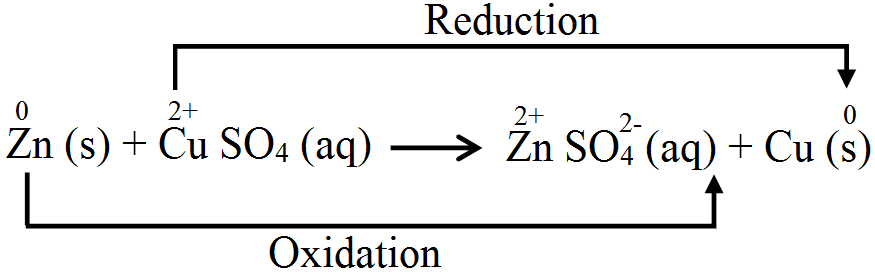
Zn rod is immersed in $\mathrm{CuSO}_4$ solution. What will you observe after an hour? Explain your observation in terms of redox reaction.
AnswerThe blue colour of $\mathrm{CuSO}_4$ solution will get discharged and reddish brown copper metal will be deposited on Zn rod. This is because blue colour $\mathrm{Cu}_2+$ (in $\mathrm{CuSO}_4$ ) gets reduced to Cu by accepting two electrons from Zn , which gets oxidised to colourless $\mathrm{ZnSO}_4$.
View full question & answer→Question 601 Mark
Fe decomposes steam while Cu does not, why?
AnswerFe is more reactive than hydrogen, it has lower reduction potential than hydrogen whereas Cu has higher reduction potential than hydrogen, copper cannot displace hydrogen from steam because it is less reactive than hydrogen.
View full question & answer→Question 611 Mark
Consider the elements: Cs, Ne, I and FIdentify the element that exhibits only postive oxidation state.
AnswerCs. Alkali metals because of the presence of a single electron in the valence shell, exhibit an oxidation state of +1.
View full question & answer→Question 621 Mark
$2\text{Cu}_2\text{S}+3\text{O}_2\xrightarrow{ \ \ \ \ \ \ \ \ }2\text{Cu}_2\text{O}+2\text{SO}_2$ In this reaction which substance is getting oxidised and which substance is getting reduced. Name reducing agent and oxidising agent.
Answer$\mathrm{Cu}_2 \mathrm{~S}$ is getting oxidised, whereas $\mathrm{O}_2$, is getting reduced. $\mathrm{Cu}_2 \mathrm{~S}$ is reducing agent, whereas $\mathrm{O}_2$ is oxidising agent.
View full question & answer→Question 631 Mark
Refer to the periodic table given in your book and now answer the following questions:
Select three metals that can show disproportionation reaction.
AnswerIn disproportionation reactions, one of the reacting substances always contains an element that can exist in at least three oxidation states.
Mn, Cu, and Ga can show disproportionation reactions as these elements can exist in three or more oxidation states.
View full question & answer→Question 641 Mark
Is it safe to stir IM $\mathrm{AgNO}_3$ solution with copper spoon?
$\text{E}^\circ_\frac{\text{Ag}^+}{\text{Ag}}=+0.80\text{V}$
$\text{E}^\circ_\frac{\text{Cu}^{2+}}{\text{Cu}}=+0.34\text{V}$
AnswerNo, because Cu is more reactive than Ag, it will disptace Ag from $\mathrm{AgNO}_3$ solution. Secndly
$\text{E}^\circ_\text{Cell}=\text{E}^\circ_\frac{\text{Ag}^+}{\text{Ag}}-\text{E}^\circ_\frac{\text{Cu}^{2+}}{\text{Cu}}$
$=0.80\text{V}-0.34\text{V}$
$=0.46\text{V}$
Since $\text{E}^\circ_\text{Cell}$ is +ve, $\Delta\text{G}^\circ$ will be negative, reaction will take place.
View full question & answer→Question 651 Mark
How would you know whether a redox reaction is taking place in an acidic, alkaline or neutral medium?
AnswerIf $\mathrm{H}^{+}$or any acid appears on either side of the chemical equation, the reaction takes place in the acidic solution.
If $\mathrm{OH}^{-}$, or any base, appears on either side of the chemical equation, the solution is basic. If neither $\mathrm{H}^{+}, \mathrm{OH}^{-}$nor any acid or base is present in the chemical equation, the solution is neutral.
View full question & answer→Question 661 Mark
The compound $\mathrm{Y} \mathrm{~Ba}_2 \mathrm{Cu}_3 \mathrm{O}_7$, which shows superconductivity, has copper in x oxidation state. Assume that the rare earth element yttrium is in its usual +3 oxidation state. Predict the value of $x$.
Answer$1 x(+3)+2 x(+2)+3 x+7 x(-2)=03+4+3 x-14=0$
$3 x=7 ; x=\frac{7}{3}$
View full question & answer→Question 671 Mark
Calculate the oxidation number of underlinesd element in the following: $\text{Na}_2\text{B}_4,\text{O}_\text{S}\text{O}_4$
Answer$\text{Na}_2\text{B}_4\text{O}_7;$
$+2+4\text{x}-14$
$4\text{x}=12$
$\text{x}=-3$
$\text{O}_\text{S}\text{O}_4$
$\text{x}-8=0$
$\text{x}=+8$
View full question & answer→Question 681 Mark
What is the oxidation number of Fe in $\left[\mathrm{Fe}(\mathrm{CO})_5\right]$?
Answer$\left[\mathrm{Fe}(\mathrm{CO})_5\right]$
$x+5(0)=0$
$x=0$
View full question & answer→Question 691 Mark
Using stock notation, represent the given compound $\mathrm{MnO}_2$.
Answer$\mathrm{Mn}(\mathrm{IV}) \mathrm{O}_2$.
View full question & answer→Question 701 Mark
Write stock notation of $\mathrm{MnO}_2$ and $\mathrm{AuCl}_3$.
Answer$\mathrm{Mn}(\mathrm{IV}) \mathrm{O}_2$ and $\mathrm{Au}(\mathrm{III}) \mathrm{Cl}_3$.
View full question & answer→Question 711 Mark
A metal is higher than a particular metal in electrochemical series. Will the metal be stronger reducing agent or weaker reducing agent?
AnswerIt will be a weaker reducing agent if electrochemical series has elements in decreasing order of their reduction potential.
View full question & answer→Question 721 Mark
Why is anode negatively charged in an electrochemical cell?
AnswerAt anode, loss of electrons takes place, i.e. oxidation takes place, electron density is more, hence anode is negatively charged.
View full question & answer→Question 731 Mark
Define the term redox titration.
AnswerThe titration in which we can determine the strength of reductant or oxidant using a redox sensitive indicator.
View full question & answer→Question 741 Mark
Write electrode reaction when hydrogen acts as:
- Cathode.
- Anode.
Answer
- At Cathode: $2\text{H}^+\text{(aq)}+2\text{e}^-\xrightarrow{ \ \ \ \ \ \ \ }\text{H}_2\text{(g)}$
- At Anode: $\text{H}_2\text{(g)}\xrightarrow{ \ \ \ \ \ }2\text{H}^+\text{(aq)}+2\text{e}^-$
View full question & answer→Question 751 Mark
Calculate the oxidation number of Cr in $\text{K}_2\text{Cr}_2\text{O}_7$ and S in $\text{S}_2\text{O}_3^{2-}$
Answer$\text{K}_2\text{Cr}_2\text{O}_7$
$+2+2\text{x}-14=0$
$\text{x}=+6$
$\text{S}_2\text{O}_3^{2-} $
$2\text{x}-6=-2$
$2\text{x}=4$
$\text{x}=+2$
View full question & answer→Question 761 Mark
Find oxidation state of ‘Cl' in
- $\text{ClO}_2$
- $\text{ClO}_3^-$
Answer
- $\stackrel{{\text{x}-2}}{\hbox{ClO}_2}$
$\text{x}-4=0$
$\Rightarrow\text{x}=+4$
- $\stackrel{{\text{x}-2}}{\hbox{ClO}_3^-}$
$\text{x}-2\times3=-1$
$\text{x}-6=-1$
$\Rightarrow\text{x}=+5$ View full question & answer→Question 771 Mark
Which indicator is used in redox tiration of oxalic acid versus $\mathrm{KMnO}_4$ in acidic medium?
Answer$\mathrm{KMnO}_4$ is self indicator.
View full question & answer→Question 781 Mark
What would happen if no salt bridge were used in the electrochemical cell (e.g. Zn -Cu cell)?
AnswerIf no salt bridge is used, the positive ions (i.e. $\mathrm{Zn}^{2+}$ ) formed by loss of electrons will accumulate around the zinc electrode and negative ions (i.e. $\mathrm{SO}_4^{2-}$ ) left after reduction of $\mathrm{Cu}^{2+}$ ions will accumulate around the copper electrode. Thus, the solution will develop charges. Further, since the inner circuit is not complete, the current stops flowing.
View full question & answer→Question 791 Mark
Consider the elements:
Cs, Ne, I and F
Identify the element which exhibits neither the negative nor does the positive oxidation state.
AnswerNe. It is an inert gas (with high ionization enthalpy and high positive electron gain enthalpy) and hence it neither exhibits -ve nor +ve oxidation states.
View full question & answer→Question 801 Mark
Zn rod is immersed in $\text{CuSO}_4$ solution. What will you observe after an hour? Explain your observation in terms of redox reaction.
Answer$\text{Zn}\text{(s)}+\text{CuSO}_4\text{(aq)}\xrightarrow{ \ \ \ \ \ \ }\text{ZnSO}_4\text{(aq)}+\text{Cu(s)}$ The blue colour will get discharged and reddish brown copper metal will get deposited.
View full question & answer→Question 811 Mark
AnswerSalt bridge is a U-shaped tube which contains Agar-Agar (gum like substance) and an inert electrolyte like $\text{KCI}$ or $\text{KNO}_3$.
View full question & answer→Question 821 Mark
Write the oxidation and reduction half reactions from the following redox reaction.
$2 \mathrm{Fe}+2 \mathrm{H}_2 \mathrm{O}+\mathrm{O}_2 \rightarrow 2 \mathrm{Fe}(\mathrm{OH})_2$
Answer$\text{Fe}\xrightarrow{\ \ \ }\text{Fe}^{2+}+2\text{e}^-$ (Oxidation)
$\frac12\text{O}_2+\text{H}_2\text{O}+2\text{e}^-\xrightarrow{\ \ \ \ \ \ }\text{2OH}^-$ (Oxidation)
View full question & answer→Question 831 Mark
$\text{E}^\circ_\frac{\text{Zn}^{2+}}{\text{Zn}}=-0.76\text{V}$
$\text{E}^\circ_\frac{\text{Cr}^{2+}}{\text{Cr}}=-0.74$
$\text{E}^\circ_\frac{\text{H}^+}{\text{H}_2}=0$
$\text{E}^\circ_\frac{\text{Fe}^{3+}}{\text{Fe}^{3+}}=0.77\text{V}$
Which is the strongest oxidising agent out of them?
Answer$\mathrm{Fe}^{3+}$ is strongest oxidising agent because it has highest standard reduction potential.
View full question & answer→Question 841 Mark
Why is anode called oxidation electrode whereas cathode is called reduction electrode?
AnswerAt anode, loss of electrons i.e. oxidation take place therefore, it is called oxidation electrode.
View full question & answer→Question 851 Mark
Write formula for the following compound:
Mercury(II) chloride.
AnswerMercury(II) chloride: $\mathrm{HgCl}_2$
View full question & answer→Question 861 Mark
Write redox couples involved in the reactions (i) to (iv) given in question 34.
Answer$\text{Cu}^{2+}/\text{Cu, Zn}^{2+}/\text{Zn, Fe}^{2+}/\text{Fe,Cd}^{2+}/\text{Cd}.$
View full question & answer→Question 871 Mark
Define oxidation and reduction according to electronic concept.
AnswerOxidation is a process in which loss of electrons takes place. Reduction is a process in which gains of electrons takes place.
View full question & answer→Question 881 Mark
Justify that the following reactions are redox reactions:$2K(s) + F_2(g) → 2K^+F^-(s)$
Answer$2K_{(s)} + F_{2(g)} → 2K^+F^-_{(s)}$The oxidation number of each element in the given reaction can be represented as:
$\stackrel{{0}}{2\ \ \text{K}_{(\text{s})}}+\stackrel{{0}}{\ \ \ \ \ \text{F}_{2(\text{g})}}\ \rightarrow\stackrel{{+1}}{2\ \ \text{K}^+}\stackrel{{-1}}{\ \ \ \ \text{F}^-_{(\text{s})}}$
In this reaction, the oxidation number of K increases from 0 in K to +1 in KF i.e., K is oxidized to KF . On the other hand, the oxidation number of F decreases from 0 in $F _2$ to -1 in KF i.e., $F _2$ is reduced to KF . Hence, the above reaction is a redox reaction.
View full question & answer→Question 891 Mark
Write formula for the following compound:
Thallium(I) sulphate.
AnswerThallium(I) sulphate:
$\mathrm{Tl}_2 \mathrm{SO}_4$
View full question & answer→Question 901 Mark
What happens when $\text{I}_2$ is titrated with sodium thio sulphate (hypo) solution? Write chemical equation.
AnswerSodium tetrathionate and sodium iodide is formed, both are colourless.
$\text{I}_2+2\text{Na}_2\text{SO}_3\xrightarrow{ \ \ \ \ \ \ }2\text{NaI}+\text{Na}_2\text{S}_4\text{O}_6$
View full question & answer→Question 911 Mark
Nitric acid is an oxidising agent and reacts with PbO but it does not react with PbO2 . Explain why?
AnswerNitric acid is an oxidising agent that means it oxidises an element from the loweroxidation state to higher oxidation state. In PbO , lead is in lower oxidation state +2 . Nitricacid oxidises lead from $\mathrm{Pb}^{2+}$ to $\mathrm{Pb}^{4+}$. Whereas in $\mathrm{PbO}_2$, lead is in +4 oxidation state, which can not be oxidised further.
$\text{PbO}+2\text{HNO}_3\xrightarrow{ \ \ \ \ \ \ \ \ }\text{Pb(NO}_3)_2+\text{H}_2\text{O}$
View full question & answer→Question 921 Mark
Why is potassium a highly reactive metal, whereas gold is a noble metal?
Answer'K' has low ionisation enthalpy and has low reduction potential, therefore, it is highly reactive metal whereas 'Au' has high reduction potential, therefore, it is a noble metal.
View full question & answer→Question 931 Mark
IF SHE (Standard Hydrogen Electrode) acts as anode and given metal acts as cathode, what is the sign of the reduction potential of metal?
AnswerIt will have +ve reduction potential.
View full question & answer→Question 941 Mark
Calculate the oxidation number of P in $\text{P}^{3-}_4$ $\text{HPO}^{2-}_3$
Answer$\text{P}^{3-}_4;$
$\text{x}-8=-3$
$\text{x}=+5$
$\text{HPO}^{2-}_3$
$+1+\text{x}-6 $
$\text{x}=+3$
View full question & answer→Question 951 Mark
Justify that the following reactions are redox reactions:
$\mathrm{CuO}_{(\mathrm{s})}+\mathrm{H}_{2(\mathrm{~g})} \rightarrow \mathrm{Cu}_{(\mathrm{s})}+\mathrm{H}_2 \mathrm{O}_{(\mathrm{g})}$
Answer$\mathrm{CuO}_{(\mathrm{s})}+\mathrm{H}_{2(\mathrm{~g})} \rightarrow \mathrm{Cu}_{(\mathrm{s})}+\mathrm{H}_2 \mathrm{O}_{(\mathrm{g})}$
Let us write the oxidation number of each element involved in the given reaction as:
$\stackrel{+2-2}{\mathrm{Cu} \mathrm{O}}_{(\mathrm{s})}+\stackrel{0}{\mathrm{H}_{2(\mathrm{~g})}} \rightarrow \stackrel{0}{\mathrm{C}} \mathrm{u}_{(\mathrm{s})}+\stackrel{+1}{\mathrm{H}_2} \stackrel{-2}{\mathrm{O}}_{(\mathrm{g})}$
Here, the oxidation number of Cu decreases from +2 in CuO to 0 in Cu i.e., CuO is reduced to Cu . Also, the oxidation number of H increases from 0 in $\mathrm{H}_2$ to +1 in $\mathrm{H}_2 \mathrm{O}$ i.e., $\mathrm{H}_2$ is oxidized to $\mathrm{H}_2 \mathrm{O}$. Hence, this reaction is a redox reaction.
View full question & answer→Question 961 Mark
Can we store copper sulphate in an iron vessel? Why?
AnswerNo, because iron is more reactive than copper, and therefore, it will displace copper from its salt solution. Hence iron vessel will react with copper sulphate solution and is therefore, not suitable for its storage.
View full question & answer→Question 971 Mark
What is the oxidation number of alkali metals in their compounds?
Question 981 Mark
Predict the products of electrolysis in the following:
An aqueous solution $\mathrm{AgNO}_3$ with platinum electrodes.
AnswerPt cannot be oxidized easily. Hence, at the anode, oxidation of water occurs to liberate $\mathrm{O}_2$. At the cathode, $\mathrm{Ag}^{+}$ions are reduced and get deposited.
View full question & answer→Question 991 Mark
Explain why decomposition of $\mathrm{H}_2 \mathrm{O}_2$ to form water and oxygen is disproportionation reaction.
AnswerSince oxidation state of ' O ' in $\mathrm{H}_2 \mathrm{O}_2$ is -1 which is increasing to O as well as decreases to -2 , therefore, $\mathrm{H}_2 \mathrm{O}_2$ undergoes disproportionation reaction.
View full question & answer→Question 1001 Mark
Define oxidation and reduction in terms of oxidation number.
AnswerOxidation involves increase in oxidation number. Reduction involves decrease in oxidation number.
View full question & answer→Question 1011 Mark
What is the most essential conditions that must be satisfied in a redox reaction?
AnswerIn a redox reaction, the total number of electrons lost by the reducing agent must be equal to the number of electrons gained by the oxidising agent.
View full question & answer→Question 1021 Mark
Justify that the following reactions are redox reactions:
$4 \mathrm{NH}_{3(\mathrm{~g})}+5 \mathrm{O}_{2(\mathrm{~g})} \rightarrow 4 \mathrm{NO}_{(\mathrm{g})}+6 \mathrm{H}_2 \mathrm{O}_{(\mathrm{g})}$
Answer$4 \mathrm{NH}_{3(\mathrm{~g})}+5 \mathrm{O}_{2(\mathrm{~g})} \rightarrow 4 \mathrm{NO}_{(\mathrm{g})}+6 \mathrm{H}_2 \mathrm{O}_{(\mathrm{g})}$
The oxidation number of each element in the given reaction can be represented as:
$\stackrel{-3}{4} \stackrel{+1}{\mathrm{H}}_{3(\mathrm{~g})}+\stackrel{0}{5 \mathrm{O}_{2(\mathrm{~g})}} \rightarrow \stackrel{+2-2}{4 \mathrm{NO}_{(\mathrm{g})}}+\stackrel{+1}{6 \mathrm{H}_2} \stackrel{-2}{\mathrm{O}}_{(\mathrm{g})}$
Here, the oxidation number of N increases from -3 in $\mathrm{NH}_3$ to +2 in NO . On the other hand, the oxidation number of $\mathrm{O}_2$ decreases from 0 in $\mathrm{O}_2$ to -2 in NO and $\mathrm{H}_2 \mathrm{O}$ i.e., $\mathrm{O}_2$ is reduced. Hence, the given reaction is a redox reaction.
View full question & answer→Question 1031 Mark
Represent a galvanic cell in electrode and ions containing Cu electrode dipped in molar solution of copper sulphate and silver electrode dipped in molar solution of silver nitrate.
$\Big[\text{Given E}^\circ_{\frac{\text{Cu}^{2+}}{\text{Cu(s)}}}=0.34\text{V, E}^\circ_{\frac{\text{Ag}^+}{\text{Ag(s)}}}=0.80\text{V}\Big]$
AnswerSince, the reduction potential of copper is less than that of Ag , so Cu electrode behaves as anode and Ag electrode as cathode,
$\mathrm{Cu}\left|\mathrm{Cu}^{2+}(\mathrm{aq}) \| \mathrm{Ag}^{+}(\mathrm{aq})\right| \mathrm{Ag} .$
View full question & answer→Question 1041 Mark
Depict the galvanic cell in which the reaction $\mathrm{Zn}(\mathrm{s})+2 \mathrm{Ag}^{+}(\mathrm{aq}) \rightarrow \mathrm{Zn}^{2+}(\mathrm{aq})+2 \mathrm{Ag}(\mathrm{s})$ takes place, Further show:
Which of the electrode is negatively charged.
AnswerThe galvanic cell corresponding to the given redox reaction can be represented as:$\text{Zn}|\text{Zn}^{2+}_{(\text{aq})}||\text{Ag}^{+}_{(\text{aq})}|\text{Ag}$
Zn electrode is negatively charged because at this electrode, Zn oxidizes to $\text{Zn}^{2+}$ and the leaving electrons accumulate on this electrode.
View full question & answer→Question 1051 Mark
Which method can be used to find out strength of reductant/ oxidant in a solution?
AnswerTitration method is used to find strength of oxidant and reductant.
View full question & answer→Question 1061 Mark
Depict the galvanic cell in which the reaction $\mathrm{Zn}(\mathrm{s})+2 \mathrm{Ag}^{+}(\mathrm{aq}) \rightarrow \mathrm{Zn}^{2+}(\mathrm{aq})+2 \mathrm{Ag}(\mathrm{s})$ takes place, Further show:The carriers of the current in the cell.
AnswerThe galvanic cell corresponding to the given redox reaction can be represented as:$\text{Zn}|\text{Zn}^{2+}_{(\text{aq})}||\text{Ag}^{+}_{(\text{aq})}|\text{Ag}$
Ions are the carriers of current in the cell.
View full question & answer→Question 1071 Mark
What is oxidation state of Cr in $\mathrm{K}_2 \mathrm{Cr}_2 \mathrm{O}_7$ ?
Answer+2 + 2x - 14 = 0
2x = 12
x = +6
View full question & answer→Question 1081 Mark
What is the oxidation number of Mn in $\mathrm{KMnO}_4$ ?
AnswerLet oxidation number of Mn be x.
$\therefore$ +1 + x - 8 = 0
⇒ x = +7.
View full question & answer→Question 1091 Mark
Which is best reducing agent and best oxidising agent?
Answer
- Li is best reducing agent due to lowest standard reduction potential.
- $\text{F}_2$ is best oxidising agent due to highest standard reduction potential.
View full question & answer→Question 1101 Mark
An electrochemical cell consist of two electrodes i.e. anode and cathode. What is direction of flow of electrons in the cell?
AnswerElectrons flow from anode to cathode because electron density is more at anode due to loss of electron and less at cathode due to gain of electrons.
View full question & answer→Question 1111 Mark
Can we use KCl as electrolyte in the salt bridge of the cell, $\mathrm{Cu}(\mathrm{s})\left|\mathrm{Cu}^{2+}(\mathrm{aq}) \| \mathrm{Ag}^{+}(\mathrm{aq})\right | \mathrm{Ag}(\mathrm{s})$ ?
AnswerKCl cannot be used as electrolyte in the salt bridge because $\mathrm{Cl}^{-}$ions will combine with $\mathrm{Ag}+$ ions to form white precipitates of AgCl.
View full question & answer→