Question types

Laws of Motion question types

44 questions across 5 question groups — pick any mix to generate a Physics paper with step-by-step answer keys.

44
Questions
5
Question groups
5
Question types
Sample Questions

Laws of Motion questions

One sample from each question group in this chapter. Select any group above to see the full set with answer keys.

Two billiard balls $A$ and $B,$ each of mass $50g$ and moving in opposite directions with speed of $5m s^{–1}$ each, collide and rebound with the same speed. If the collision lasts for $10^{–3}s$, which of the following statements are true?
  • A
    The impulse imparted to each ball is $0.25\ kg m s^{–1}$ and the force on each ball is $250N.$
  • B
    The impulse and the force on each ball are equal in magnitude and opposite in direction.
  • C
    The impulse imparted to each ball is $0.5Ns.$
  • Both $B$ and $C$

Answer: D.

View full solution
A body of mass $10\ kg$ is acted upon by two perpendicular forces, $6N$ and $8N$. The resultant acceleration of the body is:
  • A
    $1ms^{–2}$ at an angle of $14 \tan^{-1}\Big(\frac{4}{3}\Big)$ w.r.t. $6N$ force.
  • B
    $0.2ms^{–2}$ at an angle of $\tan^{-1}\Big(\frac{4}{3}\Big)$ w.r.t. $6N$ force.
  • C
    $1ms^{–2}$ at an angle of $\tan^{-1}\Big(\frac{4}{3}\Big)$ w.r.t. $8N$ force.
  • Both $A$ and $C$

Answer: D.

View full solution
A metre scale is moving with uniform velocity. This implies:
  • A
    The force acting on the scale is zero, but a torque about the centre of mass can act on the scale.
  • The force acting on the scale is zero and the torque acting about centre of mass of the scale is also zero.
  • C
    The total force acting on it need not be zero but the torque on it is zero.
  • D
    Neither the force nor the torque need to be zero.

Answer: B.

View full solution
A ball is travelling with uniform translatory motion. This means that:
  • A
    It is at rest.
  • B
    The path can be a straight line or circular and the ball travels with uniform speed.
  • All parts of the ball have the same velocity (magnitude and direction) and the velocity is constant.
  • D
    The centre of the ball moves with constant velocity and the ball spins about its centre uniformly.

Answer: C.

View full solution
In the previous problem $(5.3),$ the magnitude of the momentum transferred during the hit is:
  • A
    Zero
  • B
    $0.75 \mathrm{~kg} \mathrm{~m} \mathrm{~s}^{-1}$
  • $1.5 \mathrm{~kg} \mathrm{~m} \mathrm{~s}^{-1}$
  • D
    $14 \mathrm{~kg} \mathrm{~m} \mathrm{~s}^{-1}$

Answer: C.

View full solution
A person of mass 50 kg stands on a weighing scale on a lift. If the lift is descending with a downward acceleration of $9 \mathrm{~m} \mathrm{~s}{ }^{-2}$, what would be the reading of the weighing scale? $\left(\mathrm{g}=10 \mathrm{~m} \mathrm{~s}^{-2}\right)$
View full solution
A block of mass M is held against a rough vertical wall by pressing it with a finger. If the coefficient of friction between the block and the wall is $\mu$ and the acceleration due to gravity is g, calculate the minimum force required to be applied by the finger to hold the block against the wall?
View full solution
A person driving a car suddenly applies the brakes on seeing a child on the road ahead. If he is not wearing seat belt, he falls forward and hits his head against the steering wheel. Why?
View full solution
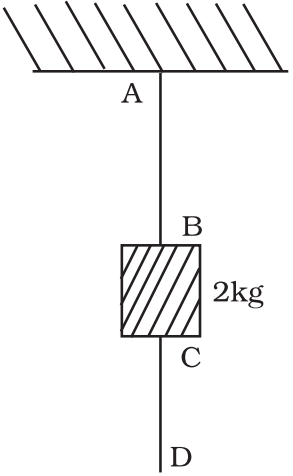
A mass of 2kg is suspended with thread AB Thread CD of the same type is attached to the other end of 2kg mass. Lower thread is pulled gradually, harder and harder in the downward directon so as to apply force on AB. Which of the threads will break and why?
View full solution
Q 153 Marks Question3 Marks
A cricket bowler releases the ball in two different ways.
  1. Giving it only horizontal velocity, and
  2. Giving it horizontal velocity and a small downward velocity. The speed $v_s$ at the time of release is the same. Both are released at a height $H$ from the ground. Which one will have greater speed when the ball hits the ground? Neglect air resistance.
View full solution
Q 163 Marks Question3 Marks
A block placed on a rough horizontal surface is pulled by a horizontal force F. Let f be the force applied by the rough surface on the block. Plot a graph of f versus F.
View full solution
Q 173 Marks Question3 Marks
 A person in an elevator accelerating upwards with an acceleration of $2 m s ^{-2}$, tosses a coin vertically upwards with a speed of 20 m $s ^1$. After how much time will the coin fall back into his hand? $\left( g =10 m s ^{-2}\right)$
View full solution
Q 183 Marks Question3 Marks
 A woman throws an object of mass $500$ g with a speed of $25 m s ^1$. If the object hits a wall and rebounds with half the original speed, what is the change in momentum of the object?
View full solution
Q 193 Marks Question3 Marks
The displacement vector of a particle of mass m is given by $\text{r}\text{(t})=\hat{\text{i}}\text{A}\cos\omega\text{t}+\hat{\text{j}}\text{B}\sin\omega\text{t}.$Show that the trajectory is an ellipse.
View full solution
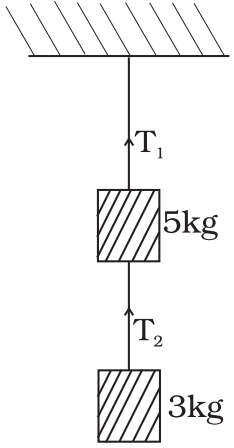
Two masses of $5kg$ and $3kg$ are suspended with help of massless inextensible strings as shown in Calculate $T_1$ and $T_2$ when whole system is going upwards with acceleration = $2m s^2$(use $g = 9.8m s^{–2}$).
View full solution
The velocity of a body of mass 2kg as a function of t is given by $\text{v}(\text{t})=2\text{t}\hat{\text{i}}+\text{t}^2\hat{\text{j.}}$ Find the momentum and the force acting on it, at time $\text{t}=2\text{s}.$
View full solution
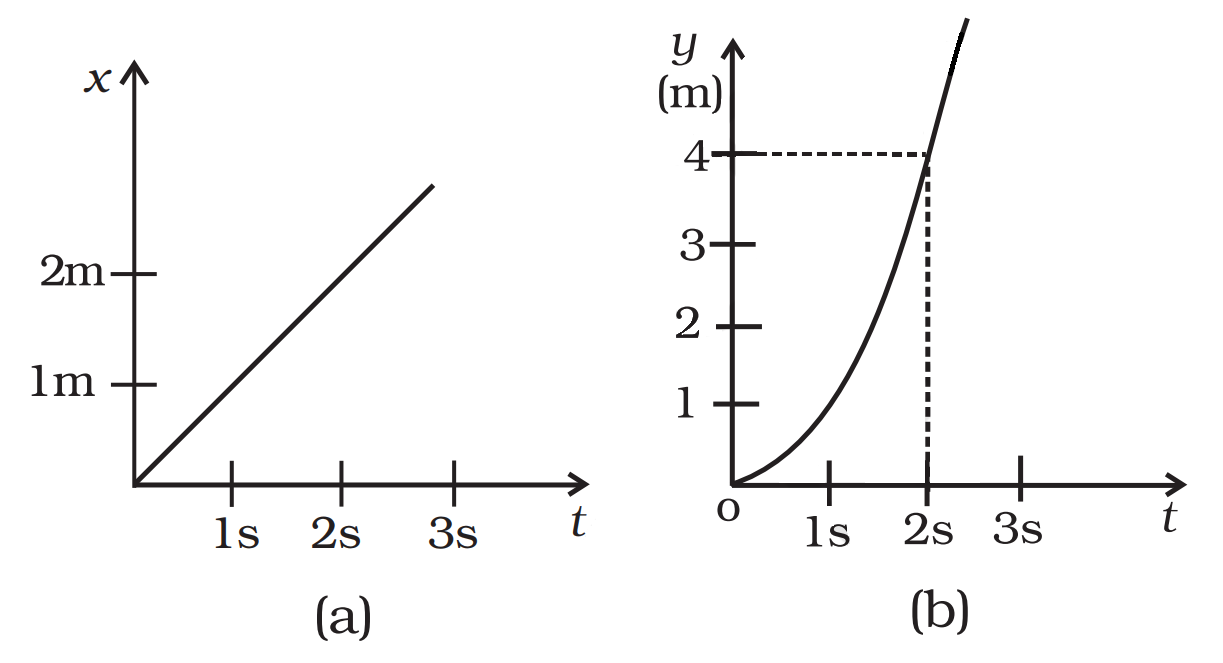
shows (x, t), (y, t) diagram of a particle moving in 2-dimensions.
If the particle has a mass of 500g, find the force (direction and magnitude) acting on the particle.
View full solution
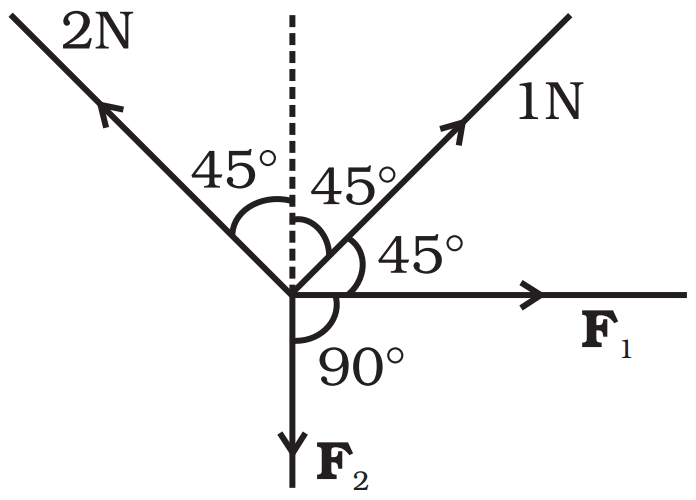
There are three forces $F_1, F_2$ and $F_3$ acting on a body, all acting on a point P on the body. The body is found to move with uniform speed.
  1. Show that the forces are coplanar.
  2. Show that the torque acting on the body about any point due to these three forces is zero.
View full solution

Generate a Laws of Motion paper free

Pick question groups from the list above, set marks and difficulty, and export a branded PDF with step-by-step answer keys. First 3 chapters free — no signup.

Download App