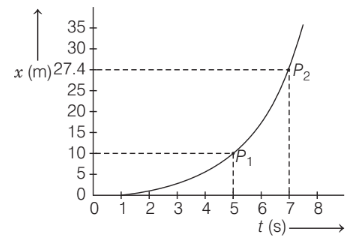
Question 14 Marks
Read the passage given below and answer the following questions from $1$ to $5$. When an object is in motion, its position changes with time. But how fast is the position changing with time and in what direction? To describe this, we define the quantity average velocity. Average velocity is defined as the change in position or displacement (△x) divided by the time intervals (△t), in which the displacement occurs: $\text{V}=\frac{\text{x2}-\text{x1}}{\text{t2}-\text{t1}}=\frac{\triangle\text{x}}{\triangle\text{t}}$ Where $x2$ and $x1$ are the positions of the object at time t2and t1, respectively. The SI unit for velocity is m/s or $m s^{–1},$ although km $h^{–1} $ is used in many everyday applications. Like displacement, average velocity is also a vector quantity. Average speed is defined as the total path length travelled divided by the total time interval during which the motion has taken place: Average speed = Total path length/ Total time interval. Average speed has obviously the same unit $(m s^{–1})$ as that of velocity. But it does not tell us in what direction an object is moving. Thus, it is always positive (in contrast to the average velocity which can be positive or negative). If the motion of an object is along a straight line and in the same direction, the magnitude of displacement is equal to the total path length. The velocity at an instant is defined as the limit of the average velocity as the time interval Dt becomes infinitesimally small. In other words $\text{V}=\lim_{\text{dt}-0}\frac{\text{dx}}{\text{dt}}$
$\text{V}=\frac{\text{dx}}{\text{dt}}$ Note that for uniform motion, velocity is the same as the average velocity at all instants. Instantaneous acceleration is defined in the same way as the instantaneous velocity $\text{A}=\lim_{\text{dt}-0}\frac{\text{dv}}{\text{dt}}$
$\text{A}=\frac{\text{dv}}{\text{dt}}$
$\text{V}=\frac{\text{dx}}{\text{dt}}$ Note that for uniform motion, velocity is the same as the average velocity at all instants. Instantaneous acceleration is defined in the same way as the instantaneous velocity $\text{A}=\lim_{\text{dt}-0}\frac{\text{dv}}{\text{dt}}$
$\text{A}=\frac{\text{dv}}{\text{dt}}$
- For uniform motion instantaneous velocity is same as:
- Average velocity
- Average acceleration
- Instantaneous speed
- None of these
- If velocity is constant then
- Acceleration is zero
- Acceleration is positive
- Acceleration is negative
- None of these
- Define average speed
- Define instantaneous acceleration
- Define average velocity
Answer
Average speed has SI unit of m/ s. it is scalar quantity it has only magnitude and doesn’t have any direction. it is always positive
$\text{A}=\frac{\text{dv}}{\text{dt}}$
Where $x2$ and $x1$ are the positions of the object at time $t2$ and $t1 $, respectively. The SI unit for velocity is m/ s or $m s^{–1}.$
View full question & answer→- (a) Average velocity
- (a) Acceleration is zero
- Average speed is defined as the total path length travelled divided by the total time.
Average speed has SI unit of m/ s. it is scalar quantity it has only magnitude and doesn’t have any direction. it is always positive
- Instantaneous acceleration is defined rate of change of velocity with time when time tends to zero
$\text{A}=\frac{\text{dv}}{\text{dt}}$
- Average velocity is defined as the change in position or displacement $(Dx)$ divided by the time intervals $(Dt),$ in which the displacement occurs:
Where $x2$ and $x1$ are the positions of the object at time $t2$ and $t1 $, respectively. The SI unit for velocity is m/ s or $m s^{–1}.$