Questions

2 Marks Questions

Take a timed test

47 questions · self-marked practice — reveal the answer and mark yourself.

Question 12 Marks
The fundamental frequency of a closed pipe is 293Hz when the air in it is at a temperature of 20°C. What will be its fundamental frequency when the temperature changes to 22°C?
Answer
We know that the frequency = f, T = temperatures$\text{f}\propto\sqrt{\text{T}}$
So, $\frac{\text{f}_1}{\text{f}_2}=\frac{\sqrt{\text{T}_1}}{\sqrt{\text{T}}}$$\Rightarrow\frac{293}{\text{f}_2}=\frac{\sqrt{293}}{\sqrt{295}}$
$\Rightarrow\text{f}_2=\frac{293\times\sqrt{295}}{\sqrt{293}}=294$
View full question & answer
Question 22 Marks
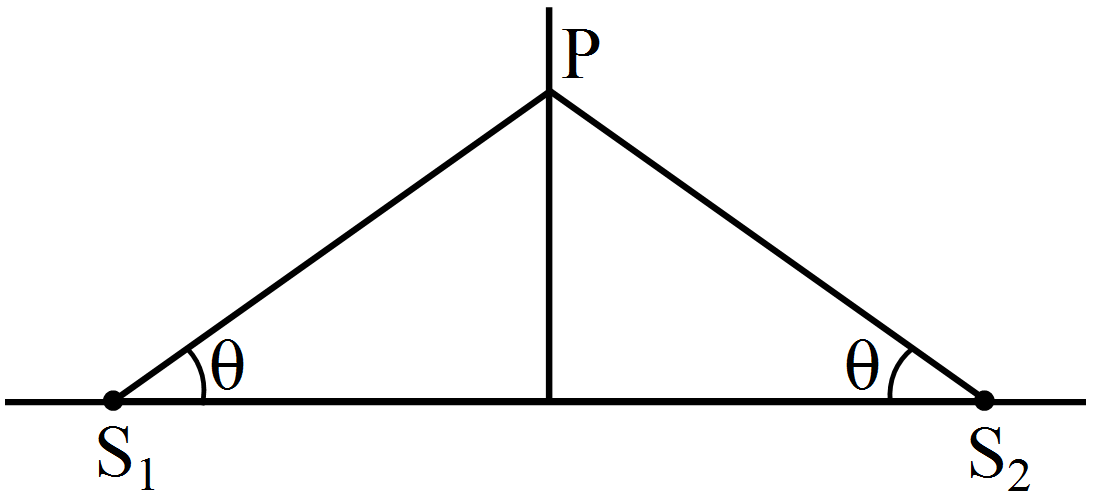
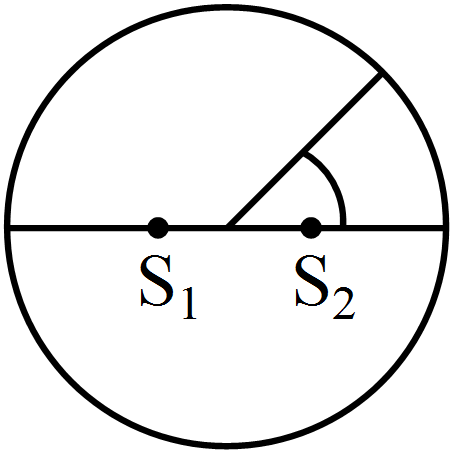
Figure, shows two coherent sources $\mathrm{S}_1$ and $\mathrm{S}_2$ which emit sound of wavelength $\boldsymbol{\lambda}$ in phase. The separation between the sources is $3 \lambda$. A circular wire of large radius is placed in such a way that $S_1 S_2$ lies in its plane and the middle point of $\mathrm{S}_1 \mathrm{~S}_2$ is at the centre of the wire. Find the angular positions $\theta$ on the wire for which constructive interference takes place.
Answer
Let the sound waves from the two coherent sources $S_1$ and $S_2$ reach the point P.$\text{OQ}=\text{R}\cos\theta$
$\text{OP}=\text{R}\cos\theta$
$\text{OS}_2=\text{OS}_1=1.5\lambda$
From the figure, we find that:$\text{PS}_1^2=\text{PQ}^2+\text{QS}62=(\text{R}\sin\theta)^2+(\text{R}\cos\theta-1.5\lambda)^2$
$\text{PS}_1^2=\text{PQ}^2+\text{QS}^2_1=(\text{R}\sin\theta)^2+(\text{R}\cos\theta+1.5\lambda)^2$
Path difference between the sound waves reaching point P is given by:$(\text{S}_1\text{P})^2-(\text{S}_2\text{P})^2=\Big[(\text{R}\sin\theta)^2+(\text{R}\cos\theta+1.5)^2\Big]\\-\Big[(\text{R}\sin\theta)^2+(\text{R}\cos\theta-1.5\lambda)^2\Big]$
$=(1.5\lambda+\text{R}\cos\theta)^2-(\text{R}\cos\theta-1.5\lambda)^2$
$=6\lambda\text{R}\cos\theta$
$(\text{S}_1\text{P}-\text{S}_2\text{P})=\frac{6\lambda\text{R}\cos\theta}{2\text{R}}$
Suppose, for construction interference, the path difference be made equal to the integral multiple of $\lambda.$ Hence,$(\text{S}_1\text{P}-\text{S}_2\text{P})=3\lambda\cos\theta=\text{n}\lambda$
$\Rightarrow\cos\theta=\frac{\text{n}}{3}$
$\Rightarrow\theta=\cos^{-1}\Big(\frac{\text{n}}{3}\Big)$
Where, n = 0, 1, 2, ...$\Rightarrow\theta=0^\circ,48.2^\circ,70.5^\circ$ and $90^\circ$ are similar point in other quadrants.
View full question & answer
Question 32 Marks
Sound with intensity larger than 120dB appears painful to a person. A small speaker delivers 2.0W of audio output. How close can the person get to the speaker without hurting his ears?
Answer
If sound level = 120dB, then I = intensity = $1W/m^2$ Given that, audio output = 2W Let the closest distance be x. So, intensity $=\Big(\frac{2}{4\pi\text{x}^2}\Big)=1$$\Rightarrow\text{x}^2=\Big(\frac{2}{2\pi}\Big)$
$\Rightarrow\text{x}=0.4\text{m}$
$=40\text{cm}.$
View full question & answer
Question 42 Marks
Find the minimum and maximum wavelengths of sound in water that is in the audible range (20-20000Hz) for an average human ear. Speed of sound in water = 1450m/s.
Answer
For minimum wavelength $\text{n}=20\text{KHz}$$\Rightarrow\text{v}=\text{n}\lambda$
$\Rightarrow\lambda=\Big(\frac{1450}{20\times10^3}\Big)=7.25\text{cm}.$
For maximum wavelength n should be minium$\Rightarrow\text{v}=\text{n}\lambda$
$\Rightarrow \lambda =\frac{\text{v}}{\text{n}}$
$\Rightarrow\frac{1450}{20}=72.5\text{m}.$
View full question & answer
Question 52 Marks
Find the fundamental, first overtone and second overtone frequencies of an open organ pipe of length 20cm. Speed of sound in air is 340m/s.
Answer
If $\text{V}=340\text{m/s},\text{I}=20\text{cm}=20\times10^{-2}\text{m}$
Fundamental frequency $=\frac{\text{V}}{21}=\frac{340}{2\times20\times10^{-2}}=850\text{Hz}$
We know first over tone $=\frac{2\text{V}}{21}=\frac{2\times340}{2\times20\times10^{-2}}$ (for open pipe) = 1750Hz
Second over tone $=3\Big(\frac{\text{V}}{21}\Big)=3\times850=2550\text{Hz}.$
View full question & answer
Question 62 Marks
In a Quincke's experiment the sound detected is changed from a maximum to a minimum when the sliding tube is moved through a distance of 2.50cm. Find the frequency of sound if the speed of sound in air is 340m/s.
Answer
Distance between tow maximum to a minimum is given by, $\frac{\lambda}{4}=2.50\text{cm}$$\Rightarrow\lambda=10\text{cm}=10^{-1}\text{m}$
We know, V = nx$\Rightarrow\text{n}=\frac{\text{V}}{\lambda}=\frac{340}{10^{-1}}$
$=3400\text{Hz}$
$=3.4\text{KHz}$
View full question & answer
Question 72 Marks
A tuning fork produces $4$ beats per second with another tuning fork of frequency $256Hz$. The first one is now loaded with a little wax and the beat frequency is found to increase to $6$ per second. What was the original frequency of the tuning fork?
Answer
Frequency of tuning fork A, $n_1 = 256 Hz$ No. of beats/ second m = 4 Frequency of second fork $B: n_2 = $?$\text{n}_2=\text{n}_1\pm\text{m}$
$\Rightarrow\text{n}_2=256\pm4$
$\Rightarrow\text{n}_2=260\text{Hz or 252 Hz}$
Now, as it is loaded with wax, its frequency will decrease. As it produced 6 beats per second, the original frequency, the beats second should decreas, wich is not possible.
View full question & answer
Question 82 Marks
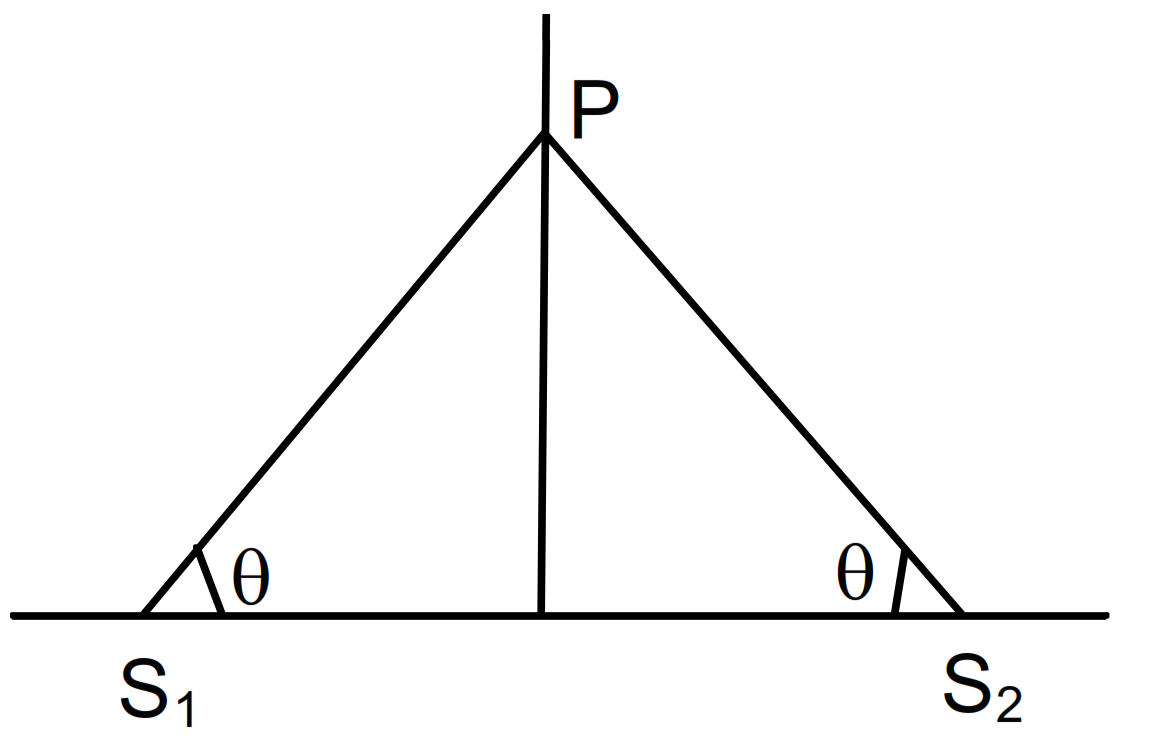
Two sources of sound $S_1$ and $S_2$ vibrate at same frequency and are in phase figure. The intensity of sound detected at a point $P$ as shown in the figure is $I _0$.
a. If 0 equals $45^{\circ}$, what will be the intensity of sound detected at this point if one of the sources is switched off?
b. What will be the answer of the previous part if $=60^{\circ}$ ?
Answer


The two sources of sound $S_1$ and $S_2$ vibrate at same phase and frequency. Resultant intensity at $P=I_0$
a. Let the amplitude of the waves at $S_1$ and $S_2$ be ' $r$ '
When $\theta=45^{\circ}$, path difference $=S_1 P-S_2 P=0$ (because $S_1 P=S_2 P$ )
So, when source is switched off, intensity of sound at $P$ is $\frac{I_0}{4}$.
b. When $\theta=60^{\circ}$, path difference is also 0.
Similarly it can be proved that, the intensity at $P$ is $\frac{I_0}{4}$ when one is switched off.
View full question & answer
Question 92 Marks
A cylindrical metal tube has a length of $50cm$ and is open at both ends. Find the frequencies between $1000Hz$ and $2000Hz$ at which the air column in the tube can resonate. Speed of sound in air is $340m/s$.
Answer
Given: Length of cylindrical metal tube L = 50cm Speed of sound in air $v = 340ms^{-1}$ Fundamental frequency ($f_1$) of an open pipe:$\text{f}_1=\Big(\frac{\text{v}}{2\text{L}}\Big)$
$=\frac{340}{2\times 50\times 10^{-2}}=340\text{Hertz}$
So, the required hamonics will be in the range of 1000Hz to 2000Hz.$\text{f}_2=2\times340=380\text{Hz}$
$\text{f}_3=3\times340=1020\text{Hz}$
$\text{f}_4=4\times 340=1360\text{Hz}$
$\text{f}_5=5\times 340=1700\text{Hz}$
$\text{f}_6=6\times 340=2040\text{Hz}$
$f_2, f_3, f_4​​​​​​​... $are the second, third , fourth overtone, and so on. The possible frequecies between 1000Hz and 2000Hz are 1020Hz and 1700Hz.
View full question & answer
Question 102 Marks
In a standing wave pattern in a vibrating air column, nodes are formed at a distance of 4.0cm. If the speed of sound in air is 328m/s, what is the frequency of 73 the source?
Answer
Here given distance between two nodes is = 4.0cm,$\Rightarrow\lambda=2\times4.0=8\text{cm}$
We know that $\text{V}=\text{n}\lambda$$\therefore \text{f}=\frac{\text{v}}{\lambda}=\frac{328}{8\times 10^{-2}}=4.1\text{KHz}$
$\eta=\frac{328}{8\times10^{-2}}=4.1\text{Hz}.$
View full question & answer
Question 112 Marks
The separation between a node and the next antinode in a vibrating air column is 25cm. If the speed of sound in air is 340m/s, find the frequency of vibration of the air column.
Answer
$\text{v}=340\text{m/s}$Distances between two nodes or antinodes
$\Rightarrow\frac{\lambda}{4}=25\text{cm}$
$\Rightarrow\lambda=100\text{cm}=1\text{m}$
$\Rightarrow\text{n}=\frac{\text{v}}{\lambda}=340\text{Hz}.$
View full question & answer
Question 122 Marks
If the sound level in a room is increased from 50dB to 60dB, by what factor is the pressure amplitude increased?
Answer
$\beta_1=50\text{dB},\ \beta_2=60\text{dB}$$\therefore\text{I}_1=10^{-7}\text{W/m},\ \text{I}_2=10^{-6}\text{W/m}^2$
$\Big($because $\beta=10\log_{10}\big(\frac{\text{I}}{\text{I}_0}\big),$ where $\text{I}_0=10^{-12}\text{W/m}^2\Big)$
Again, $\frac{\text{I}_2}{\text{l}_1}=\Big(\frac{\text{P}_2}{\text{P}_1}\Big)^2$
$=\Big(\frac{10^{-6}}{10^{-7}}\Big)$
$=10$ (where p = pressure amplitude)
$\therefore\Big(\frac{\text{P}_2}{\text{P}_1}\Big)=\sqrt{10}.$
View full question & answer
Question 132 Marks
Find the greatest length of an organ pipe open at both ends that will have its fundamental frequency in the normal hearing range (20Hz-20,000Hz). Speed of sound in air = 340m/s.
Answer
Let the length will be l.
Here given that $\text{V}=340\text{m/s}$ and $\text{n}=20\text{Hz}$
Here $\frac{\lambda}{2}=\text{l}\Rightarrow\lambda=2\text{l}$
We know $\text{V}=\text{n}\lambda\Rightarrow\text{l}=\frac{\text{V}}{\text{n}}=\frac{340}{2\times20}=\frac{34}{4}=8.5\text{cm}$ (for maximum wavelength, the frequency is minimum).
View full question & answer
Question 142 Marks
Two successive resonance frequencies in an open organ pipe are 1944Hz and 2592Hz. Find the length of the tube. The speed of sound in air is 324m/s.
Answer
Let the length of the resonating column will be = 1 Here $\text{V}=320\text{m/s}$ Then the two successive resonance frequencies are $\frac{(\text{n}+1)\text{v}}{4\text{l}}$ and $\frac{\text{nv}}{4\text{l}}$ Here given $\frac{(\text{n}+1)\text{v}}{4\text{l}}=2592;\ \lambda=\frac{\text{nv}}{4\text{l}}=1944$$\Rightarrow\frac{(\text{n}+2)\text{v}}{4\text{l}}-\frac{\text{nv}}{4\text{I}}=2592-1944=648$
$\Rightarrow\frac{2\text{v}}{\text{I}}=648$
$\Rightarrow\text{l}=\frac{2\times324\times100}{4\times648}\text{cm}=25\text{cm}$
Hence, the length of the tube is 25cm.
View full question & answer
Question 152 Marks
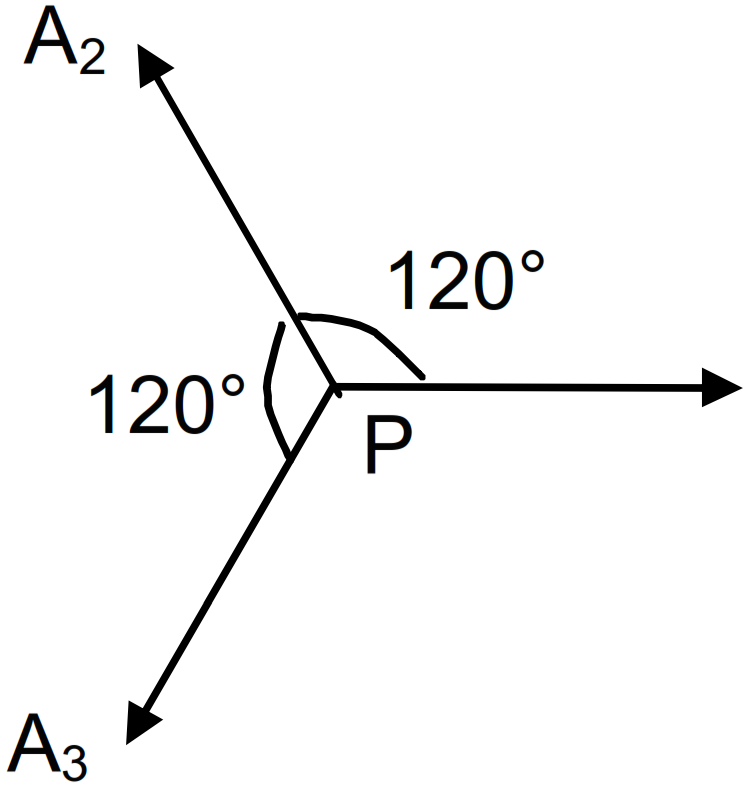
Three sources of sound $\mathrm{S}_1, \mathrm{~S}_2$ and $\mathrm{S}_3$ of equal intensity are placed in a straight line with $\mathrm{S}_1 \mathrm{~S}_2=\mathrm{S}_2 \mathrm{~S}_3$ figure. At a point P , far away from the sources, the wave coming from S is $120^{\circ}$ ahead in phase of that from $\mathrm{S}_1$. Also, the wave coming from $\mathrm{S}_3$ is $120^{\circ}$ ahead of that from $\mathrm{S}_2$. What would be the resultant intensity of sound at P ?
Answer

Because the 3 sources have equal intensity, amplitude are equal
So, $A_1 = A_2 = A_3$
As shown in the figure, amplitude of the resultant = 0 (vector method)
So, the resultant, intensity at B is zero.
View full question & answer
Question 162 Marks
Two loudspeakers are arranged facing each other at some distance. Will a person standing behind one of the loudspeakers clearly hear the sound of the other loudspeaker or the clarity will be seriously damaged because of the 'collision' of the two sounds in between?
Answer
The sound waves of both speakers would collide with each other and the sound waves of the speaker facing towards man would be damaged up to some extent.
View full question & answer
Question 172 Marks
Sound waves from a loudspeaker spread nearly uniformly in all directions if the wavelength of the sound is much larger than the diameter of the loudspeaker.
  1. Calculate the frequency for which the wavelength of sound in air is ten times the diameter of the speaker if the diameter is $20\ cm.$
  2. Sound is essentially transmitted in the forward direction if the wavelength is much shorter than the diameter of the speaker. Calculate the frequency at which the wavelength of the sound is one tenth of the diameter of the speaker described above. Take the speed of sound to be $340\ m/s.$
Answer
According to the question,
  1. $\lambda=20\text{cm}\times10=200\text{cm}=2\text{m}$
$\text{v}=340\text{m/s}$
So, $\text{n}=\frac{\text{v}}{\lambda}=\frac{340}{2}=170\text{Hz}.$
  1. $\text{N}=\frac{\text{v}}{\lambda}=\frac{340}{2\times10^{-2}}=17.000\text{Hz}$
$=17\text{KH}_2$ $\big($because $\lambda=2\text{cm}=2\times10^{-2}\text{m}\big)$
View full question & answer
Question 182 Marks
A vertical rod is hit at one end. What kind of wave propagates in the rod if:
  1. The hit is made vertically.
  2. The hit is made horizontally?
Answer
  1. If hit is made vertically the wave is longitudinal.
  2. If hit is made horizontal the wave is transverse.
View full question & answer
Question 192 Marks
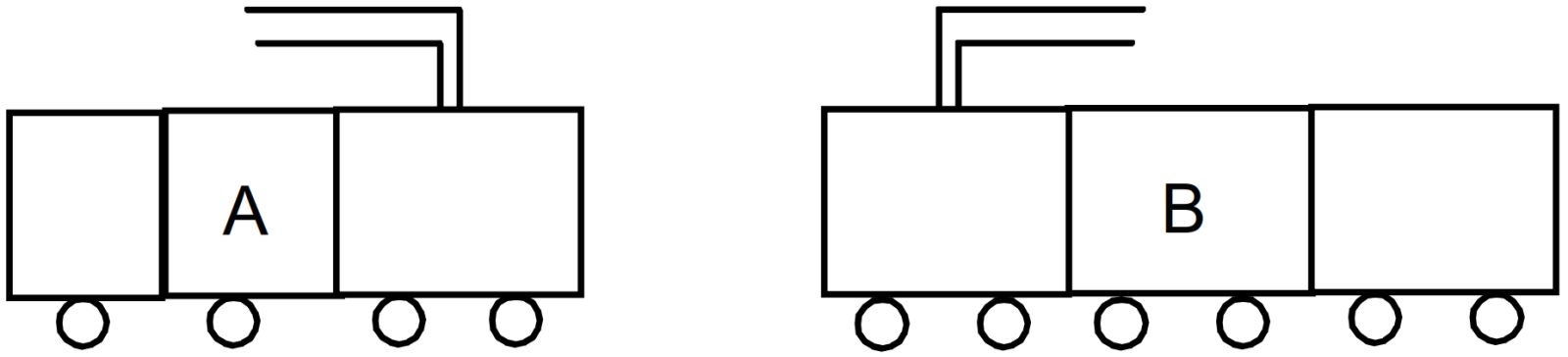
Two electric trains run at the same speed of $72km/h$ along the same track and in the same direction with a separation of $2.4km$ between them. The two trains simultaneously sound brief whistles. A person is situated at a perpendicular distance of 500m from the track and is equidistant from the two trains at the instant of the whistling. If both the whistles were at $500Hz$ and the speed of sound in air is $340m/s$, find the frequencies heard by the person.
Answer
Given: Speed of sound in air $v = 340 ms^{−1}$ Frequency of whistles $f_0= 500Hz$ Speed of train $v_s= 72 km/ h=72\times \frac{5}{18}=20\text{m}/\text{s}$
The person will receive the sound in a direction that makes an angle θ with the track. The angle θ is given by,$\theta =\tan^{-1}\bigg(\frac{0.5}{\frac{2.4}{2}}\bigg)=22.62^\circ$
The velocity of the source will be $'\text{v}\cos \theta'$ when heard by the observer.

So, the apparent frequency received by the man from train A is:$\text{f}_1=\Big(\frac{\text{v}}{\text{v}-\text{v}_\text{s}\cos\theta}\Big)\times \text{f}_0$
$\Rightarrow \text{f}_1=\Big(\frac{340}{340-\text{v}_\text{s}\cos22.62^\circ}\Big)\times500$
$\Rightarrow \text{f}_1=\Big(\frac={340}{340-20\times \cos 22.62^\circ}\Big)\times 500$
$\Rightarrow \text{f}_1=528.70\text{Hz}\approx529\text{Hz}$
The apparent frequency heard by the man from train B is:$\text{f}_2=\Big(\frac{\text{v}}{\text{v}+\text{v}\cos\theta}\Big)\times \text{f}_0$
$\Rightarrow \text{f}_2=\Big(\frac{340}{340+20\times \cos22.62^\circ}\Big)\times 500$
$\Rightarrow \text{f}_2=474.24\text{Hz}\approx 474\text{hz}$
View full question & answer
Question 202 Marks
At what temperature will the speed of sound be double of its value at $0^{\circ} \mathrm{C}$ ?
Answer
$\text{T}_1=273,\ \text{V}_2=2\text{v}_1$$\text{V}_1=\text{v},\ \text{T}_2=?$
We know that $\text{V}\propto\sqrt{\text{T}}$
$\Rightarrow\frac{\text{T}_2}{\text{T}_1}=\frac{\text{V}^2_2}{\text{V}^2_1}$
$\Rightarrow\text{T}_2=273\times2^2=4\times273\text{K}$
So temperature will be $(4\times273)-273=819^\circ\text{c}.$
View full question & answer
Question 212 Marks
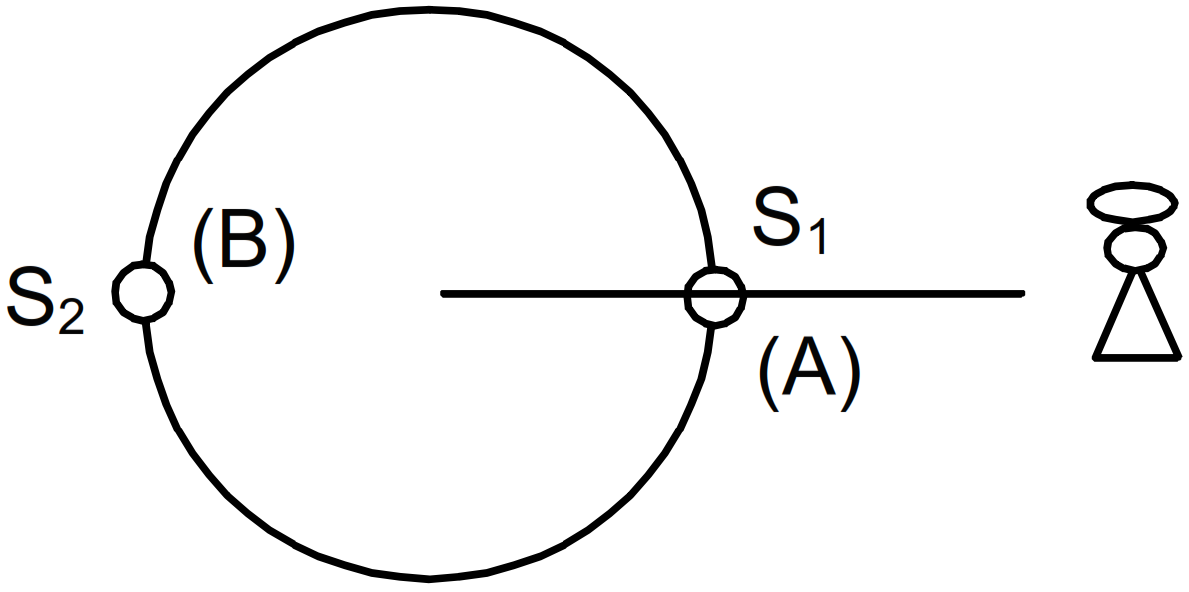
A small source of sound vibrating at frequency 500Hz is rotated in a circle of radius $\frac{100}{\pi}\text{cm}$ at a constant angular speed of 5.0 revolutions per second. A listener situates himself in the plane of the circle. Find the minimum and the maximum frequency of the sound observed. Speed of sound in air = 332m/s.
Answer

According to the given data
Radius of the circle $\frac{100}{\pi}\times10^{-2}\text{m}=\Big(\frac{1}{\pi}\Big)\ \text{meteres};\ \omega=5\text{rev/sec}.$
So the linear speed $\text{v}=\omega\text{r}=\frac{5}{\pi}=1.59$
So, velocity of the source $\text{V}_\text{s}=1.59\text{m/s}$
As shown in the figure at the position A the observer will listen maximum and at the position B it will listen minimum frequency.
So, apparent frequency at $\text{A}=\frac{332}{332-1.59}\times500=515\text{Hz}$
Apparent frequency at $\text{B}=\frac{332}{332+1.59}\times500=485\text{Hz}.$
View full question & answer
Question 222 Marks
Two tuning forks vibrate with the same amplitude but the frequency of the first is double the frequency of the second. Which fork produces more intense sound in air?
Answer
If both forks have same amplitude then the fork having high frequency will produce more intense sound in air.
View full question & answer
Question 232 Marks
A Kundt's tube apparatus has a steel rod of length 1.0m clamped at the centre. It is vibrated in its fundamental mode at a frequency of 2600Hz. The lycopodium powder dispersed in the tube collects into heaps separated by 6.5cm. Calculate the speed of sound in steel and in air.
Answer
Here given,$\text{L}_\text{r}=\frac{1.0}{2}=0.5\text{m},\ \text{d}_\text{a}=6.5\text{cm}\times10^{-2}\text{m}$
As Kundt’s tube apparatus is a closed organ pipe, its fundamental frequency$\text{n}=\frac{\text{V}_\text{r}}{4\text{L}_\text{r}}$
$\Rightarrow\text{V}_\text{r}=2600\times4\times0.5=5200\text{m/s}$
$\frac{\text{V}_\text{r}}{\text{V}_\text{a}}=\frac{2\text{L}_\text{r}}{\text{d}_\text{a}}$
$\Rightarrow\text{V}_\text{a}=\frac{5200\times6.5\times10^{-2}}{2\times0.5}=338\text{m/s}$
View full question & answer
Question 242 Marks
Show that if the room temperature changes by a small amount from T to $\text{T}+\triangle\text{T},$ the fundamental frequency of an organ pipe changes from v to $\text{v}+\triangle\text{v},$ where-$\frac{\triangle\text{v}}{\text{v}}=\frac{1}{2}\frac{\triangle\text{T}}{\text{T}}.$
Answer
We know that $\text{f}\propto\sqrt{\text{T}}$ According to the question $\text{f}+\triangle\text{f}\propto\sqrt{\triangle\text{T}}+\text{T}$$\Rightarrow\frac{\text{f}+\triangle\text{f}}{\text{f}}=\sqrt{\frac{\triangle\text{t}+\text{T}}{\text{T}}}$
$\Rightarrow1+\frac{\triangle\text{f}}{\text{f}}=\Big(1+\frac{\triangle\text{T}}{\text{T}}\Big)^{\frac{1}{2}}=1+\frac{1}{2}\frac{\triangle\text{T}}{\text{T}}+\ \dots$ (neglecting other terms)
$\Rightarrow\frac{\triangle\text{f}}{\text{f}}=\Big(\frac{1}{2}\Big)\frac{\triangle\text{T}}{\text{T}}$
View full question & answer
Question 252 Marks
Two trains are travelling towards each other both at a speed of $90km/h$. If one of the trains sounds a whistle at $500Hz$, what will be the apparent frequency heard in the other train? Speed of sound in air = $350m/s$.
Answer


According to the given data $V_s = 90km/hour = 25m/sec. v_0 = 25 m/\sec$
So, apparent frequency heard by the observer in train B or
Observer in $=\Big(\frac{350+25}{350-25}\Big)\times500=577\text{Hz}.$
View full question & answer
Question 262 Marks
A source of sound with adjustable frequency produces 2 beats per second with a tuning fork when its frequency is either 476Hz or 480Hz. What is the frequency of the tuning fork?
Answer
Given, First Frequency $f_1 = 476Hz$ Second frequency $f_2 = 480Hz$ Number of beats produced per second by the tuning fork m = 2 As the tuning fork produces 2 beats, its frequency should be an average of two. This is given by,$\text{f}=\frac{(\text{f}_1+\text{f}_2)}{2}$
$\text{f}=\frac{(476+480)}{2}=478\text{Hz}$
View full question & answer
Question 272 Marks
An open organ pipe has a length of $5\ cm.$
  1. Find the fundamental frequency of vibration of this pipe.
  2. What is the highest harmonic of such a tube that is in the audible range? Speed of sound in air is $340\ m/s$ and the audible range is $20-20,000\ Hz$.
​​​​​​​
Answer
  1. Here given $\text{l}=5\text{cm}=5\times10^{-2}\text{m},\ \text{v}=340\text{m/s}$
$\Rightarrow\text{n}=\frac{\text{V}}{2\text{l}}=\frac{340}{2\times5\times10^{-2}}=3.4\text{Khz}$
  1. If the fundamental frequency $=3.4\text{Khz}$
$\Rightarrow$ Then the highest harmonic in the audible range $(20Hz - 20KHz)$
$=\frac{20000}{3400}=5.8=5 ($integral multiple of $3.4KHz).$
View full question & answer
Question 282 Marks
The first overtone frequency of a closed organ pipe $P_1$ is equal to the fundamental frequency of an open organ pipe $P_2$. If the length of the pipe $P_1$ is 30 cm , what will be the length of $P_2$ ?
Answer
According to the questions $f_1$ first overtone of a closed organ pipe $\text{P}_1=\frac{3\text{v}}{4\text{I}}=\frac{3\times\text{V}}{4\times30}$ $f_2$ fundamental frequency of a open organ pipe $\text{P}_2=\frac{\text{V}}{2\text{I}_2}$ Here given $\frac{3\text{V}}{4\times30}=\frac{\text{V}}{2\text{I}_2}\Rightarrow\text{I}_2=20\text{cm}$$\therefore\ $length of the pipe $P_2$ will be 20cm.
View full question & answer
Question 292 Marks
The voice of a person, who has inhaled helium, has a remarkably high pitch. Explain on the basis of resonant vibration of vocal cord filled with air and with helium.
Answer
As helium is light gas it is very less dense so sound wave propagates faster in helium gas. Thus frequency of the speech is high thus making high pitch voice.
View full question & answer
Question 302 Marks
Draw a diagram to show the standing pressure wave and standing displacement wave for the 3rd overtone mode of vibration of an open organ pipe.
Answer
The displacement node is a pressure anti-node and via-versa.
View full question & answer
Question 312 Marks
Ultrasonic waves of frequency 4.5MHz are used to detect tumour in soft tissues. The speed of sound in tissue is 1.5km/s and that in air is 340m/s. Find the wavelength of this ultrasonic wave in air and in tissue.
Answer
Given $\text{V}_\text{air}=340\text{m/s},\ \text{n}=4.5\times10^6\text{Hz}$$\Rightarrow\lambda_\text{air}=\Big(\frac{340}{4.5}\Big)\times10^{-6}=7.36\times10^{-5}\text{m}$
$\text{V}_\text{tissue}=1500\text{m/s}$
$\Rightarrow\lambda_\text{t}=\Big(\frac{1500}{4.5}\Big)\times10^{-6}$
$=3.3\times10^{-4}\text{m}.$
View full question & answer
Question 322 Marks
A 30.0cm long wire having a mass of 10.0g is fixed at the two ends and is vibrated in its fundamental mode. A 50.0cm long closed organ pipe, placed with its open end near the wire, is set up into resonance in its fundamental mode by the vibrating wire. Find the tension in the wire. Speed of sound in air = 340m/s.
Answer
Given, $\text{m}=10\text{g}=10\times10^{-3}\text{kg},\ \text{l}=30\text{cm}=0.3\text{m}$ Let the tension in the string will be = T$\mu=\frac{\text{Mass}}{\text{Unit length}}=33\times10^{-3}\text{kg}$
The fundamental frequency $\Rightarrow\text{n}_0=\frac{1}{2\text{l}}\sqrt{\frac{\text{T}}{\mu}}\ \dots(1)$ The fundamental frequency of closed pipe$\Rightarrow\text{n}_0=\Big(\frac{\text{v}}{4\text{l}}\Big)=\frac{340}{4\times50\times10^{-2}}=170\text{Hz}\ \dots(2)$
According equations (1) × (2) we get$170=\frac{1}{2\times30\times10^{-2}}\times\sqrt{\frac{\text{T}}{33\times10^{-3}}}$
$\Rightarrow\text{T}=347\ \text{Newton}$
Hence, then tansion in the wire is 347 N.
View full question & answer
Question 332 Marks
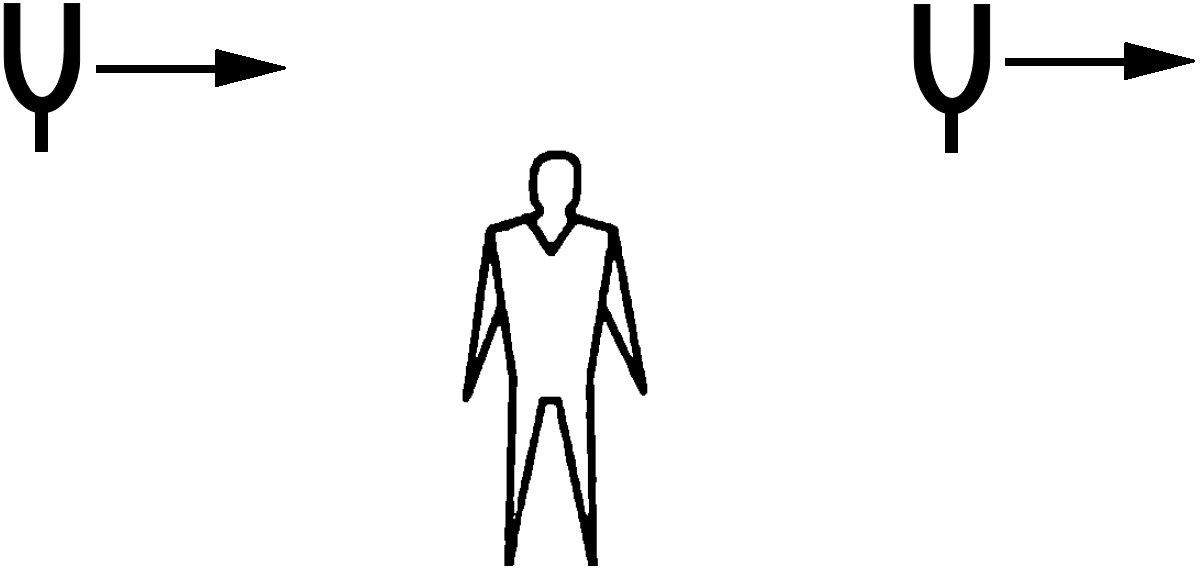
Figure, shows a person standing somewhere in between two identical tuning forks, each vibrating at 512Hz. If both the tuning fbrks move towards right at a speed of 5.5m/s, find the number of beats heard by the listener. Speed of sound in air = 330m/s.
Answer


According to the data, $V_s = 5.5m/s$ for each turning fork.
So, the apparent frequency heard from the tuning fork on the left,
$\text{f}'=\Big(\frac{330}{330-5.5}\Big)\times512=527.36\text{Hz}=527.5\text{Hz}$
Similarly, apparent frequency from the tunning fork on the right,
$\text{f}'=\Big(\frac{330}{330-5.5}\Big)\times512=510\text{Hz}$
So, beats produced $527.5-510=17.5\text{Hz}.$
View full question & answer
Question 342 Marks
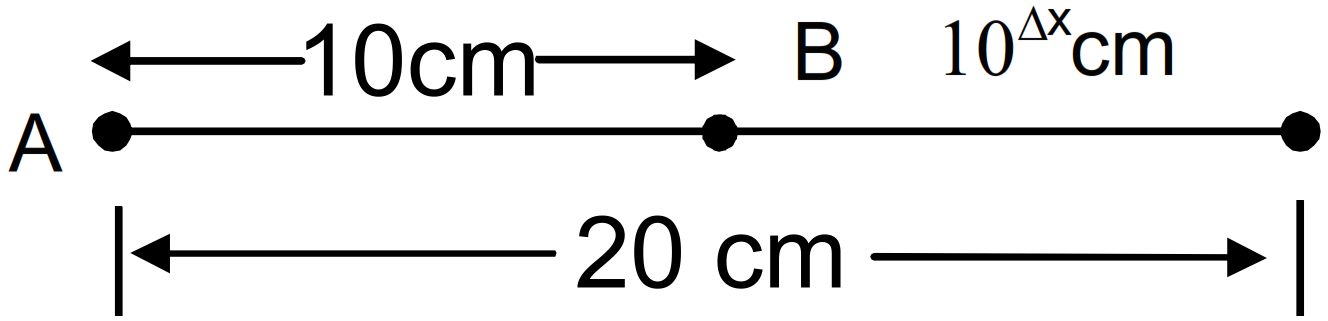
Two point sources of sound are kept at a separation of $10\ cm$. They vibrate in phase to produce waves of wavelength $5.0\ cm.$ What would be the phase difference between the two waves arriving at a point $20\ cm$ from one source$-$
  1. On the line joining the sources.
  2. On the perpendicular bisector of the line joining the sources?
​​​​​​​
Answer
  1. Given $\triangle\text{x}=10\text{cm},\ \lambda=5.0\text{cm}$
$\Rightarrow\phi=\frac{2\pi}{\lambda}\times\triangle\eta=\frac{2\pi}{5}\times10=4\pi.$
So phase difference is zero.
  1. Zero, as the particle is in same phase because of having same path.
View full question & answer
Question 352 Marks
A steel tube of length 1.00m is struck at one end. A Find the time gap between the two hearings. Use the person with his ear close to the other end hears the table in the text for speeds of sound in various sound of the blow twice, one travelling through the body substances. of the tube and the other through the air in the tube. Find the time gap between the two hearings. Use the table in the text for speeds of sound in various substances.
Answer
$\text{V}_\text{air}=230\text{m/s},\ \text{V}_\text{s}=5200\text{m/s}$Here $\text{S}=7\text{m}$
So,
$\text{t}=\text{t}_1-\text{t}_2=\Big(\frac{1}{330}-\frac{1}{5200}\Big)$
$=2.75\times10^{-3}\text{sec}=2.75\text{ms}.$
View full question & answer
Question 362 Marks
A bullet passes past a person at a speed of 220m/s. Find the fractional change in the frequency of the whistling sound heard by the person as the bullet crosses the person. Speed of sound in air = 330m/s.
Answer
Let the frequency of the bullet will be f
Given, $\text{u}=330\text{m/s},\ \text{v}_\text{s}=220\text{m/s}$
Apparent frequency before crossing = $\text{f}'\Big(\frac{330}{330-220}\Big)\text{f}=3\text{f}$
Apparent frequency after crossing = $\text{f}'\Big(\frac{330}{330+220}\Big)\text{f}=0.6\text{f}$
So, $\Big(\frac{\text{f}'}{\text{f}'}\Big)=\frac{0.6\text{f}}{3\text{f}}=0.2$
Therefore, fractional change = 1 - 0.2 = 0.8.
View full question & answer
Question 372 Marks
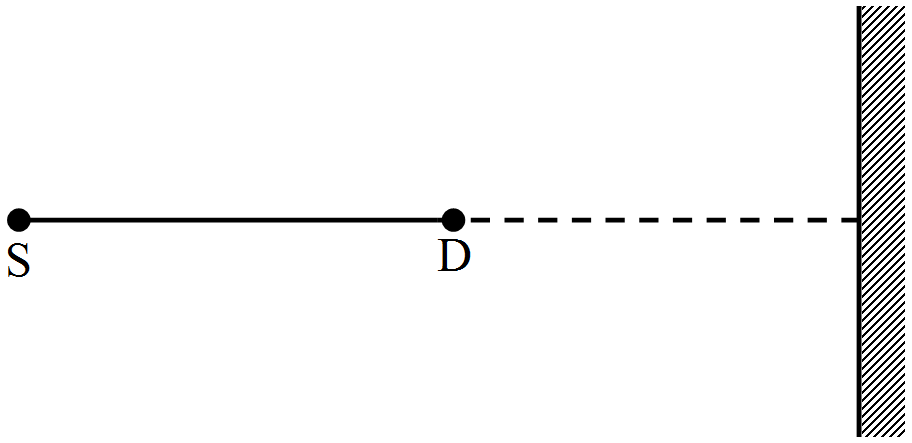
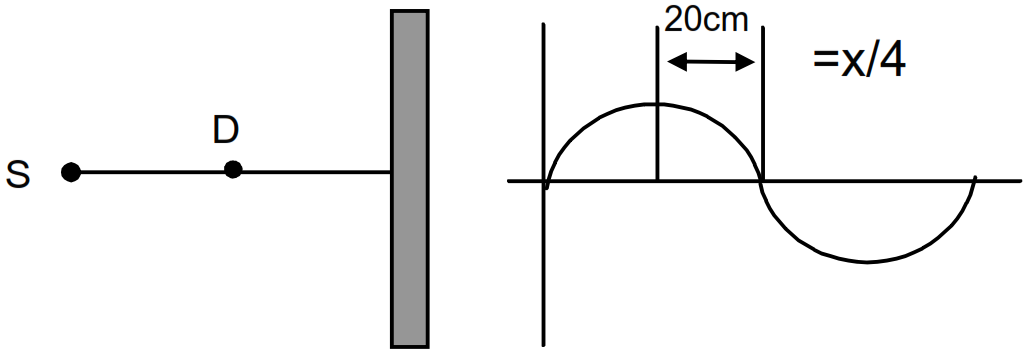
A source of sound S and a detector D are placed at some distance from one another. A big cardboard is placed near the detector and perpendicular to the line SD as shown in figure, It is gradually moved away and it is found that the intensity changes from a maximum to a minimum as the board is moved through a distance of 20cm. Find the frequency of the sound emitted. Velocity of sound in air is 336m/s.
Answer

According to the given data
$\text{V}=336\text{m/s},$
$\frac{\lambda}{4}$ distance between maximum and minimum intensity
$=(20\text{cm})\Rightarrow\lambda=80\text{cm}$
⇒ n = frequency = $\frac{\text{V}}{\lambda}=\frac{336}{80\times10^{-2}}$
$=420\text{Hz}.$
View full question & answer
Question 382 Marks
A closed organ pipe can vibrate at a minimum frequency of 500Hz. Find the length of the tube. Speed of sound in air = 340m/s.
Answer
According to the questions $\text{V}=340\text{m/s},\ \text{n}=500\text{Hz}$$\text{f}=\frac{\text{v}}{4\text{L}}$
$\therefore \text{L}=\frac{\text{v}}{4\text{f}}$
$\therefore \text{L}=\frac{340}{4\times 500}=0.17\text{m}$
$=17\text{cm}$
View full question & answer
Question 392 Marks
A tuning fork of frequency 256Hz produces 4 beats per second with a wire of length 25cm vibrating in its fundamental mode. The beat frequency decreases when the length is slightly shortened. What could be the minimum length by which the wire be shortened so that it produces no beats with the tuning fork?
Answer
Given that, $\text{l}=25\text{cm}=25\times10^{-2}\text{m}$ By shortening the wire the frequency increases, $\Bigg[\text{f}=\Big(\frac{1}{2\text{l}}\Big)\sqrt{\Big(\frac{\text{TB}}{\text{M}}\Big)}\Bigg]$ As the vibrating wire produces 4 beats with 256Hz, its frequency must be 252Hz or 260Hz. Its frequency must be 252Hz, because beat frequency decreases by shortening the wire. So, $252=\frac{1}{2\times25\times10^{-2}}\sqrt{\frac{\text{T}}{\text{M}}}\ \dots(1)$ Let length of the wire will be l, after it is slightly shortened,$\Rightarrow256=\frac{1}{2\times\text{l}_1}\sqrt{\frac{\text{T}}{\text{M}}}\ \dots(2)$
Dividing (1) by (2) we get$\frac{252}{256}=\frac{\text{l}_1}{25\times10^{-2}}$
$\Rightarrow\frac{252\times25\times10^{-2}}{256}$
$\Rightarrow 0.24609\text{m}$
So, it should be shorten by (25 - 24.61) = 0.39cm.
View full question & answer
Question 402 Marks
A person can hear sound waves in the frequency range 20Hz to 20kHz. Find the minimum and the maximum wavelengths of sound that is audible to the person. The speed of sound is 360m/s.
Answer
For maximum wavelength $\text{n}=20\text{Hz}.$ As $\Big(\eta\propto\frac{1}{\lambda}\Big)$ For minimum wavelength, $\text{n}=20\text{kHz}$$\therefore\lambda=\frac{360}{(20\times10^3)}=18\times10^{-3}\text{m}=18\text{mm}$
$\Rightarrow\text{x}=\Big(\frac{\text{v}}{\text{n}}\Big)=\frac{360}{20}=18\text{m}.$
View full question & answer
Question 412 Marks
Calculate the bulk modulus of air from the following data about a sound wave of wavelength 35cm travelling in air. The pressure at a point varies between $(1.0\times10^5\pm14)$ Pa and the particles of the air vibrate in simple harmonic motion of amplitude $5.5 \times 10^{-6}m$.
Answer
We know that, Bulk modulus $\text{B}=\frac{\triangle\text{p}}{\big(\frac{\triangle\text{V}}{\text{V}}\big)}=\frac{\text{P}_0\lambda}{2\pi\text{S}_0}$ Where $P_0$ = pressure amplitude $\Rightarrow\text{P}_0=1.0\times10^5 S_0$ = displacement amplitude $\Rightarrow\text{S}_0=5.5\times10^{-6}\text{m}$$\Rightarrow \text{B}=\frac{\text{P}_0\lambda}{2\pi\text{S}_0}=\frac{\triangle \text{p}}{\frac{\triangle\text{V}}{\text{V}}}$
$\Rightarrow\text{B}=\frac{14\times35\times10^2\text{m}}{2\pi(5.5)\times10^{-6}\text{m}}$
$=1.4\times10^5\text{N/m}^2.$
View full question & answer
Question 422 Marks
In a resonance column experiment, a tuning fork of frequency $400Hz$ is used. The first resonance is observed when the air column has a length of $20.0\ cm$ and the second resonance is observed when the air column has a length of $62.0\ cm$.
  1. Find the speed of sound in air.
  2. How much distance above the open end does the pressure node form? ​​​​​​
Answer
Here given $\text{I}_2=0.67\text{m},\ \text{I}_1=0.2\text{m},\ \text{f}=400\text{Hz}$
  1. We know that $\lambda=2(\text{I}_2-\text{I}_1)$
$\Rightarrow\lambda=2(62-20)=84\text{cm}=0.84\text{m}$
So, $\text{v}=\text{n}\lambda=0.84\times400=336\text{m/s}$
  1. We know from above that, $\text{I}_1+\text{d}=\frac{\lambda}{4}$
$\Rightarrow\text{d}=\frac{\lambda}{4}-\text{I}_1=21-20=1\text{cm}.$
View full question & answer
Question 432 Marks
In discussing Doppler effect, we use the word "apparent frequency". Does it mean that the frequency of the sound is still that of the source and it is some physiological phenomenon in the listener's ear that gives rise to Doppler effect? Think for the observer approaching the source and for the source approaching the observer.
Answer
In both cases if observer approaches source or source approaches observer the apparent frequency is physiological phenomenon as the frequency of the sound is still the same but due to motion w.r.t. each other the apparent frequency changes.
View full question & answer
Question 442 Marks
Can you hear your own words if you are standing in a perfect vacuum? Can you hear your friend in the same conditions?
Answer
We can hear our own words if we are in vacuum as sound wave would travel through our body.
But we cannot hear friend’s voice as it does not has any material to propagate.
View full question & answer
Question 452 Marks
A man stands before a large wall at a distance of 50.0m and claps his hands at regular intervals. Initially, the interval is large. He gradually reduces the interval and fixes it at a value when the echo of a clap merges with the next clap. If he has to clap 10 times during every 3 seconds, find the velocity of sound in air.
Answer
He has to clap 10 times in 3 seconds. So time interval between two clap $=\Big(\frac{3}{10}\text{second}\Big).$ So the time taken go the wall $=\Big(\frac{3}{2}\times10\Big)$$=\frac{3}{20}\text{second}$
$=333\text{m/s}$
View full question & answer
Question 462 Marks
An electronically driven loudspeaker is placed near the open end of a resonance column apparatus. The length of air column in the tube is $80cm$. The frequency of the loudspeaker can be varied between $20Hz-2kHz$. Find the frequencies at which the column will resonate. Speed of sound in air = $320m/s$.
Answer
The resonance column apparatus is equivalent to a closed organ pipe.
Here $\text{l}=80\text{cm}=10\times10^{-2}\text{m};\ \text{v}=320\text{m/s}$
$\Rightarrow\text{n}_0=\frac{\text{v}}{4\text{l}}=\frac{320}{4\times50\times10^{-2}}=100\text{Hz}$
So the frequency of the other harmonics are odd multiple of $n_0 = (2n + 1)100Hz$.
According to the question, the harmonic should be between 20Hz and 2KHz.
View full question & answer
Question 472 Marks
The speed of sound as measured by a student in the laboratory on a winter day is 340m/s when the room temperature is $17^\circ C$. What speed will be measured by another student repeating the experiment on a day when the room temperature is $32^\circ C$?
Answer
$\text{V}_1=330\text{m/s},\ \text{V}_2=?$$\text{T}_1=273+17=290\text{K},\ \text{T}_2=272+32=305\text{K}$
We know $\text{v}\propto\sqrt{\text{T}}$
$\frac{\sqrt{\text{V}_1}}{\sqrt{\text{V}_2}}=\frac{\sqrt{\text{T}_1}}{\sqrt{\text{T}}_2}$
$\Rightarrow\text{v}_2=\frac{\text{V}_1\times\sqrt{\text{T}_2}}{\sqrt{\text{T}_1}}$
$=340\times\sqrt{\frac{305}{290}}=349\text{m/s}$
View full question & answer