Question 15 Marks
The unit of length convenient on the nuclear scale is a fermi: 1 $f = 10^{–15}m$. Nuclear sizes obey roughly the following empirical relation:$\text{r}=\text{r}_0\text{A}^{1/3}$
where r is the radius of the nucleus, A its mass number, and r o is a constant equal to about, 1.2 f. Show that the rule implies that nuclear mass density is nearly constant for different nuclei. Estimate the mass density of sodium nucleus. Compare it with the average mass density of a sodium atom obtained in Exercise. 2.27.
AnswerRadius of nucleus r is given by the relation,$\text{r}=\text{r}_0\text{A}^{1/3}\ \dots(\text{i})$
$r_0= 1.2 f = 1.2 \times 10^{-15}m$ Volume of nucleus, $\text{V}=\frac{1}{3}\pi\text{r}^3$$=\frac{1}{3}\pi(\text{r}_0\text{A}^{1/3})^3=\frac{1}{3}\pi\text{r}_0^3\text{A}\ \dots(\text{ii})$
Now, the mass of a nuclei M is equal to its mass number i.e., M = A amu = $A \times 1.66 \times 10^{-27}kg$ Density of nucleus, p = Mass of nucleus/Volume of nucleus$=\frac{\text{A}\times1.66\times10^{-27}}{\frac{4}{3}\pi\text{r}_0^3\text{A}}=\frac{3\times1.66\times10^{-27}}{4\pi\text{r}_0^3}\text{kg/m}^3$
This relation shows that nuclear mass depends only on constant $r_0$. Hence, the nuclear mass densities of all nuclei are nearly the same. Density of sodium nucleus is given by,$\rho_\text{sodium}=\frac{3\times1.66\times10^{-27}}{4\times3.14\times(1.2\times10^{-15})^3}$
$=\Big(\frac{4.98}{21.71}\Big)\times10^{-18}$
$=2.29\times10^{-17}\text{kg m}^{-3}$
View full question & answer→Question 25 Marks
A great physicist of this century (P.A.M. Dirac) loved playing with numerical values of Fundamental constants of nature. This led him to an interesting observation. Dirac found that from the basic constants of atomic physics (c, e, mass of electron, mass of proton) and the gravitational constant G, he could arrive at a number with the dimension of time. Further, it was a very large number, its magnitude being close to the present estimate on the age of the universe (~15 billion years). From the table of fundamental constants in this book, try to see if you too can construct this number (or any other interesting number you can think of). If its coincidence with the age of the universe were significant, what would this imply for the constancy of fundamental constants?
AnswerOne relation consists of some fundamental constants that give the age of the Universe by: Where, t = Age of Universe e = Charge of electrons = $1.6 \times 10^{-19}C \in_0$ = Absolute permittivity
$m_p$ = Mass of protons = $1.67 \times 10^{-27}kg\ m_e$ = Mass of electrons = $9.1 \times 10^{-31}kg$ c = Speed of light = $3 \times 10^8m/s$ G = Universal gravitational constant = $6.67 \times 10^{11}Nm^2kg^{-2}$
Also, $\frac{1}{4\pi\in_0}=9\times10^9\text{Nm}^2/\text{C}^2$ Substituting these values in the equation, we get$\text{t}=\frac{(1.6\times10^{-19})^4\times(9\times10^9)^2}{(9.1\times10^{-31})\times1.67\times10^{-27}\times(3\times10^8)\times6.67\times10^{-11}}$
$=\frac{(1.6)^4\times81}{9.1\times1.67\times27\times6.67}\times10^{-76+18+62+27-24+11}\text{S}$
$=\frac{(1.6)^4\times81}{9.1\times1.67\times27\times6.67\times365\times24\times24\times3600}\times10^{-76+18+62+27-24+11}\text{years}$
$\approx6\times10^{-9}\times10^{18}\text{years}$
$=6\text{ billion years}$
View full question & answer→Question 35 Marks
It is a well known fact that during a total solar eclipse the disk of the moon almost completely covers the disk of the Sun. From this fact and from the information you can gather from examples $2.3$ and $2.4$, determine the approximate diameter of the moon.
AnswerThe position of the Sun, Moon, and Earth during a lunar eclipse is shown in the given figure.
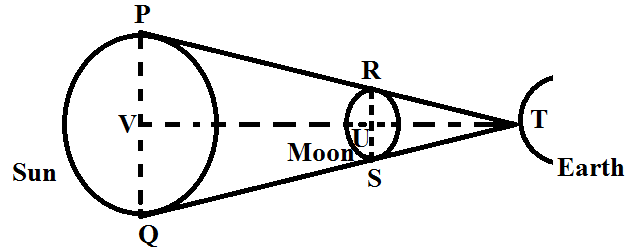
Distance of the Moon from the Earth $=3.84 \times 10^8 \mathrm{~m}$ Distance of the Sun from the Earth $=1.496 \times 10^{11} \mathrm{~m}$ Diameter of the Sun $=1.39 \times 10^9 \mathrm{~m}$ It can be observed that $\Delta \mathrm{TRS}$ and $\Delta \mathrm{TPQ}$ are similar. Hence, it can be written as: $\mathrm{PQ} / \mathrm{RS}=$ VT/UT $1.39 \times 10^9 /$ RS $=1.496 \times 10^{11} / 3.84 \times 10^8 \mathrm{RS}=(1.39 \times 3.84 / 1.496) \times 10^6=3.57 \times 10^6 \mathrm{~m}$ Hence, the diameter of the Moon is $3.57 \times 10^6 \mathrm{~m}$ View full question & answer→Question 45 Marks
A book with many printing errors contains four different formulas for the displacement $y$ of a particle undergoing a certain periodic motion:
- $\text{y}=\text{a}\sin2\pi\text{ t/T}$
- $\text{y}=\text{a}\sin \text{vt}$
- $\text{y}=(\text{a/T})\sin\text{t/a}$
- $\text{y}=(\text{a}\sqrt{2})(\sin2\pi\text{t/T}+\cos2\pi\text{t/T})$
$(a =$ maximum displacement of the particle, $v =$ speed of the particle. $T =$ time$-$period of motion$).$ Rule out the wrong formulas on dimensional grounds. AnswerThe displacement $y$ has the dimension of length, therefore, the formula for it should also have the dimension of length. Trigonometric functions are dimensionless and their arguments are also dimensionless. Based on these considerations now check each formula .
- $\frac{2\pi\text{t}}{\text{T}}=\frac{\text{T}}{\text{T}}=1=(\text{M}^0\text{L}^0\text{T}^0)\ \ \dots$ dimensionless
- $\text{vt}=(\text{LT}^{-1})(\text{T})=\text{L}=\big[\text{M}^0\text{L}^0\text{T}^0\big]\ \ \dots$not dimensionless
- $\frac{\text{t}}{\text{a}}=\frac{\text{T}}{\text{L}}=[\text{L}^{-1}\text{T}^1]\ \ \dots$ not dimensionless
- $\frac{2\pi\text{t}}{\text{T}}=\frac{\text{T}}{\text{T}}=1=\big[\text{M}^0\text{L}^0\text{T}^0\big]\ \ \dots$ dimensionless
dimensionally. The formulas in $(ii)$ and $(iii)$ are dimensionally wrong. View full question & answer→Question 55 Marks
The nearest star to our solar system is $4.29$ light years away. How much is this distance in terms of parsecs? How much parallax would this star (named Alpha Centauri) show when viewed from two locations of the Earth six months apart in its orbit around the Sun?
AnswerDistance of the star from the solar system $=4.29$ ly 1 light year is the distance travelled by light in one year 1 light year $=$ Speed of light $\times 1$ year $=3 \times 10^8 \times 365 \times 24 \times 60 \times 60=94608 \times 10^{11} \mathrm{~m}$
$\therefore 4.29 \mathrm{ly}=405868.32 \times 10^{11} \mathrm{~m}$
$\because 4.29 \mathrm{ly}=405868.32 \times 10^{11} / 3.08 \times 10^{16}=1.32 \mathrm{parsec} \theta=\frac{\mathrm{d}}{\mathrm{D}}$
where, Diameter of Earth's orbit, $\mathrm{d}=3 \times 10^{11} \mathrm{~m}$
Distance of the star from the earth, $\mathrm{D}=405868.32 \times 10^{11} \mathrm{~m}$
$\therefore \theta=3 \times 10^{11} / 405868.32 \times 10^{11}=7.39 \times 10^{-6} \mathrm{rad}$
But, $1 \mathrm{sec}=4.85 \times 10^{-6} \mathrm{rad}$
$\therefore 7.39 \times 10^{-6} \mathrm{rad}=7.39 \times 10^{-}6 / 4.85 \times 10^{-6}=1.52$
View full question & answer→Question 65 Marks
The mass of a box measured by a grocer’s balance is $2.300\ kg.$ Two gold pieces of masses $20.15g$ and $20.17g$ are added to the box. What is
- The total mass of the box,
- The difference in the masses of the pieces to correct significant figures?
AnswerMass of grocer's box $= 2.300\ kg$ Mass of gold piece $I = 20.15g = 0.02015\ kg$ Mass of gold piece $II = 20.17g = 0.02017\ kg$
- Total mass of the box $= 2.3 + 0.02015 + 0.02017 = 2.34032\ kg$ In addition, the final result should retain as many decimal places as there are in the number with the least decimal places. Hence, the total mass of the box is $2.3\ kg.$
- Difference in masses $= 20.17 - 20.15 = 0.02g$ In subtraction, the final result should retain as many decimal places as there are in the number with the least decimal places.
View full question & answer→Question 75 Marks
One mole of an ideal gas at standard temperature and pressure occupies $22.4 L$ (molar volume). What is the ratio of molar volume to the atomic volume of a mole of hydrogen? (Take the size of hydrogen molecule to be about $1\mathring{\text{A}}$). Why is this ratio so large?
AnswerRadius of hydrogen atom, $\mathrm{r}=0.5 \mathring A=0.5 \times 10^{10} \mathrm{~m}$ Volume of hydrogen atom $=4 / 3 \pi \mathrm{r}^3=(4 / 3) \times(22 / 7) \times(0.5 \times$ $\left.10^{-10}\right)^3=0.524 \times 10^{-30} \mathrm{~m}^3$ Now, 1 mole of hydrogen contains $6.023 \times 10^{23}$ hydrogen atoms. $\therefore$ Volume of 1 mole of hydrogen atoms, $V_a=6.023 \times 10^{23} \times 0.524 \times 10^{-30}$
$=3.16 \times 10^{-7} \mathrm{~m}^3$ Molar volume of 1 mole of hydrogen atoms at STP, $\mathrm{V}_{\mathrm{m}}=22.4 \mathrm{~L}=22.4 \times 10^{-3} \mathrm{~m}^3$
$\therefore \frac{\mathrm{V}_{\mathrm{m}}}{\mathrm{~V}_{\mathrm{a}}}=\frac{22.4 \times 10^{-3}}{3.6 \times 10^{-7}}=7.08 \times 10^4$
Hence, the molar volume is $7.08 \times 10^4$ times higher than the atomic volume. For this reason, the inter-atomic separation in hydrogen gas is much larger than the size of a hydrogen atom.
View full question & answer→Question 85 Marks
Estimate the average mass density of a sodium atom assuming its size to be about $2.5 \mathring{\text{A}}.$ (Use the known values of Avogadro’s number and the atomic mass of sodium). Compare it with the mass density of sodium in its crystalline phase: $970kg ~m^{–3}$. Are the two densities of the same order of magnitude? If so, why?
AnswerDiameter of sodium atom = Size of sodium atom $=2.5\mathring{\text{A}}$ Radius of sodium atom, $\text{r}=\Big(\frac{1}{2}\Big)\times2.5\mathring{\text{A}}=1.25\mathring{\text{A}}=1.25\times10^{-10}\text{m}$ Volume of sodium atom, $\text{V}=\Big(\frac{4}{3}\Big)\pi\text{r}^3$$=\Big(\frac{4}{3}\Big)\times3.14\times(1.25\times10^{-10})^3=\text{V}_{\text{Sodium}}$
According to the Avogadro hypothesis, one mole of sodium contains $6.023 \times 10^{23}$ atoms and has a mass of $23g$ or $23 \times 10^{–3}kg$.
$\therefore$ Mass of one atom = $23 \times 10^{-3}/6.023 \times 10^{23}Kg = m_1$
Density of sodium atom, $\rho=\frac{\text{m}_1}{\text{V}_\text{Sodium}}$ Substituting the value from above, we get Density of sodium atom, $\rho=4.67\times10^{-3}\text{Kg m}^{-3}$ It is given that the density of sodium in crystalline phase is $970kg m^{–3}$. Hence, the density of sodium atom and the density of sodium in its crystalline phase are not in the same order. This is because in solid phase, atoms are closely packed. Thus, the inter-atomic separation is very small in the crystalline phase.
View full question & answer→Question 95 Marks
A man walking briskly in rain with speed v must slant his umbrella forward making an angle $\theta$ with the vertical. A student derives the following relation between $\theta$ and v: $\tan \theta = \text{v}$ and checks that the relation has a correct limit: as $\text{v}\rightarrow 0,\ \theta \rightarrow0,$ as expected. (We are assuming there is no strong wind and that the rain falls vertically for a stationary man). Do you think this relation can be correct? If not, guess the correct relation.
AnswerIncorrect; on dimensional ground The relation is $\tan \theta=\mathrm{v}$ Dimension of R.H.S $=\mathrm{M}^0 \mathrm{~L}^1 \mathrm{~T}^{-1}$ Dimension of L.H.S = $M^0 L^0 T^0(\because$ The trigonometric function is considered to be a dimensionless quantity) Dimension of R.H.S is not equal to the dimension of L.H.S. Hence, the given relation is not correct dimensionally. To make the given relation correct, the R.H.S should also be dimensionless. One way to achieve this is by dividing the R.H.S by the speed of rainfall v'. Therefore, the relation reduces to $\tan \theta=\frac{\mathrm{v}}{\mathrm{v}^{\prime}}$. This relation is dimensionally correct.
View full question & answer→Question 105 Marks
A famous relation in physics relates ‘moving mass’ m to the ‘rest mass’ mo of a particle in terms of its speed v and the speed of light, c. (This relation first arose as a consequence of special relativity due to Albert Einstein). A boy recalls the relation almost correctly but forgets where to put the constant c. He writes:$\text{m}=\frac{\text{m}_0}{(1-\text{v}^2)^{1/2}}.$
Guess where to put the missing c.
AnswerGiven the relation, $\mathrm{m}=\frac{\mathrm{m}_0}{\left(1-\mathrm{v}^2\right)^{1 / 2}}$
Dimension of $m=M^1 L^0 T^0$ Dimension of $m_0=M^1 L^0 T^0$ Dimension of $v=M^0 L^1 T^{-1}$ Dimension of $v^2=M^0 L^2 T^{-2}$
Dimension of $c=M^0 L^1 \mathrm{~T}^{-1}$ The given formula will be dimensionally correct only when the dimension of L.H.S is the same as that of R.H.S. This is only possible when the factor, $\left(1-v^2\right)^{1 / 2}$ is dimensionless i.e., ( $1-v^2$ ) is dimensionless.
This is only possible if $\mathrm{v}^2$ is divided by $\mathrm{c}^2$. Hence, the correct relation is $\mathrm{m}=\mathrm{m}_0\left(\frac{1-\mathrm{v}^2}{\mathrm{c}^2}\right)^{\frac{1}{2}}$
View full question & answer→Question 115 Marks
A large fluid star oscillates in shape under the influence of its own gravitational field. Using dimensional analysis, find the expression for period of oscillation (T) in terms of radius of star (R). Mean density of fluid (o) and universal gravitational constant (G).
AnswerSuppose period of oscillation T depends on radius of star R, mean density of fluid p and universal gravitational constant (G) as: $=\text{T}=\text{KR}^\text{a}\rho^\text{b}\text{G}^{\text{c}}$ $[\text{M}^0\text{L}^0\text{T}^1]=[\text{L}]^\text{a}[\text{ML}^{-3}]^{\text{b}}[\text{M}^{-1}\text{L}^3\text{T}^{-2}] ^\text{c}$ $=\text{M}^{\text{b}-\text{c}}\text{L}^{\text{a}-3\text{b}+3\text{c}}\text{T}^{-2\text{c}}$ Comparing powers of M, L and T, We have $\text{b}-\text{c}=0$ $\text{a}-3\text{b}+3\text{c}=0$ $-\text{2c}=1$ On simpliyfying these equations, We get: $\text{c}=\frac{-1}{2},\text{b}=\frac{-1}{2},\text{a}=0$ Thus, we have $\text{T}=\text{k}\rho^{\frac{-1}{2}}\text{G}^{\frac{-1}{2}}=\frac{\text{k}}{\sqrt{\rho\text{G}}}$
View full question & answer→Question 125 Marks
Name the physical quantity of the dimension given below:
i. $\mathrm{ML}^{\circ} \mathrm{T}^{-3}$
ii. $\mathrm{ML}^{-1} \mathrm{~T}^{-1}$
iii. $\mathrm{M}^{-1} \mathrm{~L}^3 \mathrm{~T}^{-2}$
iv. $\mathrm{ML}^2 \mathrm{~T}^{-3}$
v. $\mathrm{ML}^0 \mathrm{~T}^{-2}$
vi. $\mathrm{T}^{-1}$
Answer
- Energy intensity.
- Coeff. of viscosity.
- Gravitational Constant.
- Power.
- Surface tension or force constant or spring factor.
- Frequency.
View full question & answer→Question 135 Marks
To determine acceleration due to gravity, the time of 20 oscillations of a simple pendulum of length 100cm was observed to be 40s. Calculate the value of g and maximum percentage error in the measured value of g.
AnswerHere, $\text{T}=2\pi\sqrt{\frac{\text{l}}{\text{g}}}$ Or $\text{T}^2=4\pi^2\frac{\text{l}}{\text{g}}\text{or}\text{ g}=4\pi^2\frac{\text{l}}{\text{T}^2}$ Given $\text{l}=100\text{cm},\text{T}=\frac{40\text{s}}{20}=2\text{s}$ $\therefore\text{g}=4\times(3.14)^2\times\frac{1000\text{cm}}{(2\text{s})^2}$ $=\frac{4\times9.8596\times100}{4}\text{cms}^{-2}$ $=985.9\text{cm}^{-2}$ Let us now calculate the maximum error $\text{g}=4\pi^2\times\frac{\text{l}}{\text{T}^2}=4\pi^2\frac{1}{\Big(\frac{\text{t}}{20}\Big)^2}$ $\Big(\text{talking}\text{ T}=\frac{\text{t}}{20}\Big)$ Or $\text{g}=\frac{4\pi^2\text{l}\times(20)^2}{\text{t}^2}\text{s}$ Talking log on both sides, We get: $\log\text{g}=\log4+2\log\pi+\log\text{l}+2\log20-2\log\text{t}$ [differentiating both sides,] $\frac{\Delta\text{g}}{\text{g}}=\frac{\Delta\text{l}}{\text{l}}-2\frac{\Delta\text{t}}{\text{t}}$ Given $\text{l}=100\text{cm}$ $\Delta\text{l}=0.1\text{cm}$ (least count of the metre scale) $\text{t} = 40\text{s} $ $\Delta\text{t}=0.1\text{s}$ (least count of a stop watch) $\therefore$ Maximum error in $\text{g}=\frac{0.1}{100}+2\times\frac{0.1}{40}$ $=0.001+0.005=0.006\times100\%=0.6\%$ Here 0.1% is the error in the measurement of length, and 0.5% is the error in the measurement of time. Therefore, time needs more careful measurement
View full question & answer→Question 145 Marks
The period of oscillation of a simple pendulum is $\text{T}=2\pi\sqrt{4\text{g}}$Measured value of L is 20.0cm known to 1mm accuracy and time for 100 oscillations of the pendulum is found to be 90s using a wrist watch of 1s resolution. What is the accuracy in the determination of g?
Answer$\text{g}=\frac{4\pi^2\text{L}}{\text{T}^2}$ Here, $\text{T}=\frac{\text{t}}{\text{n}}$ And $\Delta\text{T}=\frac{\Delta\text{t}}{\text{n}}$ Therefore, $\frac{\Delta\text{T}}{\text{T}}=\frac{\Delta\text{t}}{\text{t}}$ The errors in both L and t are the least count errors. $\Big(\frac{\Delta\text{g}}{\text{g}}\Big)=\Big(\frac{\Delta\text{L}}{\text{L}}\Big)+2\Big(\frac{\Delta\text{T}}{\text{T}}\Big)$ $=\frac{0.1}{20.0}+2\Big(\frac{1}{90}\Big)=0.32$ Thus, the percentage error in g is: $100\Big(\frac{\Delta\text{g}}{\text{g}}\Big)=100\Big(\frac{\Delta\text{L}}{\text{L}}\Big)+2\times100\Big(\frac{\Delta\text{T}}{\text{T}}\Big)=3\%$
View full question & answer→Question 155 Marks
The unit of length convenient on the nuclear scale is a fermi: 1 $f = 10^{–15}m$. Nuclear sizes obey roughly the following empirical relation: $\text{r}=\text{r}_0\text{A}^{1/3}$ where r is the radius of the nucleus, A its mass number, and r o is a constant equal to about, 1.2 f. Show that the rule implies that nuclear mass density is nearly constant for different nuclei. Estimate the mass density of sodium nucleus. Compare it with the average mass density of a sodium atom obtained in Exercise. 2.27.
AnswerRadius of nucleus r is given by the relation, $\text{r}=\text{r}_0\text{A}^{1/3}\ \dots(\text{i}) r_0= 1.2 f = 1.2 \times 10^{-15}m$ Volume of nucleus, $\text{V}=\frac{1}{3}\pi\text{r}^3$
$=\frac{1}{3}\pi(\text{r}_0\text{A}^{1/3})^3=\frac{1}{3}\pi\text{r}_0^3\text{A}\ \dots(\text{ii})$ Now, the mass of a nuclei M is equal to its mass number i.e., M = A amu = $A \times 1.66 \times 10^{-27}kg$ Density of nucleus, p = Mass of nucleus/Volume of nucleus $=\frac{\text{A}\times1.66\times10^{-27}}{\frac{4}{3}\pi\text{r}_0^3\text{A}}=\frac{3\times1.66\times10^{-27}}{4\pi\text{r}_0^3}\text{kg/m}^3$ This relation shows that nuclear mass depends only on constant $r_0$. Hence, the nuclear mass densities of all nuclei are nearly the same. Density of sodium nucleus is given by, $\rho_\text{sodium}=\frac{3\times1.66\times10^{-27}}{4\times3.14\times(1.2\times10^{-15})^3}$
$=\Big(\frac{4.98}{21.71}\Big)\times10^{-18}$
$=2.29\times10^{-17}\text{kg m}^{-3}$
View full question & answer→Question 165 Marks
Liquid is flowing steadily through a pipe. Assume that the volume of the liquid flowing out per second depends on (a) the coefficient of viscosity of the liquid $(\eta)$(b) the radius of the pipe (r) and (c) the pressure gradient along the pipe (pressure gradient is drop in pressure per unit length of the pipe, and is equal to P/ l, where P is the difference between the ends of the pipe and I is the length of the pipe). The dimensions of viscosity is [$ML^{-1}T^{-1}$). Deduce by the method of dimensions, the formula for the volume of the liquid flowing out per second.
AnswerLet V be the volume of liquid flowing out steadily through the pipe per second: Given:$\text{V}\propto\eta^{\text{a}}\text{r}^\text{b}\Big(\frac{\text{P}}{\text{l}}\Big)^\text{c}$
$\text{V}\propto\text{k}\eta^{\text{a}}\text{r}^\text{b}\Big(\frac{\text{P}}{\text{l}}\Big)^\text{c}$
Where k is constant, Writing the dimensions on both the sides.$[\text{M}^{0}\text{L}^3\text{T}^{-1}]=[\text{ML}^{-1}\text{T}^{-1}]^\text{a}[\text{L}^{\text{b}}][\text{ML}^{-2}\text{T}^{-2}]^{\text{c}}$
OR $[\text{M}^{0}\text{L}^3\text{T}^{-1}][\text{M}^{\text{a}+\text{c}}\text{L}^{-\text{a}+\text{b}-2\text{c}}\text{T}^{-\text{a}-2\text{c}}]$
Comparing the values of M, L and T, We have:$\text{a}+\text{c}=0\dots\text{(i)}$
$-\text{a}+\text{b}-\text{2c}=0\dots\text{(ii)}$
$-\text{a}-\text{2c}=-1\dots\text{(iii)}$
Solving these equations, We get,$\text{a}=-1,\text{b}=4\text{ and }\text{c}=1$
Puning these values in $\text{V}=\text{k}\eta^{-1}\text{r}^{4}\Big(\frac{\text{P}}{\text{l}}\Big)$
Thus. the volume of the liquid flowing out per second$=\frac{\text{k}\text{P}\text{r}^4}{\eta\text{l}}$
View full question & answer→Question 175 Marks
The Reynold's number $n_R$ for a liquid flowing through a pipe depends upon:
- The density of the liquid $\rho,$
- The coefficient of viscosity $\eta,$
- the speed of flow of the liquid $\upsilon,$
- The radius of the tube $r.$
AnswerLet: $\text{n}_\text{R}=\rho^{\text{x}}\eta^{\text{y}}\upsilon^{\text{z}}\text{r}\dots(\text{i})$
Note: in Equation. $(i)$ we have used the information that $n_R$ is directly proportional to $r.$ If this information was not available there will be four unknowns. By equating powers of $M, L$ and $T$ only three independent equations will be obtained and they cannot give values of the four unknowns. Now $[\text{n}_\text{R}]=[\text{M}^0\text{L}^0\text{T}^0]$
$[\rho]=[\text{ML}^{-3}]$
$[\eta]=[\text{ML}^{-1}\text{T}^{-1}]$
$[\text{r}]=[\text{L}]$ Substituting dimensions of parameters involved in Equations: We have: $[\text{M}^0\text{L}^0\text{T}^0]=(\text{ML}^{-3})(\text{ML}^{-1}\text{T}^{-1})^{\text{y}}(\text{LT}^{-1})^{\text{z}}[\text{L}^{+1}]$
$=[\text{M}^{\text{x}+\text{y}}\text{L}^{-3\text{x}-\text{y}+\text{z}+1}\text{T}^{\text{-y-}\text{-z}}]$ By the principle of homogeneity of dimensions: $\text{x}+\text{y}=0$
$-3\text{x}-\text{y}+\text{z}+1=\text{0}$
$-\text{y}-\text{z}=0$ Solving this equations,
We get: $\text{x}=1,\text{y}=-1,\text{z}=1$
Hence, $\text{n}_\text{R}=\text{k}\text{r}\rho^1\eta^{-1}\upsilon^1$ Or $\text{n}_\text{R}\frac{\text{k}_\text{r}\rho\upsilon}{\eta}$
View full question & answer→Question 185 Marks
A laser light bean sent to the moon takes 2.56s to return after reflection at the Moon's surface. Calculate the radius of the lunar orbit around the earth.
AnswerRadius of the lunar orbit around the earth = Distance between the moon and the earth. Time taken by the laser beam from earth to moon and then back to the earth = 2.56s. $\therefore$ Time taken by the laser beam to go from earth to the moon is $\text{t}=\frac{2.56}{2}=1.28\text{s}$ Speed of the laser beam (i.e. light) $\text{c}=3\times10^8\text{ms}^{-1}$ $\therefore$ Distance between moon and earth, $\text{S}=\text{ct}=3\times10^8\times1.28$ $=3.84\times10^8\text{m}=3.84\times10^5\text{km}$Ms Distance between moon and earth,
View full question & answer→Question 195 Marks
A large fluid star oscillates in space under the influence of its own gravitational field. Using dimensional analysis find the expression for its period (T) of oscillation in terms of radius of star (R) mean density of fluid (p) and universal gravitational constant (G).
AnswerTime period $\text{T }\infty\text{ R}^{\text{a}}\rho^{\text{b}}\text{G}^{\text{c}}$ $\therefore\text{M}^{0}\text{L}^{0}\text{T}^{1}=\text{KL}^{\text{a}}(\text{ML}^{-3})^{\text{b}}(\text{M}^{\text{-1}}\text{L}^{3}\text{T}^{-2})^{\text{c}}$ Equating power of $\text{M}:0=\text{b}-\text{c}\Rightarrow\text{b}=\text{c}$ $\text{L}:0=\text{a}-3\text{b}+3\text{c}$ $\text{T}:1=-2\text{c}\Rightarrow\text{c}=\frac{-1}{2}$ $\therefore\text{b}=\text{c}\Rightarrow\text{b}=\frac{-1}{2}$ Substitute b and c in $0=\text{a}-3\text{b}+3\text{c}$ $\therefore\text{From}(\text{ii}),\text{a}=3\text{b}-3\text{c}$ $\text{a}=3\times\Big(\frac{-1}{2}\Big)-3\Big(\frac{-1}{2}\Big)=0$ $\text{T}=\text{K}\sqrt{\frac{\text{G}}{\rho}}$
View full question & answer→Question 205 Marks
In an experimental set up, the density of a small sphere is to be determined. The diameter of the small sphere is measured with the help of a screw gauge, whose pitch is 0.4mm and there are 50 divisions on the circular scale. The reading on the main scale is 2.5mm and that on the circular scale is 20 divisions. If the measured mass of the sphere has a relative error of 2%, find the relative percentage error in density.
AnswerLeat count of screw guage $=\frac{\text{Pitch}}{\text{Total division on circular scale}}$ Least count $=\frac{0.5}{50}=0.01\text{mm}=\Delta\text{r}$ Diameter = main scale + circular × least count $=2.5+20\times\frac{0.5}{50}=2.70\text{mm}$ $\frac{\Delta\text{r}}{\text{r}}=\frac{0.001}{2.70}$ Density, $\text{D}=\frac{\text{Mass}}{\text{Volume}}=\frac{\text{M}}{\frac{4}{3}\pi\Big(\frac{\text{r}}{2}\Big)^3}$ Here, r diameter, $\therefore\frac{\Delta\text{D}}{\text{D}}\times100=\Big[\frac{\Delta\text{M}}{\text{M}}+3\Big(\frac{\Delta\text{r}}{\text{r}}\Big)\Big]\times100$ $=\frac{\Delta\text{M}}{\text{M}}\times100+3\times\frac{\Delta\text{r}}{\text{r}}\times100$ $=2\%+3\times\frac{1}{2.7}=3.11\%$ Hence, relative percentage error in the density is 3.11%.
View full question & answer→Question 215 Marks
In an experiment on determining the density of a rectangular block, the dimensions of the block are measured with a Venier Caliper (with a least count of 0.01cm) and its mass is measured with a beam balance of least count of 0.1gm. How do we report our result for the density of the block?
AnswerLet the measured values be: Mass the block (m) = 39.3g length (l) = 5.12cm breadth (b) = 2.56cm thickness (t) = 0.37cm The density of the block is given by: $\text{d}=\frac{\text{mass}}{\text{volume}}=\frac{\text{m}}{\text{l}\text{ ,b}\text{ ,h}}$ $=\frac{39.3}{5.12'2.56'0.37}=8.1037\text{gram}/\text{ cm}^3$ Now the uncertain value are: $\text{l}=\pm0.01\text{cm}$ $\text{b}=\pm0.01\text{cm}$ $\text{t}=\pm0.01\text{cm}$ Maximum relative error, in the density, value is given by: $\frac{\text{Dd}}{\text{d}}=\frac{\text{Dl}}{\text{l}}+\frac{\text{Db}}{\text{b}}+\frac{\text{Dt}}{\text{t}}+\frac{\text{Dm}}{\text{m}}$ $=\frac{0.01}{5.12}+\frac{0.01}{2.56}+\frac{0.01}{0.37}+\frac{0.7}{39.3}$ $=0.0019+0.0039+0.027+0.0024=0.0358$ $\therefore\Delta\text{d}=0.358\times8.1037=0.3\text{g}/\text{cm}^3\text{approx}$
View full question & answer→Question 225 Marks
A great physicist of this century (PAM Dirac) loved playing with the numerical values of fundamental constants of nature. This led him to an interesting observation. Dirac found that from the basic constants of atomic physics $m_e, m_p$ and the gravitational constant G, he could arrive at a number with the dimension of time. Further, it was a very large number, its magnitude being close to the present estimate on the age of the universe (~15 billion yr). From the table of fundamental constants in this book, try to see if you too can construct this number (or any other interesting number you can think of). If its coincidence with the age of the universe were significant, what would this imply for the constancy of fundamental constants?
AnswerFew basic constants of atomic physics are given below. Charge of an electron (e) = $1.6 \times 10^{-19}C$ Speed of light in vacuum $(c)= 3 \times 10^8 m/ s$ Gravitational constant $(\text{G})=6.67\times10^{11}\text{N-M}^2/\text{ kg}^2$ Mass of electron $(\text{m}_\text{e})=9.1\times10^{-31}\text{kg}$ Mass of proton $(\text{m}_\text{p})=1.67\times10^{-27}$ Permittivity of free space $(\in_0)=8.85\times10^{-12}\text{N}-\text{m}^2/\text{ C}^2$ On trying with these basic constants, we can get a quantity whose dimension is equal to the dimension of time. One such quantity is: $\text{x}=\frac{\text{e}^4}{16\pi^2\in^2_0\text{m}_\text{p}\text{m}^2_\text{e}\text{c}^3\text{G}}$ On writing dimensions of each quantity on RHS, [x] $=\frac{[\text{AT}]^4}{[\text{M}^{-1}\text{L}^{-3}\text{T}^4\text{A}^2]\times[\text{M}\times[\text{M}]^2\times[\text{LT}^{-1}]^3\times[\text{M}^{-1}\text{L}^3\text{T}^{-2}]}$ $=[\text{M}^{2-1-2+1}\text{L}^{6-3-3}\text{T}^{4-8+2+3}\text{A}^{4-4}]$ $=[\text{M}^{3-3}\text{L}^{6-6}\text{T}^{9-8}\text{A}^{4-4}]$ $=[\text{M}^0\text{L}^0\text{TA}^0]=[\text{T}]$
Now, substituting values of all constants in the given relation, $\text{x}=\frac{(1.6\times10^{-19})^4}{16\times(3.14)^2\times(8.854\times10^{-12})^2\times(1.67\times10^{-27})}\\\times(9.1\times10^{-31})\times(3\times10^8)^3\times(6.67\times10^{-11})$ $=2.18\times10^{16}\text{s}$ $=6.9\times10^8\text{ year}=10^9\text{ year}$ $=1\text{billion year}$ The estimates value of the quantity x is close to the age of the universe.
View full question & answer→Question 235 Marks
In an experiment to estimate the size of a molecule of oleic acid $1mL$ of oleic acid is dissolved in $19mL$ of alcohol. Then $1mL$ of this solution is diluted to $20mL$ by adding alcohol. Now $1$ drop of this diluted solution is placed on water in a shallow trough. The solution spreads over the surface of water forming one molecule thick layer. Now, lycopodium powder is sprinkled evenly over the film and its diameter is measured. Knowing the volume of the drop and area of the film we can calculate the thickness of the film which will give us the size of oleic acid molecule. Read the passage carefully and answer the following questions:
- Why do we dissolve oleic acid in alcohol?
- What is the role of lycopodium powder?
- What would be the volume of oleic acid in each $mL$ of solution prepared?
- How will you calculate the volume of $n$ drops of this solution of oleic acid?
- What will be the volume of oleic acid in one drop of this solution?
Answer
- To get a molecular level we have to reduce the concentration of oleic acid by dissolving it in a proper solvent. Oleic acid is an organic compound so cannot be dissolve in ionic solvent water. It can dissolve in organic solvent alcohol.
- Lycopodium prevent to mix oleic acid in water, when drop of oleic acid is poured on water. So lycopodium powder spread on water surface first and then thin layer of diluted oleic acid is made on surface of lycopodium spread on water.
- The concentration of oleic acid in solution of alcohol in $V$ volume solution is $\frac{1}{20}\times\frac{1}{20}\text{V}=\frac{1}{400}\text{V}$ml if $V = 1ml$ then required concentration in one ml solution $=\frac{1}{400}\text{ml}$ as given in question.
- Volume of $n$ drop solution can be calculate by burette, by dropping $1ml,$ solution drop by drop in beaker and counting its number of drop. If $n$ drops are in $1ml$, then volume of $1$ drop $=\frac{1}{\text{n}}\text{ml}$
- The volume of $1$ drop of solution is $\frac{1}{\text{n}}\text{ml}.$ If n drops are measured in one ml in part $(d)$. Then concentration of oleic acid in one drop solution $=\frac{1}{400}\text{V}=\frac{1}{400}.\frac{1}{\text{n}}\text{ml}=\frac{1}{400}\text{ml}$ oleic acid.
View full question & answer→Question 245 Marks
The factors affecting the time period of a simple pendulum are mass, length and the acceleration due to gravity. Deduce a relation for the time period of a simple pendulum.
AnswerIn order to find the correct relationship, suppose the time period T varies as $m^a, l^b$ and $g^c$, where a, b and c are the powers of m, l and g respectively, i.e., $\text{T}\propto\text{m}^{\text{a}}\text{l}^{\text{b}}\text{g}^{\text{c}}=\text{km}^{\text{a}}\text{l}^{\text{b}}\text{g}^\text{c},$ Where k is constant. Writing the dimensions of both the sides.
We have: $[\text{T}]=[\text{M}]^{\text{a}}\text{L}^{\text{b}}[\text{LT}^{-2}]^\text{c}$ Or $[\text{M}^{0}\text{L}^0\text{T}^0]=[\text{M}^\text{a}\text{L}^{\text{b+c}}\text{T}^{-2\text{c}}]$ Comparing the dimensions of M, L and T, We get: $\text{a}=0$ $\text{b}+\text{c}=0$ $-2\text{c}=1$ $\text{Or a}=\text{O,b}=\frac{1}{2}\text{ and}\text { c}=\frac{1}{2}$ Substituting the values of a, b, c, the required expression of the time period of the pendulum is. $\text{T}=\text{k}\text{M}^0\text{L}^\frac{1}{2}{_\text{g}}-\frac{1}{2}$ $\text{T}=\text{k}\sqrt{\frac{1}{\text{g}}}$
View full question & answer→Question 255 Marks
The parallactic angle subtended by a distant star is 0.76 on the earth's orbital diameter ($1.5 \times 10^{11}m$). Calculate the distance of the star from the earth.
AnswerThe parallatic angle, $\phi=0.76=\frac{0.76\times\pi}{180\times60\times60}$ radians $=\frac{19\pi}{1.62\times10^7}\text{ radians}$ The orbital diameter, say $\text{D}=1.5\times10^{11}\text{m}$ $\therefore$ The required distance $\text{d}=\frac{\text{D}}{\phi}$ $=\frac{1.5\times10^{11}\times1.62\times10^{7}}{19\pi}\text{m}$ $=\frac{2.43\times10^{18}}{19\times3.14}\text{m}$ $=\frac{243\times10^{16}}{59.66}\text{m}=4.073\times10^{16}\text{m}$ Since, 1 light year $=9.5\times10^{15}\text{m}$ $\text{d}=\frac{4.073\times10^{16}}{9.5\times10^{15}}$ light year = 429 light year.
View full question & answer→Question 265 Marks
It is required to find the volume of a rectangular block. A Vernier Caliper is used to measure the length, width and height of the block. The measured values are found to be 1.37cm, 4.11cm and 2.56cm respectively.
AnswerThe measured (nominal) volume of the block is: $\text{V}=\text{l}\times\text{w}\times\text{h}$ $=(1.37\times4.11\times2.56)\text{cm}^3=14.41\text{cm}^3$ The least count of vernier caliper is $\pm0.01\text{cm}$ $\therefore$ Uncertain values can be written as: $\text{l}=(1.37\pm0.01)\text{cm}$ $\text{w}=(4.11\pm0.01)\text{cm}$ $\text{h}=(2.56\pm0.01)\text{cm}$ Lower limits of the volume of the block is, $\text{V}_\text{min}=(1.37-0.01)\times(4.11-0.01)\times(2.56-0.01)\text{cm}^3$ $=(1.36\times4.10\times2.55)\text{cm}^3=14.22\text{cm}^3$ This is $0.19cm^3$ lower than the nominal measured value. Similarly the upper limit can also be calculated as follows. $\text{V}_\text{(max)}=(1.37+0.01)\times(4.11+0.01)\times(2.26+0.01)\text{cm}^3$ $=(1.38\times4.12\times2.57)\text{cm}^3=14.61\text{cm}^3$ This is $0.20cm^3$ higher than the measured value. But we choose the higher of these two values as the uncertainly i.e. $(14.41\pm0.20)\text{cm}^3$
View full question & answer→Question 275 Marks
The period of oscillation of a simple pendulum is $\text{T}=2\pi\sqrt{\frac{\text{l}}{\text{g}}}$ measured value of 1 is 20.0cm known to 1mm accuracy and time for 100 oscillations of the pendulum is found to be 90s using a wrist watch of 1s resolution. What is the accuracy in determination of g?
AnswerPeriod of oscillation of a simple pendulum, $\text{T}=2\pi\sqrt{\frac{\text{l}}{\text{g}}}$ Squaring on both sides we get: $\text{T}^2=4\pi^2\frac{\text{l}}{\text{g}}\Rightarrow\text{g}=\frac{4\pi^2\text{l}}{\text{T}^2}$ $\because$ Measured value of l is 20cm known to 1mm accuracy: $\frac{\Delta\text{g}}{\text{g}}\times100=\frac{\Delta\text{l}}{\text{l}}\times100+\frac{2\Delta\text{T}}{\text{T}}\times100$ $\Delta\text{l}=0.1\text{cm},\Delta\text{T}=1\text{sec},\text{l}=20\text{cm}$ $\text{T}=90\text{ sec}.$ $\frac{\Delta\text{g}}{\text{g}}\times100=\frac{0.1}{20}\times100+2\times\frac{1}{90}\times100$ $\frac{\Delta\text{g}}{\text{g}}\times100=\frac{1}{2}+\frac{20}{9}$ $\Rightarrow\frac{\Delta\text{g}}{\text{g}}\times100=\frac{49}{18}$ $\Rightarrow\frac{\Delta\text{g}}{\text{g}}\times100=2.72\%\simeq3\%$
View full question & answer→Question 285 Marks
The heat dissipated in a resistance can be obtained by the measurement of resistance, the current and time. If the maximum error in the measurement of these quantities is 1%, 2% and 1% respectively, what is the maximum error in determination of the dissipated heat?
AnswerHeat produced H is given b: $\text{H}=\frac{\text{I}^2\text{Rt}}{\text{J}}$ $\therefore\frac{\Delta\text{H}}{\text{H}}=2\frac{\Delta\text{I}}{\text{I}}+\frac{\Delta\text{R}}{\text{R}}+\frac{\Delta\text{t}}{\text{t}}+\frac{\Delta\text{j}}{\text{j}}$ For maximum percentage error, $\frac{\Delta\text{H}}{\text{H}}\times100$ $=2\frac{\Delta\text{I}}{\text{I}}\times100+\frac{\Delta\text{R}}{\text{R}}\times100\\+\frac{\Delta\text{t}}{\text{t}}\times100+\frac{\Delta\text{j}}{\text{j}}\times100$ $=2\times2\%+1\%+1\%+0\%=6\%$
View full question & answer→Question 295 Marks
Reynold's number $N_R$ (a dimensionless quantity) determines the condition of laminar flow of a viscous liquid through a pipe. $N_R$ is a function of the density of the liquid r, its average speed is v and the coefficient of viscosity of the liquid is h. If $N_R$ is given directly proportional to d (the diameter of the pipe), show from dimensional consideration that $\text{N}_\text{R}\propto\frac{\text{d}\rho\upsilon}{\eta}$ the unit of $\eta$ in S.I. system is $kg m^{-1} s^{-1}$.
AnswerAs the Reynold's number $N_R$ depends on density $\rho,$ average speed v and coefficient of viscosity $\eta,$ then let us say: $\text{N}_\text{R}\propto\rho^{\text{a}}\upsilon^{\text{b}}\eta^{\text{c}}$ Again $N_R$_ is proportional to d, the diameter of the pipe, combining the two quantities we have, $\text{N}_\text{R}\propto\rho^{\text{a}}\upsilon^{\text{b}}\eta^{\text{c}}\text{d}$ Or $$$\text{N}_\text{R}\propto\text{k}\rho^{\text{a}}\upsilon^{\text{b}}\eta^{\text{c}}\text{d}\dots{\text{(i)}}$
$[\text{N}_\text{R}]=[\text{M}^0\text{L}^0\text{T}^0]$
$[\rho]=[\text{LT}^{-3}]$
$[\eta]=[\text{ML}^{-1}\text{T}^{-1}]$
$[\text{d}]=[\text{L}]$ Substituting the dimension in (i), We have: $[\text{M}^0\text{L}^0\text{T}^0]=[\text{ML}^{-3}]^{\text{a}}[\text{LT}^{-1}]^{\text{b}}[\text{ML}^{-1}\text{T}^{-1}]^{\text{c}}[{\text{L}}]$
$=[\text{M}^{\text{a}+\text{c}}\text{L}^{-3\text{a}+\text{b}-\text{c}+1}\text{T}^{-\text{b}-\text{c}}]$ Comparing the dimensions of M, L and T, We have $\text{a}+\text{c}=0$
$-3\text{a}+\text{b}-\text{c}+1=0$
$-\text{b}-\text{c}=0$ On Simplifyong, We get: $\text{c}=-1,\text{b}=1,\text{a}=1$ Therefore, the relation (i) becomes: $\text{N}_\text{R}=\text{k} \ \rho \ \upsilon^1 \ \eta^{-1}\text{d}$ Or $\text{N}_\text{R}=\text{k}.\rho\frac{\upsilon\text{d}}{\eta}$
$\text{N}_\text{R}\propto\text{k}.\rho\frac{\upsilon\text{d}}{\eta}$
View full question & answer→Question 305 Marks
Obtain a relation between the distance travelled by a body in time t, if its initial velocity be u and acceleration:
AnswerLet the distance covered is S, Then $S = k\ u^a f^bt^c$^, where k is a constant Writing dimensions on both the sides, We have, $[\text{L}] = [\text{LT}^{-1}]^\text{a} [\text{LT}^{-2}]^\text{b} [\text{T}]^\text{c}$
$\text{Or } [\text{L}] = [\text{L}^{\text{a} + \text{b}} \text{T}^{-\text{a} - 2\text{b} + \text{c}}]$ Comparing powers on both sides, We get: $1 = \text{a} + \text{b} $ and $ 0 = -\text{a} - 2\text{b} + \text{c}$ We have only two equations with three unknowns, therefore, we split the problem into two parts Let the body have no acceleration Then $\text{S} = \text{K}_1 \text{ u}^\text{a} \text{ t}^\text{b}$
$\text{Or } [\text{L}] = [\text{LT}^{-1}]^\text{a} [\text{T}]^\text{b} = [\text{L}^\text{a}\text{T}^{\text{-a}+\text{b}}]$
$\text{Or a = 1}$
$-\text{a} + \text{b} = 0 \text{ or } \text{b} = 1$
$\text{S} = \text{k}_1 \text{ut}$ Suppose the body has no intial velocity then $\text{S} = \text{k}_2 \text{f}^\text{ a}\text{t}^\text{b}$
$[\text{L}] = \text{k}_2[\text{LT}^{-2}]^\text{a}[\text{T}]^\text{b}$
$\text{Or} [\text{L}] = [\text{L}^\text{a} \text{T}^{-2\text{a}+\text{b}}] \text{ or } \text{a} = 1$
$-2\text{a} + \text{b} = 0 \text{ or } \text{b} = 2\text{a} = 2$
$\text{S} = \text{k}_2\text{ft}^2$ If the body has both the initial velocity and acceleration comparing (i) and (ii) We get: $\text{S} = \text{k}_1 \text{ut} + \text{k}_2 \text{ft}^2$ This is the required equation. If we put: $\text{k}_1 = 1,\text{k}_2=\frac{1}{2}$
$\text{S}=\text{ut}+\frac{1}{2}\text{ft}^2$
View full question & answer→Question 315 Marks
An artificial satellite is revolving around a planet of mass M and radius R, in a circular orbit of radius r. From Kepler’s Third law about the period of a satellite around a common central body, square of the period of revolution T is proportional to the cube of the radius of the orbit r. Show using dimensional analysis, that $\text{T}=\frac{\text{k}}{\text{R}}\sqrt{\frac{\text{r}^3}{\text{g}}},$ where k is a dimensionless constant and g is acceleration due to gravity.
AnswerAccording to Kepler;s third law, $\text{T}^2\propto\text{a}^3$ i.e., square of time period ($T^2$) of a satellite revolving around a planet, is proportional to the cube of the radius of the orbit ($a^3$). We have to apply Kepler's third law, $\text{T}^2\propto\text{r}^3\Rightarrow\text{T}\propto\text{r}^\frac{3}{2}$ Also, T depends on R and g. Let $\text{T}\propto\text{r}^\frac{3}{2}\text{g}^\text{a}\text{R}^\text{b}$ $\Rightarrow\text{T}=\text{kr}^{\frac{3}{2}}\text{R}^\text{a}\text{g}^\text{b}\ \ \ \ \ ...(\text{i})$ Where, k is a dimensionless constant of proportionality. Writing the dimensions of various quantities on both the sides, we get $[\text{M}^0\text{L}^0\text{T}]=[\text{L}]^\frac{3}{2}[\text{LT}^{-2}]^\text{a}[\text{L}]^\text{b}$ $=[\text{M}^0\text{L}^{\text{a}+\text{b}+\frac{3}{2}}\text{T}^{-2\text{a}}]$ On comparing the dimensions of both sides, we get $\text{a}+\text{b}+\frac{3}{2}=0\ \ \ ...(\text{ii})$ $-2\text{a}=1\Rightarrow\text{a}=\frac{-1}{2}\ \ \ ...(\text{iii})$ From Eq. (ii), we get $\text{b}-\frac{1}{2}+\frac{3}{2}=0\Rightarrow\text{b}=-1$ Substituting the values of a and b in Eq. (i), we get $\text{T}=\text{kr}^\frac{3}{2}\text{R}^{-1}\text{g}^{\frac{-1}{2}}\Rightarrow\text{T}=\frac{\text{k}}{\text{R}}\sqrt{\frac{\text{r}^3}{\text{g}}}$
View full question & answer→Question 325 Marks
If instead of mass, length and time as fundamental quantities, we choose velocity, acceleration and force as fundamental quantities and express their dimensions by V, A and F respectively, show that the dimensions of Young's modulus can be expressed as $\left[\mathrm{FA}^2 \mathrm{~V}^{-4}\right]$.
AnswerWe know that the usual dimensions of Y are: $\frac{[\text{MLT}^{-2}]}{[\text{L}^2]},\text{i.e}[\text{ML}^{-1}\text{T}^{-2}]$ To express these in terms of F, A and V, we must express, M, L and T in terms of these new 'fundamental’ quantities. Now, $\text{V}=[\text{LT}^{-1}],[\text{A}]=[\text{LT}^{-2}]$ And $[\text{F}]=[\text{MLT}^{-2}]$ It Follow that $\text{M}=[\text{FA}^{-1}],\text{T}=[\text{VA}^{-1}],\text{L}=[\text{V}^2\text{A}^{-1}]$ $[\text{Y}]=[\text{ML}^{-1}\text{T}^{-2}]$ $=[\text{FA}^{-1}][\text{V}^{2}\text{A}^{-1}]^{-1}[\text{VA}^{-1}]^{-2}=[\text{FA}^2\text{V}^{-4}]$ Thus the 'new' dimensions of Young's modulus are $[FV^{-4}A^2]$
View full question & answer→Question 335 Marks
The time period of oscillation of simple pendulum is given by $\text{t}=2\pi\sqrt{\frac{\text{l}}{\text{g}}}$ What is the accuracy in the determination of g if 10cm length is known to 1 mm accuracy and 0.5s, time period is measured from time of 100 oscillations with a watch of 1s resolution?
AnswerIt is given that, $\frac{\Delta\text{l}}{\text{l}}=\frac{0.1}{10},\Delta\text{t}=1\text{s}$ and Time of 100 oscillations, $\text{t}=100\times0.5=50\text{s}$ $\frac{\Delta\text{t}}{\text{t}}=\frac{1}{50}$ From, $\text{t}=2\pi\sqrt{\frac{\text{l}}{\text{g}}}$ $\text{t}^2=4\pi^2\frac{\text{l}}{\text{g}}$ $\text{g}=4\pi^2\times\frac{\text{l}}{\text{t}^2}$ $\therefore\frac{\Delta\text{g}}{\text{g}}=\pm\Big[\frac{\Delta\text{l}}{\text{l}}+2\frac{\Delta\text{t}}{\text{t}}\Big]$ Percentage error, $\frac{\Delta\text{g}}{\text{g}}\times100=\pm\Big[\frac{0.1}{10}+\frac{2\times1}{50}\Big]\times100$ $=\pm5\%$
View full question & answer→Question 345 Marks
Briefly explain how you will estimate the molecular diameter of oleic acid.
AnswerTo determine the molecular diameter of oleic acid, we first of all dissolve 1mL of oleic acid in 20mL of alcohol. Then redissolve 1mL of this solution in 20mL of alcohol. Hence, the concentration of final solution is:$\frac{1}{20}\times\frac{1}{20}=\frac{1}{400}\text{th}$ part of oleic acid in alcohal
Now take a large sized trough filled with water. Lightly sprinkle lycopodium powder on water surface. Using a dropper of fine bore gently put few drops (say n) of the solution prepared on to water. The solution drops spread into a thin, large and roughly circular film of molecular thickness on water surface. Quickly measure the diameter of thin circular film and calculate its surface area S.
If volume of each drop of solution be V, then volume of n drops = nV
Volume of oleic acid in this volume of solution $=\frac{\text{nV}}{400}$
It be the thickness of oleic acid film formed over water surface then the volume of oleic acid film = St.
$\therefore\text{St}=\frac{\text{nV}}{400}\Rightarrow\text{t}=\frac{\text{n}\text{V}}{400\text{s}}$
As the film is extremely thin, this thickness t may be considered to be the size of one molecule of oleic acid i.e., t is the molecular diameter of oleic acid.
Experimentally, molecular diameter of oleic acid is found to be of the order of $10^{-9}m$.
View full question & answer→Question 355 Marks
Using a screw gauge, the diameter of a metal rod was measured. The observation are given as follows: $0.39\ mm, 0.38\ mm, 0.37\ mm. 0.41\ mm, 0.38\ mm, 0.38\ mm, 0.37\ mm, 0.40\ mm, 0.39\ mm.$ Calculate
- The most accurate value of the diameter.
- The relative error.
- The percentage error in the measurement of the diameter.
AnswerMean diameter: $\bar{\text{(d)}}=\frac{\text{d}_1+\text{d}_2+\text{d}_3+\text{d}_4+\text{d}_5+\text{d}_6+\text{d}_7+\text{d}_8}{8}$
$=\frac{0.39+0.38+0.37+0.41+0.38+0.37+0.40+0.39}{8}$
$=0.38625\text{mm}\approx0.39\text{mm}$ Most accurate value $= 0.39\ mm$ Absolute errors, $\Delta\text{d}_1=|0.39-0.39|=0\text{mm}$
$\Delta\text{d}_2=|0.39-0.38|=0.01\text{mm}$
$\Delta\text{d}_3|0.39-0.37|=0.02\text{mm}$
$\Delta\text{d}_4=|0.39-0.41|=0.02\text{mm}$
$\Delta\text{d}_5=|0.39-0.38|=0.01\text{mm}$
$\Delta\text{d}_6=|0.39-0.37|=0.02\text{mm}$
$\Delta\text{d}_7=|0.39-0.40|=0.01\text{mm}$
$\Delta\text{d}_8=|0.39-0.39|=0\text{mm}$ Mean absolute error is given by: $\frac{\Delta\bar{\text{d}}=|\Delta\text{d}_1|+|\Delta\text{d}_2+|\Delta\text{d}_3|+|\Delta\text{d}_4|+|\Delta\text{d}_5|+|\Delta\text{d}_7|+|\Delta\text{d}_8|}{8}$
$=\frac{0+0.01+0.02+0.02+0.01+0.02+0.01+0}{8}$
$=0.01125\text{mm}$
$=0.01\text{mm}$ Relative error
$=\frac{\Delta\bar{\text{d}}}{\text{d}}$
$=\frac{0.01}{0.39}$
$=0.0256$ Pertcentage error
$\delta\text{d}=\Big(\frac{\Delta\bar{\text{d}}}{\text{d}}\times100\Big)\%$
$=0.0256\times100\%$
$=2.56\%$
$=2.6\%$
View full question & answer→Question 365 Marks
A great physicist of this century (P.A.M. Dirac) loved playing with numerical values of Fundamental constants of nature. This led him to an interesting observation. Dirac found that from the basic constants of atomic physics (c, e, mass of electron, mass of proton) and the gravitational constant G, he could arrive at a number with the dimension of time. Further, it was a very large number, its magnitude being close to the present estimate on the age of the universe (~15 billion years). From the table of fundamental constants in this book, try to see if you too can construct this number (or any other interesting number you can think of). If its coincidence with the age of the universe were significant, what would this imply for the constancy of fundamental constants?
AnswerOne relation consists of some fundamental constants that give the age of the Universe by: Where, $t=$ Age of Universe $\mathrm{e}=$ Charge of electrons $=1.6 \times 10^{-19} \mathrm{C} \epsilon_0=$ Absolute permittivity $\mathrm{m}_{\mathrm{p}}=$ Mass of protons $=1.67 \times 10^{-27} \mathrm{~kg}$
$m_e=$ Mass of electrons $=9.1 \times 10^{-31} \mathrm{~kg} \mathrm{c}=$ Speed of light $=3 \times 10^8 \mathrm{~m} / \mathrm{s} \mathrm{G}=$ Universal gravitational constant $=6.67$
$\times 10^{11} \mathrm{Nm}^2 \mathrm{~kg}^{-2}$ Also, $\frac{1}{4 \pi \epsilon_0}=9 \times 10^9 \mathrm{Nm}^2 / \mathrm{C}^2$ Substituting these values in the equation, we get $\text{t}=\frac{(1.6\times10^{-19})^4\times(9\times10^9)^2}{(9.1\times10^{-31})\times1.67\times10^{-27}\times(3\times10^8)\times6.67\times10^{-11}}$
$=\frac{(1.6)^4\times81}{9.1\times1.67\times27\times6.67}\times10^{-76+18+62+27-24+11}\text{S}$
$=\frac{(1.6)^4\times81}{9.1\times1.67\times27\times6.67\times365\times24\times24\times3600}\times10^{-76+18+62+27-24+11}\text{years}$
$\approx6\times10^{-9}\times10^{18}\text{years}$
$=6\text{ billion years}$
View full question & answer→Question 375 Marks
During a total solar eclipse the moon almost entirely covers the sphere of the sun. Write the relation between the distances and sizes of the sun and moon.
AnswerKey point: In geometry, a solid angle (symbol: $\Omega$ or w) is the twodimensional angle in three-dimensional space that an object subtends at a point. It is a measure of how large the object appears to an observer looking from that point. In the International System of Units (SI), a solid angle is expressed in a dimensionless unit called a steradian (symbol: sr). 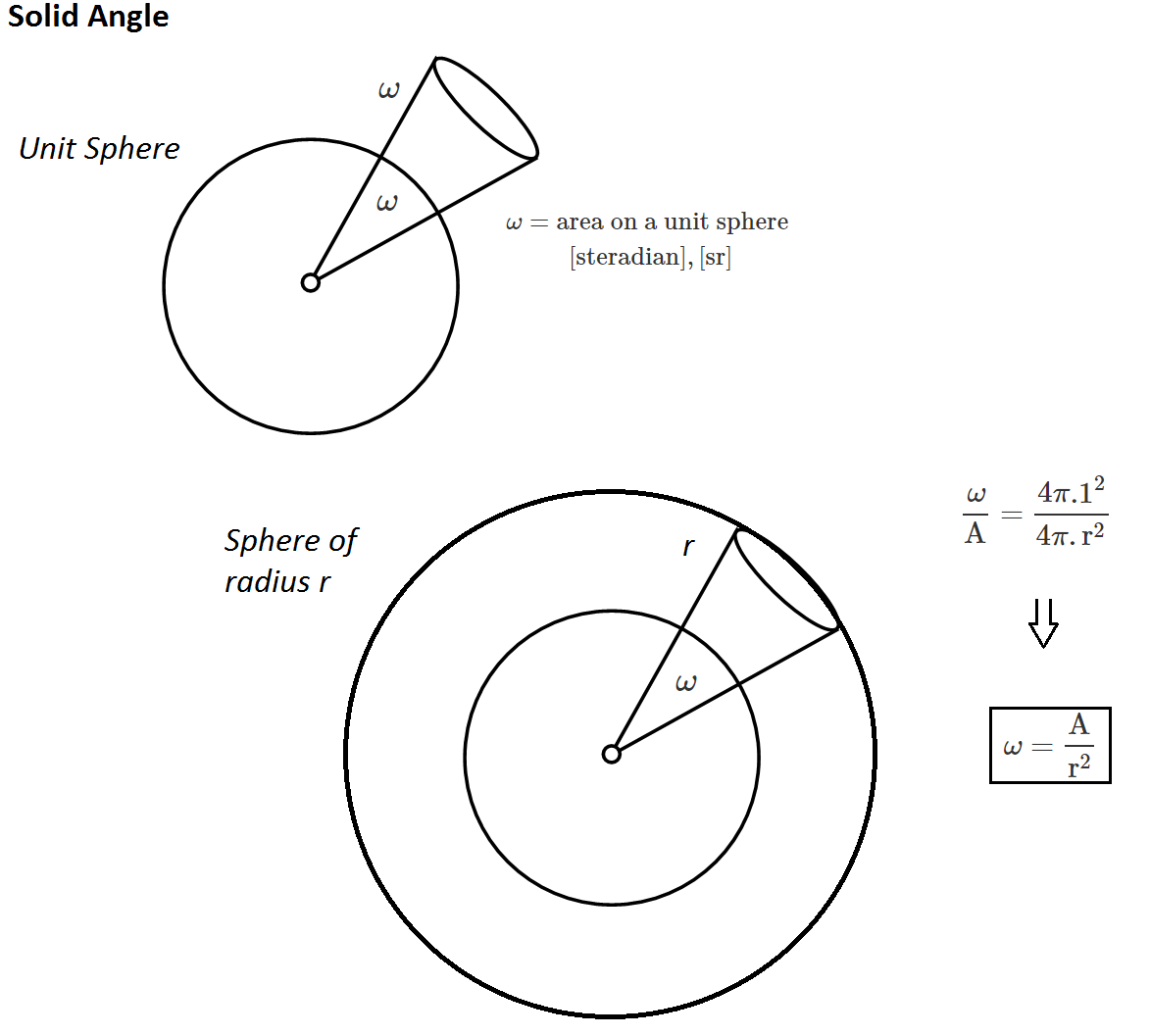
A small object nearby may subtend the solid angle as a larger object farther away. For example, although the Moon is much smaller than the Sun, it is also much closer to Earth. Diagram given below shows that moon almost entirely covers the sphere of the sun. $R_{me}$ = Distance of moon from earth $R_{se}$ = Distance of sun from earth Let the solid angle made by sun and moon is $\text{d}\Omega,$ we can write
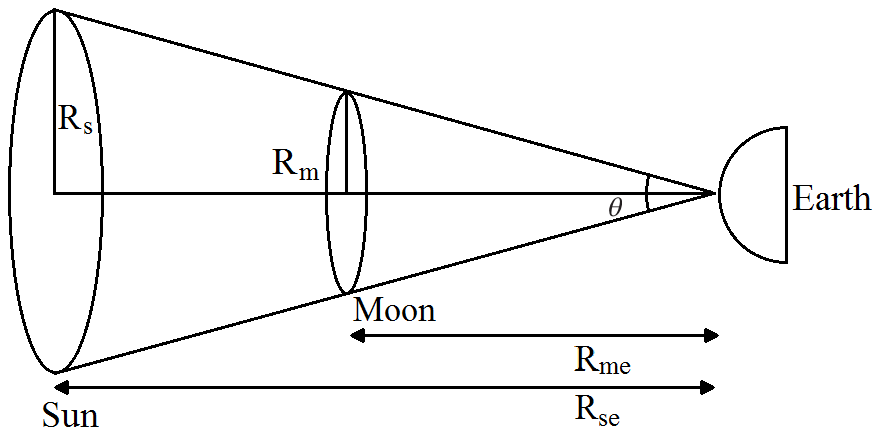
$\text{d}\Omega=\frac{\text{A}_\text{sun}}{\text{R}^2_\text{se}}=\frac{\text{A}_\text{moon}}{\text{R}^2_\text{me}}$ Here, $A_{sun}$ = Area of the sun $A_{moon}$ = Area of the moon $\Rightarrow\theta=\frac{\pi\text{R}_\text{s}^2}{\text{R}_\text{se}^2}=\frac{\pi\text{R}_\text{m}^2}{\text{R}_\text{me}^2}$ $\Rightarrow\Big(\frac{\text{R}_\text{s}}{\text{R}_\text{se}}\Big)^2=\Big(\frac{\text{R}_\text{m}}{\text{R}_\text{me}}\Big)^2$ $\Rightarrow\frac{\text{R}_\text{s}}{\text{R}_\text{se}}=\frac{\text{R}_\text{m}}{\text{R}_\text{me}}\ \text{or}\ \frac{\text{R}_\text{s}}{\text{R}_\text{m}}=\frac{\text{R}_\text{se}}{\text{R}_\text{me}}$ (Here, radius of sun and moon represent their sizes respectively) View full question & answer→