Questions

3 Marks Question

Take a timed test

83 questions · self-marked practice — reveal the answer and mark yourself.

Question 13 Marks
Write a short note on
Adaptations of desert plants and animals
Answer
  1. Adaptations of desert plants:
Plants found in deserts are well adapted to cope with harsh desert conditions such as water scarcity and scorching heat. Plants have an extensive root system to tap underground water. They bear thick cuticles and sunken stomata on the surface of their leaves to reduce transpiration. In Opuntia, the leaves are entirely modified into spines and photosynthesis is carried out by green stems. Desert plants have special pathways to synthesize food, called CAM (C4 pathway). It enables the stomata to remain closed during the day to reduce the loss of water through transpiration.
  1. Adaptations of desert animals:
View full question & answer
Question 23 Marks
Write a short note on
Behavioural adaptations in animals
Answer
Behavioural adaptations in animals:Certain organisms are affected by temperature variations. These organisms undergo adaptations such as hibernation, aestivation, migration, etc. to escape environmental stress to suit their natural habitat. These adaptations in the behaviour of an organism are called behavioural adaptations. For example, ectothermal animals and certain endotherms exhibit behavioral adaptations. Ectotherms are cold blooded animals such as fish, amphibians, reptiles, etc. Their temperature varies with their surroundings. For example, the desert lizard basks in the sun during early hours when the temperature is quite low. However, as the temperature begins to rise, the lizard burrows itself inside the sand to escape the scorching sun. Similar burrowing strategies are exhibited by other desert animals. Certain endotherms (warm-blooded animals) such as birds and mammals escape cold and hot weather conditions by hibernating during winters and aestivating during summers. They hide themselves in shelters such as caves, burrows, etc. to protect against temperature variations.
View full question & answer
Question 33 Marks
Write a short note on
Effects of temperature or water scarcity and the adaptations of animals
Answer
Effects of temperature or water scarcity and the adaptations of animals:Temperature is the most important ecological factor. Average temperature on the Earth varies from one place to another. These variations in temperature affect the distribution of animals on the Earth. Animals that can tolerate a wide range of temperature are called eurythermals. Those which can tolerate a narrow range of temperature are called stenothermal animals. Animals also undergo adaptations to suit their natural habitats. For example, animals found in colder areas have shorter ears and limbs that prevent the loss of heat from their body. Also, animals found in Polar regions have thick layers of fat below their skin and thick coats of fur to prevent the loss of heat. Some organisms exhibit various behavioural changes to suit their natural habitat. These adaptations present in the behaviour of an organism to escape environmental stresses are called behavioural adaptations. For example, desert lizards are ectotherms. This means that they do not have a temperature regulatory mechanism to escape temperature variations. These lizards bask in the sun during early hours when the temperature.
View full question & answer
Question 43 Marks
List any three important characteristics of a population and explain.
Answer
A population can be defined as a group of individuals of the same species, residing in a particular geographical area at a particular time and functioning as a unit. For example, all human beings living at a particular place at a particular time constitute the population of humans. Three important characteristics of a population are:
  • Birth rate (Natality): It is the ratio of live births in an area to the population of an area. It is expressed as the number of individuals added to the population with respect to the members of the population.
  • Death rate (Mortality): It is the ratio of deaths in an area to the population of an area. It is expressed as the loss of individuals with respect to the members of the population.
  • Age Distribution: It is the percentage of individuals of different ages in a given population. At any given time, a population is composed of individuals that are present in various age groups. The age distribution pattern is commonly represented through age pyramids.
View full question & answer
Question 53 Marks
How is diapause different from hibernation?
Answer
Diapause Hibernation
It is a stage of suspended delelopment in an organism to cope with unfavourable conditions. It is a resting stage in an animal to escape harsh environmental condition.
It can occur in summer and winter. It occurs only in winters, so also winter sleep in which animal passes the winter in dormant conditions.
It is a dormant stage in the development of an organism. It is a stage of inactivation of few organisms.
E.g.: It is common among insects such as monarch butterflies and in the embryos of many oviparous species of fish. E.g.: It is shown by kangaroo mouse, small birds. Several insects and bats.
View full question & answer
Question 63 Marks
Write a short note on
Adaptations of plants to water scarcity:
Answer
Adaptations of plants to water scarcity:Plants found in deserts are well adapted to cope with water scarcity and scorching heat of the desert. Plants have an extensive root system to tap underground water. They bear thick cuticles and sunken stomata on the surface of their leaves to reduce transpiration. In Opuntia, the leaves are modified into spines and the process of photosynthesis is carried out by green stems. Desert plants have special pathways to synthesize food, called CAM (C4 pathway). It enables their stomata to remain closed during the day to reduce water loss by transpiration.
View full question & answer
Question 73 Marks
Write a short note on
Importance of light to plants
Answer
Importance of light to plants:Sunlight acts as the ultimate source of energy for plants. Plants are autotrophic organisms, which need light for carrying out the process of photosynthesis. Light also plays an important role in generating photoperiodic responses occurring in plants. Plants respond to changes in intensity of light during various seasons to meet their photoperiodic requirements for flowering. Light also plays an important role in aquatic habitats for vertical distribution of plants in the sea.
View full question & answer
Question 83 Marks
How do kangaroo rats and desert plants adapt themselves to survive in their extreme habitat? Explain.
Answer
Kangaroo rats- Internal fat oxidation where water is a byproduct, excretes concentrated urine
Desert Plants- Thick cuticle/sunken stomata/leaves reduced to spines/deep roots/Special photosynthetic pathway/CAM.
View full question & answer
Question 93 Marks
Explain Parasitism and co-evolution with the help of one example of each.
Answer
Mode of interaction between two species in which one species (parasite) depends on the other species (host) for food and shelter/one organism is benefitted, the other is harmed.
e.g. Human liver fluke/Malarial parasite/Cuscuta.
Co-evolution is the relationship between two interacting organisms where both organisms failed to survive in the absence of the other.
e.g. Fig and fig wasp/ophrys and bumble bee.
View full question & answer
Question 103 Marks
How do snails, seeds, bears, zooplanktons, fungi and bacteria adapt to conditions unfavourable for their survival?
Answer
Snail-aestivation.
Seeds-dormancy/suspended metabolic activities.
Bear-Hibernation.
Zooplankton-diapause/suspended development.
Fungi-Spore/Zygospore.
Bacteria-Cyst/spore.
View full question & answer
Question 113 Marks
  1. State how the constant internal environment is beneficial to organisms
  2. Explain any two alternatives by which organisms can overcome stressful external conditions.
View full question & answer
Question 123 Marks
Different animals respond to changes in their surroundings in different ways. Taking one example each, explain "some animals undergo aestivation while some others hibernation". How do fungi respond to adverse climatic conditions?
Answer
Some animals go into aestivation to avoid summer related problems (heat and dessication), eg. snails/fish.
Some animals go into hibernation to avoid winter related problem (extreme cold) eg. bear.
Fungi form thick walled spores and suspend their activities to respond to adverse climatic condition.
View full question & answer
Question 133 Marks
Predation is usually referred to as a detrimental association. State any three positive roles that a predator plays in an ecosystem.​​​​​​
Answer
Keeps prey population (phytophagous/herbivores/carnivore) under control, maintenance of ecological balance/maintenance of species diversity, acts as conduit for energy transfer.
View full question & answer
Question 143 Marks
Explain co-evolution with reference to parasites and their hosts. Mention any four special adaptive features evolved in parasites for their parasitic mode of life.
Answer
Co-evolution can be defined as reciprocal adaptations in the two interacting organisms that brings about the evolutionary change in both of them. In terms of the relation of host and parasite, it can be explained as follows:
A parasite is an organism that is totally dependent on the host organism for its survival, but in doing so, it also harms the host. The host evolves over a long period of time to protect itself from parasite, while parasite evolves so that it can find another way to derive nutrition from the host and hence, the cycle continues.
Four special adaptive features evolved in parasites for their parasitic mode of life are as follows:
  1. Parasites have organs for attachment such as suckers that help them to firmly attach to the host body and derive nutrition from them. For example, hooks and suckers in Taenia solium.
  2. Parasites are covered by protective body covering, that is, cuticle (in case of Ascaris lumbricoides) and tegumen (in case of Taenia solium) to protect them from harmful effects of digestive enzymes of the host.
  3. All parasitic organisms are usually devoid of locomotory structures; they do not require to move in search of food.
  4. Parasitic organisms have high reproductive capacity to ensure the continuation of parasitic race.
View full question & answer
Question 153 Marks
  1. "Organisms may be conformers or regulators." Explain this statement and give one example of each.
  2. Why are there more conformers than regulators in the animal world?
Answer
  1.  
  • Conformers- organisms which cannot maintain a constant internal environment under varying external environmental conditions change body temperature and osmotic concentration with change in external environment eg. all plants/fishes/amphibians/reptiles.
  • Regulators- organisms which can maintain homeostasis (by physiological means or behavioural means) maintain constant body temperature and osmotic concentration eg. birds/mammals.
  1. Thermoregulation is energetically expensive for animals.
View full question & answer
Question 163 Marks
Name and explain the type of interaction that exists in mycorrhizae and between cattle egret and cattle.
Answer
Mutualism:Association between fungi and the root of higher plants, fungus, absorbs essential nutrients from the soil and plant provides the fungi with energy-yielding carbohydrates. (both benefitted)
Commensalism:
Cattle stir up and flush out insects from the vegetation on which the egret feed, cattle is neither harmed nor benefitted/not effected.
View full question & answer
Question 173 Marks
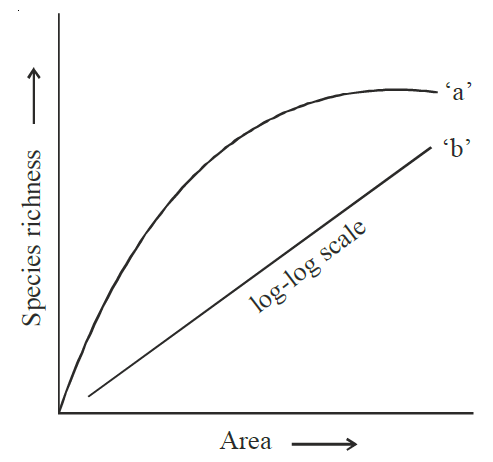
The following graph shows the species-area relationship. Answer the following question as directed.
  1. Name the naturalist who studied the kind of relationship shown in the graph. Write the observation made by him.
  2. Write the situations as discovered by the ecologists when the value of 'Z' (slope of the line) lies.
  1. 0.1 and 0.2
  2. 0.6 and 1.2
What does 'Z' stand for?
  1. When would the slope of the line 'b' become steeper?
Answer
  1. Alexander Von Humboldt. Within a region species, richness increased with increasing explored area but only up to a limit.
  2.  
  • The slopes of regression lines are the similar/unaffected distribution in an area/normal range.
  • The slope of regression is steeper when we analyse the species-area relationship among very large areas like entire continent.
Z (slope of the line) regression co-efficient.
  1. If species richness is more/0.62 - 1.2
View full question & answer
Question 183 Marks
  1. Write the importance of measuring the size of a population in a habitat or an ecosystem.
  2. Explain with the help of an example how the percentage cover is a more meaningful measure of population size than more numbers.
Answer
  1. The size of the population tells us a lot about its status in the habitat. Whatever ecological processes investigate in a population, be the outcome of competition with another species, the impact of or predator. It evaluate the term to change in the population size.
  2. Population size more technically called population density. Population size of a species is the number of individuals of a species per unit area volume.
Population Density

$=\frac{\text{Number of individuals in a region (N)}}{\text{Number of unit area in a region (S) }} $

$=\text{P}\triangle=\frac{N}{S}$

A population at any given time is composed of individuals of different ages. When the age distribution (per cent individuals of a given age or age group) is plotted for the population, the resulting structure is called age pyramid’.

Age distribution depends upon the natality and mortality, and determines the population growth with regard to age distribution, there are three kinds of population.
  1. Rapidly growing or Expanding population: It has birth rate and low death rate, so there are more number of young individuals in the population. According to a recent survery, more then 36% of the Indian Population consists of children below the age of 14 years, so Indian population is called young population.
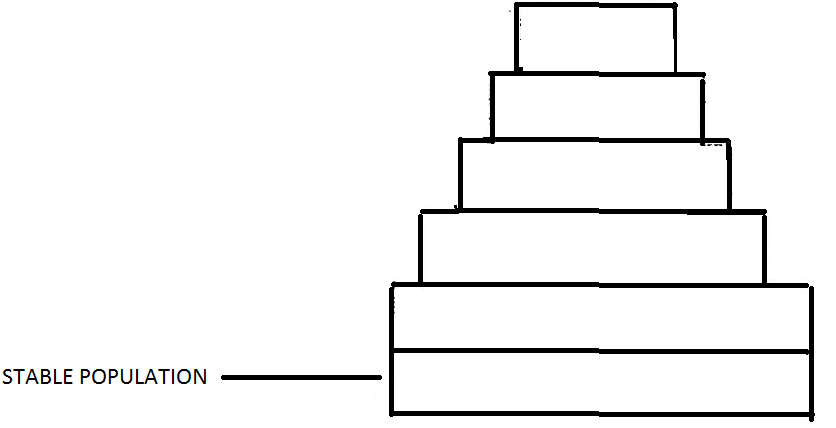
  2. Stationary or Stable Population: It has equal birth and death rates, so population show zero population growth.
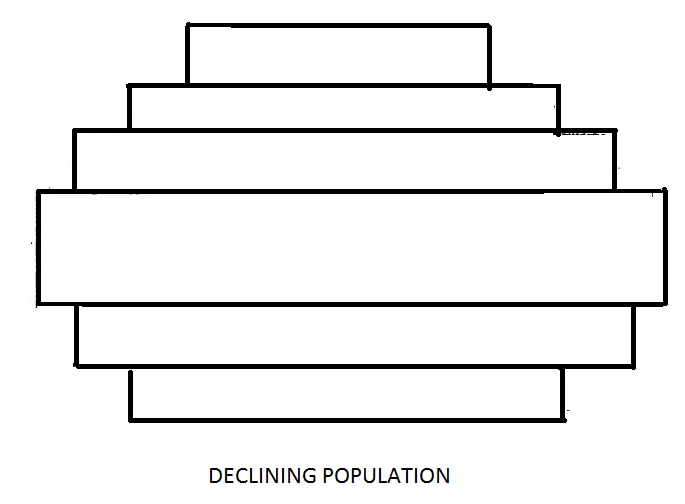
  3. Declining Population: It has higher death rate then birth rate, so the population of young members is lowers than that of old members, e.g. Japan (Ageing Population).
View full question & answer
Question 193 Marks
How do organisms like fungi, zooplanktons and bears overcome the temporary short-lived climatic stressful conditions? Explain.
Answer
Fungi - produce thick-walled spores to survive unfavourable condition.
Zooplanktons - diapause to suspend development.
Bear - undergo hibernation in winter.
View full question & answer
Question 203 Marks

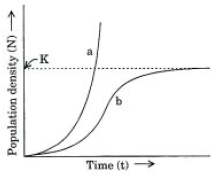
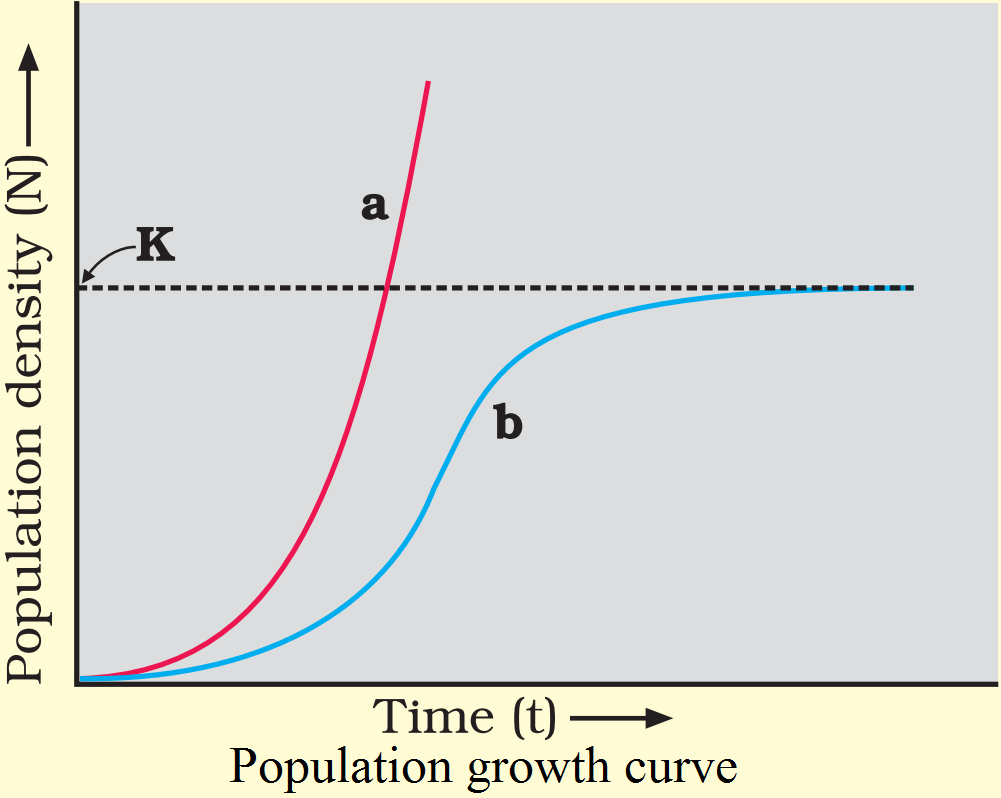
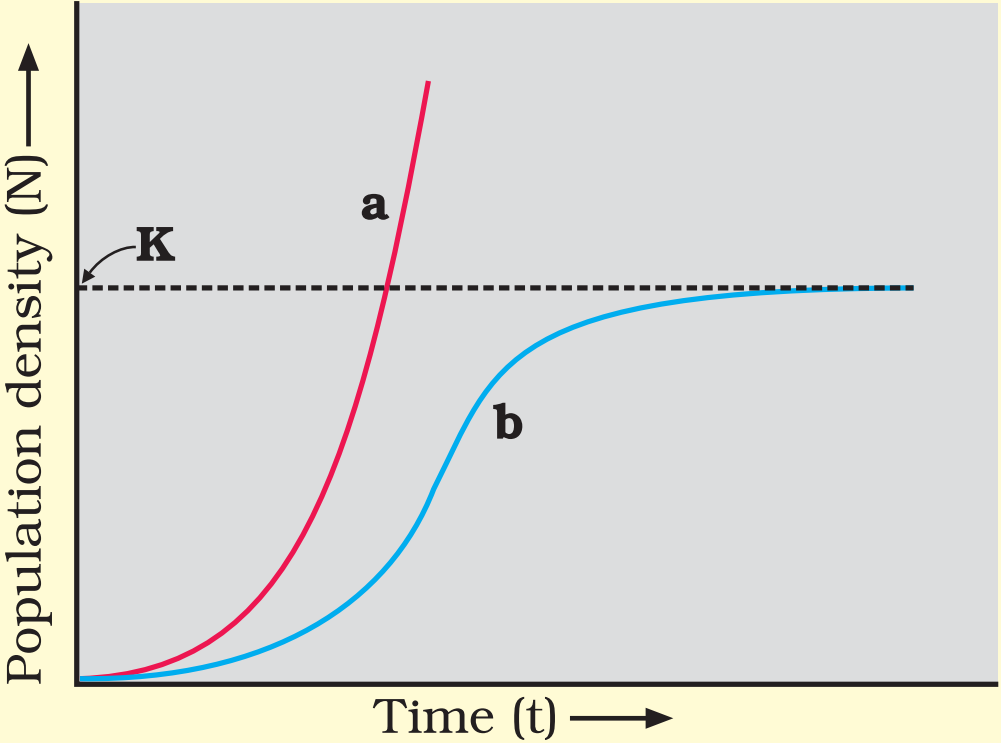
Study the population growth curves shown above.
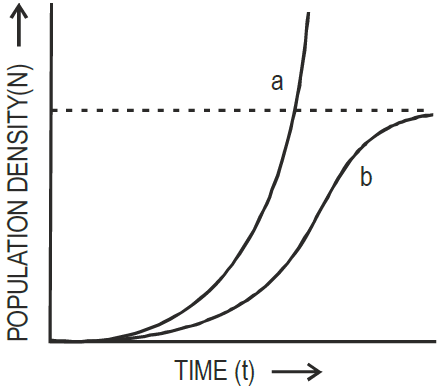
  1. Identify curves ‘a’ and ‘b’.
  2. Mention the responsible for the curves ‘a’ and ‘b’ respectively.
  3. Give the necessary equation for the curve ‘b’.
Answer
  1.  
  1. Exponential curve.
  2. Logistic curve.
  1.  
  1. Unlimited food resource/responses are not limiting the growth.
  2. Limited food resource/responses are limiting the growth.
  1. $\frac{dN}{dt}=rN\bigg( \frac {K-N}{K} \bigg)$
View full question & answer
Question 213 Marks
Highlight the differences between the population interactions given below. Give an example of each.
  1. Parasitism.
  2. Amensalism.
  3. Mutualism.
Answer
  1. Parasitism: Only one species benefits.
Example: Cuscuta/Tape worn.
  1. Amensalism: One species is harmed whereas the other is unaffected.
Example: Penicillium growing on bacterial culture/Trichoderma - biological control agent and plant pathogen.
  1. Mutualism: Both Species benefit.
Example: lichens.
View full question & answer
Question 223 Marks
Co-evolution is a spectacular example of mutualism between an animal and a plant. Describe co-evolution with the help of an example.
Answer
Fig & wasp.
The female wasp uses the fruit for oviposition/egg laying, uses seeds within the fruit (developing seeds) for nourishing its larvae, the wasp pollinates the fig inflorescence, the given fig species can be pollinated by its ‘partner’ wasp species & no other species.
View full question & answer
Question 233 Marks
Highlight the differences and a similarity between the following population interactions: competition, predation and commensalism.
Answer
  Competition Predation Commensalism
Differences Both species lose in their interaction. Only one species benefits in their interaction. One species is benefitted and the other is neither benefitted nor harmed in their interaction.
Similarity Both the interacting species live together. Both the interacting species live together. Both the interacting species live together.
View full question & answer
Question 243 Marks
  1. A parasite has to adapt to be able to live in the host. Write the various parasitic adaptations.
  2. Mention an adaptive feature exhibited in brood parasitism in Koel and Crow.
Answer
  1.  
  • Loss of unnecessary sense organs.
  • Adhesive organs or suckers to cling on to the host.
  • Loss of digestive system.
  • High reproductive capacity.
  • Loss of chlorophyll and leaves.
  1. The eggs of the parasitic bird (Koel) resemble the host’s egg (Crow) in size and colour to reduce the chances of the host bird detecting the foreign eggs and ejecting them out from the nest.
View full question & answer
Question 253 Marks
When do you describe the relationship between two organisms as mutualistic, competitive and parasitic? Give one example of each type.
Answer
Mutualistic: Both the interacting organisms are benefitted from each other e.g. Lichens- Algae and fungi mutually help each other or any other appropriate example.
Competition: When two organisms belonging to closely related species/unrelated groups compete for the same resources that are limiting both are losers, e.g. superior barnacle dominates and excludes the small barnacles/in some South American lakes visiting flamingoes and resident fishes compete for their common food (zooplankton) in the lake.
Parasitic: One of the two organisms is dependent on the other( host) for nutrition and support/the host is harmed and the parasite is benefitted. e.g. Malarial parasite and human/Cuscuta on host plant.
View full question & answer
Question 263 Marks
  1. Explain any two defence mechanisms plants evolved against their predators.
  2. How does predation differ from parasitism?
Answer
  1.  
  1. Thorns are (morphological) means of defence.
  2. produce/store chemicals which inhibit digestion/disrupts reproduction/kill/Calotropis produces highly poisonous cardiac glycosides/plants may produce chemicals such as nicotine/caffiene/quinine/strychnine/opium are produced as defence.
  1.  
Parasitism Predation
Lives & feed on the host. Only feeds on prey.
host specific. prudent/not prey specific.
Co-evolve with the host. Control/check prey population.
View full question & answer
Question 273 Marks
Explain with the help of suitable examples the three different ways by which organisms overcome their stressful conditions lasting for short duration.
Answer
Migration- The organisms (animals) can move away temporarily from stressful habitat to a more hospitable area and return when stressful period is over.
e.g. humans moving from Delhi to Shimla during summer/many animals or birds undertake long distance migration to hospitable area.
Spore formation– various kind of thick walled spores are formed which germinate on availability of suitable enviornment.
e.g. bacteria/fungi/lower plants.
Dormancy– seeds or vegetative reproductive structures help to tide over stress by reducing their metabolic activity.
e.g seeds or vegetative reproductive structures of higher plants.
Hibernation– It takes place during winter.
e.g bears or any other correct relevant example.
Aestivation– It takes place during summer to avoid heat and dessication. (in animals)
e.g snails/fish or any other correct relevant example.
Diapause- under unfavourable conditions zooplanktons enter a stage of suspended metabolic activity.
e.g zooplankton.
View full question & answer
Question 283 Marks
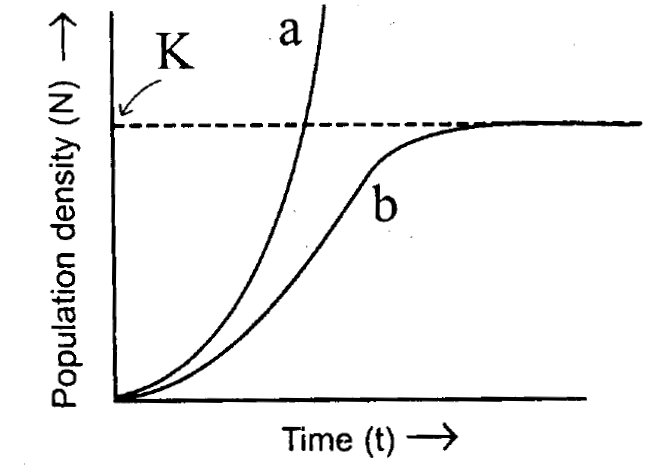
Study the graph given below and answer the question that follow:
  1. Write the status of food and space in the curves (a) and (b).
  2. In the absence of predators, which one of the two curves would appropriately depict the prey population?
  3. Time has been shown on X-axis and there is a parallel dotted line above it. Give the significance of this dotted line.
Answer
  1. a - unlimited food and space.
b - limited food and space.
  1. Curve a.
  2. Carrying capacity/a given habitat has enough resources to support maximum possible number - beyond which no further growth is possible.
View full question & answer
Question 293 Marks
In certain seasons we sweat profusely while in some other season we shiver. Explain.
Answer
To regulate body temperature.
In summer outside temperature is higher than body temperature, sweating causes cooling by evaporation of sweat.
In winter outside temperature is lower than body temperature, shivering is an (involuntary) exercise which produces heat.
View full question & answer
Question 303 Marks
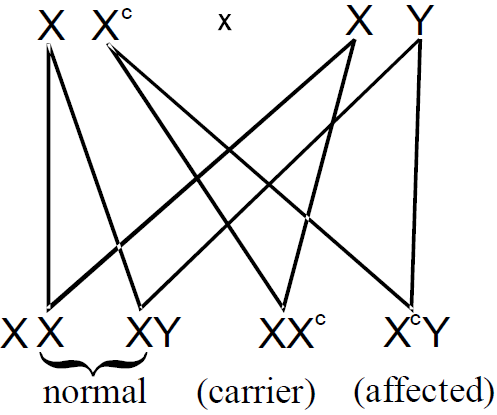
A couple with normal vision bear a colour blind child. Work out a cross to show how it is possible and mention the sex of the affected child.
Answer

Affected child is male
View full question & answer
Question 313 Marks
During a school trip to ‘Rohtang Pass’, one of your classmate suddenly developed ‘altitude sickness’. But, she recovered after some time.
  1. Mention one symptom to diagnose the sickness.
  2. What caused the sickness?
  3. How could she recover by herself after some time?
Answer
  1. Nausea/fatigue/heart palpitation.
  2. Low atmospheric pressure at high altitude, body deprived of $O_2$.
  3. Increase in RBC decreases binding capacity of haemoglobin, increased breathing rate, get acclimatised.
View full question & answer
Question 323 Marks
Explain mutualism with the help of any two examples. How is it different from commensalism?
Answer
Mutualism is a kind of population interaction in which both the participating species derive a benefit from each other’s presence. Examples of mutualism are given below:
  1. Associations between fungi and plants, called mycorrhizae—The plants is benefitted by essential soil nutrients that the fungus absorbs and transfers to the plant through its roots. The fungus, in turn, derives the benefits of receiving energy-yielding carbohydrates from the plant.
  2. Pollination- The flowers of a plant provide sweet, mucilaginous nectar to birds or insects in return for getting help from the birds or insets in spreading their pollen grains onto other flowers. The plant-pollinator pair often undergoes co-evolution to safeguard against the use of the nectar by other non-useful organisms.
Mutualisms differs from commensalism in that the latter provides a benefit to just one of the participating species the benefitted species being called a commensal.
View full question & answer
Question 333 Marks
Name the type of interaction seen in each of the following examples:
  1. Ascaris worms living in the intestine of human.
  2. Wasp pollinating fig inflorescence.
  3. Clown fish living among the tentacles of sea-anemone.
  4. Mycorrhizae living on the roots of higher plants.
  5. Orchid growing on a branch of a mango tree.
  6. Disappearance of smaller barnacles when Balanus dominated in the Coast of Scotland.
Answer
  1. Parasitism.
  2. Mutualism.
  3. Commensalism.
  4. Mutualism.
  5. Commensalism.
  6. Competition.
View full question & answer
Question 343 Marks
Study the population growth curves in the graph given below and answer the questions which follow:
  1. Identify the growth curves ‘a’ and ‘b'.
  2. Which one of them is considered a more realistic one and why?
  3. If dN/dt=rN(K-N/K) is the equation of the logistic growth curve, what does K stand for?
  4. What is symbolised by N?
Answer
  1. ‘a’- Exponential.
‘b’ Logistic/Sigmoid/Verhulst - pearl Logistic.
  1. ‘b’- because food for the animals is finite and so will soon become a limiting factor, so in normal environment, it will be the realistic one.
  2. ‘K’- Carrying capacity.
  3. ‘N’– Population density at time ‘t’.
View full question & answer
Question 353 Marks
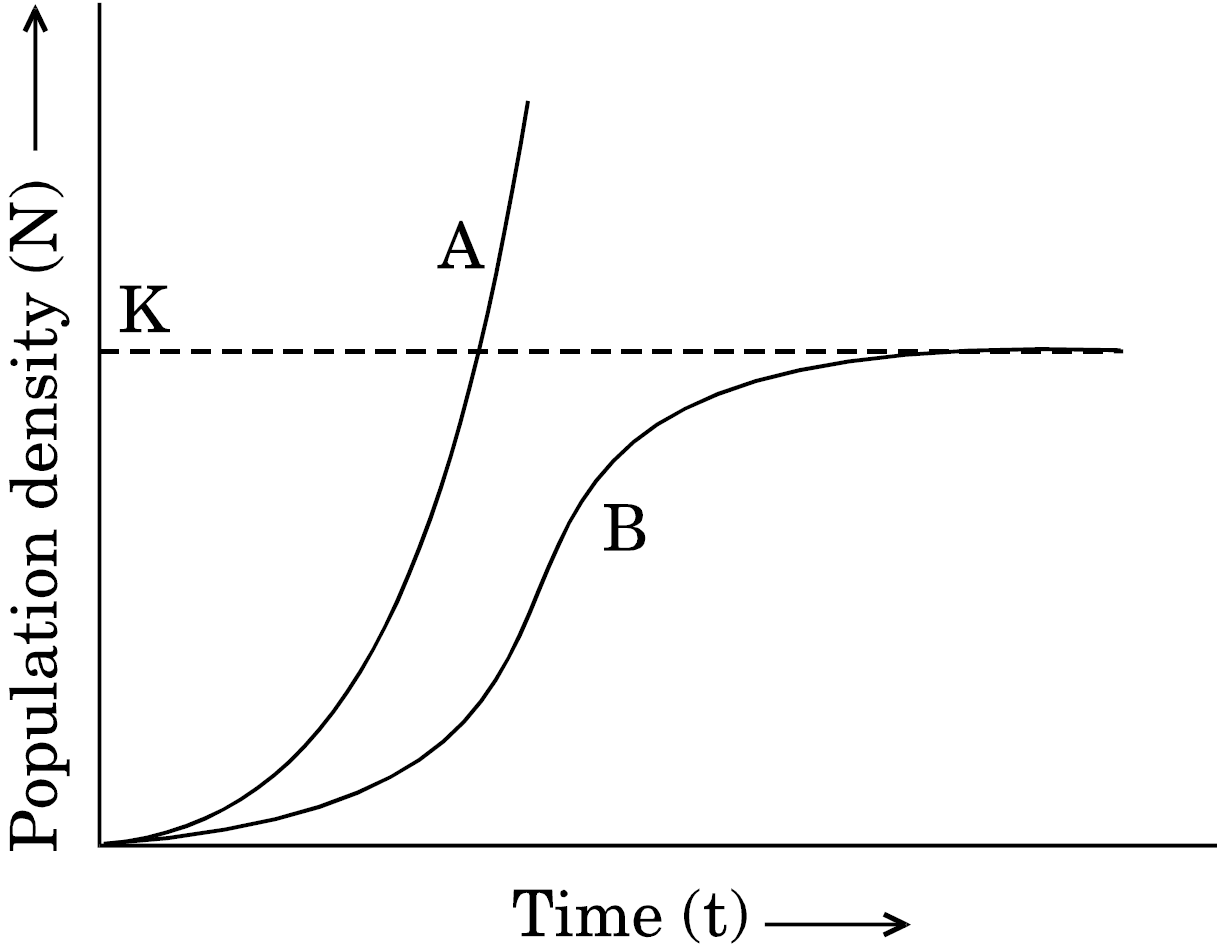
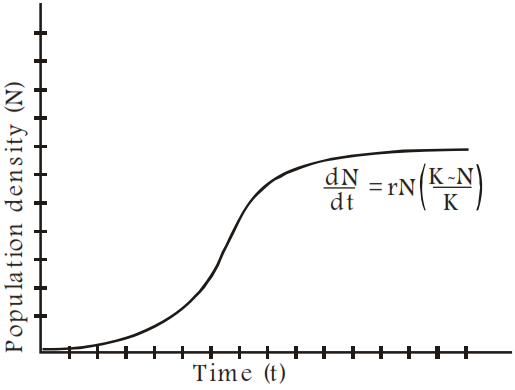
Study the population growth curve given below and answer the questions that follow:
  1. Identify ‘A’ and ‘B’ shown in the graph.
  2. When and why do such curves occur in a population?
Answer
  1. ‘A’ - Exponential.
‘B’ - Logistic.
  1. ‘A’- Exponential growth - when resources (food and space) are not limiting/ when resources in the habitat are unlimited, each species has the ability to realise its full potential to grow in number in absence of checks.
‘B’ - Logistic growth - When resources become limiting/ competition between individuals for limited resources occurs, the fittest individuals will survive and reproduce.
View full question & answer
Question 363 Marks
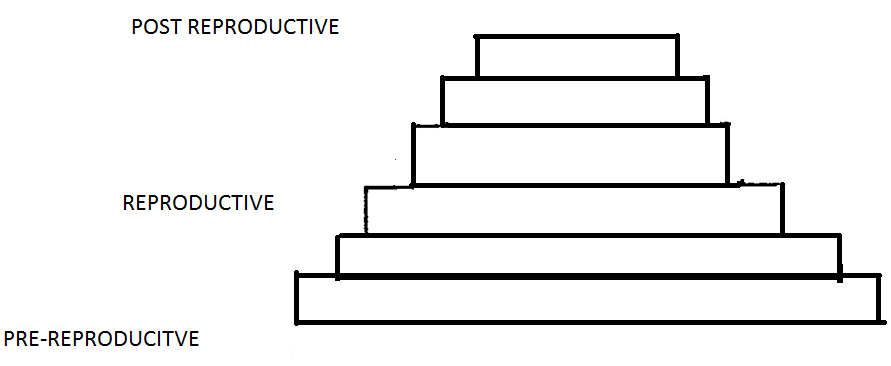
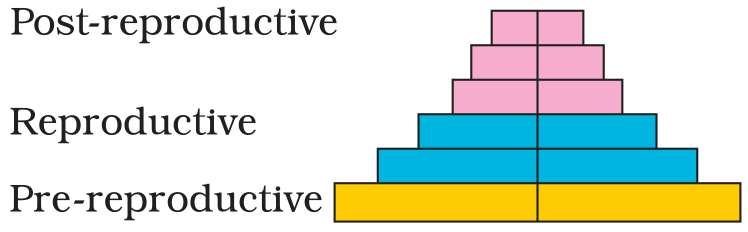
Study the age pyramids ‘A’, ‘B’ and ‘C’ of the human population given below and answer the questions that follow:
  1. Identify pyramids ‘B’ and ‘C’.
  2. Write the basis on which the above pyramids are plotted.
Answer
  1. Expanding or Triangular Age Pyramid: In this, number of pre-reproductive individuals is very large, number of age reproductive individuals is moderate, while post-repr oductive individuals are fewer. This type of age pyramid shows that population is growing. The rate of growth depends upon the size of pre-reproductive population. This type of population growth is observed in developing countries like India, Brazil.
  2. Declining or Urn-shaped Pyramid: The proportion of reproductive age group is higher than the individuals in pre-reproductive age group. The number of post-reproductive individuals in also sizeable. It is declining or diminishing population with negative growth. This type of population growth is observed in countries like Japan.
  3. Stable or Bell-shaped Age Pyramid: In this, the number of pre-reproductive and reproductive in dividuals is almost equal. Post-reproductive individuals are comparatively fewer. The population size remains stable, neither growing nor diminishing. This type of population growth is o bserved in countries like USA, Denmark.
View full question & answer
Question 373 Marks
Explain the difference between commensalism and mutualism types of interactions, with the help of a suitable example of each.
View full question & answer
Question 383 Marks
Mention three physical properties and three chemical properties of soil, that determine the type of vegetation in a given region.
Answer
  1. Physical properties:
  1. Soil grain size.
  2. Aggregation of particles.
  3. Soil composition.
  1. Chemical properties:
  1. pH.
  2. Mineral composition.
  3. Topography.
View full question & answer
Question 393 Marks
Write the formula for the change in population density.
Answer
To calculate the population density, you will divide the population by the size of the area.
$\text{Thus, Population Density} = \frac{\text{Number of People}}{\text{Land Area}}$
The unit of land area should be square miles or square kilometers
View full question & answer
Question 403 Marks
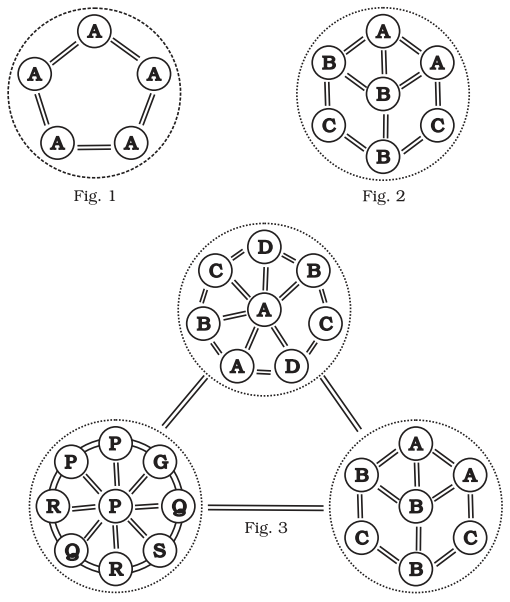
Comment on the following figures: 1, 2 and 3:
A, B, C, D, G, P, Q, R, S are species.
Answer
Figure 1 shows a population of species A. All the individuals are interacting among themselves.
Figure 2 shows a community with three populations of A, B and C. They are interacting with each other and their environment.
Figure 3 shows a biome with three communities. One of the communities is in climax and other two are at different stages of development. All the three communities are in the same environment and they interacts with each other and with the environment.
View full question & answer
Question 413 Marks
Define ectoparasite and endoparasite and give suitable examples.
Answer
  • Ectoparasites: Parasites that feed on the external surface of the host organism are called ectoparasites. The most familiar examples of this group are the lice on humans and ticks on dogs.
  • Endoparasites: Endoparasites are those that live inside the host body at different sites (liver, kidney, lungs, red blood cells, etc.). The human liver fluke (a trematode parasite) is an endoparasite.
View full question & answer
Question 423 Marks
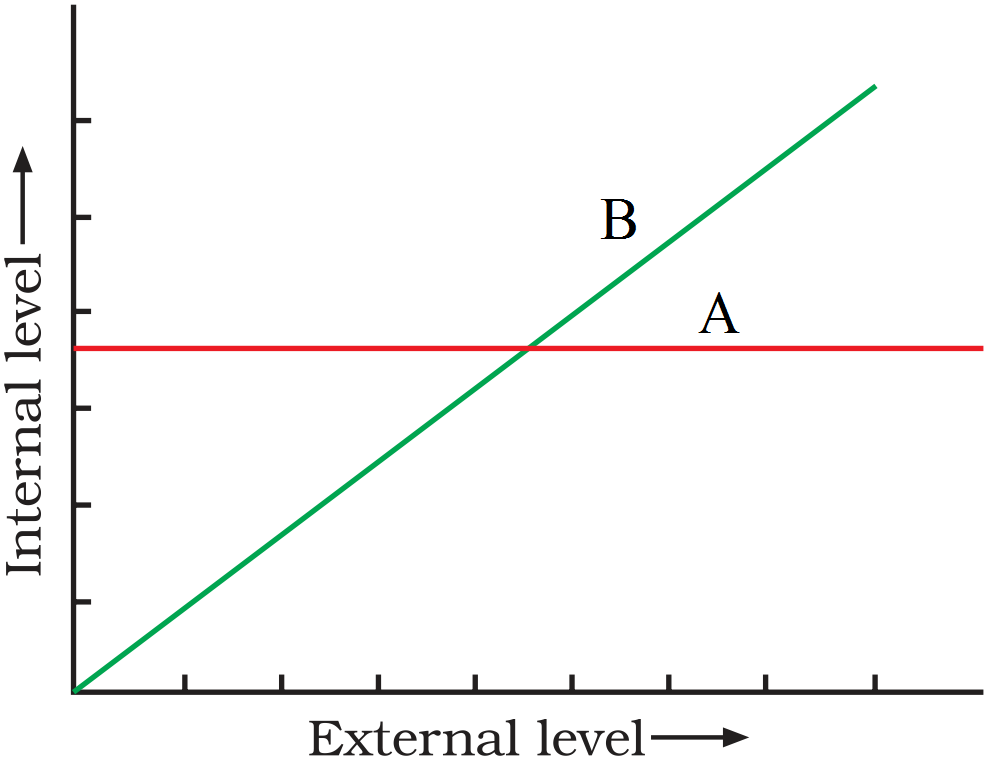
The following graph represents the organismic response to certain environmental condition (e.g. temperature):
  1. Which one of these, 'a' or 'b', depicts conformers?
  2. What does the other line graph depict?
  3. How do these organisms differ from each other with reference to homeostasis?
  4. Mention the category to which humans belong.
Answer
  1. 'a' depicts conformers.
  2. The other line 'b' depicts regulaters.
  3.  
  Conformers   Regulators
1 These are the organisms, which cannot maintain a constant internal environment and change according to the ambient atmospheric conditions 1 These are the organisms which maintain a constant internal environment despite changes in the environment.
2 They show a narrow range of distribution. 2 They show a much wider range of distribution.
  1. Humans are regulaters.
View full question & answer
Question 433 Marks
List three symptoms of high altitude sickness and state three adaptations to overcome it.
Answer
  1. The symptoms are:
  1. Nausea.
  2. Fatigue.
  3. Heart palpitations.
  1. It is because at high altitudes, the atmospheric pressure is low and the body does not get enough oxygen.
  2. She would recover after sometime as the body would get acclimatised by,
  1. Increasing the breathing rate.
  2. Increasing the production of red blood cells.
  3. Decreasing the binding capacity of haemoglobin.
View full question & answer
Question 443 Marks
Identify the curves 'a' and 'b' shown in the graph given below, List the conditions responsible for growth patterns 'a' and 'b'.
Answer
  1. Curve 'a' is Exponential growth curve: When the resources are not limiting, this form of curve appears.
  2. Curve 'b' is Logistic growth curve: When the resources are limiting, this form of growth curve appears, where K represents the carrying capacity.
View full question & answer
Question 453 Marks
Explain co-evolution with reference to parasites and their hosts. Mention any four special adaptive features evolved in parasites for their parasitic mode of life.
OR
Explain parasitism and co-evolution with the help of one example of each.
Answer
Co-evolution is a phenomenon where many parasites have evolved to be host-specific in such a way that both the host and parasite tend to co-evolve, i.e. if the host develops/evolves special mechanism for rejecting or resisting the parasite the parasite has to evolve mechanism to counteract and neutralise them to succeed with the same host species. Parasites have special adaptations according to their lifestyles such as; loss of unnecessary sense organs, presence of adhesive organs or suckers, loss of digestive system, and high reproductive system.
View full question & answer
Question 463 Marks
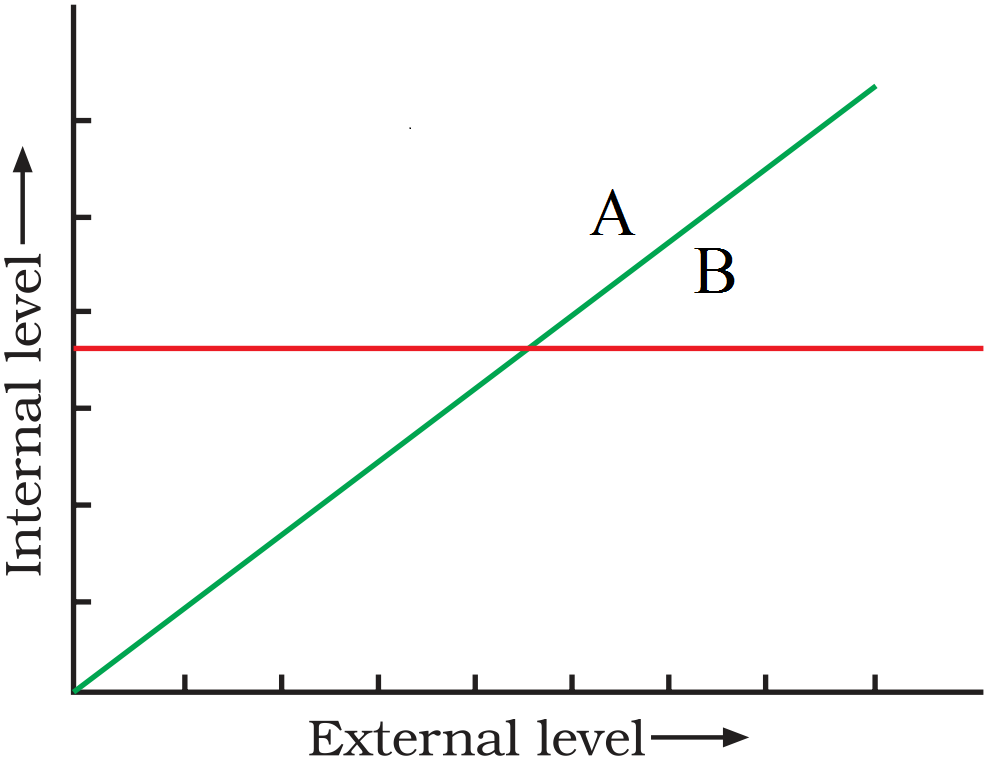
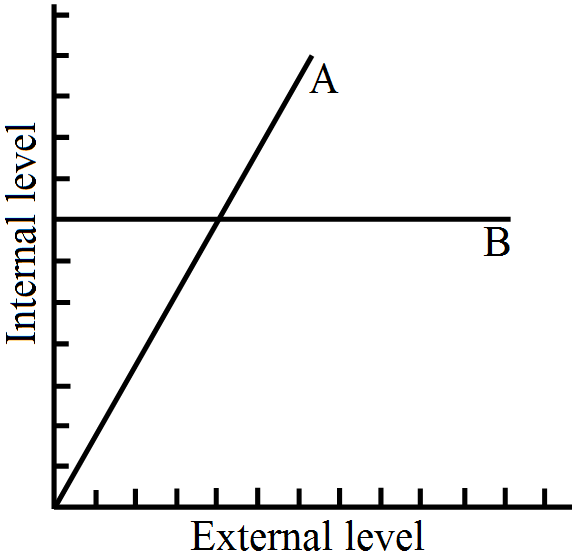
The following graph AE represents the organismic response to certain environmental condition (e.g. temperature)
  1. Which one among A and B depicts conformers?
  2. What does the other line graph depict?
  3. How do these organisms differ from each other with reference to homeostasis?
  4. Mention the category to which humans belong. Internal level.
Answer
  1. A depicts conformers.
  2. The other line B depicts regulators.
  3. Differences between conformers and regulators are:
Serial number
Conformers
Regulators
1.
These cannot maintain a constant internal environment and change according to the ambient atmospheric conditions.
These organisms maintain a constant internal environment despite changes in the environment.
2.
They show a narrow range of distribution.
They show a much wider range of distribution.
  1. Humans are regulators.
View full question & answer
Question 473 Marks
Study the graph given below and answer the questions that follows.
  1. Write the status of food and space in the curves A and B.
  2. In the absence of predators, which one of the two curves would appropriately depict the prey population?
  3. Time has been shown on X-axis and there is a parallel dotted line above it. Give the significance of this dotted line.
Answer
  1. A-Unlimited food and space.
B-Limited food and space.
  1. Curve B'.
  2. The dotted line represents the carrying capacity. It is the capacity of a given habitat having enough resources to support maximum possible number, beyond which no further growth is possible.
View full question & answer
Question 483 Marks
What is 'predation'? Explain with the help of suitable examples why is it required in a community with rich biodiversity.
Answer
Predation is an interaction where one organism (predator) kills and eats the other weaker organism called prey. Predation is a natural way of transferring the energy fixed by plants, to higher trophic levels.
Examples: snake eating a frog, tiger killing and eating a deer. Predators keep prey population under control which otherwise could achieve very high population densities and cause instability in ecosystem. They also help in maintaining a species diversity in a community by reducing the intensity of competition among competing prey species.
View full question & answer
Question 493 Marks
Name and explain the type of interaction that exists in mycorrhizae and between cattle egret and grazing cattle.
Answer
Mycorrhizae: It is an association between fungi and roots of higher plants. It is called mutualism. The fungi help plant in the absorption of essential nutrients from the soil, while in turn it provides the fungi with energy yielding carbohydrates. Both partners are benefitted. The cattle egret and grazing cattle share commensalism type of relationship. The grazing cattle flush out insects from grass while grazing. So, it becomes easier for egret to catch and feed on them. In this, one partner gets benefit, while other remains unaffected.
View full question & answer
Question 503 Marks
Describe the various types of age pyramids.
Answer
Age pyramids are of three types:
  1. Triangular age pyramids: The number of pre-reproductive individuals is very large. Number of reproductive individuals is moderate while post-reproductive individuals are fewer. Population is growing.
  2. Bell shaped age pyramids: The number of pre-reproductive and reproductive individuals is almost equal. post-reproductive individuals are comparatively fewer. The population size remains stable.
  3. Urn shaped age pyramid: Proportion of reproductive age group is higher than the individuals in pre-reproductive age group. Number of post-reproductive individuals is also sizeable. It is declining population with negative growth.
View full question & answer
Question 513 Marks
Egrets are often seen along with grazing cattle. How do you refer to this interaction? Give a reason for this association.
Answer
  1. Commensalism.
  2. As egrets move, the cattle stir up and flush out from the vegetation the insects which otherwise might be difficult for the egrets to find and catch. Thus, the egrets are benefitted while the cattle are neither benefitted nor harmed.
View full question & answer
Question 523 Marks
Name and explain the type of interaction between big trees and certain species of wasps?
Answer
  1. Mutualism.
  2. Certain wasps pollinate fig by laying eggs in their inflorescence. Fig plants in return offer some of its seeds as food for developing larvae of wasps.
View full question & answer
Question 533 Marks
A population of Paramoecium caudatum was grown in a culture medium. After 5 days the culture medium became overcrowed with Paramoeium and had depleted nutrients. What will happen to the population and what type of growth curve will the population attain? Draw the growth curve.
Answer
The population of Paramoecium will show logistic growth which can be shown by a sigmoid curve. The population growth will show following phases:
  1. Lag phase.
  2. Acceleration phase.
  3. Deceleration phase.
  4. Asymptote phase
The asymptote phase shall be reached on fifth day. The following figure shows the growth curve:
View full question & answer
Question 543 Marks
What is high altitude sickness? Write its symptoms.
Answer
If one had ever been to any high altitude place (>3,500m like Rohtang Pass near Manali and Mansarovar in Tibetan Autonomous Region), thepathological effect caused by acute exposure to low partial pressure of oxygen at high altitude is called altitude sickness. Its symptoms include nausea, fatigue and heart palpitations.
View full question & answer
Question 553 Marks
In an aquarium two herbivorous species of fish are living together and feeding on phytoplanktons. As per the Gause’s Principle, one of the species is to be eliminated in due course of time, but both are surviving well in the aquarium. Give possible reasons.
Answer
Each species has a specific position or functional role within the community, called niche. According to the Gause’s principle, no two species can live in the same niche. In this case, two herbivorous species are living in the same niche and feeding on phytoplanktons. It may be because of the availability of sufficient phytoplanktons and or less number of individuals of the fish species. Of the two species might have occurred and though neither of the species have been eliminated, niche overlapping may effect the growth and development of individuals of the species.
View full question & answer
Question 563 Marks
In a sea shore, the benthic animals live in sandy, muddy and rocky substrata and accordingly developed the following adaptations.
  1. Burrowing.
  2. Building cubes.
  3. Holdfasts/ peduncle.
Find the suitable substratum against each adaptation.
Answer
  1. These animals live in sandy substratum and make burrows, e.g. lobsters, crabs, etc.
  2. These animals live in muddy substratum as cube-like aggregates. Small size of cube helps in passive feeding mechanisms, e.g. zooplanktons.
  3. These animals live in rocky substratum and attach to the substratum with the help of holdfast, e.g. sponges.
View full question & answer
Question 573 Marks
Explain with the help of two examples, how certain plants have evolved morphological and chemical defenses against primary consumers such as cows and goats.
Answer
  1. Thorns and spines are the most common morphological means of defence.
Example: spines of Acacia and cacti.
  1. Many plants produce and store chemicals, which when consumed by the herbivores make them sick, inhibit digestion, disrupt reproduction or even kill them.
Example: Calotropis produces highly poisonous cardiac glycosides.
View full question & answer
Question 583 Marks
Water is very essential for life. Write any three features each for plants and animals, which enable them to survive in water scarce environment.
Answer
Adaptations of plants to water scarcity, i.e. in xerophytic plants.
  1. Roots grow very deep to explore any possibility of available underground water.
  2. Many desert plants have a thick cuticle on their leaf surfaces and have their stomata arranged in deep pits to minimise water loss through transpiration. They also have a special photosynthetic pathway known as Crassulacean Acid Metabolism, (CAM) that enables their stomata to remain closed during day time so as to minimise transpiration.
  3. Some desert plants like Opuntia, have no leaves. Their leaves are reduced to spines and photosynthesis occurs in flattened stems. Adaptations of animals to water scarcity like in kangaroo rat.
  • The kangaroo rat in North American deserts is capable of meeting all its water requirement by internal oxidation of its body fat (water is a byproduct).
  • It can also concentrate its urine so that minimal volume of water is used to expel excretory products.
View full question & answer
Question 593 Marks
Draw and explain expanding age pyramid of human population. Why is it so called?
Answer

  1. In this pyramid, the number of individuals in the pre-reproductive stage is more than that in the reproductive stage; hence, the population will be increasing steadily as there will be more individuals in the reproductive phase in future.
  2. Since population will expand steadily, it is called so.
View full question & answer
Question 603 Marks
  1. Write the importance of measuring the size of a population in a habitat or an ecosystem.
  2. Explain with the help of an example how the percentage cover is more meaningful measure of population size than mere number.
Answer
  1. Measurement of population in habitat determines the relative abundance of a particular species and its effect on the available resources of that particular habitat.
  2. The percentage cover is more meaningful measure of population size than mere numbers because the relative abundance of a species is not only determined by number of individuals but by the relative abundance in both biomass and number, e.g. in a unit area, the number of grass species or relative abundance in number is high but not the relative biomass, if the same area has one or two Ficus bengalensis tree, it is very low in relative abundance of number but high in relative abundance of biomass.
View full question & answer
Question 613 Marks
Explain brood parasitism with the help of an example.
Answer
  1. Brood parasitism refers to the phenomenon in which a (parasitic) bird species lays its eggs in the nest of another (host) bird species and lets the host incubate them.
  2. The eggs of the parasitic bird must have evolved resemblance to the eggs of the host in size and colour to reduce the chances of the host bird detecting the foreign eggs and ejecting them from the nest, e.g. the cuckoo lays its eggs in the nest of a crow.
View full question & answer
Question 623 Marks
Explain what is meant by environmental resistance and its relationship to population growth.
Answer
Environmental resistance is the term used to describe all the forces of the environment that act to limit population growth. Organisms will run out of food or have their sunlight blocked; temperatures will plunge or rain will cease; greater number of predators will discover the population; the wastes produced by the organisms will begin to be toxic to the population.
View full question & answer
Question 633 Marks
Different animals respond to changes in their surrounding in different ways. Taking one example each, explain 'some animals undergo aestivation while others hibernation. How do fungi respond to adverse climatic conditions?
Answer
  1. Aestivation is the phenomenon by which some animals escape in time the stressful conditions during summer.
  2. Hibernation is the phenomenon by which some animals escape in time the stressful conditions during winter.
  3. Fungi form various kinds of thick-walled spores that remain dormant during unfavourable conditions and germinate at the return of favourable conditions.
View full question & answer
Question 643 Marks
Name and explain three adaptations of mangroves to the conditions prevailing in Sunderbans (West Bengal).
Answer
  1. The plants of saline habitats which not only have the ability to tolerate high concentration of salts in their rooting medium but are also able to obtain their water supply from the same are called halophytes.
  2. These are found in tidal marshes, coastal dunes, mangroves and saline soils. Certain green algae are also found in these areas, e.g. Dunaliella.
  3. Mangroves are the areas that not only have excess salt but also have excess water and anaerobic conditions besides difficulty in anchoring and seed germination.
  4. A number of plants possess small negatively geotrophic vertical roots called pneumatophores (have lenticels for gaseous exchange), e.g. Avicennia, Aegiatilis
  5. Another adaptation of mangrove plants is vivipary or seed germination while the fruit is still attached to plants, e.g. Rhizophora, Aegiceras, Ceriops.
View full question & answer
Question 653 Marks
Explain by taking three different examples, how certain organisms pull through the adverse conditions, when unable to migrate under stressful period.
Answer
Organisms overcome the stressful conditions that are of short duration in the following ways:
  1. The animals migrate, i.e. they move away from the stressful habitat to a more hospitable area and return to their habitat when the stressful period is over, e.g. Birds from Siberia and other cold countries migrate to Bharatpur Sanctuary in Rajasthan.
  2. Animals which cannot migrate, suspend/ reduce their metabolic activity and avoid stress by escaping in time.
  • They show hiberation, i.e., escaping in time during winters, e.g. bears and frogs.
  • They may go into aestivation, i.e. escaping in time to avoid summer-related problems, e.g. snails and fish.
  • Zooplanktons enter diapause, a state of suspended development.
  1. In bacteria, fungi and lower groups of plants, various types of thick-walled spores are formed; they germinate under suitable conditions.
View full question & answer
Question 663 Marks
Differentiate between intraspecific and inter specific competition.
Answer
Intraspecific competition is the competition among individuals of the same species. The competing individuals have similar types of adaptation. For example, when a number of seeds are grown together they compete for food, space Interspecific competition is the competition among the members of different species. The competing individuals have different types of adaptation. It is commonly observed in dense forests where sun loving threes are unable to develop under the shade of others.
View full question & answer
Question 673 Marks
'Predation is beneficial in long run'. Comment.
Answer
Predators are an important part of a healthy ecosystem. Predators cull vulnerable prey, such as the old, injured, sick, or very young, leaving more food for the survival and prosperity of healthy prey animals. Also, by controlling the size of prey populations, predators help slow down the spread of disease.
View full question & answer
Question 683 Marks
State any three methods by which animals cope with the temporary unfavourable conditions in their habitat when they cannot migrate.
Answer
Regulate: Homeostasis is maintained by ensuring constant body temperature and constant osmotic concentration, etc., by physiological and sometimes behavioural means. All birds, memmals, few lower vertebrates and invertebrates are endotherms as they have the mechanism of thermoregulation and osmoregulation for maintaining their homeostasis.
Conform: About 99% of animals and almost all plants cannot maintain a constant internal environment. Their body temperature changes with the ambient temperature, i.e. they are ectotherms.
Migrate: If an organism moves away temporarily from a stressful habitat to a more hospitable area and return, when the stressful period is over, the process is called migration.
View full question & answer
Question 693 Marks
Name the type of curve that characterises most populations growing in favourable environment. Define carrying capacity.
Answer
  1. Sigmoid curve.
  2. In nature a given habitat has enough resources to support a maximum possible number of population, beyond which no further growth of the population is possible. This limit is called as nature's carrying capacity (K) for that species in that habitat.
View full question & answer
Question 703 Marks
Name the special type of tissue enabling plants like lotus and water hyacinth to survive in aquatic environment. Mention any two specific functions of this tissue?
Answer
  1. Aerenchyma (special air storage parenchyma).
  2. It makes the plant parts light, spongy and flexible.
  3. It helps in gaseous exchange with the atmosphere.
View full question & answer
Question 713 Marks
Why do all the fresh water organisms have contractile vacuoles whereas majority of marine organisms lack them?
Answer
In fresh water organisms, the concentration of solute inside the cell is higher than that in external environment. This means that the external environment is hypotonic. This leads to movement of water inside the cells because of osmosis. Contractile vacuoles work like safety devices and prevent lysis of cell. In marine organisms, the concentration of solute inside the cell is lower than that in external environment. This means that the external environment is hypertonic. Hence, the cell does not have to face the risk of lysis. This explains the absence of contractile vacuoles in marine organisms.
View full question & answer
Question 723 Marks
During a school trip to 'Rohtang Pass', one of your classmate suddenly developed 'altitude sickness'. But, he/she recovered after some time.
  1. Mention one symptom to diagnose the sickness.
  2. What caused the sickness?
Answer
  1. The primary symptoms of 'altitude sickness' are headache, nausea, fatigue, etc.
  2. Sickness was caused due to the low atmosphere pressure prevailing at high altitude. Due to this, the body gets deprived of sufficient oxygen.
View full question & answer
Question 733 Marks
Given below is a graph depicting organismic response to changing external conditions. According to their response the organisms are grouped into two types. Name the type which will show (i) Pattern A (ii) Pattern B.
Answer
A- Conformers.
B- Regulators.
View full question & answer
Question 743 Marks
Study the population growth curves in the graph given below and answer the questions which follow?
  1. Identify the growth curves 'a' and 'b'.
  2. Which one of them is considered a more realistic one and why?
  3. If $\frac{\text{dN}}{\text{dt}}=\text{r N}\Big(\frac{\text{K}-\text{N}}{\text{K}}\Big)$ is the equation of the logistic growth curve, what does K stand for?
  4. What is symbolised by N?
Answer
  1.  
  1. T-shaped, exponential growth curve.
  2. S-shaped logistic/ sigmoid growth curve
  1. curve b is more realistic because food for the animals is finite and so will soon become a limiting factor.
  2. 'K' is the carrying capacity of the area.
  3. 'N' is population density at time t.
View full question & answer
Question 753 Marks
How are eurythermal animals different from stenothermal animals? Give an example of each.
Answer
  Eurythermal animals   Stenothermal animals
1 These are the animals which can tolerate a wide range of temperatures. 1 These are the animals which can tolerate only a narrow range of temperatures.
2 They show a wide geographical distribution.
Example: Human beings, shark.
2 They are restricted in their geographical distribution.
Example: Polar bear, seal.
View full question & answer
Question 763 Marks
  1. State how the constant internal environment is beneficial to organisms.
  2. Explain any two alternatives by which organisms can overcome stressful external conditions.
Answer
  1. Constant internal environment Permits all biochemical reactions and physiological functions to proceed with maximal efficiency and thus, enhance the overall fitness of the species.'
  2. These organisms suspend their metabolic functions during the stressful period and resume their functions at the return of favourable conditions. For example, bear undergoes winter sleep called hibernation and certain animals like snails and fish undergo summer sleep known as aestivation.
View full question & answer
Question 773 Marks
Explain with the help of an example, each of the three population interactions, where the organisms live closely together.
Answer
In predation, parasitism and commensalism the interacting species live closely together.
  1. Predation: It is the interspecific interaction, in which a larger animal, called predator, kills together and consumes a smaller animal, called prey,
Example: a tiger killing and eating a deer.
  1. Parasitism: It is the interspecific interaction, in which one species, called parasite, takes food and shelter from another living species, called host,
Example: tapeworm in the intestine of man.
  1. Commensalism: It is the interspecific interaction, in which one species is benefitted and the other is neither benefitted nor harmed, i.e. neutral,
Example: an orchid plant growing on a mango tree.
View full question & answer
Question 783 Marks
Explain Gause's Competitive Exclusion Principle with the help of a suitable example.
Answer
  1. Gause's Competitive Exclusion Principle states that two closely related species competing for the same resources cannot co-exist indefinitely and the competitively inferior one will be eliminated eventually.
  2. This is true not only when the resources are limiting but also when resources are abundant.
  3. For example, the Abingdon tortoise in Galapagos Islands became extinct within a decade after the goats were introduced into the Island.
  4. It is probably due to the greater browsing efficiency of the goat or the feeding efficiency of one species (tortoise) is reduced by the interfering presence of the other species (goat).
View full question & answer
Question 793 Marks
Give reason:
  1. Population of different species are not capable of breeding with each other.
  2. Intraspecific competition is more intense than interspecific competition.
  3. Parasites tend to loose certain organs.
Answer
  1. Because of various types of biological (e.g. breeding behaviour, inability to form fertile hybrids) and physical barriers (e.g. habitat and geographical distribution).
  2. Because the requirements of individuals of the same species are very similar, hence they compete more intensely.
  3. Because parasites obtain nourishment and other things from host, e.g. they have reduced ingesting and egesting organs.
View full question & answer
Question 803 Marks
In the following table of interspecific interactions, fill the blanks with (+) sign for beneficient interaction, (-) sign for detrimental and 0 for neutral interaction.
Species A
Species B
Name of Interaction
+
 
Mutualism
 
-
Competition
 
-
Predation
+
 
Parasitism
+
 
Commensalism
 
0
Amensalism
Answer
Species A
Species B
Name of Interaction
+
+
Mutualism
-
-
Competition
+
-
Predation
+
-
Parasitism
+
0
Commensalism
-
0
Amensalism
View full question & answer
Question 813 Marks
Why is predation important and required in a community with rich biodiversity? Explain with the help of suitable examples.
OR
What is 'predation"? Explain with the help of suitable examples, why it is required in a community with rich biodiversity.
Answer
  1. Predators act as conduits for energy transfer across trophic levels. They transfer the energy fixed by the plants to higher trophic levels.
  2. They help in maintaining species diversity by reducing the intensity of competition among the prey species.
  • In the rocky intertidal zones of the American Pacific Coast, the starfish Pisaster is a predator.
  • In a field experiment, when all the starfish were removed from an enclosed area, more than ten species of invertebrates became extinct within a year, due to interspecific competition.
  1. They keep the prey population under control and thereby prevent the ecosystem instability.
  • A cactus introduced into Australia in 1920s caused havoc by spreading rapidly into millions of hectares of the land.
  • Later, this was brought under control by introducing a cactus-feeding moth (a predator) from its natural habitat.
Predation is the interspecific interaction in which a large animal, called predator, kills and consumes a smaller animal, called prey.
View full question & answer
Question 823 Marks
Do you agree that regional and local variations exist within each biome? Substantiate your answer with suitable example.
Answer
Yes, regional and local variations exist within each biome. Regional and local variations within each biome lead to the formation of a wide variety of habitats. On planet Earth, life exists not just in a few favourable habitats but even in extreme and harsh habitats-^scorching Rajasthan desert, perpetually rain-soaked Meghalaya forests, deep ocean trenches, torrential streams, permafrost polar regions, high mountain tops, boiling thermal springs, and stinking compost pits, to name a few. Even our intestine is a unique habitat for hundreds of species of microbes.
View full question & answer
Question 833 Marks
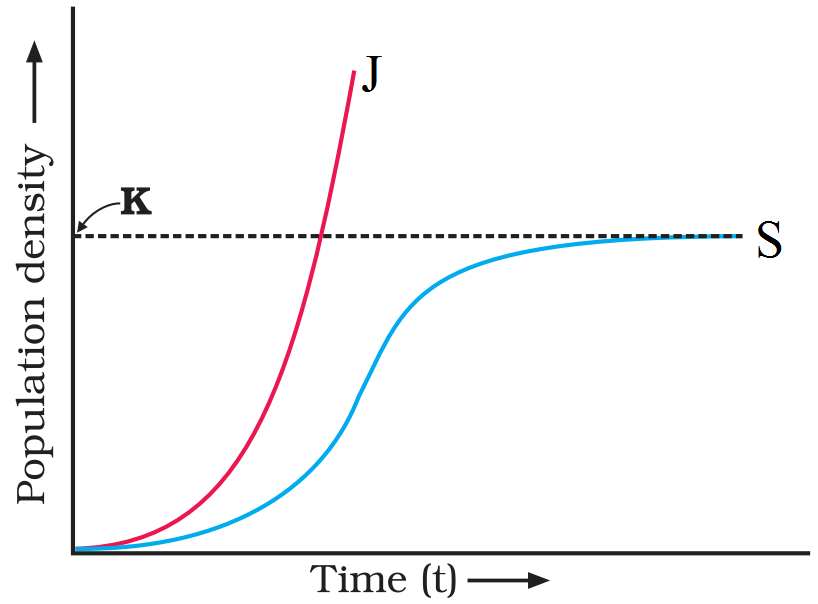
A forest hardly has any carnivores. Census of herbivorous mammals was taken and plotted as a graph shown below:

Identify the curve that will explain the population growth of herbivores. Give reasons for your answer.
Answer
  1. The curve J will explain the population growth of herbivores.
  2. In the absence of camivores, the number of herbivores will keep on increasing exponentially; hence, an enormous population density is reached in a short time.
View full question & answer