Questions

2 Marks Questions

Take a timed test

56 questions · 5 auto-graded MCQ + 51 self-marked written.

Question 12 Marks
Copper can be extracted by hydrometallurgy but not zinc. Explain.
Answer
Hydro metallurgy method is based on the fact that more electropositive metals displace less electro positive metals from their salt solution. Copper is precipitated from copper sulphate solution by adding iron.
$\text{CuS}\text{O}_4+\text{Fe}\rightarrow\text{FeS}\text{O}_4+\text{Cu}\downarrow$
But Zinc is not precipitated from zinc sulphate solution by adding iron. Hence copper can be extracted by hydro metallurgy but not zinc.
View full question & answer
Question 22 Marks
Giving examples, differentiate between 'roasting' and 'calcination'.
Answer
Roasting is the process of converting sulphide ores to oxides by heating the ores in a regular supply of air at a temperature below the melting point of the metal. For example, sulphide ores of Zn, Pb, and Cu are converted to their respective oxides by this process.
$2\text{ZnS}+3\text{O}_2\xrightarrow[]{\ \ \Delta\ \ }2\text{ZnO}+2\text{SO}_2\\\text{Zinc blende}$
$2\text{Pbs}+3\text{O}_2\xrightarrow[]{\ \ \Delta\ \ }2\text{PbO}+2\text{SO}_2\\\text{Gelena}$
$2\text{Cu}_2\text{S}+3\text{O}_2\xrightarrow[]{\ \ \Delta\ \ }2\text{Cu}_2\text{O}+2\text{SO}_2\\\text{Copper glance}$
On the other hand, calcination is the process of converting hydroxide and carbonate ores to oxides by heating the ores either in the absence or in a limited supply of air at a temperature below the melting point of the metal. This process causes the escaping of volatile matter leaving behind the metal oxide. For example, hydroxide of Fe, carbonates of Zn, Ca, Mg are converted to their respective oxides by this process.
$\text{Fe}_2\text{O}_3.3\text{H}_2\text{O}\xrightarrow[]{\ \ \Delta\ \ }\text{Fe}_2\text{O}_3+3\text{H}_2\text{O}\\\ \ \text{Limonite}$
$\text{ZnCO}_{3(\text{s})}\xrightarrow[]{\ \ \Delta\ \ }\text{ZnO}_{(\text{s})}+\text{CO}_{2(\text{g})}\\\ \ \text{Calamine}$
$\text{CaMg}(\text{CO}_3)_2\xrightarrow[]{\ \ \Delta\ \ }\text{CaO}_{(\text{s})}+\text{MgO}_{(\text{s})}+2\text{CO}\\\ \ \text{Dolomite}$
View full question & answer
Question 32 Marks
Explain:
Column chromatography
Answer
Column Chromatography: In column chromatography an adsorbent $($e.g., $Al_2O_3)$ is packed in a glass column. The mixture to be separated or purified, taken in a suitable solvent, is applied on the top of the column. The components of the mixture get adsorbed on the column. They are then eluted out with a suitable eluent (Solvent). The weakly adsorbed component is eluted first followed by the more strongly adsorbed and so on. The method is especially suitale for such elements which are available only in minute quantities and the impurities are not very much different in their chemical behaviour from the element to be purified.
View full question & answer
Question 42 Marks
What is the role of graphite rod in the electrometallurgy of aluminium?
Answer
In the electrometallurgy of aluminium, oxygen gas is evolved at anode. $O_2$ reacts with graphite or carbon (graphite electrodes) to form carbon monoxide and carbon dioxide. In case if some other metal electrodes is used as anode, then oxygen will react with aluminium formed during the process to form aluminium oxide$(Al_20_3)$ which will pass into the reaction mixture resulting into wastage of $Al.$ Since graphite is cheaper than aluminium, its wastage or can be tolerated.
View full question & answer
Question 52 Marks
Why copper matte is put in silica lined converter?
Answer
Coppermatte contains $Cu_2$ Sand $FeS$. Copper matte is put in a silica-lined converter to remove the remaining $FeO$ and FeS present in the matte as slag $(FeSiO_3).$ Also, some silica is added to the silica-lined converter. Then, a hot air blast is blown. As a result, the remaining $FeS$ and $FeO$ are converted to iron silicate $(FeSiO_3)$ and $Cu_2S$ is converted into metallic copper.
$2FeS + 3O_2 → 2FeO + 2SO_2$
$FeO + SiO_2 → FeSiO_3$
$2Cu_2S + 3O_2 → 2Cu_2O + 2SO_2$
$2Cu_2O + Cu_2S → 6Cu + SO_2$
View full question & answer
Question 62 Marks
Why is zinc not extracted from zinc oxide through reduction using $CO?$
Answer
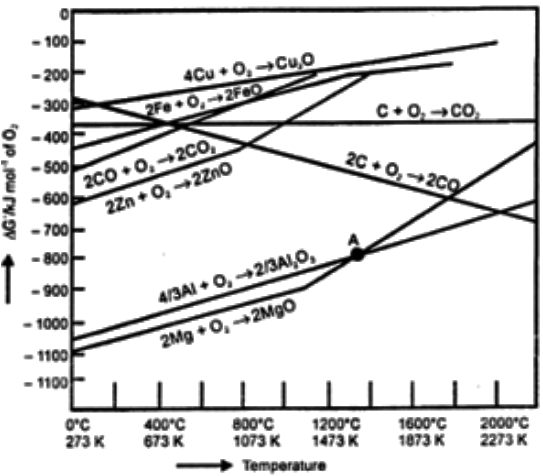
The standard Gibbs free energy of formation of $ZnO$ from $Zn$ is lower than that of $CO_2$ from $CO$. Therefore, $CO$ cannot reduce $ZnO$ to $Zn$. Hence, $Zn$ is not extracted from $ZnO$ through reduction using $CO$.
View full question & answer
Question 72 Marks
How can you separate alumina from silica in a bauxite ore associated with silica? Give equations, if any.
Answer
To separate alumina from silica in bauxite ore associated with silica, first the powdered ore is digested with a concentrated NaOH solution at $473-523K$ and $35-36$ bar pressure. This results in the leaching out of alumina $(Al_2O_3)$ as sodium aluminate and silica $(SiO_2)$ as sodium silicate leaving the impurities behind.
$\text{A}\text{l}_2\text{O}_{3(\text{s})}+2\text{NaOH}_{(\text{aq})}+3\text{H}_2\text{O}_{(1)}\rightarrow2\text{Na}\big[\text{Al}(\text{OH})_4\big]_{(\text{aq})}\\\text{Alumina}\ \ \ \ \ \ \ \ \ \ \ \ \ \ \ \ \ \ \ \ \ \ \ \ \ \ \ \ \ \ \ \ \ \ \ \ \ \ \ \ \ \ \ \ \ \ \ \ \ \ \ \text{sodium aluminate}$
$\text{SiO}_2+2\text{NaOH}_{(aq)}\rightarrow\text{Na}_2\text{SiO}_{3(\text{aq})}+\text{H}_2\text{O}\\\text{Silica}\ \ \ \ \ \ \ \ \ \ \ \ \ \ \ \ \ \ \ \ \ \ \ \ \ \ \ \ \text{Sodium silicate}$
Then, $CO_2$ gas is passed through the resulting solution to neutralize the aluminate in the solution, which results in the precipitation of hydrated alumina. To induce precipitation, the solution is seeded with freshly prepared samples of hydrated alumina.
$2\text{Na}\big[\text{Al}(\text{OH})_4\big]_{(\text{aq})}+\text{CO}_{2(\text{g})}\rightarrow\text{Al}_2\text{O}_3.\text{xH}_2\text{O}_{(\text{s})}+2\text{NaHCO}_{3(\text{aq})}\\\text{Sodium aluminate}\ \ \ \ \ \ \ \ \ \ \ \ \ \ \ \ \ \ \ \ \ \text{Hydrate alumina}\ \ \text{Sodium hydrogen carbonate}$
During this process, sodium silicate remains in the solution. The obtained hydrated alumina is filtered, dried, and heated to get back pure alumina.
$\text{Al}_2\text{O}_3.\text{xH}_2\text{O}_{(\text{s})}\xrightarrow[]{\ \ 1470\ \ \ }\text{Al}_2\text{O}_{3(\text{s})}+\text{xH}_2\text{O}_{(\text{g})}\\\text{Hydrated alumina}\ \ \ \ \ \ \ \ \ \text{Alumina}$
View full question & answer
Question 82 Marks
The value of $\Delta_{\text{f}}\text{G}^\ominus$ for formation of $Cr_2O_3$ is $-540\ kJ\ mol^{-1}$ and that of $Al_2O3$ is $-827\ kJ\ mol^{-1}.$ Is the reduction of $Cr_2O_3$ possible with Al?
Answer
Chemical equation for the formation of $Cr_2O_3$ and $Al_2O_3$ are as follows:
  1. $\frac{4}{3}\text{Cr}_{(\text{s})}+\frac{3}{2}\text{O}_{2(\text{g})}\rightarrow\frac{2}{3}\text{Cr}_2\text{O}_{3(\text{s})};\ \ \Delta\text{G}^{\circ}_{\text{f}}=-540\text{kJ mol}^{-1}$
  2. $\frac{4}{3}\text{Al}_{(\text{s})}+\frac{3}{2}\text{O}_{2(\text{g})}\rightarrow\frac{2}{3}\text{Al}_2\text{O}_{3(\text{s})};\ \ \Delta\text{G}^{\circ}_{\text{f}}=-827\text{kJ mol}^{-1}$
Substrating equation (a) from equation (b), we get
$\frac{4}{3}\text{Al}_{(\text{s})}+\frac{2}{3}\text{Cr}_2\text{O}_{3(\text{s})}\rightarrow\frac{2}{3}\text{Al}_2\text{O}_{3(\text{s})}+\frac{4}{3}\text{Cr}_{(\text{s})}\ \ \ \Delta\text{G}^{\circ}=-287\text{kJ mol}^{-1}$
As can be seen $\Delta_{\text{r}}\text{G}^{\circ}$ is negative, thus, reduction of $Cr_2O_3$ by Al is possible.
View full question & answer
Question 92 Marks
Which of the ores mentioned in Table can be concentrated by magnetic separation method?
Metal Ores Components
Aluminium Bauxite $AlO_x(OH)3-2x$
$[$where $0 < x < 1]$
Iron
Kaolinite $(a$ form of clay$)$
Haematite
Magnetite
Siderite
Iron pyrites
$[Al_2(OH)_4Si_2O_5]$
$Fe_2O_3$
$Fe_3O_4$
$FeCO_3$
$FeS_2$
Copper
Copper pyrites
Malachite
Cuprite
Copper glance
$CuFeS_2$
$CuCO_3.Cu(OH)_2$
$Cu_2O$
$Cu_2S$
Zinc
Zinc blende or Sphalerite
Calamine
Zincite
$ZnS$
$ZnCO_3$
$ZnO$
Answer
If the ore or the gangue can be attracted by the magnetic field, then the ore can be concentrated by the process of magnetic separation. Among the ores mentioned in table $6.1,$ the ores of iron such as haematite $(Fe_2O_3),$ magnetite $(Fe_3O_4),$ siderite $(FeCO_3),$ and iron pyrites $(FeS_2)$ can be separated by the process of magnetic separation.
View full question & answer
Question 102 Marks
Predict conditions under which Al might be expected to reduce $MgO.$
$($Hint: See Intext question $6.4)$
Answer
The equations for the formation of the two oxides are
$4/3Al(s) + O_2(s) → 2/3Al_2O_3(s)$
$2Mg(s) + O_2(s) → 2MgO(s)$
If we look at the plots for the formation of the two oxides of the Ellingham diagram, we find that they intersect at certain point. The corresponding value of $\Delta\text{G}^{\circ}$ becomes zero for the reduction of $MgO$ by $Al$ metal.
$2\text{MgO}(\text{s})+4/3\text{Al(s)}\rightleftharpoons2\text{Mg}(\text{s})+2/3\text{Al}_2\text{O}_3(\text{s})$
This means that the reduction of $MgO$ by Al metal can occur below this temperature. Aluminium (Al) metal can reduce $MgO$ to $Mg$ above this temperature because $\Delta^{\circ}\text{G}$ for $Al_20_3$ is less as compared to that of $MgO.$
$3\text{MgO}(\text{s})+2\text{Al}(\text{s})\xrightarrow[]{(>1665\text{k})}\text{Al}_2\text{O}_3(\text{s})+3\text{Mg}(\text{s})$
View full question & answer
Question 112 Marks
Explain: Zone refining
Answer

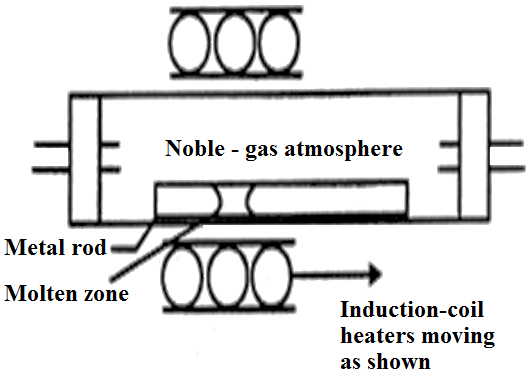
Zone refining: The method is based on the principle that the impurities are more soluble in the melt than in the solid state of the metal. A circular mobile heater is fixed at one end of a rod of impure metal. The molten zone moves along with the heater which is moved forward. As the heater moves forward, the pure metal crystallizes out of the metal and the impurities pass on into the adjacent molten zone. The process is repeated several times and the heater is moved in the same direction. At one end impurities get con-centrated. This end is cut off. In this way, the impu-rities are swept from one end of the bar to the other. By repeating the process, ultra pure metal of silicon, germanium etc are obtained.
View full question & answer
Question 122 Marks
Outline the principles of refining of metals by the following methods:
Zone refining
Answer
Zone refining: This method is used for production of semiconductors and other metals of very high
purity, e.g., Ge, Si, B, Ca and In.
It is,based on the principle that the impurities are more soluble in the molten state (melt) than in the solid state of the metal.
The impure metal in the form of bar is heated at one end with a moving circular heater. As the heater is slowly moved along the length of the rod, the pure metal crystallises out of the melt whereas the impurities pass into the adjacent molten zone. This process is repeated several times till the impurities are completely driven to one end of the rod which is then cut off and discarded.
View full question & answer
Question 132 Marks
Outline the principles of refining of metals by the following methods:
Electrolytic refining
Answer
Electrolytic refining: Many metals, such as Cu, Ag, Au, Al, Pb, etc., are purified by this method. The irnpun metals is made the anode while a thin sheet of pure metal acts as a cathode. The electrolytic solution consists of a salt or a complex salt solution of the metal. On passing the current, the pure metal is deposited on the cathode while the impurities fall down as anode mud.
View full question & answer
Question 142 Marks
How is leaching carried out in case of low grade copper ores?
Answer
In case of low grade copper ores, leaching is carried out using acid or bacteria in the presence of air. In this process, copper goes into the solution as $Cu^{2+}$ ions.
$\text{Cu}_{(\text{s})}+2\text{H}^+_{(\text{aq})}+\frac{1}{2}\text{O}_{2(\text{g})}\rightarrow\text{Cu}^{2+}_{(\text{aq})}+2\text{H}_2\text{O}_{(\text{l})}$
The resulting solution is treated with scrap iron or 2 H to get metallic copper.
$\text{Cu}^{2+}_{(\text{aq})}+\text{H}_{2(\text{g})}\rightarrow\text{Cu}_{(\text{s})}+2\text{H}^+_{(\text{aq})}$
View full question & answer
Question 152 Marks
The choice of a reducing agent in a particular case depends on thermodynamic factor. How far do you agree with this statement? Support your opinion with two examples.
Answer
We can study the choice of a reducing agent in a particular case using Ellingham diagram. It is evident from the diagram that metals for which the standard free energy of formation oftheir oxides is more negative can reduce those metal oxides for which the standard free energy of formation of their respective oxides is less negative. It means that any metal will reduce the oxides of other metals which lie above it in the Ellingham diagram. This is because the standard free energy change $(\Delta_{\text{r}}\text{G}^{\circ})$ of the combined redox reaction will be negative by an amount equal to the difference in $\Delta_{\text{f}}\text{G}^{\circ}$ of the two metal oxides. Thus both Al and $Zn$ can reduce $FeO$ to Fe but Fe cannot reduce $Al_2O_3$ to $A1$ and $ZnO$ to $Zn$. In the same way, G can reduce $ZnO$ to Zn but not $CO.$
Note: Only that reagent will be preferred as reducing agent which will lead to decrease in free energy value $(\Delta\text{G}^{\circ})$ at a certain specific temperature.
View full question & answer
Question 162 Marks
Name the common elements present in the anode mud in electrolytic refining of copper. Why are they so present?
Answer
Selonium, tellurium, silver, gold and platinum are the elements present in the anode mud in electrolytic refining of copper.
These elements are less reactive than copper, hence does not participate in electrolytic refining process.
Hence, they settle down below the anode as anode mud.
View full question & answer
Question 172 Marks
State the role of silica in the metallurgy of copper.
Answer
During the roasting of pyrite ore, a mixture of $FeO$ and $Cu_2O$ is obtained.
$2\text{CuFe}\text{S}_2+\text{O}_2\xrightarrow[]{\Delta}\text{Cu}_2\text{S}+2\text{FeS}+2\text{S}\text{O}_2$
$2\text{Cu}_2\text{S}+3\text{O}_2\xrightarrow[]{\Delta}2\text{Cu}_2\text{O}+2\text{S}\text{O}_2$
$2\text{Fe}+3\text{O}_2\xrightarrow[]{\Delta}\text{Fe}\text{O}+2\text{S}\text{O}_2$
The role of silica in the metallurgy of copper is to remove the iron oxide obtained during the process of roasting as 'slag'. $FeS$ obtained from roasting iron sulphide ore is converted into $FeO$ which forms iron silicate with silica $(SiO_2).$ Thus $FeO$ is removed as $FeSiO_3$(slag).
$\text{FeO}\big(\text{s}\big)+\text{Si}\text{O}_2\xrightarrow[]{\Delta}\text{Fe}\text{Si}\text{O}_3\big(\text{s}\big)$
View full question & answer
Question 182 Marks
What is meant by the term "chromatography"?
Answer
It is the technique of separating the components of a mixture in which separation is achieved by the differential movement of individual components through a stationary phase under the influence of a mobile phase. The stationary is made of aluminum oxide or silica gel.
View full question & answer
Question 192 Marks
Out of $C$ and $CO$, which is a better reducing agent for $ZnO?$
Answer
The two reduction reactions are:
$ZnO(s) + C(s) → Zn(s) + CO(g) ...(i)$
$ZnO(s) + CO(g) → Zn(s) + CO_2(g) ....(ii)$

In the first case, there is increase in the magnitude of $\Delta\text{S}^{\circ}$ while in the second case, it almost remains the same. In other words, $\Delta\text{G}^{\circ}$will have more negative value in the first case when $C(s)$ is used as the reducing agent than in the second case when $CO(g)$ acts as the reducing agent. Therefore, $C(s)$ is a better reducing agent.
View full question & answer
Question 202 Marks
How is 'cast iron' different from 'pig iron'?
Answer
The iron obtained from blast furnaces is known as pig iron. It contains around 4% carbon and many impurities such as S, P, Si, Mn in smaller amounts. Cast iron is obtained by melting pig iron and coke using a hot air blast. It contains a lower amount of carbon (3%) than pig iron. Unlike pig iron, cast iron is extremely hard and brittle.
View full question & answer
Question 212 Marks
The reaction, $\text{Cr}_2\text{O}_3+2\text{Al}\rightarrow\text{Al}_2\text{O}_3+2\text{Cr}\ \ \ \ \ (\Delta\text{G}^{\ominus}=-421\text{ kJ})$ is thermodynamically feasible as is apparent from the Gibbs energy value. Why does it not take place at room temperature?
Answer
The change in Gibbs energy is related to the equilibrium constant, K as
$\Delta\text{G}=-\text{RTln}\Delta\text{G}=-\text{RT lnk}$
At room temperature, all reactants and products of the given reaction are in the solid state. As a result, equilibrium does not exist between the reactants and the products. Hence, the reaction does not take place at room temperature. Certain amount of activation energy is essential even for such reactions which are thermodynamically feasible.
View full question & answer
Question 222 Marks
Name the processes from which chlorine is obtained as a by-product. What will happen if an aqueous solution of $NaCl$ is subjected to electrolysis?
Answer
Down process is used for the preparation of sodium metal, where chlorine is obtained as a by- process. This -process involves the electrolysis of a fused mixture of $NaCl$ and $CaCl_2$ at $873$ K.Sodium is discharcge at the cathode while $Cl_2$ is obtained at the anode as a by-product.
$\text{NaCl}(\text{l})\xrightarrow[]{\text{Electrilysis}}\text{Na}^+(\text{melt})+\text{Cl}^{-}(\text{melt})$
$\text{At cathod}:\text{Na}^++\text{e}^-\rightarrow\text{Na}$
$\text{At anode}:\text{Cl}^-\rightarrow\frac{1}{2}\text{Cl}_2+\text{e}^-$
If, an aqueous solution of $NaCl$ is electrolysed, $H_2$ is evolved at the cathode while $Cl_2$ is obtained at the anode.
View full question & answer
Question 232 Marks
What criterion is followed for the selection of the stationary phase in chromatography?
Answer
The stationary phase is selected in such a way that the components of the sample have different solubility's in the phase. Hence, different components have different rates of movement through the stationary phase and as a result, can be separated from each other.
View full question & answer
Question 242 Marks
Differentiate between "minerals" and "ores".
Answer
Minerals are naturally occurring chemical substances containing metals. They are found in the Earth's crust and are obtained by mining.
Ores are rocks and minerals viable to be used as a source of metal.
For example, there are many minerals containing zinc, but zinc cannot be extracted profitably (conveniently and economically) from all these minerals.
Zinc can be obtained from zinc blende $(ZnS),$ calamine $(ZnCO_3),$ Zincite $(ZnO)$ etc.
Thus, these minerals are called ores of zinc.
View full question & answer
Question 252 Marks
Why is the extraction of copper from pyrites more difficult than that from its oxide ore through reduction?
Answer
In the graph of $\triangle _rG^\circ$ Vs T for the formation of oxides, the $Cu_2O$ line is almost at the top. So it is quite easier to reduce oxide ores of copper directly to the metal by heating with coke $($both the lines of $C,\ CO$ and $C,\ CO_2$ are at much lower positions in the graph particularly after $500-600K).$
However sulphide ores are roasted/smelted to give oxides.
$2Cu_2S + 3O_2 → 2Cu_2O + 2SO_2$
The oxide can then be easily reduced to metallic copper using coke.
$Cu_2O + C → 2Cu + CO$​​​​​​​
View full question & answer
Question 262 Marks
Is it true that under certain conditions, $Mg$ can reduce $SiO_2$ and Si can reduce $MgO?$ What are those conditions?
Answer
$\text{Mg}_{(\text{s})}+\frac{1}{2}\text{O}_{(\text{g})}\rightarrow\text{MgO}_{(\text{s})}\Big[\Delta\text{G}_{(\text{Mg},\ \text{MgO})}\Big]$
$\text{Si}_{(\text{s})}+\text{O}_{2(\text{g})}\rightarrow\text{SiO}_{2(\text{s})}\Big[\Delta\text{G}_{(\text{Si},\ \text{Sio}_2)}\Big]$
The temperature range in which $\Delta\text{G}_{(\text{Mg},\ \text{MgO})}$ is lesser than $\Delta\text{G}_{(\text{Si},\ \text{Sio}_2)}$ $Mg$ can also reduce to $SiO_2$ to $Si.$
$2\text{Mg}+\text{SiO}_2\Rightarrow2\text{MgO}+\text{Si};\ \ \Delta\text{G}^{\ominus}=-\text{ve}$
On the other hand, the temperatures range in which $\Delta\text{G}_{(\text{Si},\ \text{Sio}_2)}$ us less than $\Delta\text{G}_{(\text{Mg},\ \text{MgO})},$ Si can reduce $MgO$ to $Mg.$
$\text{SiO}_2+2\text{Mg}\rightarrow\text{SiO}_2+2\text{Mg};\ \ \Delta\text{G}^{\ominus}=-\text{ve}$
The temperature at which $\Delta_{\text{f}}\text{G}$ curves of these two substances intersect is $1966K$. Thus, at temperatures less than $1966K,$ $Mg$ can reduce $SiO_2$ and above $1966K$, Si can reduce $MgO.$
View full question & answer
Question 272 Marks
Describe the role of the following:
  1. $SiO_2$ in the extraction of copper from copper matte.
  2. $NaCN$ in froth floatation process.
Answer
  1. It acts as Flux to remove iron oxide as silicate $($slag$) / FeO + SiO_2→ FeSiO_3 ($Slag$).$
  2. $NaCN$ acts as the depressant. It selectively prevents $ZnS$ from coming to the froth but allows $PbS$ to come with the froth.
View full question & answer
Question 282 Marks
Explain the principle of the method of electrolytic refining of metals. Give one example.
Answer
In this method, the impure metal is made to act as anode. A strip of the same metal in pure form is used as cathode. They are put in a suitable electrolytic bath containing soluble salt of the same metal. Pure metal is deposited at the cathode and impurities remain in the solution.For example: electro refining of Cu, Ag, Au.
View full question & answer
Question 292 Marks
  1. Name the method used for removing gangue from sulphide ores.
  2. How is wrought iron different from steel?
Answer
  1. Froth Float ation Method.
  2. Wrought iron is the pure form of iron & Steel is an alloy of iron.
View full question & answer
Question 302 Marks
Which methods are usually employed for purifying the following metals:
  1. Nickel.
  2. Germanium.
Mention the principle behind each one of them.
Answer
  1. Nickel:- Mond Process
Principle the metal is converted into its volatile compound which is then decomposed to give pure metal at higher temperature.
  1. Germanium:- Zone refining
    Principle that the impurities are more soluble in the melt than in the solid state of the metal.
View full question & answer
Question 312 Marks
Describe the underlying principle of each of the following metal refining methods:
  1. Electrolytic refining of metals.
  2. Vapour phase refining of metals.
Answer
  1. Electrolytic refining: Crude metal is made as anode and pure metal as cathode. When current is passed through electrolyte of same metal ions then pure metal gets deposited at cathode and impurities settle at bottom of anode.
  2. Vapour phase refining of metals: Crude metal is freed from impurities by first converting it into a volatile compound which decomposes into a pure metal on heating.
View full question & answer
Question 322 Marks
write the principle behind the following methods of refining:
  1. Hydraulic washing.
  2. Vapour phase refining.
Answer
  1. Hydraulic washing: This is based on the differences in gravities of the ore and the gangue particles.
  2. Vapour phase refining: In this, the metal forms a volatile compound which on further heating at higher temperature decomposes to pure metal.
View full question & answer
Question 332 Marks
Outline the principles behind the refining of metals by the following methods:
  1. Zone refining method.
  2. Chromatographic method.
Answer
  1. Impurities are more soluble in melt than in solid state of the metal.
  2. Different components of a mixture are differently adsorbed on an adsorbent.
View full question & answer
Question 342 Marks
What happens when:
  1. $PCl_5$ is heated?
  2. $H_3PO_3$ is heated?
Write the reactions involved.
Answer
  1. $\text{PCl}_{5}\xrightarrow{heat}\text{PCl}_{3}+\text{PCl}_{2}$
  2. $\text{4H}_{3}\text{PO}_{3}\xrightarrow{heat}\text{3H}_{3}\text{PO}_{4}+\text{PH}_{3}$
View full question & answer
Question 352 Marks
Describe the principle involved in each of the following processes.
  1. Mond process for refining of Nickel.
  2. Column chromatography for purification of rare elements.
Answer
  1. Ability of Nickel to form volatile compound which can decompose on further heating.
  2. Different components of a mixture are differently adsorbed on an adsorbent.
View full question & answer
Question 362 Marks
Write down the reactions taking place in Blast furnace related to the metallurgy of iron in the temperature range 500-800K.
Answer
The following reactions take place in blast furnace during the metallurgy of iron at the temperature range 500-800 K.
$3\text{Fe}_{2}\text{O}_{3}+\text{CO}\ \xrightarrow{\ \ \ \ \ \ \ }2\text{Fe}_{3}\text{O}_{4}+\text{CO}_{2}$
$\text{Fe}_{3}\text{O}_{3}+\text{CO}\ \xrightarrow{\ \ \ \ \ \ \ }3\text{FeO}+\text{CO}_{2}$
$\text{Fe}_{2}\text{O}_{3}+\text{CO}\ \xrightarrow{\ \ \ \ \ \ }2\text{FeO}+\text{CO}_{2}$
View full question & answer
Question 372 Marks
Explain the following:
Carbon and hydrogen are not used as reducing agents at high temperatures.
Answer
At the high temperature carbon and hydrogen rect with metals to from carbides and hydrides respectively hence they are not used reding agents.
View full question & answer
Question 382 Marks
Why are sulphide ores converted to oxide before reduction?
Answer
Sulphides are not easily reduced while oxides are easily reduced. Due to this, sulphides are first oxidised and then subjected to reduction.
View full question & answer
MCQ 392 Marks
Note: In the following questions a statement of assertion followed by a statement of reason is given. Choose the correct answer out of the following choices.
Assertion: Zone refining method is very useful for producing semiconductors.
Reason: Semiconductors are of high purity.
  • A
    Both assertion and reason are true and reason is the correct explanation of assertion.
  • Both assertion and reason are true but reason is not the correct explanation of assertion.
  • C
    Assertion is true but reason is false.
  • D
    Assertion is false but reason is true.
Answer
Correct option: B.
Both assertion and reason are true but reason is not the correct explanation of assertion.
Zone refining method is very useful for producing semiconductor and other metals of very high purity, e.g., germanium.
View full question & answer
MCQ 402 Marks
Note: In the following questions a statement of assertion followed by a statement of reason is given. Choose the correct answer out of the following choices.
Assertion: Sulphide ores are concentrated by Froth Flotation method.
Reason: Cresols stabilise the froth in Froth Flotation method.
  • A
    Both assertion and reason are true and reason is the correct explanation of assertion.
  • Both assertion and reason are true but reason is not the correct explanation of assertion.
  • C
    Assertion is true but reason is false.
  • D
    Assertion is false but reason is true.
Answer
Correct option: B.
Both assertion and reason are true but reason is not the correct explanation of assertion.
Sulphide ores are concentrated by froth floatation process. This process is used for removing gangue from sulphide ore.
View full question & answer
Question 412 Marks
Which method is used for refining Zr and Ti? Explain with equation.
Answer
Van Arkel method is used for refining Zr and Ti. In this method crude metal is heated with iodine to form volatile unstable compound. The compound is then decomposed to get pure metal.
$\text{Zr}(\text{s})+2\text{I}_{2}\ \xrightarrow{\ \ \ \ \ }\text{ZrI}_{4}$
$\text{ZrI}_{4}\ \xrightarrow{\ \ \ \ \ }\text{Zr}(\text{s})+2\text{I}_{2}$
$\text{Ti}+2\text{I}_{2}\ \xrightarrow{\ \ \ \ \ }\text{TiI}_{4}(\text{g})$
$\text{TiI}_{4}\ \xrightarrow{\ \ \ \ \ \ \ }\text{Ti}+2\text{I}_{2}$
View full question & answer
Question 422 Marks
Explain the following:
$CO_2$ is a better reducing agent below $710K$ whereas $CO$ is a better reducing agent above $710K.$
Answer
According to Ellingham diagram, at temperature below $710K,$
$\triangle\text{G}^{0}_{(\text{C, CO}_{2})} < \triangle\text{G}^{0}_{(\text{C, CO})}$
Hence $CO_2$ is better reducing agent. At above $710K,$ $\triangle\text{G}^{0}_{(\text{C, CO}_{2})} < \triangle\text{G}^{0}_{(\text{C, CO})}$ Hence, $CO$ is brtter agent.
View full question & answer
Question 432 Marks
Why is sulphide ore of copper heated in a furnace after mixing with silica?
Answer
Iron oxide present as impurity in sulphide ore of copperforms slag which is iron silicate and copper is produced in the form of copper matte.
$\text{FeO}+\text{SiO}_{2}\ \xrightarrow{\ \ \ \ \ \ \ }\text{FeSiO}_{3}$
View full question & answer
Question 442 Marks
Explain the following:
Vapour phase refining method is used for the purification of Ti.
Answer
Ti reacts with iodine to from TiI$_4$ which is volatile and decomposes tp give Ti at high to give extra titanium.
$\text{Ti}+2\text{I}_{2}\ \xrightarrow{530\text{K}}\text{TiI}_{4}\ \xrightarrow{{1800\text{K}}}\text{Ti}+2\text{I}_{2}$
View full question & answer
Question 452 Marks
Write two basic requirements for refining of a metal by Mond process and by Van Arkel Method.
Answer
Two basic requirements of both processes are:
  1. The metal should form a volatile compound with an available reagent.
  2. The volatile compound should be easily decomposable, so that the recovery of metal is easy.
View full question & answer
MCQ 462 Marks
Note: In the following questions a statement of assertion followed by a statement of reason is given. Choose the correct answer out of the following choices.
Assertion: Zirconium can be purificed by Van Arkel method.
Reason: $ZrI_4$ is volatile and decomposes at $1800K.$
  • Both assertion and reason are true and reason is the correct explanation of assertion.
  • B
    Both assertion and reason are true but reason is not the correct explanation of assertion.
  • C
    Assertion is true but reason is false.
  • D
    Assertion is false but reason is true.
Answer
Correct option: A.
Both assertion and reason are true and reason is the correct explanation of assertion.
Explanation: van Arkel method is very useful for removing all the oxygen and nitrogen present in the form of impurity in certain metals like $Zr$ and $Ti.$ The crude metal is heated in an evacuated vessel with iodine. The metal iodide being more covalent, volatilises and then decomposes at $1800K$ to given pure $Zr.$
View full question & answer
MCQ 472 Marks
Note: In the following questions a statement of assertion followed by a statement of reason is given. Choose the correct answer out of the following choices.
Assertion: Hydrometallurgy involves dissolving the ore in a suitable reagent followed by precipitation by a more electropositive metal.
Reason: Copper is extracted by hydrometallurgy.
  • A
    Both assertion and reason are true and reason is the correct explanation of assertion.
  • Both assertion and reason are true but reason is not the correct explanation of assertion.
  • C
    Assertion is true but reason is false.
  • D
    Assertion is false but reason is true.
Answer
Correct option: B.
Both assertion and reason are true but reason is not the correct explanation of assertion.
Copper is extracted by hydrometallurgical process. In this process, salts of metal are dissolved in suitable solvent like water and then reduced by more electropositive element.
View full question & answer
Question 482 Marks
What should be the considerations during the extraction of metals by electrochemical method?
Answer
Generally two things are considered so that proper precautions can be taken.
  1. Reactivity of metal produced.
  2. Suitability of electrodes.
View full question & answer
MCQ 492 Marks
Note: In the following questions a statement of assertion followed by a statement of reason is given. Choose the correct answer out of the following choices.
Assertion: Nickel can be purified by Mond process.
Reason: Ni $(CO)_4$ is a volatile compound which decomposes at $460K$ to give pure $Ni.$
  • Both assertion and reason are true and reason is the correct explanation of assertion.
  • B
    Both assertion and reason are true but reason is not the correct explanation of assertion.
  • C
    Assertion is true but reason is false.
  • D
    Assertion is false but reason is true.
Answer
Correct option: A.
Both assertion and reason are true and reason is the correct explanation of assertion.
Nickel treated with carbon monoxide forms nickel tetracarbonyl $Ni\ (CO)_4$ while impurities are left behind. When the vapour of $Ni\ (CO)_4$ is heated at $460K,$ it is decomposed to give pure nickel while carbon monoxide is removed as gas.
View full question & answer
Question 502 Marks
Explain the following:
Generally sulphide ores are converted into oxides before reduction.
Answer
Sulphide ores cannot be reduced easily but oxide orde can be easily reduced, hrnce sulphild ores are grnerally converted into oxides brfore reduction.
View full question & answer
Question 512 Marks
How do we separate two sulphide ores by Froth Floatation Method? Explain with an example.
Answer
Two sulphide ores can be separated by adjusting proportion of oil to water or by using depressants. For example, in the case of an ore containing ZnS and PbS, the depressant NaCN is used. It forms complex with ZnS and prevents it from coming with froth but PbS remains with froth.
View full question & answer
Question 522 Marks
How are metals used as semiconductors refined? What is the principle of the method used?
Answer
Semiconducting metal is produced by zone refining method which is basedon the principle that the impurities are more soluble in melt than in the solid state of metals.
View full question & answer
Question 532 Marks
Give two requirements for vapour phase refining.
Answer
The two requirements for vapour phase refining are:
  1. The metal should form a volatile compound with an available reagent.
  2. The volatile compound should be easily decomposable so that the recovery is easy.
View full question & answer
Question 542 Marks
Explain the following:
Silica is added to the sulphide ore of copper in the reverberatory furnace.
Answer
Copper pyrites contain iron sulphide in addition to copper sulphide. in the reverberatory furnace copper ore is to given oxides. FeO is removed by adding silica from the matte containing $Cu_2S$ and FeS.
$2\text{FeS}+3\text{O}_{2}\ \xrightarrow{\ \ \ \ \ \ }2\text{FeO}+2\text{SO}_{2}$
$\text{FeO}+\text{SiO}_{2}\ \xrightarrow{\ \ \ \ \ \ \ \ }\text{FeSiO}_{3}$
View full question & answer
Question 552 Marks
What is a slag?
Answer
A slag is an easily fusible material which is formed when gangue still present in the roasted or the calcined ore combines with the flux. For example, in the metallurgy of iron, CaO (flux) combines with silica gangue to form easily fusible calcium silicate $(CaSiO_3)$ slag.
$CaCO_3 → CaO + CO_2$
$CaO + SiO_2 → CaSiO_3$ (slag)
View full question & answer
Question 562 Marks
How is copper extracted from low grade copper ores?
Answer
Copper is extracted by hydrometallurgy from low grade ores. It is leached out using acid or bacteria. The solution containing copper ions $(Cu^{+2})$ is treated with scrap iron, zinc or $H_2$ as:
$\text{Cu}^{2+}(\text{aq})+\text{H}_{2}(\text{g})\ \xrightarrow{\ \ \ \ \ \ \ }\text{Cu}(\text{s})+2\text{H}^{+}(\text{aq})$
$\text{Cu}^{2+}(\text{aq})+\text{Fe}(\text{s})\ \xrightarrow{\ \ \ \ \ \ \ }\text{Cu}(\text{s})+\text{Fe}^{+2}(\text{aq})$
In this way, copper, is obtained.
View full question & answer