Questions · Page 1 of 2

3 Marks Question

🎯

Test yourself on this topic

50 questions · timed · auto-graded

Question 13 Marks
  1. In which of the following does adsorption take place and why?
  1. Silica gel placed in the atmosphere saturated with water.
  2. Anhydrous $CaCl_2$ placed in the atmosphere saturated with water.
  1. How does $BF_3$ act as a catalyst in industrial process?
  2. Give an example of shape-selective catalysis.
Answer
  1. Adsorption takes place in Silica gel. In anhydrous $CaCl_2$ the water vapours are uniformly distributed throughout the body of this solid, whereas in Silica gel, it is retained only on the surface.
  2. It forms an intermediate complex due to its electron deficient nature or because it is a lewis acid.
  3. Zeolites are good shape selective catalysts.
View full question & answer
Question 23 Marks
  1. What are micelles? How do they differ from ordinary colloidal particles? Give two examples of micelles forming substances.
  2. State Hardy-Schulze rule.
Answer
  1.  
  1. Substances which behave as normal, strong electrolytes at low concentrations, but exhibit colloidal properties at higher concentrations due to formation of aggregate particles are known as micelles.
Alternate answer
Sr. No. Micelles Ordinary Colloids
$01$ Behave as normal electrolytes at low concentrations and as colloids at high concentration. Concentration does not affect the nature.
$02$ They have lyophobic and lyophilic parts in aggregation. No such polarity is present.
Examples of micelles are: concentrated solution of soap and synthetic detergents.
  1. It states that greater the valency of the active ions, the greater is its precipitating power e.g in the precipitation of –ve sol, $Al^{3+}$ ions are more effective than $Ba^{2+}$ or $Na^+$ ion.
View full question & answer
Question 33 Marks
Define the following terms:
  1. Lyophilic colloid.
  2. Zeta potential.
  3. Associated colloids.
Answer
  1. Liquid loving/solvent loving.
  2. Potential difference between the fixed layer and diffused/double layer of opposite charges.
  3. Some substances at higher concentration exhibit colloidal behaviour due to formation of aggregates. The aggregated particles thus formed are called associated colloids or micelles.
View full question & answer
Question 43 Marks
Write one difference in each of the following:
  1. Write the dispersed phase and dispersion medium of milk.
  2. Write one similarity between physisorption and chemisorption.
  3. Write the chemical method by which $Fe(OH)_3$ sol is prepared from $FeCl_3.$
Answer
  1. Dispersed phase-liquid, Dispersion medium – liquid.
  2. Both are surface phenomenon/both increase with increase in surface area.
  3. $\text{Hydrolysis}/\text{FeCl}_3+3\text{H}_2\text{O} \xrightarrow{\text{ }\text{ }\text{ }\text{hydrolysis }\text{ }\text{ }\text{ }}\text{ }\text{Fe(OH)}_3\text{(sol)+3HCl}$
View full question & answer
Question 53 Marks
Define adsorption with an example. Why is adsorption exothermic in nature? Write the types of adsorption based on the nature of forces between adsorbate and adsorbent.
Answer
The accumulation of molecular species at the surface rather than in the bulk of a solid or liquid is termed adsorption. eg: gas like $O_2,\ H_2,\ CO,\ Cl_2,\ NH_3$ or $SO_2$ is taken in a closed vessel containing powdered charcoal.
Due to bond formation/interaction between adsorbent and adsorbate Physical (van der Waal’s adsorption) & Chemical (Langmuir adsorption).
View full question & answer
Question 63 Marks
Write one difference in each of the following:
  1. Multimolecular colloid and Associated colloid.
  2. Coagulation and Peptization.
  3. Homogeneous catalysis and Heterogeneous catalysis.
Answer
  1.  
Multimolecular colloid Associated colloid
Aggregation of large number of small atoms or molecules. Aggregation of large number of ions in concentrated solutions.
  1.  
Coagulation Peptization
Settling down of colloidal particles. Conversion of precipitate into colloidal sol by adding small amount of electrolyte.
  1.  
Homogenous catalysis Heterogeneous catalysis
Reactants and catalyst are in same phase. Reactants and catalyst are in different phases.
View full question & answer
Question 73 Marks
What are emulsions? What are their different types? Give one example of each type.
Answer
These are liquid-liquid colloidal systems or the dispersion of one liquid in another liquid.
Types:
  1. Oil dispersed in water (O/W type) Example; milk and vanishing cream.
  2. Water dispersed in oil (W/O type) Example; butter and cream.
View full question & answer
Question 83 Marks
What are the characteristics of the following colloids? Give one example of each.
  1. Multimolecular colloids.
  2. Lyophobic sols.
  3. Emulsions.
Answer
  1. Multimolecular colloids are the aggregate of large number of atoms or smaller molecules held together by van der waal forces.
Example: Any metal sol, sulphur sol.
  1. Lyophobic sol: In which there is no affinity between disperse phase & dispersion medium.
Example: Any metal sol, $As_2S_3$ sol, $Fe(OH)_3$ sol.
  1. Emulsion: A colloidal system in which dispersed phase & dispersion medium both are liquids.
Example: Milk, Cod liver oil, Hair cream, vanishing cream, butter, cold cream.
View full question & answer
Question 93 Marks
Explain the following terms giving a suitable example for each:
  1. Aerosol.
  2. Emulsion.
  3. Micelle.
Answer
  1. Aerosol: A colloidal solution having a gas as the dispersion medium and a solid/liquid as the dispersed phase is called an aerosol. For example: Fog, Smoke, Dust.
  2. Emulsion: The colloidal solution in which both the dispersed phase and dispersion medium are liquids is called an emulsion. For example: Milk, Cold Cream.
  3. Micelles: There are some substances which at low concentrations behave as normal strong electrolytes, but at higher concentrations exhibit colloidal behaviour due to the formation of aggregates. The aggregated particles thus formed are called micelles. eg. Soap, Detergents.
View full question & answer
Question 103 Marks
Classify colloids where the dispersion medium is water. State their characteristics and write an example of each of these classes.
Answer
They are of two types
  1. Hydrophilic.
  2. hydrophobic.
The hydrophile sol is more stable and reversible while hydrophobic sol is less stable and is irreversible.
Hydrophilic sol e.g. $\rightarrow$ Starch, gum, gelatin etc.
Hydrobhobic sol e.g $\rightarrow$ metal sulphide, metal hydroxide.
View full question & answer
Question 113 Marks
Explain what is observed when
  1. An electric current is passed through a sol.
  2. A beam of light is passed through a sol.
  3. An electrolyte (say NaCl) is added to ferric hydroxide sol.
Answer
  1. Electrophoresis takes place when sol particles move towards opposite electrodes due to attraction.
  2. Tyndall effect will be observed due to scattering of light by colloidal particles.
  3. Coagulation takes place (due to neutralisation of charges.)
View full question & answer
Question 123 Marks
What happens in the following activities and why?
  1. An electrolyte is added to a hydrated ferric oxide sol in water.
  2. A beam of light is passed through a colloidal solution.
  3. An electric current is passed through a colloidal solution.
Answer
  1. Coagulation takes place due to neutralisation of charges.
  2. Tyndall effect will be observed due to scattering of light by colloidal particles.
  3. Electrophoresis takes place in which sol particles moves towards oppositely charged electrodes due to attraction.
View full question & answer
Question 133 Marks
Explain what is observed when:
  1. KCl, an electrolyte, is added to hydrated ferric oxide sol,
  2. An electric current is passed through a colloidal solution,
  3. A beam of light is passed through a colloidal solution.
Answer
  1. Ferric hydroxide sol is positively charged. By adding potassium chloride, the excess chloride ions neutralize its positive charge and cause it to coagulate.
  2. The dispersed phase and dispersion medium migrate towards oppositely charged electrodes (electrophoresis).
  3. The beam of light is scattered by colloidal particles(Tyndall effect).
View full question & answer
Question 143 Marks
Explain the following terms with a suitable example in each case:
  1. Shape-selective catalysis.
  2. Dialysis.
Answer
  1. Shape-Selective catalysis: The catalytic reaction that depends upon the pore structure of the catalyst and the size of the reactant and product molecules is called shape-selective catalysis e.g. zeolites.
  2. Dialysis: Removal of soluble impurities from sols by a semipermeable membrane is known as dialysis. e.g. ferric hydroxide sol is purified by this method.
View full question & answer
Question 153 Marks
Describe the following types of colloids, giving an example for each:
  1. Multimolecular colloids.
  2. Macromolecular colloids.
Answer
  1. Multimolecular colloids: When a large number of atoms or smaller molecules of a substance aggregate together to form species having size (with diameters less than 1nm) in the colloidal range are called multimolecular colloids. e.g. a gold sol, sulphur sol.
  2. Macromolecular colloids: When the size of the macromolecules may be in the colloidal range such systems are called macromolecular colloids. e.g. starch, cellulose, proteins, enzymes.
View full question & answer
Question 163 Marks
Write three differences between Physisorption and Chemisorption.
Answer
  Physisorption Chemisorption
1. Because of van der Waals forces. Caused by chemical bond formation.
2. Reversible. Irreversible.
3. Enthalpy of adsorption is low(20-40 kJ/mol). Enthalpy of adsorption is high(80-240)kJ/mol.
View full question & answer
Question 173 Marks
Define the following terms with an example in each:
  1. Lyophobic colloids.
  2. Homogeneous catalysis.
  3. O/W emulsion.
Answer
  1. The particles of the dispersed phase have no affinity for the dispersion medium/solvent repelling (hating) colloidal sols.
Example: metal and their sulphides
  1. The reactant and the catalyst are in the same phase.
$\text{CH}_3\text{COOCH}_3\text{(I)}+\text{H}_2\text{O(I)}\xrightarrow{ \text{ }\text{ }\text{HCL(I)}\text{ }\text{ }}\text{CH}_3\text{COOH(aq)}+\text{CH}_3\text{OH(aq)}$
  1. Oil is dispersed in water/Oil is dispersed phase and water is dispersion medium.
Ex- milk
View full question & answer
Question 183 Marks
Define the following terms:
  1. Sorption.
  2. Zeta potential.
  3. Kraft temperature.
Answer
  1. It is a process in which both adsorption and absorption can take place simultaneously.
  2. It is the potential difference between the fixed layer and the diffused/double layer of opposite charges around the colloidal particles.
  3. It is the temperature above which the formation of micelles takes place.
View full question & answer
Question 193 Marks
  1. Differentiate between adsorbtion and absorption.
  2. Out of $MgCl_2$ and $AlCl_3,$ which one is more effective in causing coagulation of negatively charged sol and why?
  3. Out of sulphur sol and proteins, which one forms multimolecular colloids?
Answer
  1.  
Adsorption Absorption
surface phenomena Bulk phenomena
The accumulation of molecular species at the surface rather than in the bulk of a solid or liquid is termed adsorption The substance is uniformly distributed throughout the bulk of the solid essentially a bulk phenomenon.
  1. $AlCl_{3},$ more positive charge/Hardy-Schulze rule.
  2. Sulphur.
View full question & answer
Question 203 Marks
Write one difference in each of the following:
  1. Lyophobic sol and Lyophilic sol.
  2. Solution and Colloid.
  3. Homogeneous catalysis and Heterogeneous catalysis.
Answer
  1. Lyophobic are liquid (dispersion medium)-hating and lyophilic are liquid (dispersion medium)-loving colloids.
  2. Solution is a Homogenous mixture while colloid is heterogeneous mixture/does not show Tyndall effect-shows Tyndall effect.
  3. Homogeneous catalysis: reactants and catalyst are in same phase-Heterogeneous catalysis: reactants and catalyst are not in same phase.
View full question & answer
Question 213 Marks
  1. Differentiate between adsorbtion and absorption.
  2. Out of $MgCl_2$ and $AlCl_3,$ which one is more effective in causing coagulation of negatively charged sol and why?
  3. Out of sulphur sol and proteins, which one forms multimolecular colloids?
Answer
  1.  
Adsorption Absorption
surface phenomena Bulk phenomena
The accumulation of molecular species at the surface rather than in the bulk of a solid or liquid is termed adsorption The substance is uniformly distributed throughout the bulk of the solid essentially a bulk phenomenon.
  1. $AlCl_{3},$ more positive charge/Hardy-Schulze rule.
  2. Sulphur.
View full question & answer
Question 223 Marks
Give reasons for the following observations:
  1. Leather gets hardened after tanning.
  2. Lyophilic sol is more stable than lyophobic sol.
  3. It is necessary to remove CO when ammonia is prepared by Haber's process.
Answer
  1. Mutual coagulation.
  2. Strong interaction between dispersed phase and dispersion medium or solvated layer.
  3. CO acts as a poison for catalyst.
View full question & answer
Question 233 Marks
  1. In reference to Freundlich adsorption isotherm write the expression for adsorption of gases on solids in the form of an equation.
  2. Write an important characteristic of lyophilic sols.
  3. Based on type of particles of dispersed phase, give one example each of associated colloid and multimolecular colloid.
View full question & answer
Question 243 Marks
Define each of the following terms:
  1. Micelles.
  2. Peptization.
  3. Desorption.
Answer
  1. Micelles: Micelles are associated colloids which show colloidal behaviour at high concentration and act as strong electrolytes at low concentration.
  2. Peptization: The process of converting a precipitate into colloidal sol by shaking itwith dispersion mediumin the presence of a small amount of electrolyte is called Peptization.
  3. Desorption: The process of removing an adsorbed substance froma surface onwhich it is adsorbed is called desorption.
View full question & answer
Question 253 Marks
Explain how the phenomenon of adsorption finds application in each ofthe following processes:
  1. Production of vacuum.
  2. Heterogeneous catalysis.
  3. Froth Floatation process.
Answer
  1. Production of vacuum: The remaining traces of air can be adsorbed by charcoal from a vessel to create a vacuum.
  2. Heterogeneous catalysis: Adsorption of reactants on the solid surface of the catalysts increases the rate of reaction.
  3. Froth floatation process: In this process, sulphide ore is concentrated by using pine oil which adsorbs the ore particles and imurities are wetted by water which settle at the bottom.
View full question & answer
Question 263 Marks
What is the difference between multi molecular and macromolecular colloids? Give one example of each type. How are associated colloids different from these two types of colloids?
Answer
Multimolecular colloids Macromolecular colloids
They are aggregates of molecules less than 1nm thick.
Example: Sulphur Sol.
They themselves are large molecules of colloidal dimensions.
Example: Starch.
Associated colloids – are those which at low concentration behave as normal electrolytes & at high concentration act as colloids.
View full question & answer
Question 273 Marks
How are the following colloids different from each other in respect of dispersion medium and dispersed phase? Give one example of each type.
  1. An aerosol.
  2. A hydrosol.
  3. An emulsion.
Answer
  1. -An aerosol is a colloidal solution of solid or liquid (dispersed phase) in gas (dispersion medium) eg smoke, dust, fog, mist, cloud.
  2. -A hydrosol is a colloidal solution of solid (dispersed phase) in water (dispersion medium) eg starch sol, protein sol, biological fluids.
  3. -An emulsion is a colloidal solution of liquid (dispersed phase) in liquid (dispersion medium) eg milk, cream.
View full question & answer
Question 283 Marks
What are lyophilic and lyophobic sols? Give one example of each type. Which one of these two types of sols is easily coagulated and why?
Answer
  • Lyophilic sols are solvent attracting sol.
Ex. Gum, gelatine, starch, rubber.
  • Lyophobic sols are solvent repelling sol.
Ex. Metal sols, metal sulphides.
Lyophobic sols are readily coagulated because they are not stable.
View full question & answer
Question 293 Marks
Explain the following terms giving a suitable example in each case:
  1. Emulsification.
  2. Homogeneous catalysis.
Answer
  1. Emulsification - The process of making an emulsion by mixing two liquids vigoursly is known as emulsification e.g. milk, vanishing cream, cold cream, butter, etc.
  2. Homogeneous catalysis – If the catalyst is present in the same phase as the reactant. The catalysis is called homogeneous catalysis.
$\text{2CH}_{3}\text{CH}_{2}\text{OH}\text{(l)}\xrightarrow{(conc)H_{2}SO_{4}(l)}\text{C}_{2}\text{H}_{5}\text{-O-C}_{2}\text{H}_{5}\text{(l)}+\text{H}_{2}\text{O}\text{(l)}$

$\text{2SO}_{2}\text{(g)}+\text{O}_{2}\text{(g)}\xrightarrow{NO(g)}\text{2SO}_{3}\text{(g)}.$
View full question & answer
Question 303 Marks
Define adsorption. Write any two features which distinguish physisorption from chemisorption.
Answer
Adsorption- The phenomenon of attraction and retention of the molecules of a substance on the surface of a liquid or a solid resulting into a higher concentration of the molecules on the surface is called adsorption.
Physisorption
Chemisorption
It usually takes place at low temperature and decreases with increasing temperature.
It takes place at relatively high temperatures.
It is not very specific i.e. all gases are adsorbed on all solids to some extent.
It is highly specific and takes place when there is some possibility of compound formation between the adsorbate and the adsorbent molecules.
Multi Molecular layers may be formed on the adsorbent.
Usually mono-molecular layer is formed on the absorbent.
View full question & answer
Question 313 Marks
  1. How can a colloidal solution and true solution of the same colour be distinguished from each other?
  2. List four applications of adsorption.
Answer
  1. When light beam is passed through both the solutions, path of light becomes visible in a colloidal solution (due to scattering of light by colloidal particles).
  2. Four applications of adsorption are following-
  1. In chromatography for separation of mixtures.
  2. Adsorption of toxic gases by activated charcoal in gas masks.
  3. Decolourization of cane sugar by animal charcoal.
  4. In heterogeneous catalysis.
View full question & answer
Question 323 Marks
Explain the following observations:
  1. Lyophilic colloid is more stable than lyophobic colloid.
  2. Coagulation takes place when sodium chloride solution is added to a colloidal solution of ferric hydroxide.
  3. Sky appears blue in colour.
Answer
  1. The strong force of attraction between the dispersed phase and the dispersion medium make lyophilic Sols more stable.
  2. Positive charge on $Fe(OH)_3$ sol particles get neutralised by $Cl^-$ ions from $NaCl.$
  3. Due to Tyndall effect/or the suspended particles in the atmosphere scatter the incident light.
View full question & answer
Question 333 Marks
What happens when,
  1. A freshly prepared precipitate of $Fe(OH)_3$ is shaken with a small amount of $FeCl_3$ solution?
  2. Persistent dialysis of a colloidal solution is carried out?
  3. An emulsion is centrifuged?
Answer
  1. When precipitate particles of $Fe(OH)_3$ added in small amount of $FeCl_3$ Reptization occur. The common ion $Fe^{+3}$ adsorbed on precipitate particles and converts to smaller colloidal particles.
  2. To increase the stability of colloids a small amount of electrolyte is added, so during the electrolyte almost remove and so the colloidal sol will coagulate.
  3. It the emulsion is centrifuged then it demulsified the immiscible mixture of two liquid and both get separate out.
View full question & answer
Question 343 Marks
Distinguish between physisorption and chemisorption on the basis of:
  1. Force of attraction.
  2. Temperature.
  3. Enthalpy of adsorption.
Answer
S.No.
Basis
Physiorption
Chemisorption
(a)
Force of attraction.
Weak van der Waal forces.
Strong chemical bonds.
(b)
Temperature.
Favourable at low temperature.
Increases till a certain temperature and then decreases afterwards.
(c)
Enthalpy of adsorption.
$\text{low}\ \Delta\text{H}_\text{adsorption}$
$\text{High}\ \Delta\text{H}_\text{adsorption}$
View full question & answer
Question 353 Marks
  1. ​​​​What is the role of activated charcoal in gas mask?
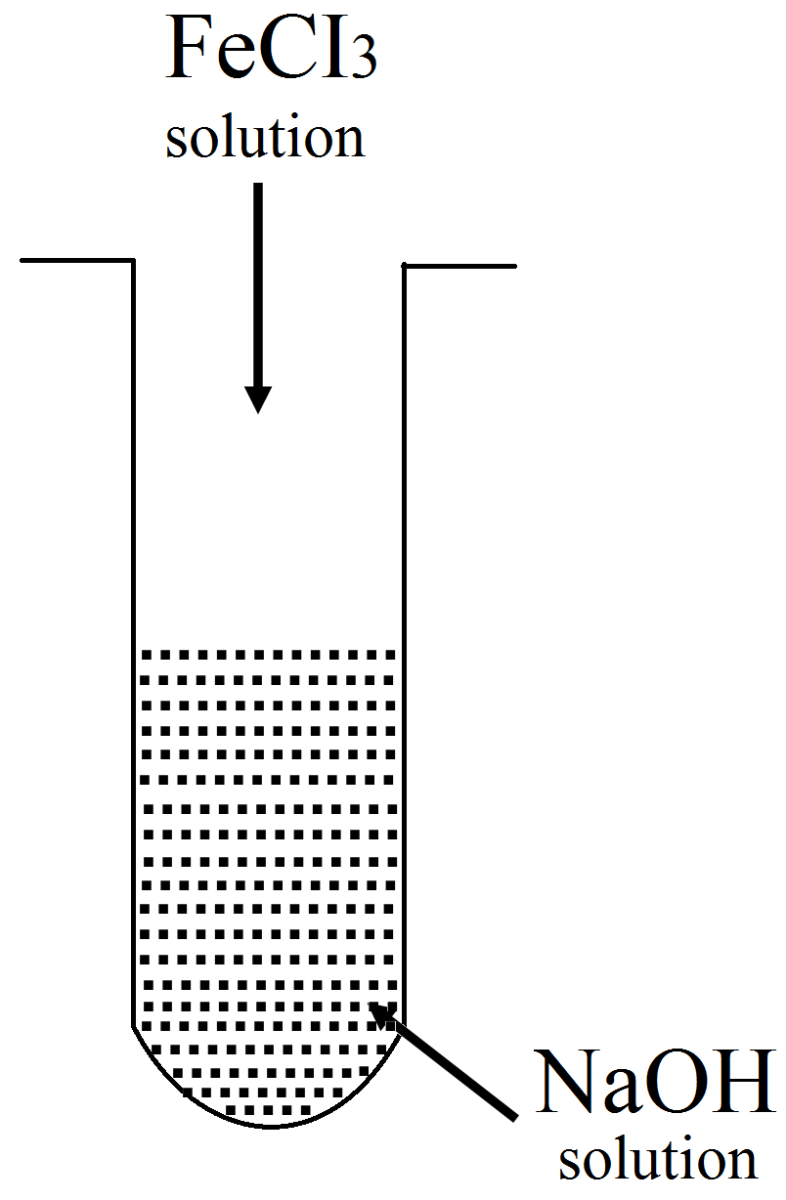
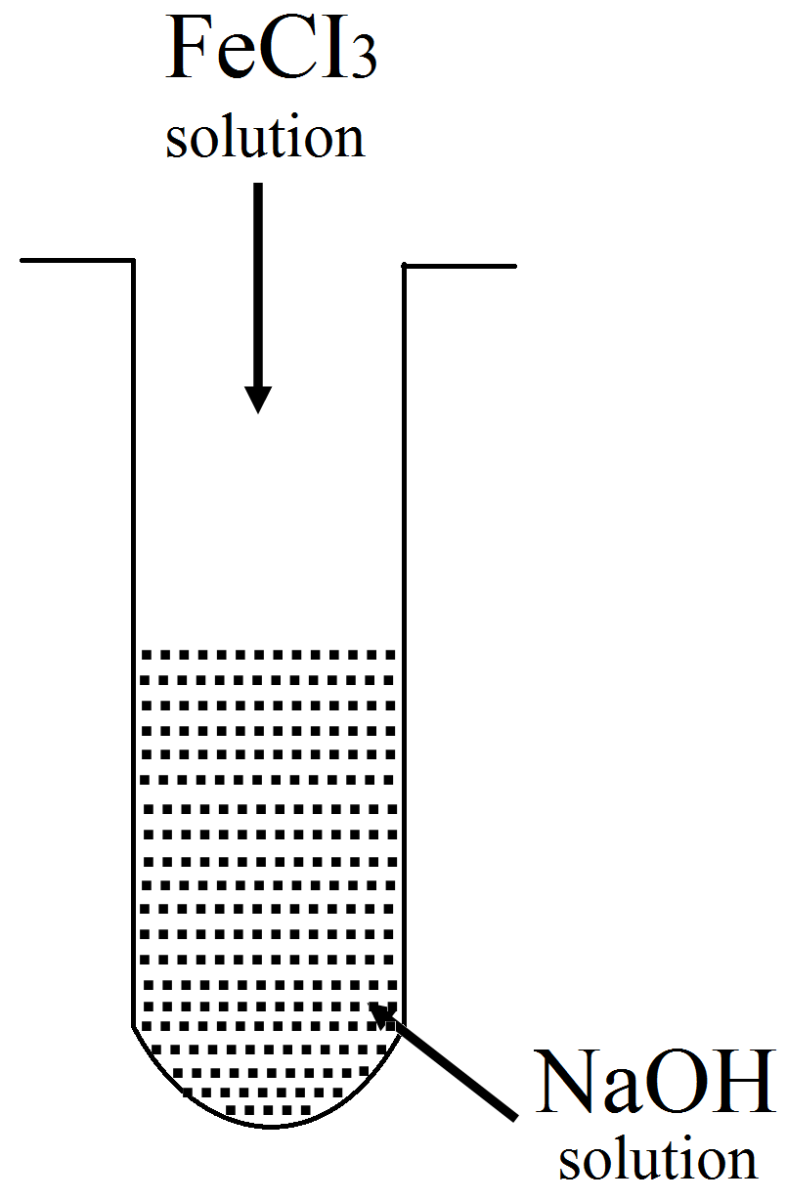
  2. A colloidal sol is prepared by the given method in figure. What is the charge on hydrated ferric oxide colloidal particles formed in the test tube? How is the sol represented?
  1. How does chemisorption vary with temperature?
Answer
  1. The activated charcoal containing gas masks are used by coal miners to protect them from the suffocating gases and particulate matter or ashes present in the coal mines. The activated carbon binds the materials by van der waal forces. Thus, chemical compounds with large molecules, large molecular weight and insolubility are easily absorbed.
  2. Colloidal particles usually adsorb those ions which are in excess and are common to its own lattice. This preferential adsorption of a particular type of ions imparts a particular type of charge to colloidal particles. When $FeCl_3$ is added in NaOH, the constituent of the sol is $Fe(OH)_3$ but the dispersion medium is having an excess of $OH^-$ ions. Hence, it gets preferentially adsorbed to the sol giving the overall negative charge. The sol is represented as $Fe_2O_3.xH_2O/ OH^-$
  1. Effect of temperature on chemisorption: Even though chemical adsorption is an exothermic process, but like most chemical changes, the extent of chemisorption increases with increase in temperature up to a certain limit and then after that, it starts decreasing.
View full question & answer
Question 363 Marks
  1. Compare physisorption and chemisorption on the basis of:
  1. Specificity.
  2. Enthalpy of adsorption.
  1. Differentiate between adsorption and absorption.
Answer
  1.  
S. No.
Basis
Physiorption
Chemisorption
(i)
Specificity
Not specific
Highly specific
(ii)
Enthalpy of adsorption
$\text{Low}\ \Delta\text{H}_\text{adsorption}$
$\text{High}\ \Delta\text{H}_\text{adsorption}$
  1. In adsorption, the substance is concentrated only at the surface while in absorption, the substance is uniformly distributed throughout the bulk of the solid/ adsorption is a surface phenomenon while absorption is a bulk phenomenon.
View full question & answer
Question 373 Marks
Give three points of difference between physisorption and chemisorption.
Answer
S. No.
Physisorption
Chemisorption
1.
Happens due to van der Waal forces.
Caused by a chemical bond.
2.
It's not specific in nature and reversible in nature.
Highly specific in nature and irreversible.
3.
It depends on the nature of the gas. More liquefiable gas is adsorbed easily.
Depend on the nature of the gas. those gases can react with the adsorbent show chemisorption.
4.
Enthalpy of adsorption is low around 20-40kJ/ mol.
Enthalpy if adsorption is high around 80-240kJ/ mol.
5.
Low temperature required.
High temperature is required.
6.
It depends on the surface area. Higher the area high in the process rate.
High activation energy is needed sometimes.
7.
Results in multimolecular layers on the adsorbent surface.
Result is unimolecular.
View full question & answer
Question 383 Marks
How will the rate of the reaction be affected when:
  1. Surface area of the reactant is reduced.
  2. Catalyst is added in a reversible reaction.
  3. Temperature of the reaction is increased?
Answer
  1. Decreases.
  2. Increases.
  3. Increases.
View full question & answer
Question 393 Marks
What are the applications of adsorption in chemical analysis?
Answer
Adsorption finds extensive applications both in research laboratory and in industry. A few applications are discussed below:
  1. In preserving vacuum: In Dewar flasks activated charcoal is placed between the walls of the flask so that any gas which enters into the annular space either due to glass imperfection or diffusion though glass is adsorbed.
  2. In glass masks: All gas masks are devices containing suitable adsorbent so that the poisonous gases present in the atmosphere are preferentially adsorbed and the air for breathing is purified.
  3. In clarification of sugar: Sugar is decolorized by treating sugar solution with charcoal powder. The latter adsorbs the undesirable colors present.
  4. In paint industry: The paint should not contain dissolved gases as otherwise the paint does not adhere well to the surface to be painted and thus will have a poor covering power. The dissolved gases are therefore, removed by suitable adsorbents during manufacture. Further, all surfaces are covered with layers of gaseous, liquid or solid films. These have to be removed before the paint is applied. This is done by suitable liquids which adsorbs these films. Such liquids are called wetting agents. The use of spirit as wetting agent in furniture painting is well known.
  5. In chromatographic analysis: The selective adsorbent of certain substances from a solution by a particular solid adsorbent has helped to develop technique for the separation of the components of the mixture. This technique is called chromatographic analysis. For example: in column chromatography a long and wide vertical tube is filled with a suitable adsorbent and the solution of the mixture poured from the top and then collected one by one from the bottom.
  6. In catalysis: The action of certain solids as catalysts is best explained in terms of adsorption. The theory is called adsorption theory. According to this theory, the gaseous reactants are adsorbed on the surface of the solid catalyst. As a result, the concentration of the reactants increases on the surface and hence the rate of reaction increases. The theory is also able to explain the greater efficiency of the catalyst in the finely divided state, the action of catalyst promoters and poisons.
  7. In adsorption indicators: Various dyes which owe their use to adsorption have been introduced as indicators particularly in precipitation titrations. For example: KBr is easily titrated with $AgNO_3$ using eosin as an indicator.
  8. In softening of hard water: The use of ion exchangers for softening of hard water is based upon the principle of competing adsorption just as in chromatography. In removing moisture from air in the storage of delicate instruments: Such instruments which may be harmed by contact with the moist air are kept out of contact with moisture using silica gel.
View full question & answer
Question 403 Marks
In reference to Freundlich adsorption isotherm write the expression for adsorption of gases on solids in the form of an equation.
Answer
Freundlich adsorption isotherm equation for adsorption of gases on solids:
$\frac{\text{x}}{\text{m}}=\text{kp}^\frac{1}{\text{n}}\ \ (\text{n > 1})$
or $\text{log} \ \frac{\text{x}}{\text{m}}=\text{log k}+\frac{1}{\text{n}}\text{log p}$
where x is the mass of the gas adsorbed on mass m of the adsorbent at pressure p, k and n are constants which depends on the nature of the gas and adsorbent at a particular temperature.
View full question & answer
Question 413 Marks
How are the colloidal solutions classified on the basis of physical states of the dispersed phase and dispersion medium?
Answer
Internal phase of Dispersed phase
External phase or Dispersion medium
Colloidal name
Example
Solid
Solid
Solid sols
Alloys, Ruby glass, Gems or precious stones, marbles, optical and vision glasses.
 
Liquid
sols
Muddy water, gold sol, protein, starch, agar, gelatin in water, paints, pigments in water.
 
Gas
Aerosols (or solids
Smoke, particulate clouds.
Liquid
Solids
Gels
Cheese, jems, jellies, plants, fruits, vegetables.
 
Liquid
Emulsions
Butter, milk, cosmetic products, e.g., shampoo, creams, emulsified oils, polish and medicines.
 
Gas
Aerosols (or liquids)
Fog, clouds, mist.
Gas
Solid
Solid foams
Pumicestone, styrene foam, foamed rubber, porous pot. thermocole rubber pillows and mattresses.
 
Liquid
Foams and froths
Lather, soap seeds, air bubble.
 
Gas
Homogeneous system
Do not exist as colloids.
View full question & answer
Question 423 Marks
What role does adsorption play in heterogeneous catalysis?
Answer
Adsorption plays an important role in heterogeneous catalysis. Adsorption is surface phenomenon in which the substances (reactants) get concentrated only on the surfaces of solid adsorbents and do not penetrate into it.This increases concentration of reactants and there is a great probability of occurrence of reaction. The catalyst adsorbs reactants and forms a intermediate compound known as activated complex. Following are various ways in which catalytic adsorption increases the reaction rate:
  1. The concentration of reactants on surface of solid adsorbent increases and it becomes easier for molecules to attack each other for effective collisions, forming products.
  2. A particular part of reactant molecule may come in contact with other molecules which otherwise is difficult.
  3. Some adsorbed molecules dissociate into atoms or free radicals which are very reactive and thus increase the reaction rate.
  4. Heat of adsorption released provides activation energy for formation of activated complex and then increase the rate of reaction.
View full question & answer
Question 433 Marks
How do size of particles of adsorbent, pressure of gas and prevailing temperature influence the extent of adsorption of a gas on a solid?
Answer
The influence is in the following ways:
  1. Smaller the size of the particles of the adsorbent, greater is the surface area and greater is the adsorption.
  2. At constant temperature, adsorption first increases with increase of pressure and then attains equilibrium at a high pressure.
  3. In physical adsorption, it decreases with increase of temperature but in chemisorption, first it increases and then decreases.
View full question & answer
Question 443 Marks
Discuss the effect of pressure and temperature on the adsorption of gases on solids.
Answer
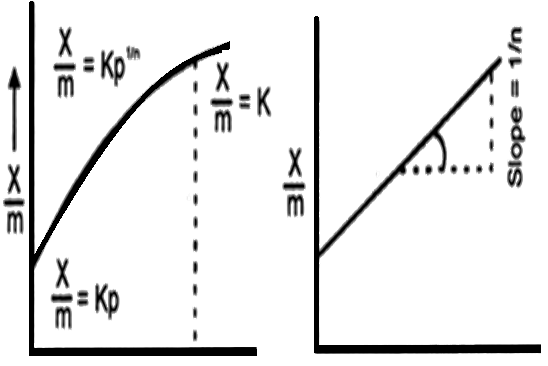
Effect of pressure on adsorption. The extent of adsorption of a gas per unit mass of adsorbent (x/m) increases with increase of pressure at a constant temperature.
  1. For a lower range of pressure (x/m) is directly proportional to the applied pressure. Larger the pressure more is the amount of gas adsorbed, lower the pressure small is the amount of a gas adsorbed. That is
$\frac{\text{x}}{\text{m}}\propto\text{p}$ (as a constant temperature)
  1. For a high pressure range the extent of adsorption of a gas per unit mass of the adsorbent (x/m) is independent of the applied pressure. That is
  1. For a moderate pressure range the value of x/m is proportional to a Fractional power of pressure. That is
$\frac{\text{x}}{\text{m}}\propto\text{p}^{1/\text{n}}$ (where T is constant)

where 1/n is a fraction. Its value may be between 0 and 1. Fig. (a) and (b) show the variations of the extent of adsorption of a gas on an adsorbent as predicted by Frundlich equations (i) and (ii) respectively

$\frac{\text{x}}{\text{m}}=\text{k}\text{p}^{1/\text{n}}\ \ \ .....(\text{i})$

$\log\Big(\frac{\text{x}}{\text{m}}\Big)=\log\text{k}+\frac{1}{\text{n}}\log\text{p}\ \ \ ....(\text{ii})$

Effect of temperature on adsorption: The amount of a gas adsorbed per unit mass of a solid surface (x/m) decreases with increase of temperature in case of physical adsorption. However, in case of chemical adsorption as the temperature increases x/m increases, attains a maximum value then decreases.
View full question & answer
Question 453 Marks
What is the difference between physisorption and chemisorption?
Answer
 
Physisorption
Chemisorption
1.
The forces of attraction between adsorbent and adsorbate are of Van der Waals type (weak forces).
The forces of attraction between adsorbent and absorbate are of a chemical nature (strong forces).
2.
This predominates at low temperatures.
This usually occurs at high temperatures.
3.
Almost all gases show this type of adsorption at low temperatures.
It is highly specific in nature.
4.
The heat of adsorption is low and has a value of about $40$ kJ per mole or less.
The heat of adsorption is high and has a value of the order of $80$ to $420$kJ per mole.
5.
This type of adsorption attains equilibrium very rapidly on changing the temperature and pressure of the system.
This type of adsorption is relatively slower.
6.
This is reversible in nature.
This is usually irreversible in nature. For example, $O_2$ adsorbed on charcoal, when adsorbed also releases $CO$ and $CO_2.$
7.
The activation energy involved in this adsorption is small and is often less than $5$ kJ. It is for this reason, this is even attained at low temperatures.
The activation energy involved in this adsorption is high. It is for this reason, it is attained only at high temperatures.
8.
Adsorption in this case is often multilayer.
Adsorption in this case in monolayer.
View full question & answer
Question 463 Marks
What is an adsorption isotherm? Describe Freundlich adsorption isotherm.
Answer
Adsorption isotherm: A graph between extent of adsorption (x/m) and the pressure 'p' of the gas at constant temperature is called adsorption isotherm.
Freundlich Isotherm: The relationship between $\frac{\text{x}}{\text{m}}$ and pressure of the gas at constant temperature is called adsorption isotherm and given
as by $\frac{\text{x}}{\text{m}}=\text{k}\text{p}^{1/\text{n}}(\text{n}>1)$ k and n depend upon the nature of gas and the solid.
$\frac{\text{x}}{\text{m}}$ first increase with increase in pressure at low pressure but becomes independent of pressure at high pressure.
Thus three cases arise from the graph
At low pressure, extent of adsorption is directly proportional to pressure (raised to power one).
$\frac{\text{x}}{\text{m}}\propto\text{P}^1$
At high pressure, extent of adsorption is independent of pressure (raised to power zero).
$\frac{\text{x}}{\text{m}}\propto\text{P}^0$
Therefore at intermediate value of pressure, adsorption is directly proportional to pressure raised to power 1/n .Here n is a variable whose value is greater than one.
$\therefore\ \frac{\text{x}}{\text{m}}\propto\text{P}^{\frac{1}{\text{n}}}$
Using constant of proportionality, k, also known as adsorption constant we get
$\frac{\text{x}}{\text{m}}\propto\text{k}\text{P}^{\frac{1}{\text{n}}}$
Taking logarithm on both sides, we get
$\log\frac{\text{x}}{\text{m}}=\log\text{k}+\frac{1}{\text{n}}\log\text{p}$
Here x is the weight of the gas absorbed by m mass of the adsorbent at a pressure p, k and n are constant (at a particular temperature) and for a particular adsorbate-adsorbent pair.
The equation above equation is comparable with comparable with equation of straight line,
y = mx + c where, m represents slope of the line and c represents intercept on y axis.
Plotting a graph between log(x/m) and log p, we will get a straight line with value of slope equal to 1/n and log k as y-axis intercept.
log(x/m) vs. log p graph.
View full question & answer
Question 473 Marks
What are micelles? How do they differ from ordinary colloidal particles? Give two examples of micelle forming substances.
Answer
There are some substances which at low concentration behave as normal electrolyte but at higher concentrations exhibit colloidal behaviour due to formation of aggregated particles. The aggregated particles thus formed are called micelles. Surface active agents such as soaps and detergents are the example of micelle forming substances.The formation of micelles takes place only above a particular temperature called Kraft temperature and above a particular concentration called critical micelle concentration (CMC). On dilution, these colloids revert back to individual ions.
View full question & answer
Question 483 Marks
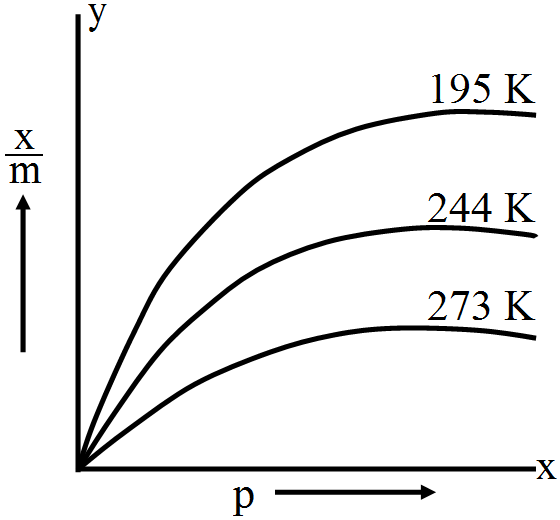
Consider the adsorption isotherms given alongside and interpret the variation in the extent of adsorption $\Big(\frac{\text{x}}{\text{m}}\Big)$ when:
  1.  
  1. Temperature increases at constant pressure.
  2. Pressure increases at constant temperature.
  1. Name the catalyst and the promoter used in Haber’s process for manufacture of ammonia.
Answer
  1.  
  1. At constant pressure, extent of adsorption $\Big(\frac{\text{x}}{\text{m}}\Big)$decreases with increase in temperature as adsorption is an exothermic process.
  2. At constant temperature, first adsorption $\Big(\frac{\text{x}}{\text{m}}\Big)$increases with increase in pressure up to a particular pressure and then it remains constant.
At low pressure, $\Big(\frac{\text{x}}{\text{m}}\Big)=\text{kp}$

At intermediate range of pressure, $\Big(\frac{\text{x}}{\text{m}}\Big)=\text{kp}^\frac{1}{\text{n}}(\text{n}>1)$

At high pressure, $\Big(\frac{\text{x}}{\text{m}}\Big)=\text{k}$ (Independent of pressure)
  1. Finely divided iron is used as a catalyst and molybdenum is used as promoter.
View full question & answer
Question 493 Marks
What is the difference between multimolecular and macromolecular colloids? Give one example of each. How are associated colloids different from these two types of colloids?
Answer
  1. In multi-molecular colloids, the colloidal particles are an aggregate of atoms or small molecules with a diameter of less than 1 nm. The molecules in the aggregate are held together by van der Waal's forces of attraction. Examples of such colloids include gold sol and sulphur sol.
  2. In macro-molecular colloids, the colloidal particles are large molecules having colloidal dimensions. These particles have a high molecular mass. When these particles are dissolved in a liquid, sol is obtained. For example: starch, nylon, cellulose, etc.
  3. Certain substances tend to behave like normal electrolytes at lower concentrations. However, at higher concentrations, these substances behave as colloidal solutions due to the formation of aggregated particles. Such colloids are called aggregated colloids.
View full question & answer
Question 503 Marks
How does a solid catalyst enhance the rate of combination of gaseous molecules?
Answer
When gaseous molecules come in contact with the surface of a solid catalyst, a weak chemical combination takes place between the surface of the catalyst and the gaseous molecules, which increases the concentration of reactants on the surface. Different molecules adsorbed side by side have better chance to react and form new molecules. This enhances the rate of reaction. Also, adsorption is an exothermic process. The heat released in the process of adsorption is utilised in enhancing the reaction rate.
View full question & answer