Questions

Case study (4 Marks)

Take a timed test

12 questions · self-marked practice — reveal the answer and mark yourself.

Question 14 Marks
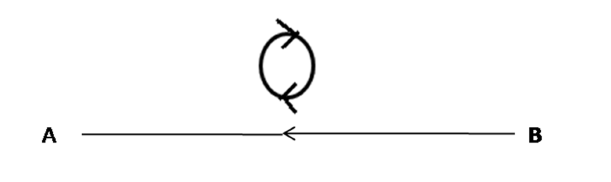
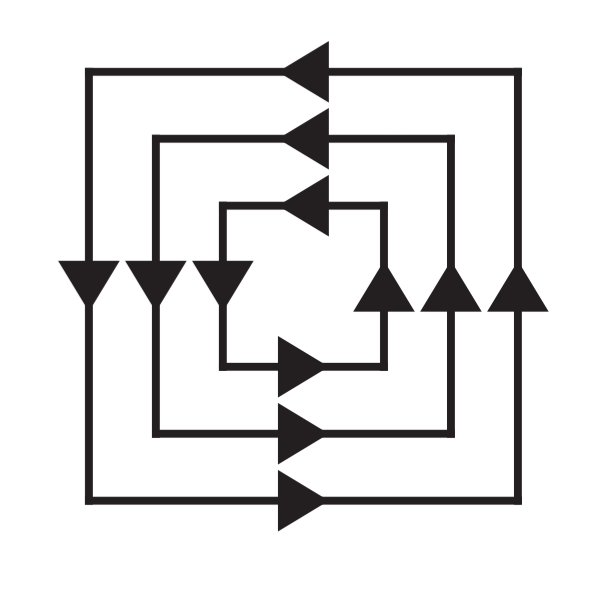
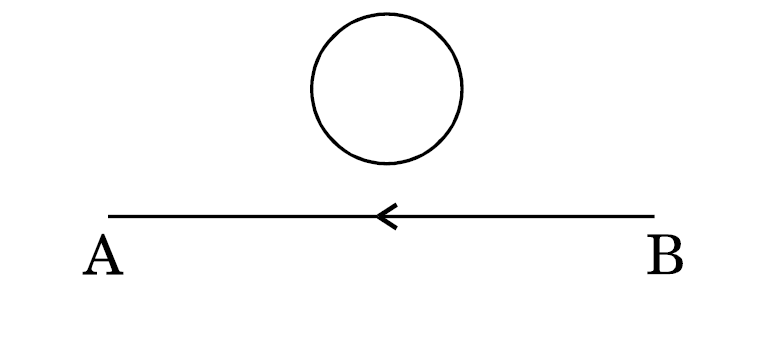
The electric current flowing in a wire in the direction from B to A is decreasing. Find out the direction of the induced current in the metallic loop kept above the wire as shown.
Answer
Clockwise.
Alternate Answer
View full question & answer
Question 24 Marks
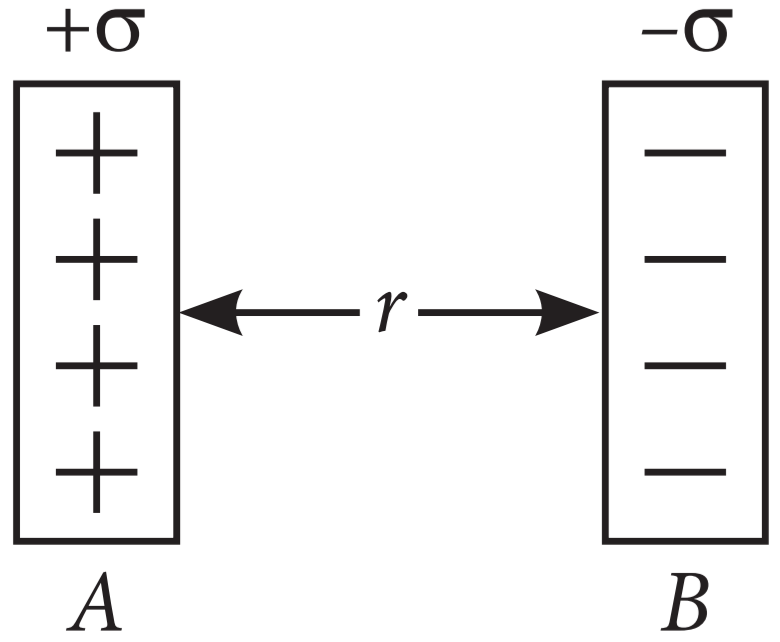
Surface charge density is defined as charge per unit surface area of surface charge distribution. i.e., $\sigma=\frac{\text{dq}}{\text{dS}}.$ Two large, thin metal plates are parallel and close to each other. On their inner faces, the plates have surface charge densities of opposite signs having magnitude of $17.0 \times 10^{-22}Cm^{-2}$ as shown. The intensity of electric field at a point is $\text{E}=\frac{\sigma}{\in_0},$ where$\in_0=$ permittivity of free space.
  1. E in the outer region of the first plate is:
  1. $17 \times 10^{-22} N/C$
  2. $1.5 \times 10^{-25} N/C$
  3. $1.9 \times 10^{-10} N/C$
  4. Zero.
  1. E in the outer region of the second plate is:
  1. $17 \times 10^{-22} N/C$
  2. $1.5 \times 10^{-15} N/C$
  3. $1.9 \times 10^{-10} N/C$
  4. Zero.
  1. E between the plates is:
  1. $17 \times 10^{-22} N/C$
  2. $1.5 \times 10^{-15} N/C$
  3. $1.9 \times 10^{-10} N/C$
  4. Zero.
  1. The ratio of E from right side of B at distances 2cm and 4cm, respectively is:
  1. 1 : 2
  2. 2 : 1
  3. 1 : 1
  4. $1:\sqrt{2}$
  1. ln order to estimate the electric field due to a thin finite plane metal plate, the Gaussian surface considered is:
  1. Spherical.
  2. Spherical.
  3. Straight line.
  4. None of these.
Answer
  1. (d) Zero.
Explanation:
There are two plates A and B having surface charge densities,

$\sigma_\text{A}=17.0\times10^{-22}\text{C/m}^2$
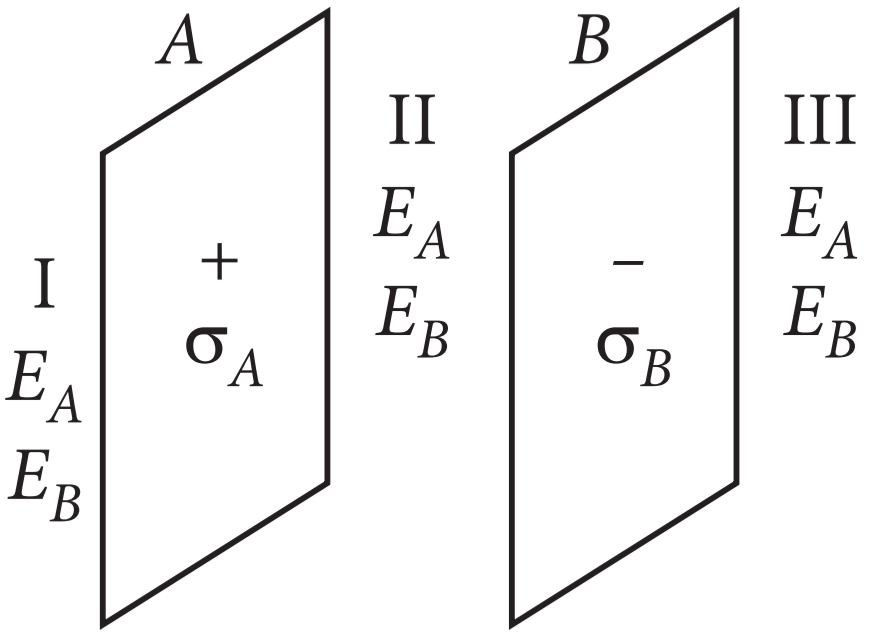
on A and $\sigma_\text{B}=-17.0\times10^{-22}\text{C/m}^2$on B, respectively. According to Gauss' theorem, if the plates have same surface charge density but having opposite signs, then the electric field in region I is zero.
$\text{E}_\text{I}=\text{E}_\text{A}+\text{E}_\text{B}$
$=\frac{\sigma}{2\in_0}+\Big(-\frac{\sigma}{2\in_0}\Big)=0$
  1. (d) Zero.
Explanation:
The electric field in region III is also zero.
$\text{E}_\text{III}=\text{E}_\text{A}+\text{E}_\text{B}$
$=\frac{\sigma}{2\in_0}+\Big(-\frac{\sigma}{2\in_0}\Big)=0$
  1. (c)$ 1.9 \times 10^{-10} N/C$
​​​​​​​​​​​​​​​​​​​​​​​ Explanation:
In region II or between the plates, the electric field.
$\text{E}_\text{II}=\text{E}_\text{A}-\text{E}_\text{B}$
$=\frac{\sigma}{2\in_0}+=\frac{\sigma}{2\in_0}$
$=\frac{\sigma(\sigma_\text{A}\text{ or }\sigma_\text{B})}{\in_0}=\frac{17.0\times10^{-22}}{8.85\times10^{-12}}$
$E = 1.9 \times 10^{-10} N/C$​​​​​​​
  1. (c) 1 : 1
​​​​​​​​​​​​​​​​​​​​​​​​​​​​​​​​​​​ Explanation:
Since electric field due to an infinite-plane sheet of charge does not depend on the distance of observation point from the plane sheet of charge. So, for the given distances, the ratio of E will be 1 : 1.
  1. (b) Spherical.
​​​​​​​​​​​​​​​​​​​​​​​​​​​​​​​​​​​​​​​​​​ Explanation:
ln order to estimate the electric field due to a thin finite plane metal plate, we take a cylindrical cross-sectional area A and length 2r as the gaussian surface.
View full question & answer
Question 34 Marks
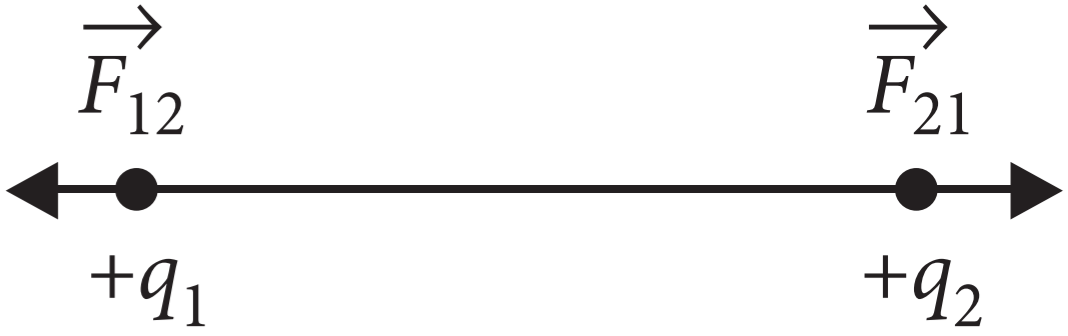
Coulomb's law states that the electrostatic force of attraction or repulsion acting between two stationary point charges is given by: $\text{F}=\frac{1}{4\pi\in_0}\frac{\text{q}_1\text{q}_2}{\text{r}^2}$

Where F denotes the force between two charges $q_1$ and $q_2$ separated by a distance r in free space, $\in_0$ is a constant known as permittivity of free space. Free space is vacuum and may be taken to be air practically. If free space is replaced by a medium, then $\in_0$ is replaced by $(\in_0\text{k})$ or $(\in_0\in_\text{r})$ where k is known as dielectric constant or relative permittivity.
  1. In coulomb's law, $\text{F}=\text{k}\frac{\text{q}_1\text{q}_2}{\text{r}^2}$ then on which of the following factors does the proportionality constant k depends?
  1. Electrostatic force acting between the two charges.
  2. Nature of the medium between the two charges.
  3. Magnitude of the two charges.
  4. Distance between the two charges.
  1. Dimensional formula for the permittivity constant $\in_0$ of free space is:
  1. $[ML^{-3}T^4 A^2]$
  2. $[M^{-1} L^3 T^2 A^2]$
  3. $[M^{-1} L^{-3} T^4 A^2]$
  4. $[ML^{-3} T^4 A^{-2}]$
  1. The force of repulsion between two charges of 1C each, kept 1m apart in vaccum is:
  1. $\frac{1}{9\times10^9}\text{N}$
  2. $9 \times 10^9N$
  3. $9 \times 10^7N$
  4. $\frac{1}{9\times10^{12}}\text{N}$
  1. Two identical charges repel each other with a force equal to 10 mgwt when they are 0.6m apart in air.$(g = 10m s^{-2}).$ The value of each charge is:
  1. 2mC
  2. $2 \times 10^{-7}mC$
  3. 2 nC
  4. $2\mu\text{C}$
  1. Coulomb's law for the force between electric charges most closely resembles with:
  1. Law of conservation of energy.
  2. Newton's law of gravitation.
  3. Newton's $2^{nd}$ law of motion.
  4. Law of conservation of charge.
Answer
  1. (b) Nature of the medium between the two charges.
Explanation:
The proportionality constant k depends on the nature of the medium between the two charges.
  1. (c) $[M^{-1} L^{-3} T^4 A^2]$
Explanation:
As, $[\in_0]=\frac{1}{4\pi\text{F}}.\frac{\text{q}_1\text{q}_2}{\text{r}^2}$
$=\frac{[\text{AT]}^2}{[\text{M L T}^{-2}][\text{L}^2]}$
$\text{[M}^{-1} \text{ L}^{-3} \text{ T}^4 \text{A}^2]$
  1. (b) $ 9 \times 10^9N$
  2. $2\mu\text{C}$
Explanation:
$\text{F}=\frac{1}{4\pi\in_0}\frac{\text{q}_1\text{q}_2}{\text{d}^2}$
$\therefore(10\times10^{-3})\times10=\frac{(9\times10^9)\times\text{q}^2}{(0.6)^2}$
Or $\text{q}^2=\frac{10^{-1}\times0.36}{9\times10^9}=4\times10^{-12}$
Or $\text{q}=2\times10^{-6}\text{ C}=2\mu\text{C}$
  1. (b) Newton's law of gravitation.
View full question & answer
Question 44 Marks
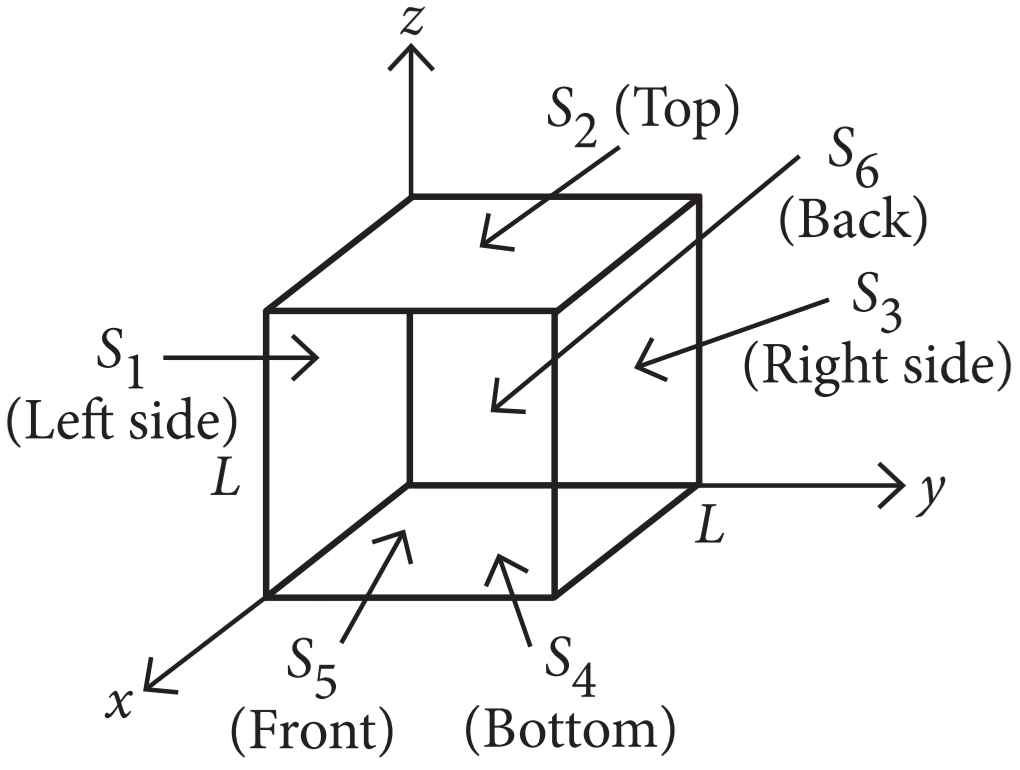
Net electric flux through a cube is the sum of fluxes through its six faces. Consider a cube as shown in figure, having sides of length L = 10.0cm. The electric field is uniform, has a magnitude $E = 4.00 \times 10^3N C^{-1}$ and is parallel to the xy plane at an angle of 37º measured from the + x - axis towards the + y - axis.
  1. Electric flux passing through surface $S_6$ is:
  1. $-24N\ m^2C^{-1}$
  2. $24N\ m^2C^{-1}$
  3. $32N\ m^2C^{-1}$
  4. $-32N\ m^2C^{-1}$
  1. Electric flux passing through surface $S_1$ is:
  1. $-24N\ m^2C^{-1}$
  2. $24N\ m^2 C^{-1}$
  3. $32N\ m^2 C^{-1}$
  4. $-32N\ m^2 C^{-1}$
  1. The surfaces that have zero flux are:
  1. $S_1$ and $S_3$
  2. $S_5$ and $S_6$
  3. $S_2$ and $S_4$
  4. $S_1$ and $S_2$
  1. The total net electric flux through all faces of the cube is:
  1. 8N $m^2\ C^{-1}$
  2. -8N $m^2\ C^{-1}$
  3. 24N $m^2\ C^{-1}$
  4. Zero.
  1. The dimensional formula of surface integral $\oint\vec{\text{E}}\cdot\text{d}\vec{\text{S}}$ of an electric field is:
  1. $[M\ L^2T^{-2} A^{-1}]$
  2. $[M\ L^3T^{-3} A^{-1}]$
  3. $[M\ L^{-1}T^3 A^{-3}]$
  4. $[M\ L^{-3}T^{-3} A^{-1}]$
Answer
  1. (d) $ -32N m^2 C^{-1}$
Explanation:
Electric flux, $\phi=\vec{\text{E}}\cdot\vec{\text{A}}=\text{EA} \cos\theta.$
Where $\vec{\text{A}}=\widehat{\text{An}}$
For electric flux passing through $\text{S}_6,\widehat{\text{n}}_{\text{s}_6}=-\widehat{\text{i}}\text{ (Back})$
$\therefore \phi_{\text{s}{_6}}=-(4\times10^3\text{ N}\text{ C}^{-1})(0.1\text{m})^2 \cos37^\circ$
$-32N m^2 C^{-1}$
  1. (a) $-24N m^2C^{-1}$
Explanation:
For electric flux passing through $\text{S}_1,\widehat{\text{n}}_{\text{s}_1}=-\widehat{\text{j}}\text{ (Left})$
$\therefore \phi_{\text{s}_{1}}=-(4\times10^3\text{ N}\text{ C}^{-1})(0.1\text{m})^2 \cos(90^\circ-37^\circ)$
$-24 N m^2 C^{-1$}
  1. (c) $S_2$ and $S_4$
Explanation:
Here, $\widehat{\text{n}}_{\text{s}_{2}} = + \widehat{\text{k}} \text{ (Top)}$
$\therefore \phi_{\text{s}_{2}}=-(4\times10^3\text{ N}\text{ C}^{-1})(0.1\text{m})^2 \cos90^\circ=0$
$\widehat{\text{n}}_{\text{s}_{3}} = + \widehat{\text{j}} \text{ (Right)}$
$\widehat{\text{n}}_{\text{s}_{4}} = - \widehat{\text{k}} \text{ (Bottom)}$
$\therefore \phi_{\text{s}_{4}}=-(4\times10^3\text{ N}\text{ C}^{-1})(0.1\text{m})^2 \cos90^\circ=0$
And, $\widehat{\text{n}}_{\text{s}_{5}} = - \widehat{\text{i}} \text{ (Fornt)}$
$\therefore \phi_{\text{s}_{5}}=-(4\times10^3\text{ N}\text{ C}^{-1})(0.1\text{m})^2 \cos37^\circ$
$= 32N m^2C^{-1}$
$S_2$ and $S_4$ surface have zero flux.
  1. (d) Zero.
​​​​​​​Explanation:
As the field is uniform, the total flux through the cube must be zero, i.e., any flux entering the cube must leave it.
  1. (b) $[M\ L^3T^{-3} A^{-1}]$
Explanation:
Surface integral $\oint\vec{\text{E}}\cdot\text{d}\vec{\text{S}}$ is the net electric flux over a closed surface S.
$\therefore[\phi_\text{E}]=[\text{M}\text{ L}^3\text{ T}^{-3}\text{ A}^{-1}]$
View full question & answer
Question 54 Marks
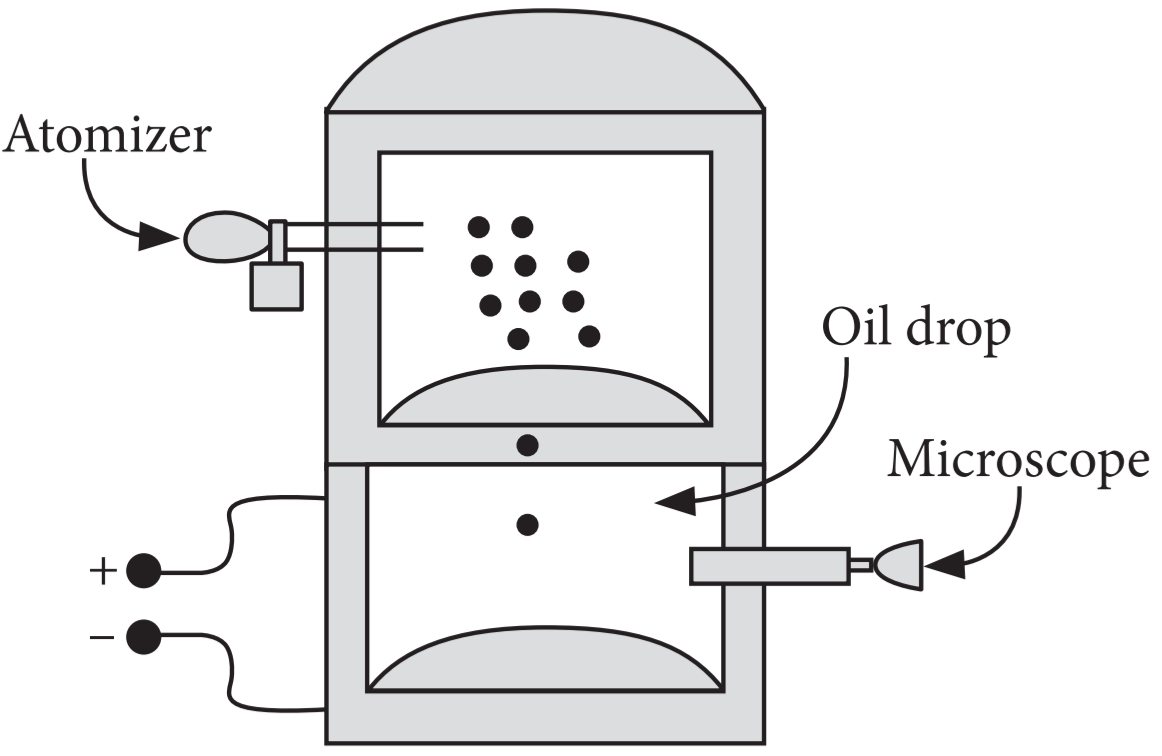
In 1909, Robert Millikan was the first to find the charge of an electron in his now-famous oil-drop experiment. In that experiment, tiny oil drops were sprayed into a uniform electric field between a horizontal pair of oppositely charged plates. The drops were observed with a magnifying eyepiece, and the electric field was adjusted so that the upward force on some negatively charged oil drops was just sufficient to balance the downward force of gravity. That is, when suspended, upward force qE just equaled Mg. Millikan accurately measured the charges on many oil drops and found the values to be whole number multiples of $1.6 \times 10^{-19}C$ the charge of the electron. For this, he won the Nobel Prize.
  1. If a drop of mass $1.08 \times 10^{-14}kg$ remains stationary in an electric field of $1.68 \times 10^5NC^{-1},$ then the charge of this drop is:
  1. $6.40 \times 10^{-19}C$
  2. $3.2 \times 10^{-19}C$
  3. $1.6 \times 10^{-19}C$
  4. $4.8 \times 10^{-19}C$
  1. Extra electrons on this particular oil drop (given the presently known charge of the electron) are:
  1. 4
  2. 3
  3. 5
  4. 8
  1. A negatively charged oil drop is prevented from falling under gravity by applying a vertical electric field $100V\  m^{-1}.$ If the mass of the drop is $1.6 \times 10^{-3}g,$ the number of electrons carried by the drop is$ (g = 10m s^{-2})$
  1. $10^{18}$
  2. $10^{15}$
  3. $10^{12}$
  4. $10^9$
  1. The important conclusion given by Millikan's experiment about the charge is:
  1. Charge is never quantized.
  2. Charge has no definite value.
  3. Charge is quantized.
  4. Charge on oil drop always increases.
  1. If in Millikan's oil drop experiment, charges on drops are found to be $8\mu\text{C, }12\mu\text{C, }20\mu\text{C, }$ then quanta of charge is:
  1. $8\mu\text{C}$
  2. $20\mu\text{C}$
  3. $12\mu\text{C}$
  4. $4\mu\text{C}$
Answer
  1. (a) $6.40 \times 10^{-19}C$
Explanation:
As, qE = mg
$\Rightarrow\text{q}=\frac{1.08\times10^{-14}\times9.8}{1.68\times10^5}$
$= 6.40 \times 10^{-19}C$
  1. (a) 4
Explanation:
q = ne or
$\Rightarrow\text{n}=\frac{6.4\times10^{-19}}{1.6\times10^{-19}}=4$
  1. (c) $10^{12}$
​​​​​​​Explanation:
For the drop to be stationary,
Force on the drop due to electric field = Weight of the drop qE = mg.
$\text{q}=\frac{\text{mg}}{\text{E}}=\frac{1.6\times10^{-6}\times10}{100}=1.6\times10^{-7}\text{C}$
Number of electrons carried by the drop is
$\text{n}=\frac{\text{q}}{\text{e}}=\frac{1.6\times10^{-7}\text{C}}{1.6\times10^{-19}\text{C}}=10^{12}$
  1. (c) Charge is quantized.
  2. (d) $4\mu\text{C}$
Explanation:
Millikan's experiment confirmed that the charges are quantized, i.e., charges are small integer multiples of the base value which is charge on electron. The charges on the drops are found to be multiple of 4. Hence, the quanta of charge is $4\mu\text{C}.$
View full question & answer
Question 64 Marks
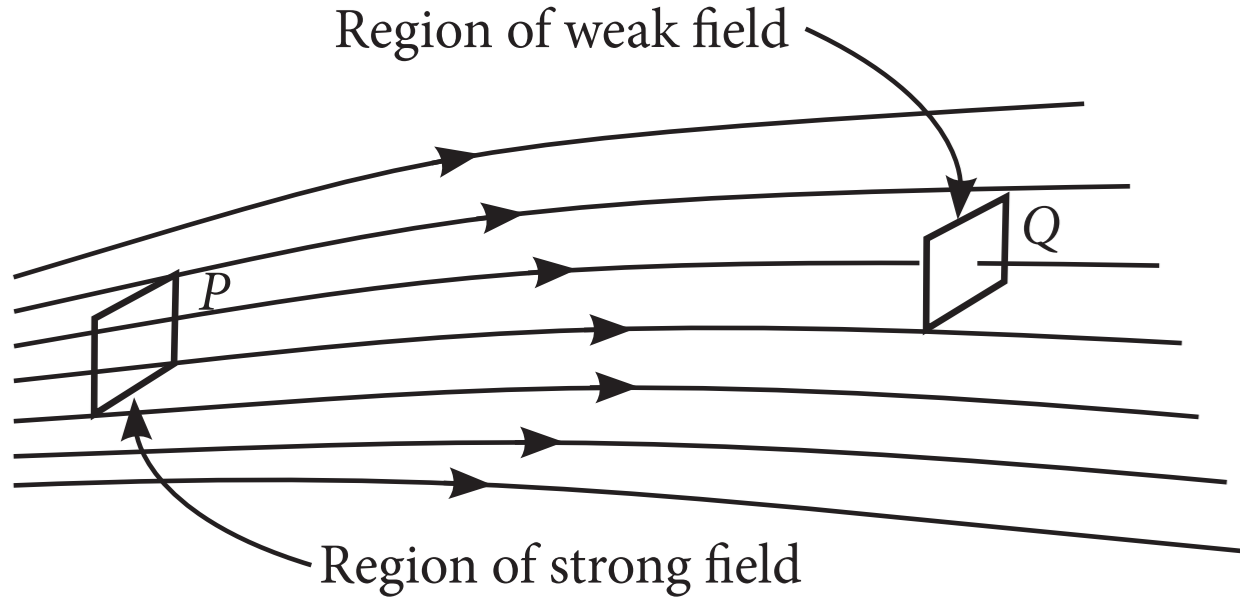
Electric field strength is proportional to the density of lines of force i.e., electric field strength at a point is proportional to the number of lines of force cutting a unit area element placed normal to the field at that point. As illustrated in the given figure, the electric field at P is stronger that at Q.
  1. Electric lines of force about a positive point charge are:
  1. Radially outwards.
  2. Circular clockwise.
  3. Radially inwards.
  4. Parallel straight lines.
  1. Which of the following is false for electric lines of force?
  1. They always start from positive charges and terminate on negative charges.
  2. They are always perpendicular to the surface of a charged conductor.
  3. They always form closed loops.
  4. They are parallel and equally spaced in a region of uniform electric field.
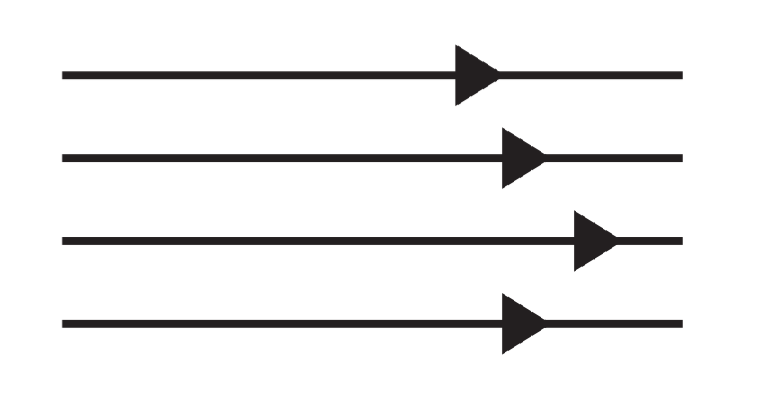
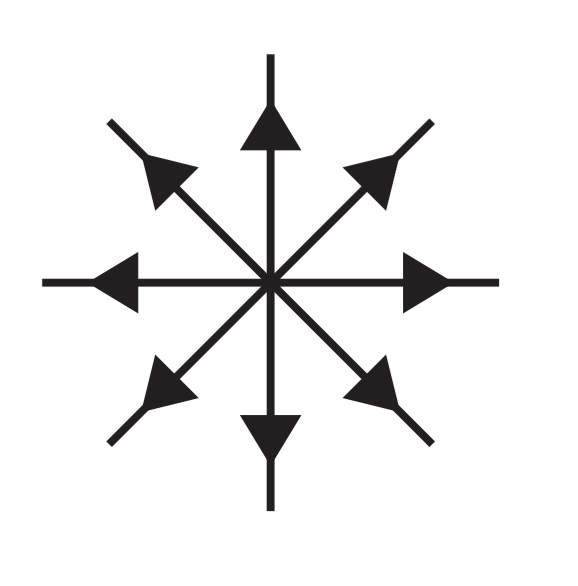
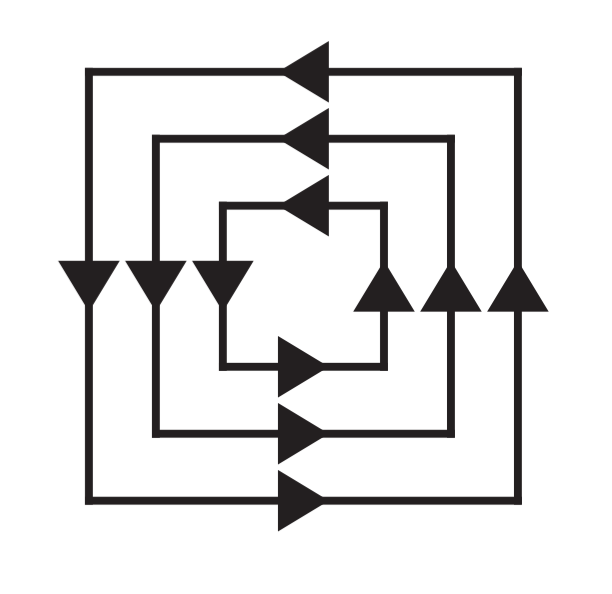
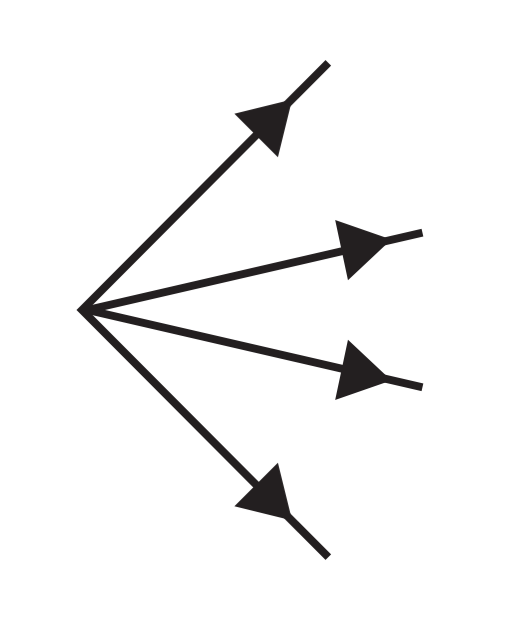
  1. Which one of the following pattern of electric line of force in not possible in filed due to stationary charges?
  1.  
  1.  
  1.  
  1.  
  1. Electric lines of force are curved:
  1. In the field of a single positive or negative charge.
  2. In the field of two equal and opposite charges.
  3. In the field of two like charges.
  4. Both (b) and (c).
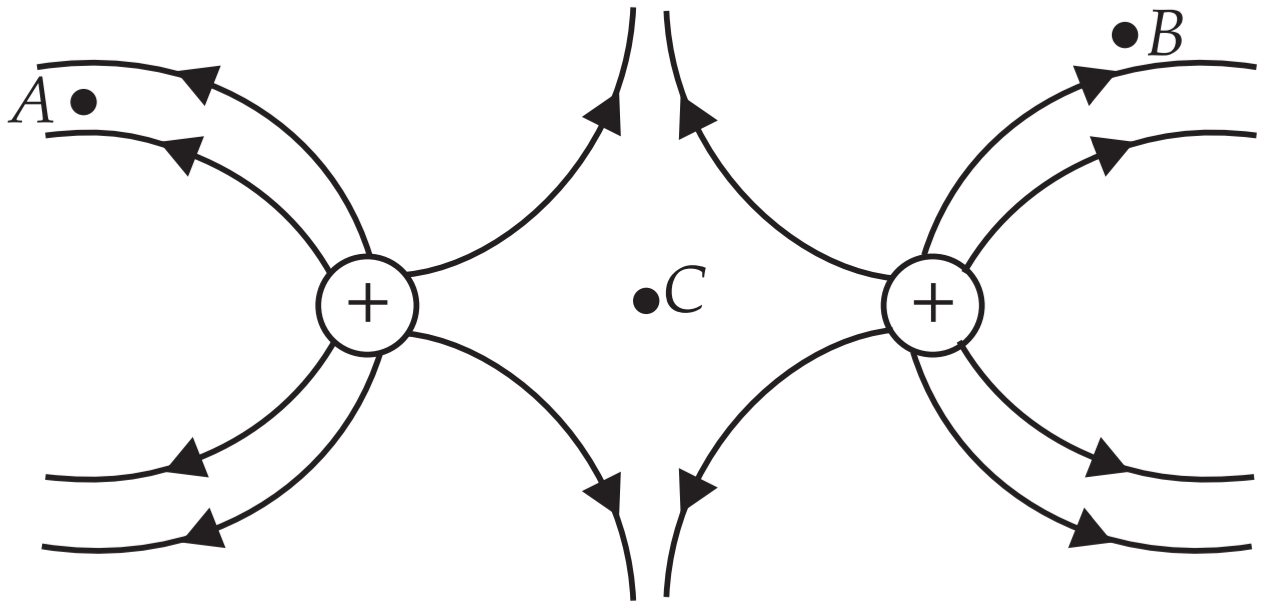
  1. The figure below shows the electric field lines due to two positive charges. The magnitudes $E_A, E_B$ and $E_C$ of the electric fields at points A, Band C respectively are related as:
  1. $E_A > E_B > E_C$
  2. $E_B > E_A > E_C$
  3. $E_A = E_B > E_C$
  4. $E_A > E_B = E_C$
Answer
  1. (a) Radially outwards.
  2. (c) They always form closed loops.
Explanation:

Electric lines of force do not form any closed loops.
  1. (c)


Explanation:

Electric field tines can't be closed.
  1. (d) Both (b) and (c).
  2. (a) $E_A > E_B > E_C$
View full question & answer
Question 74 Marks
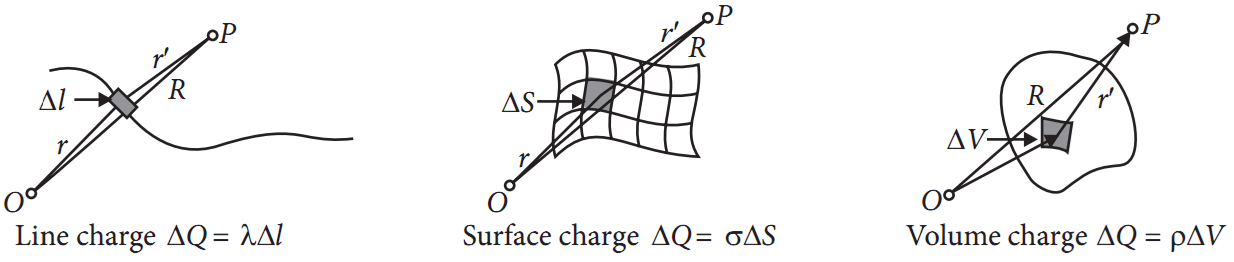
ln practice, we deal with charges much greater in magnitude than the charge on an electron, so we can ignore the quantum nature of charges and imagine that the charge is spread in a region in a continuous manner. Such a charge distribution is known as continuous charge distribution. There are three types of continuous charge distribution : (i) Line charge distribution (ii) Surface charge distribution (iii) Volume charge distribution as shown in figure.
  1. Statement 1: Gauss's law can't be used to calculate an electric field near an electric dipole.
Statement 2: Electric dipole don't have symmetrical charge distribution.
  1. Statement 1 and statement 2 are true.
  2. Statement 1 is false but statement 2 is true.
  3. Statement 1 is true but statement 2 is false.
  4. Both statements are false.
  1. An electric charge of $8.85 \times 10^{-13}C$ is placed at the centre of a sphere of radius 1m. The electric flux through the sphere is:
  1. $0.2NC^{-1} m^2$
  2. $0.1NC^{-1} m^2$
  3. $0.3NC^{-1} m^2$
  4. $0.01NC^{-1} m^2$
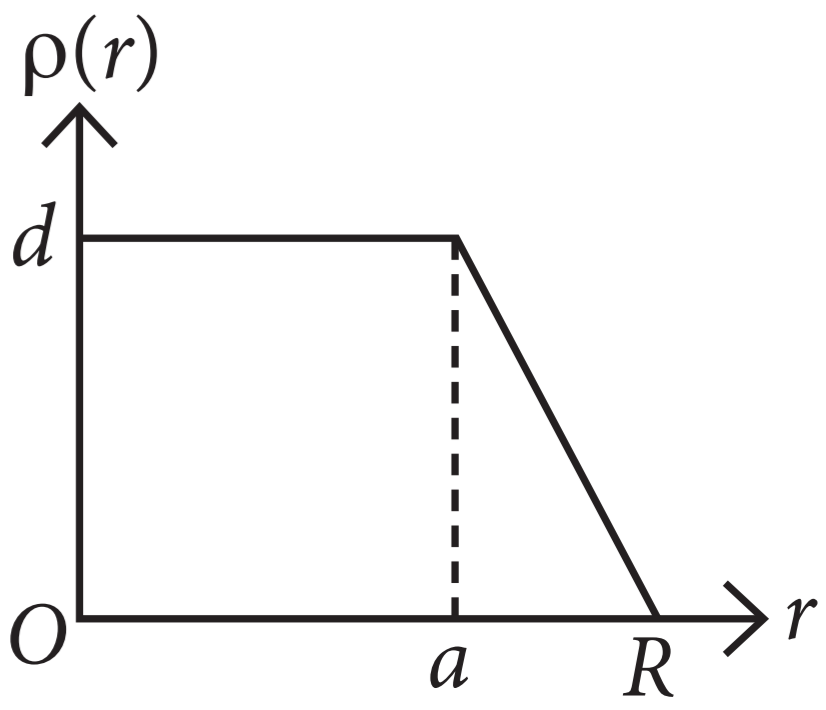
  1. The electric field within the nucleus is generally observed to be linearly dependent on r. So,
  1. a = 0
  2. $\text{a}=\frac{\text{R}}{2}$
  3. a = R
  4. $\text{a}=\frac{\text{2R}}{3}$
  1. What charge would be required to electrify a sphere of radius 25cm so as to get a surface charge density of $\frac{3}{\pi}\text{Cm}^{-2}?$
  1. 0.75C
  2. 7.5C
  3. 75C
  4. Zero
  1. The SI unit of linear charge density is:
  1. Cm
  2. $Cm^{-1}$
  3. $Cm^{-2}$
  4. $Cm^{-3}$
Answer
  1. (a) Statement 1 and statement 2 are true.
Explanation:
Gauss's law is applicable for any closed surface. Gauss's law is most useful in situation where the charge distribution has spherical or cylindrical symmetry or is distributed uniformly over the plane. Whereas electric dipole is a system of two equal and opposite point charges separated by a very small and finite distance.
  1. (b) $0.1NC^{-1} m^2$
Explanation:
According to Gauss's law, the electric flux through the sphere is
$\phi=\frac{\text{q}_{in}}{\in_0}=\frac{8.85\times10^{-13}\text{C}}{8.85\times10^{-12}\text{C}^2\text{N}^{-1}\text{m}^{-2}}$
$= 0.1NC^{-1} m^2$
  1. (c) a = R
Explanation:
For uniformly volume charge density,
$\text{E}=\frac{\text{Pr}}{3\in_0}$
$\text{E}\propto\text{r}$
  1. (a) 0.75C
Explanation:
r = 25cm = 0.25m,
$\sigma=\frac{3}{\pi}\text{C/m}^2$
As, $\sigma=\frac{\text{q}}{4\pi\text{r}^2}$
$\Rightarrow\text{q}=4\pi\times(0.25)^2\times\frac{3}{\pi}=0.75\text{C.}$
  1. (b) $Cm^{-$1}​​​​​​​
Explanation:​​​​​​​
The line charge density at a point on a tine is the charge per unit length of the line at that point
$\lambda=\frac{\text{bq}}{\text{bL}}$
Thus, the SI unit for $\lambda$ is $Cm^{-1}​​​​​​​$.
View full question & answer
Question 84 Marks
Smallest charge that can exist in nature is the charge of an electron. During friction, it is only the transfer of electrons which makes the body charged. Hence, net charge on any body is an integral multiple of charge of an electron$ [1.6 x 10^{-19}C]$ i.e. q = ± ne Where $n = 1, 2, 3, 4,....$

Hence, no body can have a charge represented as 1.1 e, 2. 7e, $\frac{3}{5}\text{e,}$ etc. Recently, it has been discovered that elementary particles such as protons or neutrons are composed of more elemental units called quarks.
  1. Which of the following properties is not satisfied by an electric charge?
  1. Total charge conservation.
  2. Quantization of charge.
  3. Two types of charge.
  4. Circular line of force.
  1. Which one of the following charges is possible?
  1. $5.8 \times 10^{-18}C$
  2. $3.2 \times 10^{-18}C$
  3. $4.5 \times 10^{-19}C$
  4. $8.6 \times 10^{-18}C$
  1. If a charge on a body is 1nC, then how many electrons are present on the body?
  1. $6.25 \times 10^{27}$
  2. $1.16 \times 10^{19}$
  3. $6.25 \times 10^{28}$
  4. $6.25 \times 10^9$
  1. If a body gives out $10^9$ electrons every second, how much time is required to get a total charge of 1C from it?
  1. 190.19 years
  2. 150.12 years
  3. 198.19 years
  4. 188.21 years
  1. A polythene piece rubbed with wool is found to have a negative charge of $3.2 \times 10^{-7}\ C$. Calculate the number of electrons transferred.
  1. $2 \times 10^{12}$
  2. $3 \times 10^{12}$
  3. $2 \times 10^{14}$
  4. $3 \times 10^{14}$
Answer
  1. (d) Circular line of force.
  2. (b) $3.2 \times 10^{-18}C$
Explanation:
From, $\text{q}=\text{ne,}\text{ n}=\frac{\text{q}}{\text{e}}$
$=\frac{3.2\times10^{-18}}{1.6\times10^{-19}}=20$
As n is an integer, hence this value of charge is possible.
  1. (d) $6.25 \times 10^9$
Explanation:
Charge on the body is q = ne
$\therefore$ No. of electrons present on the body is
$\text{n}=\frac{\text{q}}{\text{e}}=\frac{1\times10^{-9}\text{C}}{1.6\times10^{-19}\text{C}}=6.25\times10^9$
  1. (c) 198.19 years
Explanation:
Here, $n = 10^9$ electrons per second Charge given per second,
$q = ne = 10^9 \times 1.6 \times 10^{-19}C$
$q = 1.6 \times 10^{-10}C$
Total charge, Q = 1 C (given)
$\therefore$ Time required $=\frac{\text{Q}}{\text{q}}=\frac{1}{1.6\times10^{-10}}\text{s}=6.25\times10^9\text{s}$
$\therefore\frac{6.25\times10^9}{3600\times24\times365}\text{year}=198.19\text{year.}$
  1. (a) $2 \times 10^{12}$
Explanation:
As $\text{q}=\text{ne,}\text{ n}=\frac{3.2\times10^{-7}}{1.6\times10^{-19}}$
$\Rightarrow\text{n}=2\times10^{12}\text{ electrons.}$
View full question & answer
Question 94 Marks
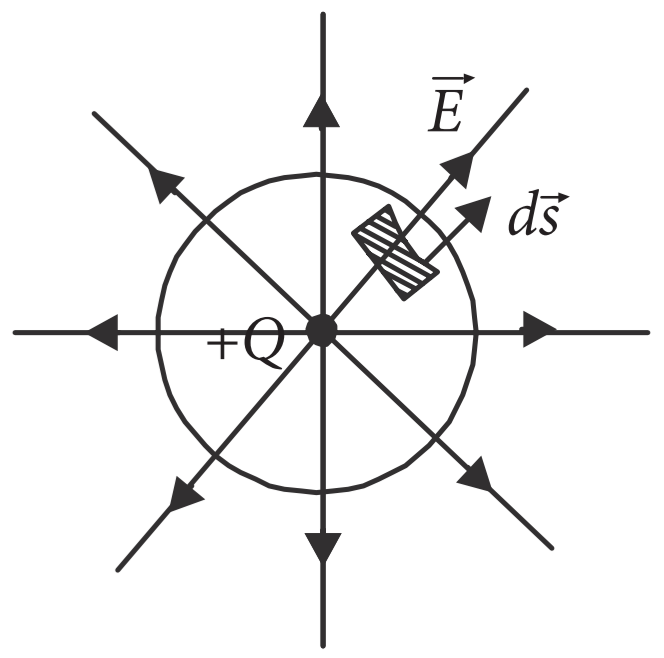
Gauss's law and Coulomb's law, although expressed in different forms, are equivalent ways of describing the relation between charge and electric field in static conditions. Gauss's law is $\in_0\phi=\text{q}_{\text{end},}$ when $\text{q}_{\text{encl}}$ is the net charge inside an imaginary closed surface called Gaussian surface. $\phi=\oint\vec{\text{E}}\cdot\text{d}\vec{\text{A}}$ gives the electric flux through the Gaussian surface. The two equations hold only when the net charge is in vacuum or air.
  1. If there is only one type of charge in the universe, then ($\vec{\text{E}}\rightarrow$ Electric field, $\text{d}\vec{\text{s}}\rightarrow$ Area vector).
  1. $\oint\vec{\text{E}}\cdot\text{d}\vec{\text{s}}\not=0$ on any surface.
  2. $\oint\vec{\text{E}}\cdot\text{d}\vec{\text{s}}$ could not be defined.
  3. $\oint\vec{\text{E}}\cdot\text{d}\vec{\text{s}}=\infty$ if charge is inside.
  4. $\oint\vec{\text{E}}\cdot\text{d}\vec{\text{s}}=0$ if charge is outside, $\oint\vec{\text{E}}\cdot\text{d}\vec{\text{s}}=\frac{\text{q}}{\in_0}$ if charge is inside.
  1. What is the nature of Gaussian surface involved in Gauss law of electrostatic?
  1. Magnetic.
  2. Scalar.
  3. Vector.
  4. Electrical.
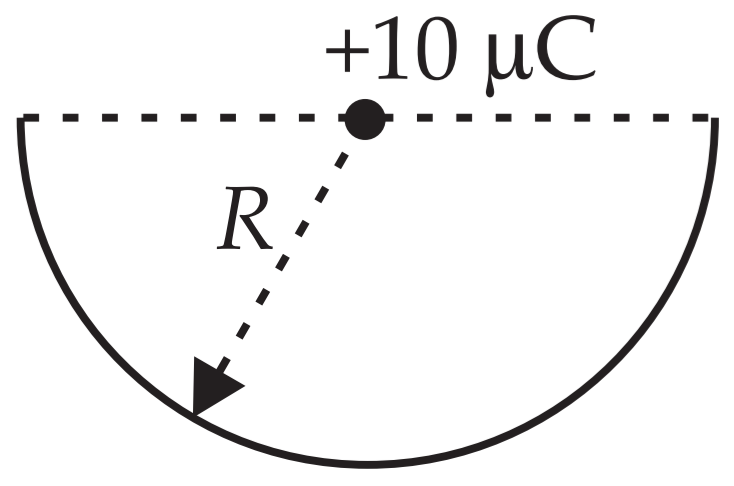
  1. A charge $10\mu\text{C}$ is placed at the centre of a hemisphere of radius R = 10cm as shown. The electric flux through the hemisphere (in MKS units) is:
  1. $20 \times 10^5$
  2. $10 \times 10^5$
  3. $6 \times 10^5$
  4. $2 \times 10^5$
  1. The electric flux through a closed surface area S enclosing charge Q is $\phi$. If the surface area is doubled, then the flux is:
  1. $2\phi$
  2. $\frac{\phi}{2}$
  3. $\frac{\phi}{4}$
  4. $\phi$
  1. A Gaussian surface encloses a dipole. The electric flux through this surface is:
  1. $\frac{\text{q}}{\in_0}$
  2. $\frac{\text{2q}}{\in_0}$
  3. $\frac{\text{q}}{2\in_0}$
  4. $\text{Zero}$
Answer
  1. (d) $\oint\vec{\text{E}}\cdot\text{d}\vec{\text{s}}=0$ if charge is outside, $\oint\vec{\text{E}}\cdot\text{d}\vec{\text{s}}=\frac{\text{q}}{\in_0}$ if charge is inside.
Explanation:
If there is only one type of charge in the universe, then it will produce electric field somehow. Hence, Gauss's law is valid.
  1. (c) Vector.
  2. (c) $6 \times 10^5$
Explanation:
According to Gauss's theorem,
Electric flux through the sphere $=\frac{\text{q}}{\in_0}$
$\therefore$ Electric flux through the hemisphere $=\frac{1}{2}\frac{\text{q}}{\in_0}$
$=\frac{10\times10^{-6}}{2\times8.854\times10^{-12}}=0.56\times10^6\text{ Nm}^2\text{ C}^{-1}$
$= 0.6 \times 10^6\ Nm^2\ C^{-1} = 6 \times 10^5\ Nm^2\ C^{-1}$
  1. (d) $\phi$
​​​​​​​​​​​​​​​​​​​​​​​​​​​​Explanation:
As flux is the total number of tines passing through the surface, for a given charge, it is always the charge enclosed $\frac{\text{Q}}{\in_0}.$ If area is doubled, the flux remains the same.
  1. (d) $\text{Zero}$
​​​​​​​​​​​​​​​​​​​​​​​​​​​​​​​​​​​Explanation:
As net charge on a dipole is (- q + q) = 0
Thus, when agaussian surface encloses a dipole, as per Gauss's theorem, electric flux through the surface,
$\oint\vec{\text{E}}\cdot\text{d}\vec{\text{S}}=\frac{\text{q}}{\in_0}=0$​​​​​​​
View full question & answer
Question 104 Marks
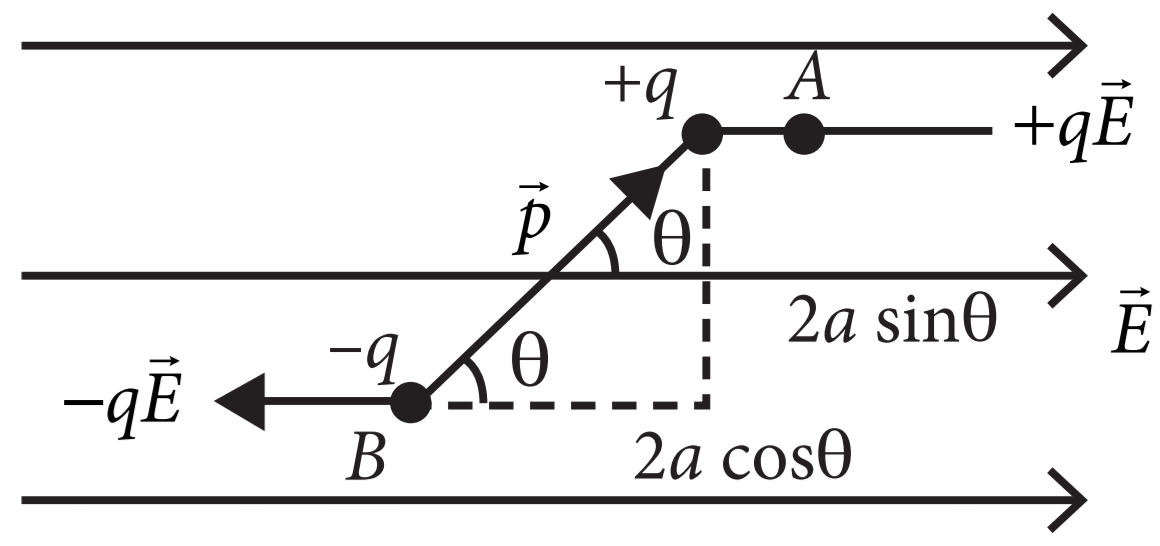
When electric dipole is placed in uniform electric field, its two charges experience equal and opposite forces, which cancel each other and hence net force on electric dipole in uniform electric field is zero. However, these forces are not collinear, so they give rise to some torque on the dipole. Since net force on electric dipole in uniform electric field is zero, so no work is done in moving the electric dipole in uniform electric field. However, some work is done in rotating the dipole against the torque acting on it.
  1. The dipole moment of a dipole in a uniform external field $\vec{\text{E}}$ is $\vec{\text{P}}.$ Then the torque 'i acting on the dipole is:
  1. $\vec{\tau}=\vec{\text{P}}\times\vec{\text{E}}$
  2. $\vec{\tau}=\vec{\text{P}}\cdot\vec{\text{E}}$
  3. $\vec{\tau}=2(\vec{\text{P}}+\vec{\text{E}})$
  4. $\vec{\tau}=(\vec{\text{P}}+\vec{\text{E}})$
  1. An electric dipole consists of two opposite charges, each of magnitude $1.0\mu\text{C}$ separated by a distance of 2.0cm. The dipole is placed in an external field of $10^5N C^{-1}$. The maximum torque on the dipole is:
  1. $0.2 \times 10^{-3}Nm$
  2. $1 \times 10^{-3}Nm$
  3. $2 \times 10^{-3}Nm$
  4. $4 \times 10^{-3}Nm$
  1. Torque on a dipole in uniform electric field is minimum when $\theta$ is equal to:
  1. 90º
  2. 180º
  3. Both (a) and (c)
  1. When an electric dipole is held at an angle in a uniform electric field, the net force F and torque t on the dipole are:
  1. $\text{F}=0, \tau=0$
  2. $\text{F}\not=0, \tau\not=0$
  3. $\text{F}=0, \tau\not=0$
  4. $\text{F}\not=0, \tau=0$
  1. An electric dipole of moment pis placed in an electric field of intensity E. The dipole acquires a position such that the axis of the dipole makes an angle $\theta$ with the direction of the field. Assuming that the potential energy of the dipole to be zero when $\theta=90^\circ$ the torque and the potential energy of the dipole will respectively be:
  1. $\text{pE}\sin\theta,-\text{pE}\cos\theta$
  2. $\text{pE}\sin\theta,-2\text{pE}\cos\theta$
  3. $\text{pE}\sin\theta,2\text{pE}\cos\theta$
  4. $\text{pE}\cos\theta,-2\text{pE}\sin\theta$
Answer
  1. (a) $\vec{\tau}=\vec{\text{P}}\times\vec{\text{E}}$
Explanation:
As $\tau=$ either force × perpendicular distance between the two forces.
$=\text{qaE}\sin\theta\text{ or }\tau=\text{PE}\sin\theta$
$(\because\text{qa}=\text{P})$
Or $\vec{\tau}=\vec{\text{P}}\times\vec{\text{E}}$
  1. (c) $2 \times 10^{-3}Nm$
Explanation:
The maximum torque on the dipole in an external electric field is given by
$\tau=\text{pE}=\text{q}(\text{2a})\times\text{E}$
Here, $\text{q}=1\mu\text{C}=10^{-6}\text{C,}$
$2a = 2cm = 2 \times 10^{-2}m,$
$E = 10^5N C^{-1},$
$\tau=?$
$\therefore\tau=10^{-6}\times2\times10^{-2}\times10^5$
$=2\times10^{-3}\text{Nm}$
  1. (d) Both (a) and (c)
Explanation:
When $\theta$ is 0 or 180º, the $\tau$ minimum, which means the dipole moment should be parallel to the direction of the uniform electric field.
  1. (c) $\text{F}=0, \tau\not=0$
Explanation:
Net force is zero and torque acts on the dipole, trying to align p with E.
  1. (a) $\text{pE}\sin\theta,-\text{pE}\cos\theta$
Explanation:
Torque, $\tau=\text{pE}\sin\theta$ and potential energy, $\text{U}=-\text{pE}\cos\theta.$​​​​​​​
View full question & answer
Question 114 Marks
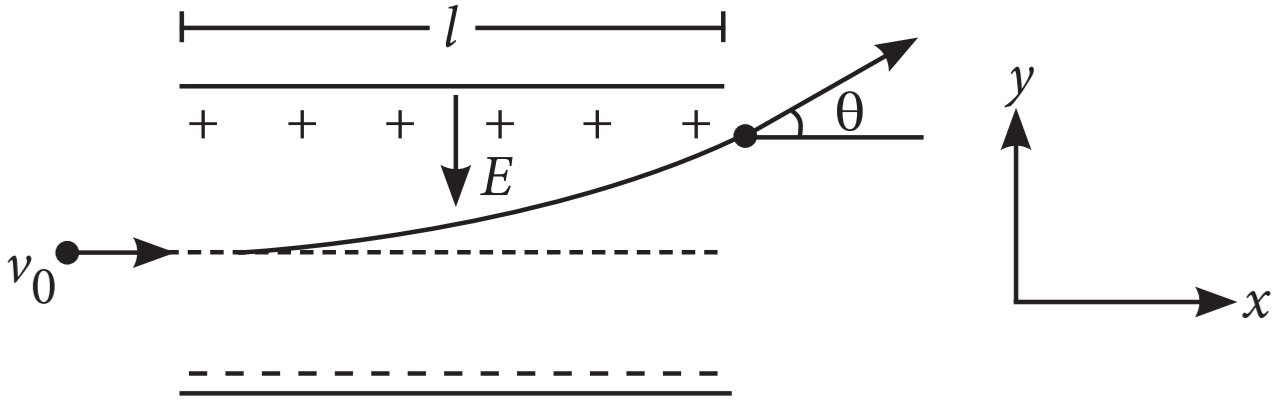
When a charged particle is placed in an electric field, it experiences an electrical force. If this is the only force on the particle, it must be the net force. The net force will cause the particle to accelerate according to Newton's second law. So $\vec{\text{F}}_\text{e}=\text{q}\vec{\text{E}}=\text{m}\vec{\text{a}}$

If $\vec{\text{E}}$ is uniform, then $\vec{\text{a}}$ is constant and $\vec{\text{a}}=\text{q}\vec{\text{E}}\text{/ m.}$ If the particle has a positive charge, its acceleration is in the direction of the field. If the particle has a negative charge, its acceleration is in the direction opposite to the electric field. Since the acceleration is constant, the kinematic equations can be used.
  1. An electron of mass m, charge e falls through a distance h metre in a uniform electric field E. Then time of fall,
  1. $\text{t}=\sqrt{\frac{\text{2hm}}{\text{eE}}}$
  2. $\text{t}=\frac{\text{2hm}}{\text{eE}}$
  3. $\text{t}=\sqrt{\frac{\text{2eE}}{\text{hm}}}$
  4. $\text{t}=\frac{\text{2eE}}{\text{hm}}$
  1. An electron moving with a constant velocity v along X-axis enters a uniform electric field applied along Y-axis. Then the electron moves:
  1. With uniform acceleration along Y-axis
  2. Without any acceleration along Y-axis
  3. In a trajectory represented as $y = ax^2$
  4. In a trajectory represented as y = ax
  1. Two equal and opposite charges of masses $m_1$ and $m_2$ are accelerated in an uniform electric field through the same distance. What is the ratio of their accelerations if their ratio of masses is $\frac{\text{m}_1}{\text{m}_2}=0.5?$
  1. $\frac{\text{a}_1}{\text{a}_2}=2$
  2. $\frac{\text{a}_1}{\text{a}_2}=0.5$
  3. $\frac{\text{a}_1}{\text{a}_2}=3$
  4. $\frac{\text{a}_1}{\text{a}_2}=1$
  1. A particle of mass m carrying charge q is kept at rest in a uniform electric field E and then released. The kinetic energy gained by the particle, when it moves through a distance y is:
  1. $\frac{1}{2}\text{qEy}^2$
  2. $qEy$
  3. $qEy^2$
  4. $qE^2y$
  1. A charged particle is free to move in an electric field. It will travel:
  1. Always along a line of force.
  2. Along a line of force, if its initial velocity is zero.
  3. Along a line of force, if it has some initial velocity in the direction of an acute angle with the line of force.
  4. None of these.
Answer
  1. (a) $\text{t}=\sqrt{\frac{\text{2hm}}{\text{eE}}}$
Explanation:
From Newton's law,
$\text{F}=\text{m}\vec{\text{a}}$
Or $\text{qE}=\text{m}\vec{\text{a}}$
$\Rightarrow\text{a}=\frac{\text{qE}}{\text{m}}=\frac{\text{eE}}{\text{m}}$
Using, $\text{s}=\text{ut}+\frac{1}{2}\text{at}^2$
$\therefore\text{ h}=0+\frac{1}{2}\times\frac{\text{eE}}{\text{m}}\text{t}^2$
$\Rightarrow\text{t}=\sqrt{\frac{\text{2hm}}{\text{eE}}}$
  1. (c) In a trajectory represented as $y = ax^2$
  2. (b) $\frac{\text{a}_1}{\text{a}_2}=0.5$
Explanation:
Force is same in magnitude for both.
$\therefore m_1a_1 = m_2a_2;$
$\frac{\text{a}_1}{\text{a}_2}=\frac{\text{m}_2}{\text{m}_1}=\frac{1}{0.5}=2$
  1. (b) qEy
Explanation:
Here, u = 0;
$\text{a}=\frac{\text{qE}}{\text{m}};\text{ s}=\text{y}$
Using, $v^2 - u^2= 2as$
$\Rightarrow\text{v}^2=2\frac{\text{qE}}{\text{m}}\text{y}$
$\therefore\text{ K.E.}=\frac{\text{1}}{\text{2}}\text{my}^2=\text{qEy}$
  1. (b) Along a line of force, if its initial velocity is zero.
Explanation:
If charge particle is put at rest in electric field, then it will move along line of force.
View full question & answer
Question 124 Marks
Consider a coin of Example 1.20. It is electrically neutral and contains equal amounts of positive and negative charge of magnitude 34.8kC. Suppose that these equal charges were concentrated in two point charges seperated by,
  1. 1cm $\Big(\sim\frac{1}{2}\times\text{diagonalof theone paisa coin}\Big)$,
  2. 100m (~ length of a long building), and
  3. $10^6m$ (radius of the earth). Find the force on each such point charge in each of the three cases. What do you conclude from these results?
Answer
We know force between two point charges separated at a distance r,
$\text{F}=\frac{|\text{q}|^2}{4\pi\in_0\text{r}^2}$
Here, $\text{q}=\pm34.8\text{kC}=\pm3.48\times10^4\text{C}$
$\text{r}_1=1\text{cm}=10^{-2}\text{m},\text{r}_2=100\text{m},\text{r}_3=10^6\text{m}$
  1. $\text{F}_1=\frac{|\text{q}|^2}{4\pi\in_0\text{r}_1^2}=\frac{9\times10^9(3.48\times10^4)^2}{(10^{-2})^2}=1.09\times10^{23}\text{N}$
  2. $\text{F}_2=\frac{|\text{q}|^2}{4\pi\in_0\text{r}_2^2}=\frac{9\times10^9(3.48\times10^4)^2}{(100)^2}=1.09\times10^{15}\text{N}$
  3. $\text{F}_3=\frac{|\text{q}|^2}{4\pi\in_0\text{r}_3^2}=\frac{9\times10^9(3.48\times10^4)^2}{(10^6)^2}=1.09\times10^{7}\text{N}$
Conclusion: Here we can observe that when positive and negative charges in ordinary neutral matter are separated as point charges, they exert very large force. It means, it is very difficult to disturb electrical neutrality of matter.
View full question & answer