Questions

3 Marks Question

Take a timed test

27 questions · self-marked practice — reveal the answer and mark yourself.

Question 13 Marks
Two particles have equal masses of 5.0g each and opposite charges of $+4.0 \times 10^{-5}\ C$ and $-4.0 \times 10^{-5}C.$ They are released from rest with a separation of 1.0m between them. Find the speeds of the particles when the separation is reduced to 50cm.
Answer
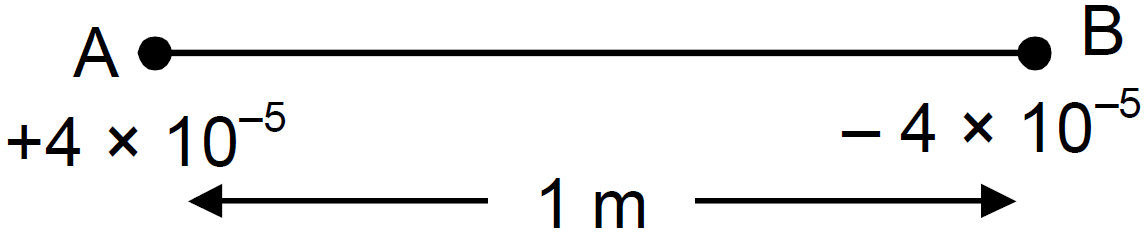

$\text{q}_1=\text{q}_2=4\times10^{-5}$
$\text{s}=1\text{m},\ \text{m}=5\text{g}$
$=0.005\text{kg}$
$\text{F}=\text{K}\frac{\text{q}^2}{\text{r}^2}$
$=\frac{9\times10^9\times\big(4\times10^{-5}\big)^2}{1^2}$
$=14.4\text{N}$
Acceleration ‘a’ $=\frac{\text{F}}{\text{m}}$
$=\frac{14.4}{0.005}$
$=2880\text{m/s}^2$
Now, $\text{u}=0,$
$\text{s}=50\text{cm}=0.5\text{m}$
$\text{a}=2880\text{m/s}^2,\ \text{V}=?$
$\Rightarrow\text{V}=\sqrt{2880}$
$=53.66\text{m/s}\approx54\text{m/s}$ for each particle.

View full question & answer
Question 23 Marks
Assume that each atom in a copper wire contributes one free electron. Estimate the number of free electrons in a copper wire having a mass of 6.4g (take the atomic weight of copper to be $64g\  mol^{-1}.$
Answer
64 grams of copper have 1 mole
6.4 grams of copper have 0.1 mole
1 mole = No atoms
0.1 mole = (no × 0.1) atoms
$= 6 \times 10^{23}\times 0.1$ atoms $= 6 \times 10^{22} $ atoms
1 atom contributes 1 electron
$6 \times 10^{22}$ atoms contributes $6 \times 10^{22} $ electrons.
View full question & answer
Question 33 Marks
A charge of 1.0C is placed at the top of your college building and another equal charge at the top of your house. Take the separation between the two charges to be 2.0km. Find the force exerted by the charges on each other. How many times of your weight is this force?
Answer
Given:
$\text{q}_1=\text{q}_2=\text{q}=1.0\text{C}$
Distance between the charges, $\text{r}=2\text{km}=2\times10^3\text{m}$
By Coulomb's Law, electrostatic force,
$\text{F}=\frac{1}{4\pi\in_0}\frac{\text{q}_1\text{q}_2}{\text{r}^2}$
$\text{F}=9\times10^9\times\frac{1\times1}{(2\times10^3)^2}$
$=2.25\times10^3\text{N}$
Let my mass, m, be 50kg.
Weight of my body, W = mg
$\Rightarrow\text{W}=50\times10\text{N}=500\text{N}$
Now,
$\frac{\text{Weight of my body}}{\text{Force between the charges}}=\frac{500}{2.25\times10^3}$
$=\frac{1}{4.5}$
So, the force between the charges is 4.5 times the weight of my body.
View full question & answer
Question 43 Marks
A water particle of mass 10.0mg and having a charge of $1.50 \times 10^{-6} C$ stays suspended in a room. What is the magnitude of electric field in the room? What is its direction?
Answer


$\text{m}=10,\ \text{mg}=10\times10^{-3}\text{g}\times10^{-3}\text{kg},$
$\text{q}=1.5\times10^{-6}\text{C}$
But $\text{qE}=\text{mg}$
$\Rightarrow(1.5\times10^{-6})\text{E}=10\times10^{-6}\times10$
$\Rightarrow\text{E}=\frac{10\times10^{-4}\times10}{1.5\times10^{-6}}$
$=\frac{100}{1.5}=66.6\text{N/C}$
$=\frac{100\times10^3}{1.5}=\frac{10^{5+1}}{15}$
$=6.6\times10^{3}$
View full question & answer
Question 53 Marks
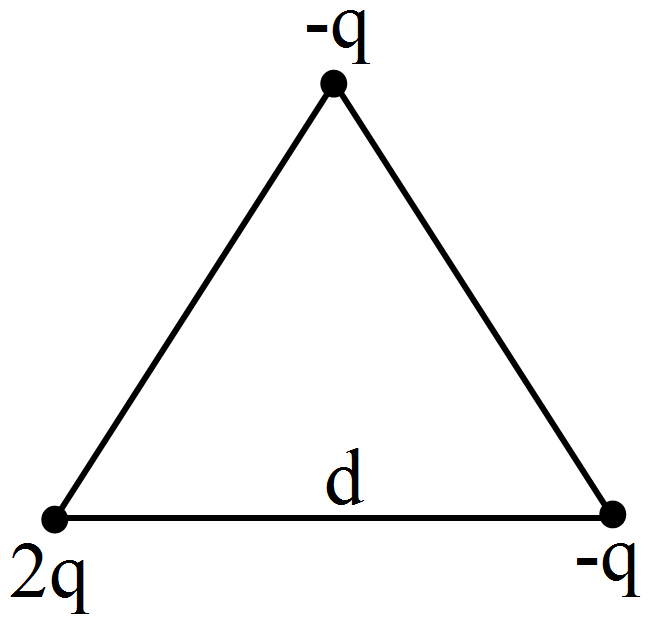
Three charges are arranged on the vertices of an equilateral triangle as shown in figure. Find the dipole moment of the combination.
Answer

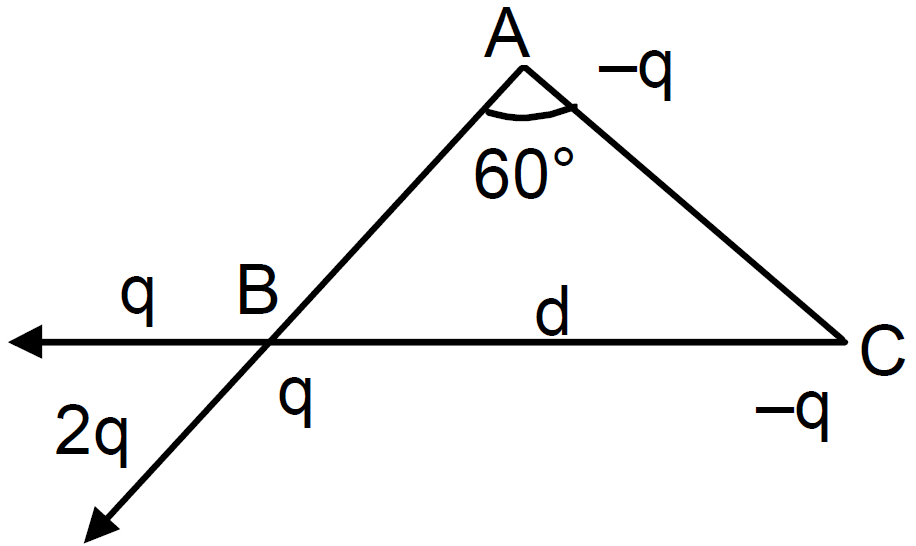
Let -q & -q are placed at A & C
Where 2q on B
So length of A = d
So the dipole moment = (q × d) = P
So, Resultant dipole moment
$\text{P}=\Big[(\text{qd})^2+(\text{qd})^2+2\text{qd}\times\text{qd}\cos60^\circ\Big]^{\frac{1}{2}}$
$=\big[3\text{q}^2\text{d}^2\big]^{\frac{1}{2}}$
$=\sqrt{3}\text{qd}$
$=\sqrt{3}\text{p}$
View full question & answer
Question 63 Marks
Suppose an attractive nuclear force acts between two protons which may be written as $\text{F}=\text{Ce}^{-\text{kr}}/\text{r}^2.$
  1. Write down the dimensional formulae and appropriate SI units of C and k.
  2. Suppose that k = 1 fermi$^{-1}$ and that the repulsive electric force between the protons is just balanced by the attractive nuclear force when the separation is 5 fermi. Find the value of C.
Answer
Expression of electrical force $\text{F}=\text{C}\times\text{e}^{\frac{-\text{kr}}{\text{r}^2}}$
Since $e^{-kr}$ is a pure number. So, dimensional formulae of $\text{F}=\frac{\text{dimensional formulae of C}}{\text{dimensional formulae of r}^2}$
Or, $\big[\text{MLT}^{-2}\big]\big[\text{L}^2\big]=$ dimensional formulae of $\text{C}=\big[\text{ML}^3\text{T}^{-2}\big]$
Unit of C = unit of force $\times$ unit of $r^2 =$ Newton$ \times m^2 =$ Newton$-m^2$​​​​​​​
Since -kr is a number hence dimensional formulae of
$\text{k}=\frac{1}{\text{dim entional formulae of r}}=\big[\text{L}^{-1}\big]$ Unit of $k = m^{-1}​​​​​​​$​​​​​​​
View full question & answer
Question 73 Marks
Two equal charges are placed at a separation of 1.0m. What should be the magnitude of the charges so that the force between them equals the weight of a 50kg person?
Answer
Let the magnitude of each charge be
Separation between them, r = 1m
Force between them, F = 50 × 9.8 = 490N
By Coulomb's Law force,
$\text{F}=\frac{1}{4\pi\in_0}\frac{\text{q}_1\text{q}_2}{\text{r}^2}$
$\Rightarrow490=9\times10^9\times\frac{\text{q}^2}{1^2}$
$\Rightarrow\text{q}^2=54.4\times10^{-9}$
$\Rightarrow\text{q}=\sqrt{54.4\times10^{-9}}$
$=23.323\times10^{-5}\text{C}$
$\text{q}=2.3\times10^{-4}\text{C}$
View full question & answer
Question 83 Marks
Find the speed of the electron in the ground state of a hydrogen atom. The description of ground state is given in the previous problem.
Answer
Fe from previous problem No. $18=8.2\times10^{-8}\text{N},\ \text{Ve}=?$
Now, $\text{M}_\text{e}=9.12\times10^{31}\text{kg},\ \text{r}=0.53\times10^{-10}\text{m}$
Now, $\text{Fe}=\frac{\text{M}_\text{e}\text{v}^2}{\text{r}}$
$\Rightarrow\text{v}^2=\frac{\text{Fe}\times\text{r}}{\text{m}_\text{e}}$
$=\frac{8.2\times10^{-8}\times0.53\times10^{-10}}{9.1\times10^{-31}}$
$=0.4775\times10^{13}$
$=4.775\times10^{12}\text{m}^2/\text{s}^2$
$\text{v}=2.18\times10^6\text{m/s}$
View full question & answer
Question 93 Marks
The kinetic energy of a charged particle decreases by 10J as it moves from a point at potential 100V to a point at potential 200V. Find the charge on the particle.
Answer
K.C. decreases by 10J.
Potential = 100v to 200v.
So, change in K.E = amount of work done
$\Rightarrow10\text{J}=(200-100)\text{v}\times\text{q}_0$
$\Rightarrow100\text{q}_0=10\text{v}$
$\Rightarrow\text{q}_0=\frac{10}{100}$
$=0.1\text{C}$
View full question & answer
Question 103 Marks
Two insulating small spheres are rubbed against each other and placed 1cm apart. If they attract each other with a force of 0.1N, how many electrons were transferred from one sphere to the other dunng rubbing?
Answer
$\text{F}=0.1\text{N}$
$\text{r}=1\text{cm}=10^{-2}$ (As they rubbed with each other. So the charge on each sphere are equal)
So, $\text{F}=\frac{\text{kq}_1\text{q}_2}{\text{r}^2}$
$\Rightarrow0.1=\frac{\text{kq}^2}{(10^{-2})^2}$
$\Rightarrow\text{q}^2=\frac{0.1\times10^{-4}}{9\times10^9}$
$\Rightarrow\text{q}^2=\frac{1}{9}\times10^{-14}$
$\Rightarrow\text{q}=\frac{1}{3}\times10^{-7}$
$1.6\times10^{-19}\text{c}$ Carries by 1 electron
1 c carried by $\frac{1}{1.6\times10^{-19}}$
$0.33\times10^{-7}$ c carries by
$\frac{1}{1.6\times10^{-19}} \times0.33\times10^{-7}$
$=0.208\times10^{12}$
$=2.08\times10^{11}$
View full question & answer
Question 113 Marks
Two charged particles, having equal charges of $2.0 \times 10^{-5}C$ each, are brought from infinity to within a separation of 10cm. Find the increase in the electric potential energy during the process.
Answer
$\text{q}_1=\text{q}_2=2\times10^{-5}\text{C}$
Each are brought from infinity to 10cm a part $d = 10 \times 10^{-2}m$
So work done = negative of work done. (Potential E)
$\text{P.E}=\int\limits_\infty^{10}\text{F}\times\text{ds}$
$\text{P.E}=\text{K}\times\frac{\text{q}_1\text{q}_2}{\text{r}}$
$=\frac{9\times10^9\times4\times10^{10}}{10\times10^{-2}}$
$=36\text{J}$
View full question & answer
Question 123 Marks
The number of electrons in an insulator is of the same order as the number of electrons in a conductor. What is then the basic difference between a conductor and an insulator?
Answer
The outer electrons of an atom or molecule in a conductor are only weakly bound to it and are free to move throughout the body of the material.
On the other hand, in insulators, the electrons are tightly bound to their respective atoms and cannot leave their parent atoms and move through a long distance.
View full question & answer
Question 133 Marks
Estimate the number of electrons in 100g of water. How much is the total negative charge on these electrons?
Answer
Molecular mass of water $= 18g$
Number of molecules in $18g$ of $H_2O =$ Avogadro's number
$= 6.023 \times 10^{23}$​​​​​​​
Number of electrons in 1 molecule of $H_2O = (2 \times 1) + 8 = 10$
Number of electrons in $6.023 \times 10^{23}$ molecules of $H_2O = 6.023 \times 10^{24}​​​​​​​$​​​​​​​
That is, number of electrons in $18g$ of $H_2O = 6.023 \times 10^{24}​​​​​​​$​​​​​​​
So, number of electrons in 100g of $ H_2O=\frac{6.023\times10^{24}}{18}\times100$
$=3.34\times10^{25}$
$\therefore$ Total charge $=3.34\times10^{25}\times1.6\times10^{-19}$
$=5.34\times10^6\text{C}$
View full question & answer
Question 143 Marks
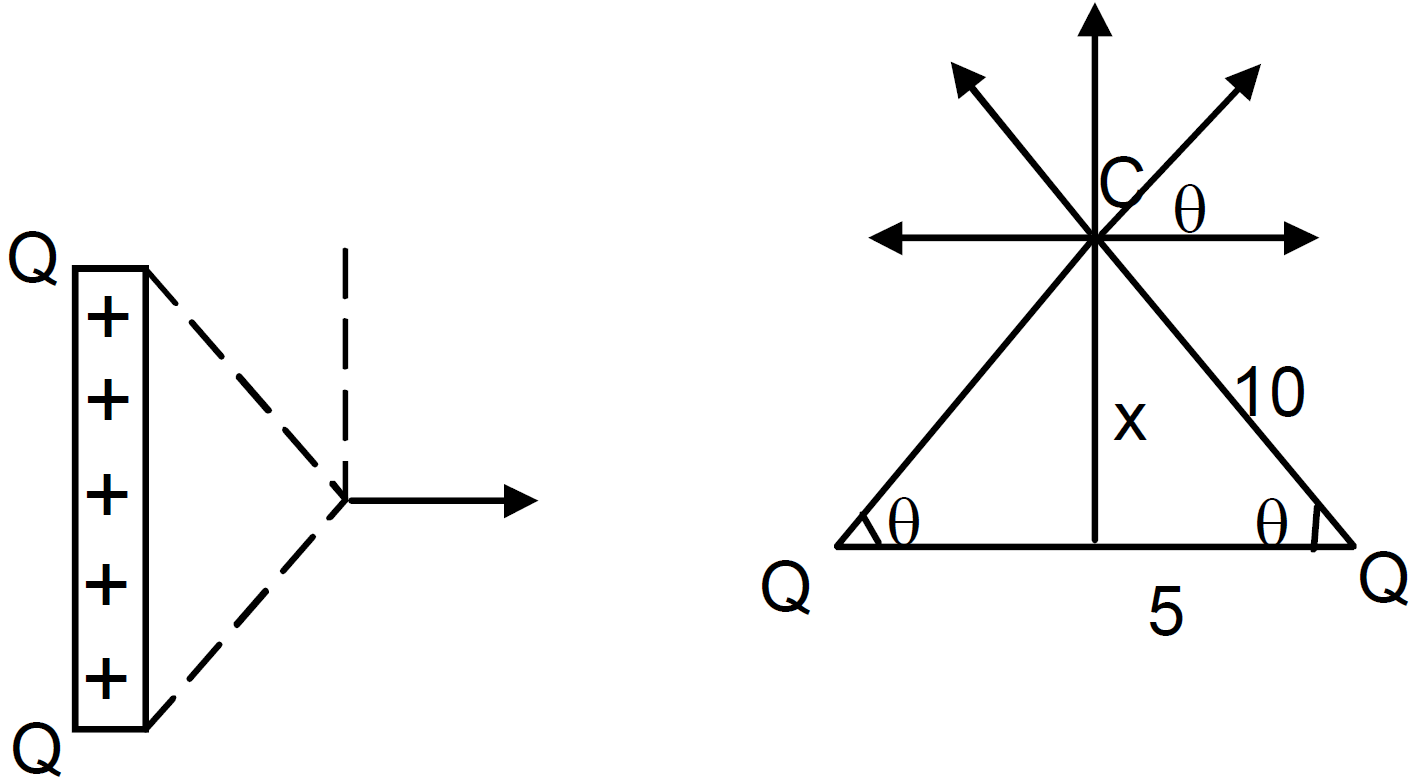
A 10cm long rod carries a charge of $+50\mu\text{C}$ distributed uniformly along its length. Find the magnitude of the electric field at a point 10cm from both the ends of the rod.
Answer

$\text{G}=50\mu\text{C}=50\times10^{-6}\text{C}$

We have, $\text{E}=\frac{2\text{KQ}}{\text{r}}$ for a charged cylinder
$\Rightarrow\text{E}=\frac{2\times9\times10^9\times50\times10^{-6}}{5\sqrt{3}}$
$=\frac{9\times10^{-5}}{5\sqrt{3}}$
$=1.03\times10^{-5}$
View full question & answer
Question 153 Marks
Does the force on a charge due to another charge depend on the charges present nearby?
Answer
Coulomb's Law states that the force between two charged particle is given by,
$\text{F}=\frac{\text{q}_1\text{q}_2}{4\pi\in_0\text{r}^2}$
Where,
$q_1$ and $q_2$ are the charges on the charged particles .
r = separation between the charged particles.
$\in_0$ = parmittivity of free space.
According to the Law of Superposition, the electrostatic force between two charged particles are unaffected due to the presence of other charges.
View full question & answer
Question 163 Marks
Two identical particles, each having a charge of $2.0 \times 10^{-4}C$ and mass of 10g, are kept at a separation of 10cm and then released. What would be the speeds of the particles when the separation becomes large?
Answer


$\text{m}=10\text{g}$
$\text{F}=\frac{\text{KQ}}{\text{r}}$
$=\frac{9\times10^9\times2\times10^{-4}}{10\times10^{-2}}$
$\text{F}=1.8\times10^{-7}$
$\text{F}=\text{m}\times\text{a}$
$\Rightarrow\text{a}=\frac{1.8\times10^{-7}}{10\times10^{-3}}$
$=1.8\times10^{-3}\text{m/s}^2$
$\text{V}^2-\text{u}^2=2\text{as}$
$\Rightarrow\text{V}^2=\text{u}^2+2\text{as}$
$\text{V}=\sqrt{0+2\times1.8\times10^{-3}\times10\times10^{-2}}$
$=\sqrt{3.6\times10^{-4}}$
$=0.6\times10^{-2}$
$=6\times10^{-3}\text{,m/s}.$
View full question & answer
Question 173 Marks
Suppose an attractive nuclear force acts between two protons which may be written as $\text{F}=\text{Ce}^{-\text{kr}}/\text{r}^2.$
  1. Write down the dimensional formulae and appropriate SI units of C and k.
  2. Suppose that k = 1 fermi$^{-1}$ and that the repulsive electric force between the protons is just balanced by the attractive nuclear force when the separation is 5 fermi. Find the value of C.
Answer
Expression of electrical force $\text{F}=\text{C}\times\text{e}^{\frac{-\text{kr}}{\text{r}^2}}$
Since $e^{-kr}$ is a pure number. So, dimensional formulae of $\text{F}=\frac{\text{dimensional formulae of C}}{\text{dimensional formulae of r}^2}$
Or, $\big[\text{MLT}^{-2}\big]\big[\text{L}^2\big]=$ dimensional formulae of $\text{C}=\big[\text{ML}^3\text{T}^{-2}\big]$
Unit of $ C =$ unit of force $\times$ unit of $r^2 = $Newton $\times\ m^2 =$Newton-$m^2$​​​​​​​
Since -kr is a number hence dimensional formulae of
$\text{k}=\frac{1}{\text{dim entional formulae of r}}=\big[\text{L}^{-1}\big]$ Unit of $k = m^{-1}​​​​​​​$​​​​​​​
View full question & answer
Question 183 Marks
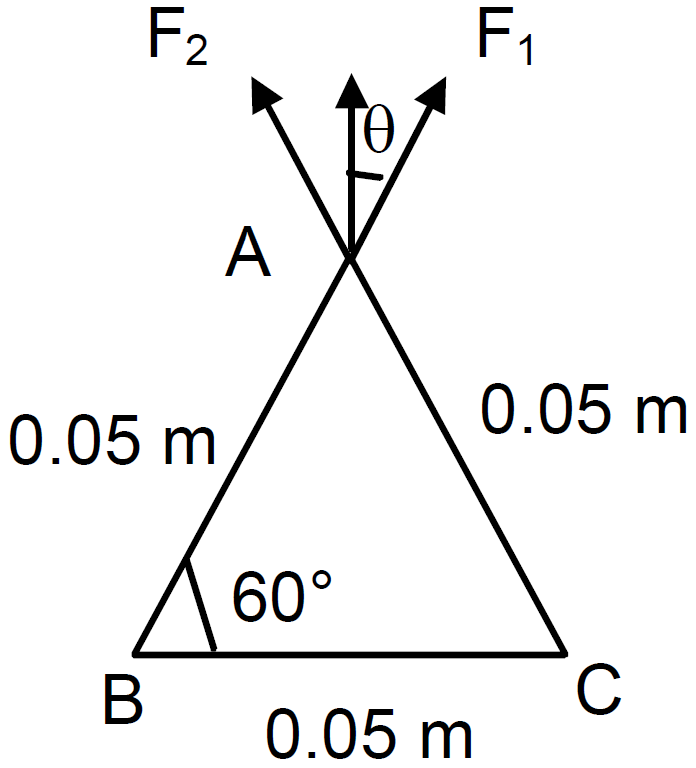
Three equal charges, $2.0 \times 10^{-6}C$ each, are held fixed at the three corners of an equilateral triangle of side 5cm. Find the Coulomb force experienced by one of the charges due to the rest two.
Answer


Three charges are held at three corners of a equilateral trangle.
Let the charges be A, B and C.
It is of length 5cm or 0.05m
Force exerted by B on $A = F_1$
Force exerted by C on $A = F_2$
So, force exerted on $A =$ resultant $F_1 = F_2$
$\Rightarrow\text{F}=\frac{\text{kq}_2}{\text{r}^2}$
$=\frac{9\times10^9\times2\times2\times2\times10^{-12}}{5\times5\times10^{-4}}$
$=\frac{36}{25}\times10$
$=14.4$
Now, force on $A = 2 × F \cos 30°$ since it is equilateral $\triangle.$
⇒ Force on $\text{A}=2\times1.44\times\sqrt{\frac{3}{2}}$
$=24.94\text{N}.$
View full question & answer
Question 193 Marks
When a charged comb is brought near a small piece of paper, it attracts the piece. Does the paper become charged when the comb is brought near it?
Answer
When a charged comb is brought near a small piece of paper, it attracts the piece due to induction. There's a distribution of charges on the paper. When a charged comb is brought near the pieces of paper then an opposite charge is induced on the near end of the pieces of paper so the charged comb attracts the opposite charge on the near end of paper and similar on the farther end. The net charge on the paper remains zero.
View full question & answer
Question 203 Marks
Two identically charged particles are fastened to the two ends of a spring of spring constant $100Nm^{-1}$ and natural length 10cm. The system rests on a smooth horizontal table. If the charge on each particle is $2.0 \times 10^{-8}C,$ find the extension in the length of the spring. Assume that the extension is small as compared to the natural length. Justify this assumption after you solve the problem.
Answer
$\text{K}=100\text{N/m},\ \ell=10\text{cm}=10^{-1}\text{m}$
$\text{q}=2.0\times10^{-8}\text{c},\ \text{Find}\ell=?$

Force between them $\text{F}=\frac{\text{kq}_1\text{q}_2}{\text{r}^2}$
$=\frac{9\times10^92\times10^{-8}\times2\times10^{-8}}{10^{-2}}$
$=36\times10^{-5}\text{N}$
So, $\text{F}=-\text{kx}$ or $\text{x}=\frac{\text{F}}{-\text{K}}$
$=\frac{36\times10^{-5}}{100}$
$=36\times10^{-7}\text{cm}$
$=3.6\times10^{-6}\text{m}$
View full question & answer
Question 213 Marks
If a charge is placed at rest in an electric field, will its path be along a line of force? Discuss the situation when the lines of force are straight and when they are curved.
Answer
If a charge is placed at rest in an electric field, its path will be tangential to the lines of force. When the electric field lines are straight lines then the tangent to them will coincide with the electric field lines so the charge will move along them only. When the lines of force are curved, the charge moves along the tangent to them.
View full question & answer
Question 223 Marks
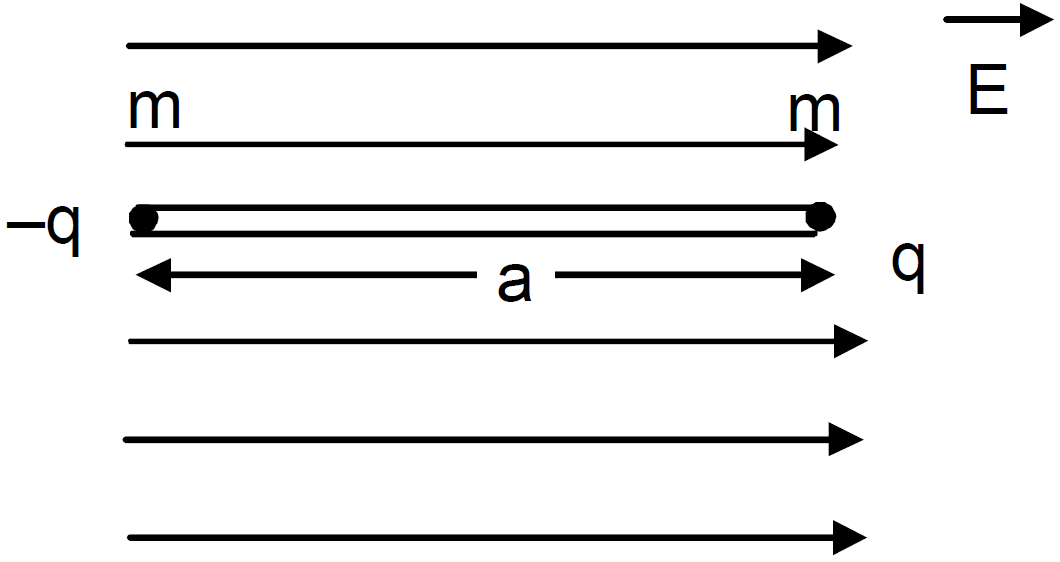
Two particles, carrying charges -q and +q and having equal masses m each, are fixed at the ends of a light rod of length a to form a dipole. The rod is clamped at an end and is placed in a uniform electric field E with the axis of the dipole along the electric field. The rod is slightly tilted and then released. Neglecting gravity find the time period of small oscillations.
Answer
Consider the rod to be a simple pendulum.
For simple pendulum,

$\text{T}=2\pi\sqrt{\frac{\ell}{\text{g}}}$ $\big(\ell=$ length, q = acceleration$\big)$
Now, force experienced by the charges
F = Eq Now, acceleration $=\frac{\text{F}}{\text{m}}$
$=\frac{\text{Eq}}{\text{m}}$
Hence length = a
so, Time period $=2\pi\sqrt{\frac{\text{a}}{\Big(\frac{\text{Eq}}{\text{m}}\Big)}}$
$=2\pi\sqrt{\frac{\text{ma}}{\text{Eq}}}$
View full question & answer
Question 233 Marks
Two particles A and B having charges of $+2.00 \times 10^{-6}C$ and of $-4.00 \times 10^{-6}C$ respectively are held fixed at a separation of 20.0cm. Locate the point(s) on the line AB where
  1. The electric field is zero.
  2. The electric potential is zero.
Answer
$\text{q}_2=2\times10^{-6}\text{C},\ \text{q}_1^2=-4\times10^{-6}\text{C},$
$\text{r}=20\text{cm}=0.2\text{m}$
$(E_1 =$ electric field due to $q_1, E_2 =$ electric field due to $q_2)$
$\Rightarrow\frac{(\text{r}-\text{x})^2}{\text{x}^2}=\frac{-\text{q}_2}{\text{q}_1}\Rightarrow\frac{(\text{r}-1)^2}{\text{x}}=\frac{-\text{q}_2}{\text{q}_1}$
$=\frac{4\times10^{-6}}{2\times10^{-6}}=\frac{1}{2}$
$\Rightarrow\Big(\frac{\text{r}}{\text{x}}-1\Big)=\frac{1}{\sqrt{2}}$
$=\frac{1}{1.414}$
$\Rightarrow\frac{\text{r}}{\text{x}}=1.414+1$
$=2.414$
$\Rightarrow\text{x}=\frac{\text{r}}{2.414}$
$=\frac{20}{2.414}$
$=8.285\text{cm}$
View full question & answer
Question 243 Marks
Can two equipotential surfaces cut each other?
Answer
At the point of intersection, two normals can be drawn. Also, we know that electric field lines are perpendicular to the equipotential surface. This implies that at that point two different directions of the electric field are possible, which is not possible physically.
Hence, two equipotential surfaces cannot cut each other.
View full question & answer
Question 253 Marks
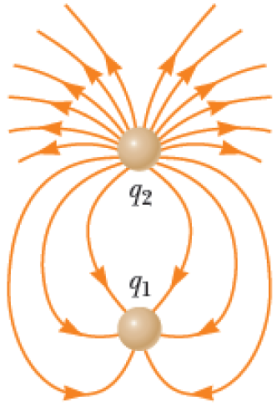
Consider the situation shown in figure. What are the signs of $q_1$ and $q_2?$ If the lines are drawn in proportion to the charge, what is the ratio $\frac{\text{q}_1}{\text{q}_2}?$
Answer
The electric lines of force are entering charge $q_1;$ So, it is is negative. On the other hand, the lines of force are originating from charge $q_2;$ so, it positive.
If the lines are drawn in proprotion to the charges, then
$\frac{\text{q}_1}{\text{q}_2}=\frac{6}{18}$
$\Rightarrow\frac{\text{q}_1}{\text{q}_2}=\frac{1}{3}$
6 lines are entering $q_1$ and 18 are coming our of $q_2.$
View full question & answer
Question 263 Marks
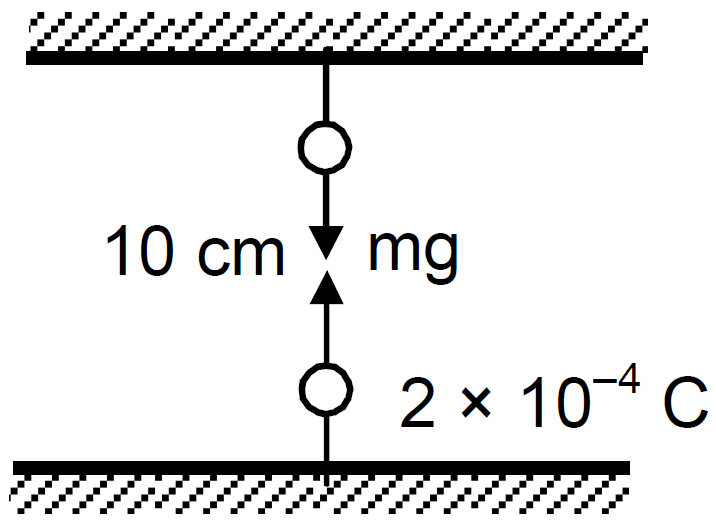
A particle having a charge of $2.0 \times 10^{-4}C$ is placed directly below and at a separation of 10cm from the bob of a simple pendulum at rest. The mass of the bob is 100g. What charge should the bob be given so that the string becomes loose?
Answer


Mass of the bob $= 100g = 0.1kg$
So Tension in the string $= 0.1 × 9.8 = 0.98N.$
For the Tension to be 0, the charge below should repel the first bob.
$\Rightarrow\text{F}=\frac{\text{kq}_1\text{q}_2}{\text{r}^2}$ $\big[\text{T}-\text{mg}+\text{F}=0\ \Rightarrow\text{T}=\text{mg}-\text{f},\ \text{T}=\text{mg}\big]$
$\Rightarrow0.98=\frac{9\times10^9\times2\times10^{-4}\times\text{q}^2}{(0.01)^2}$
$\Rightarrow\text{q}_2=\frac{0.98\times1\times10^{-2}}{9\times2\times10^5}$
$=0.054\times10^{-9}\text{N}$
View full question & answer
Question 273 Marks
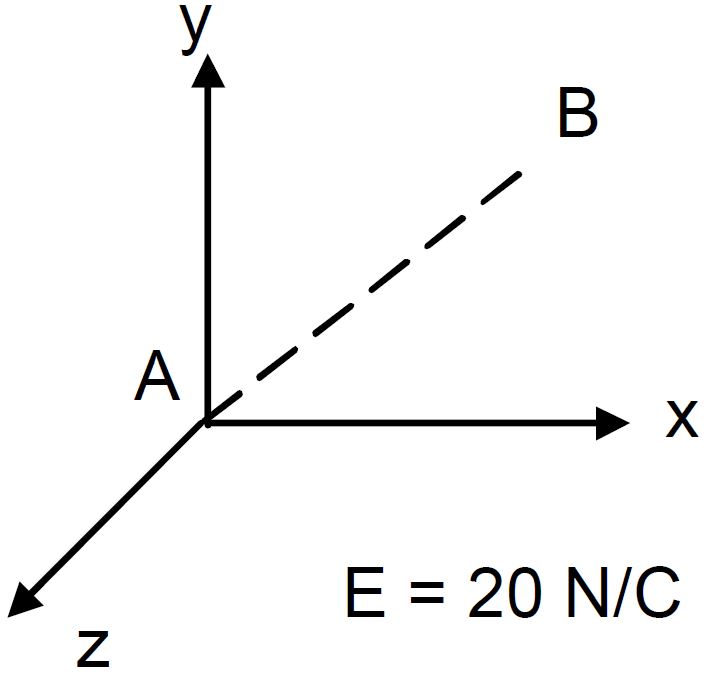
An electric field of $20NC^{-1}$ exists along the x-axis in space. Calculate the potential difference $V_B - V_A$ where the points A and B are given by,
  1. $A = (0, 0); B = (4m, 2m)$
  2. $A = (4m, 2m); B = (6m, 5m)$
  3. $A = (0, 0); B = (6m, 5m)$
Do you find any relation between the answers of parts (a), (b) and (c)?
Answer

  1. $\text{A}=(0,0);\ \text{B}=(4,2)$
$\Rightarrow\text{V}_\text{B}-\text{V}_\text{A}=\text{E}\times\text{d}$

$=20\times\sqrt{16}$

$=80\text{V}$
  1. $\text{A}=(4\text{m},2\text{m});\ \text{B}=(6\text{m},5\text{m})$
$\Rightarrow\text{V}_\text{B}-\text{V}_\text{A}=\text{E}\times\text{d}$

$=20\times\sqrt{(6-4)^2}$

$=20\times2$

$=40\text{V}$
  1. $\text{A}=(0,0);\ \text{B}=(6\text{m},5\text{m})$
$\Rightarrow\text{V}_\text{B}-\text{V}_\text{A}=\text{E}\times\text{d}$

$=20\times\sqrt{(6-0)^2}$

$=20\times6$

$=120\text{V}.$
View full question & answer