Questions

5 Marks Questions

Take a timed test

14 questions · self-marked practice — reveal the answer and mark yourself.

Question 15 Marks
A parallel beam of white light is incident normally on a water film $1.0 \times 10^{-4}cm$ thick. Find the wavelength in the visible range (400nm - 700nm) which are strongly transmitted by the film. Refractive index of water = 1.33.
Answer
For strong transmission, $2\mu\text{d}=\text{n}\lambda\Rightarrow\lambda=\frac{2\mu\text{d}}{\text{n}}$
Given that, $\mu=1.33,\text{d}=1\times10^{-4}\text{cm}=1\times10^{-6}\text{m}$
$\Rightarrow\lambda=\frac{2\times1.33\times1\times10^{-6}}{\text{n}}=\frac{2660\times10^{-9}}{\text{n}}\text{m}$
When, $\text{n}=4,\lambda_1=665\text{nm}$$\text{n}=5,\lambda_2=532\text{nm}$
$\text{n}=6,\lambda_3=443\text{nm}$
View full question & answer
Question 25 Marks
A thin paper of thickness 0.02mm having a refractive index 1.45 is pasted across one of the slits in a Young's double slit experiment. The paper transmits $\frac{4}{9}$ of the light energy falling on it.
  1. Find the ratio of the maximum intensity to the minimum intensity in the fringe pattern.
  2. How many fringes will cross through the centre if an identical paper piece is pasted on the other slit also? The wavelength of the light used is 600nm.
Answer
Given that, $t = 0.02mm = 0.02 \times 10^{-3}m,$
$\mu_1=1.45,\ \lambda=600\text{nm}=600\times10^{-9}\text{m}$
  1. Let, $I_1 =$ Intensity of source without paper = I
  2. Then $I_2 =$ Intensity of source with paper $=\Big(\frac{4}{9}\Big)\text{I}$
$\Rightarrow\frac{\text{I}_1}{\text{I}_2}=\frac{9}{4}\Rightarrow\frac{\text{r}_1}{\text{r}_2}=\frac{3}{2}\ [\because\text{I}\propto\text{r}^2]$
where, $r_1$ and $r_2$ are corresponding amplitudes.
So, $\frac{\text{I}_\text{max}}{\text{I}_\text{min}}=\frac{(\text{r}_1+\text{r}_2)^2}{(\text{r}_1-\text{r}_2)^2}=25:1$
No. of fringes that will cross the origin is given by,
$\text{n}=\frac{(\mu-1)\text{t}}{\lambda}=\frac{(1.45-1)\times0.02\times10^{-3}}{600\times10^{-9}}=15.$
View full question & answer
Question 35 Marks
A glass surface is coated by an oil film of uniform thickness $1.00 \times 10^{-4}cm$. The index of refraction of the oil is 1.25 and that of the glass is 1.50. Find the wavelengths of light in the visible region (400nm - 750nm) which are completely transmitted by the oil film under normal incidence.
Answer
For the thin oil film,$\text{d}=1\times10^{-4}\text{cm}=10^{-6}\text{m},$ $\mu_{\text{oil}}=1.25\ \text{and}\ \mu_\text{x}=1.50$
$\lambda=\frac{2\mu\text{d}}{\Big(\text{n}+\frac{1}{2}\Big)}\frac{2\times10^{-6}\times1.25\times2}{2\text{n}+1}=\frac{5\times10^{-6}\text{m}}{2\text{n}+1}$
$\Rightarrow\lambda=\frac{5000\text{nm}}{2\text{n}+1}$
For the wavelengths in the region (400nm - 750nm) When, $\text{n}=3,\lambda=\frac{5000}{2\times3+1}=\frac{5000}{7}=714.3\text{nm}$ When, $\text{n}=4,\lambda=\frac{5000}{2\times4+1}=\frac{5000}{9}=555.6\text{nm}$
When, $\text{n}=5,\lambda=\frac{5000}{2\times5+1}=\frac{5000}{11}=454.5\text{nm}$
View full question & answer
Question 45 Marks
In a Young's double slit experiment using monochromatic light, the fringe pattern shifts by a certain distance on the screen when a mica sheet of refractive index 1.6 and thickness 1.964 micron $(1$ micron $= 10^{-6}m)$ is introduced in the path of one of the interfering waves. The mica sheet is then removed and the distance between the screen and the slits is doubled. It is found that the distance between the successive maxima now is the same as the observed fringe-shift upon the introduction of the mica sheet. Calculate the wavelength of the monochromatic light used in the experiment.
Answer
In the given Young’s double slit experiment,$\mu=1.6,$ t = 1.964 micron $= 1.964 \times 10^{-6}m$
We know, number of fringes shifted $=\frac{(\mu-1)\text{t}}{\lambda}$
So, the corresponding shift = No.of fringes shifted × fringe width$=\frac{(\mu-1)\text{t}}{\lambda}\times\frac{\lambda\text{D}}{\text{d}}=\frac{(\mu-1)\text{tD}}{\text{d}}\ ...(1)$
Again, when the distance between the screen and the slits is doubled, Fringe width $=\frac{\lambda(2\text{D})}{\text{d}}\ ...(2)$ From (1) and (2), $\frac{(\mu-1)\text{tD}}{\text{d}}=\frac{\lambda(2\text{D})}{\text{d}}$$\Rightarrow\lambda=\frac{(\mu-1)\text{t}}{\lambda}$
$=\frac{(1.6-1)\times(1.964)\times10^{-6}}{2}=589.2\times10^{-9}=589.2\text{nm}.$
View full question & answer
Question 55 Marks
The wavelength of sodium light in air is 589nm.
  1. Find its frequency in air.
  2. Find its wavelength in water (refractive index = 1.33).
  3. Find its frequency in water.
  4. Find its speed in water.
Answer
Given that, for sodium light, $\lambda=589\text{nm}=589\times10^{-9}\text{m}$
  1. $\text{f}_\text{a}=\frac{3\times10^8}{589\times10^{-9}}=5.09\times10^{14}\sec\Big[\because\text{f}=\frac{\text{c}}{\lambda}\Big]$
  2. $\frac{\mu_\text{a}}{\mu_\text{w}}=\frac{\lambda_\text{w}}{\lambda_\text{a}}\Rightarrow\frac{1}{1.33}=\frac{\lambda_\text{w}}{589\times10^{-9}}\Rightarrow\lambda _\text{w}=443\text{nm}$
  3. $\text{f}_\text{w}=\text{f}_\text{a}=5.09\times10^{14}\sec^{-1}$ [Frequency does not change]
  4. $\frac{\mu_\text{a}}{\mu_\text{w}}=\frac{\text{v}_\text{w}}{\text{v}_\text{a}}\Rightarrow\text{v}_\text{w}=\frac{\mu_\text{a}\text{v}_\text{a}}{\mu_\text{w}}=\frac{3\times10^{10^8}}{1.33}=2.25\times10^8\text{m/sec}.$
View full question & answer
Question 65 Marks
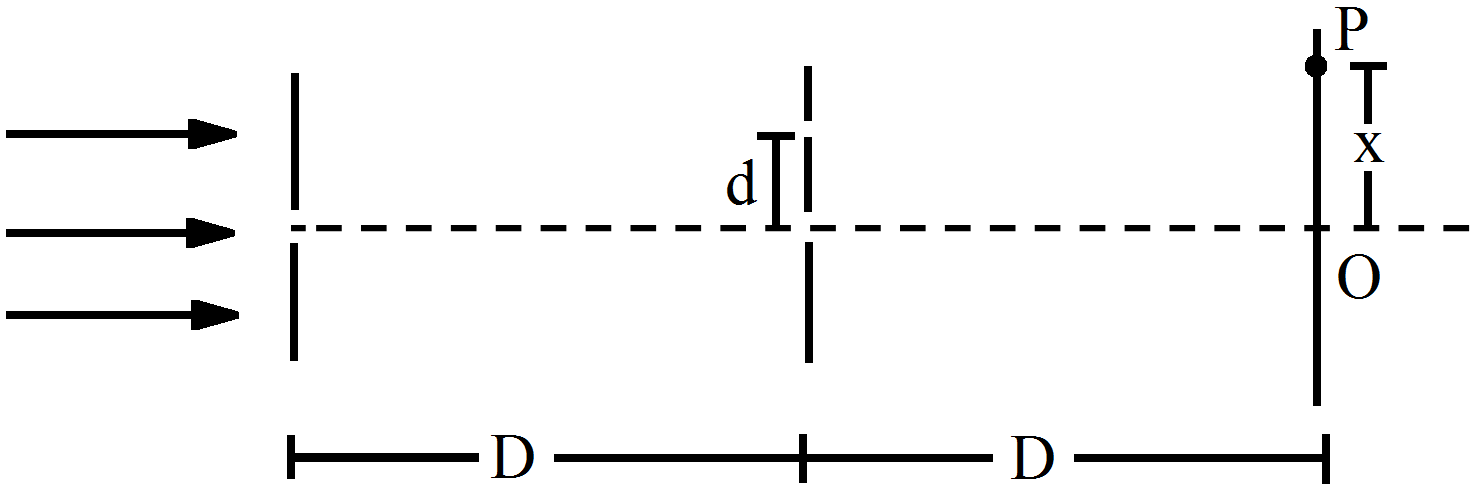
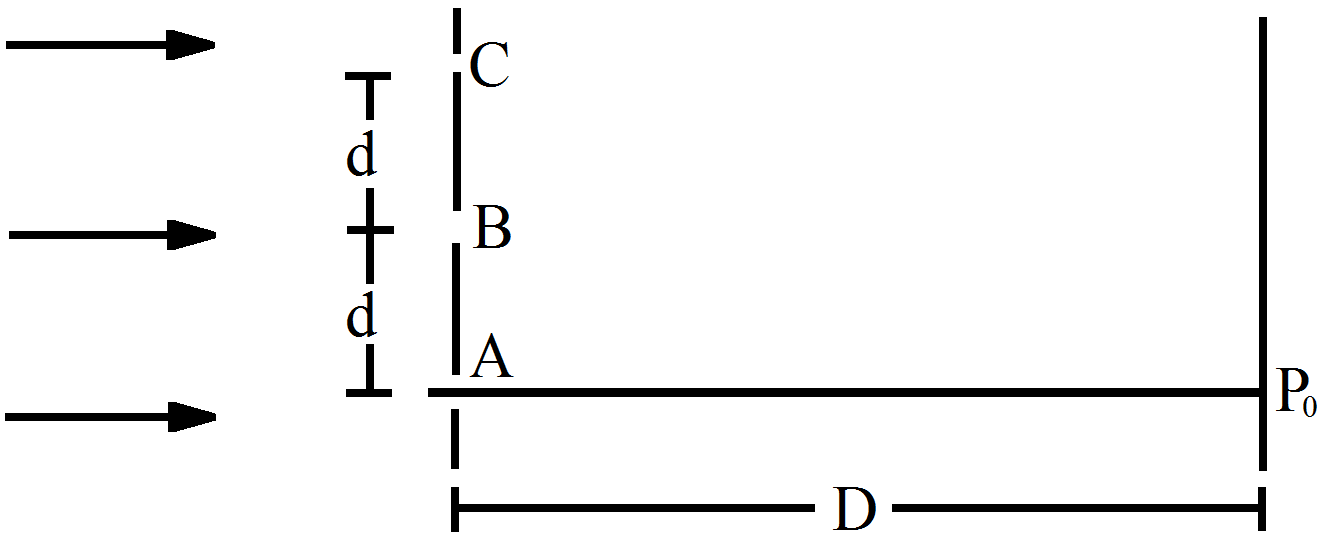
Figure shows three equidistant slits being illuminated by a monochromatic parallel beam of light. Let $\text{BP}_0-\text{AP}=\frac{\lambda}{3}$ and $\text{D}>\lambda.$
  1. Show that in this case $\text{d}=\sqrt{\frac{2\lambda\text{D}}{3}}.$
  2. Show that the intensity at P, is three times the intensity due to any of the three slits individually.
Answer
Since $S_1, S_2$ are in same phase, at O there will be maximum intensity. Given that, there will be a maximum intensity at P.
⇒ path difference $=\Delta\text{x}=\text{n}\lambda$ From the figure,$(\text{S}_1\text{P})^2-(\text{S}_2\text{P})^2=\Big(\sqrt{\text{D}^2+\text{X}^2}\Big)^2-\Big(\sqrt{(\text{D}-2\lambda)^2+\text{X}^2}\Big)^2$
$=4\lambda\text{D}-4\lambda^2=4\lambda\text{D}$ ($\lambda^2$ is so small and can be neglected)
$\Rightarrow\text{S}_1\text{P}-\text{S}_2\text{P}=\frac{4\lambda\text{D}}{2\sqrt{\text{x}^2+\text{D}^2}}=\text{n}\lambda$
$\Rightarrow\frac{2\text{D}}{\sqrt{\text{x}^2+\text{D}^2}}=\text{v}$
$\Rightarrow\text{n}^2(\text{X}^2+\text{D}^2)=4\text{D}^2=\Delta\text{X}=\frac{\text{D}}{\text{n}}\sqrt{4-\text{n}^2}$
when $\text{n}=1,\text{x}=\sqrt{3}\text{D}$$ (1^{st}$ order)$\text{n}=2,\text{x}=0$ $(2^{nd}$ order$)$
$\therefore$ When $\text{X}=\sqrt{3}\text{D},$ at P there will be maximum intensity.
View full question & answer
Question 75 Marks
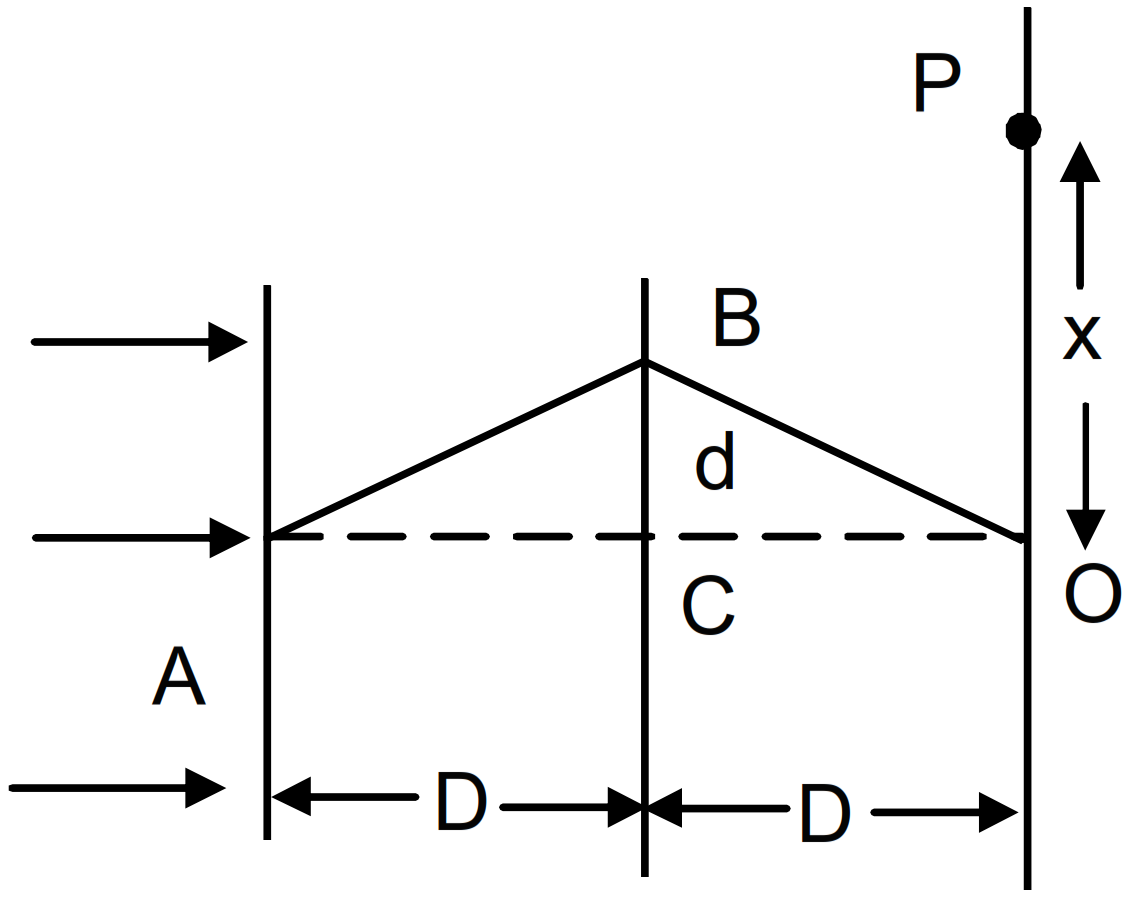
Consider the arrangement shown in figure (17-E4). The distance D is large compared to the separation d between the slits.
  1. Find the minimum value of d so that there is a dark fringe at 0.
  2. Suppose d has this value. Find the distance x at which the next bright fringe is formed.
  3. Find the fringe-width.
Answer
From the diagram, it can be seen that at point O. Path difference = (AB + BO) - (AC + CO) = 2(AB - AC) [Since, AB = BO and AC = CO] $=2\Big(\sqrt{\text{d}^2+\text{D}^2}-\text{D}\Big)$ For dark fringe, path difference should be odd multiple of $\frac{\lambda}{2}.$ So, $2\Big(\sqrt{\text{d}^2+\text{D}^2}-\text{D}\Big)=(2\text{n}+1)\Big(\frac{\lambda}{2}\Big)$$\Rightarrow\sqrt{\text{d}^2+\text{D}^2}=\text{D}+(2\text{n}+1)\Big(\frac{\lambda}{4}\Big)$
$\Rightarrow\text{D}^2+\text{d}^2=\text{D}^2+(2\text{n}+1)^2\frac{\lambda^2}{16}+(2\text{n}+1)\frac{\lambda\text{D}}{2}$
Neglecting, $(2\text{n}+1)^2\frac{\lambda^2}{16},$ as it is very small We get, $\text{d}=\sqrt{(2\text{n}+1)\frac{\lambda\text{D}}{2}}$ For minimum ‘d’, putting $\text{n}=0\Rightarrow\text{d}_\text{min}=\sqrt{\frac{\lambda\text{D}}{2}}.$
View full question & answer
Question 85 Marks
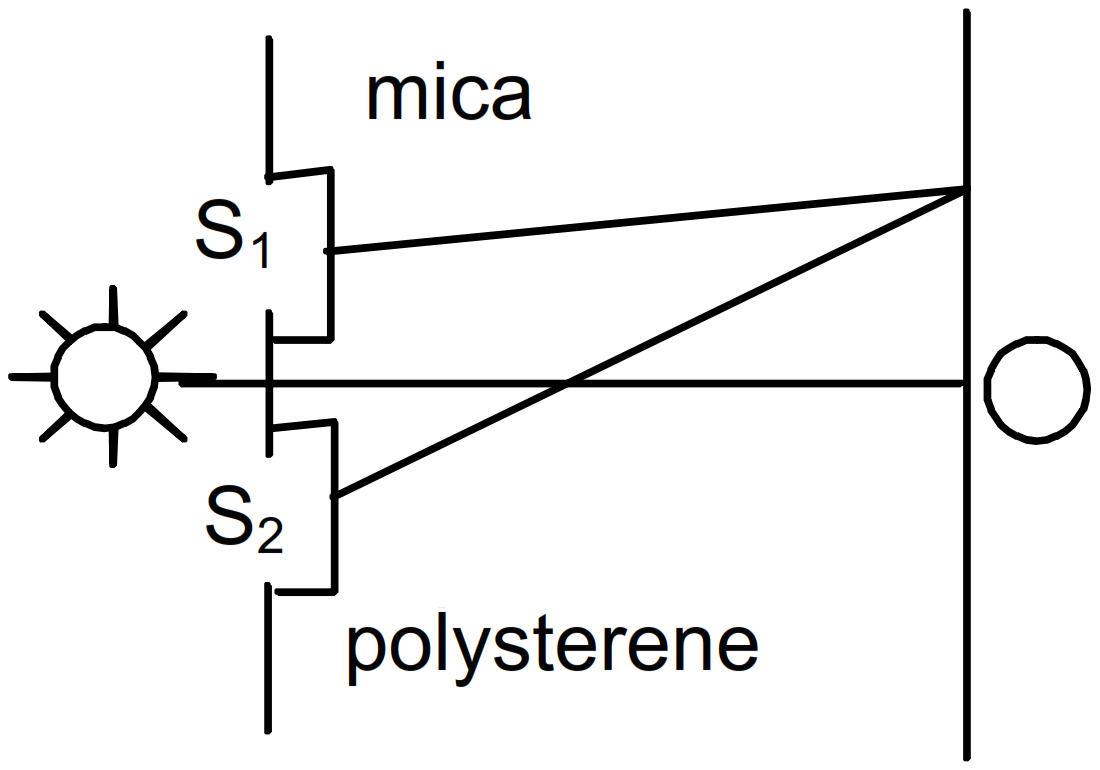
A mica strip and a polysterene strip are fitted on the two slits of a double slit apparatus. The thickness of the strips is 0.50mm and the separation between the slits is 0.12cm. The refractive index of mica and polysterene are 1.58 and 1.55 respectively for the light of wavelength 590nm which is used in the experiment. The interference is observed on a screen a distance one meter away.
  1. What would be the fringe-width?
  2. At what distance from the centre will the first maximum be located?
Answer


Given that, $t_1 = t_2 = 0.5mm = 0.5 \times 10^{-3}m,$ $\mu_\text{m}=1.58$ and $\mu_\text{p}=1.55,$
$\lambda=590\text{nm}=590\times 10^{-9}\text{m}, \text{d}=0.12\text{cm},\\ \mu_{\text{m}}=1.58\text{ and }\mu_{\text{p}}=1.55,$
Fringe width $=\frac{\text{D}\lambda}{\text{d}}=\frac{1\times590\times10^{-9}}{12\times10^{-4}}=4.91\times10^{-4}\text{m}.$
When both the strips are fitted, the optical path changes by
$\Delta\text{x}=(\mu_\text{m}-1)\text{t}_1-(\mu_\text{p}-1)\text{t}_2=(\mu_\text{m}-\mu_\text{p})\text{t}$
$=(1.58-1.55)\times(0.5)(10^{-3})=0.015\times10^{-13}\text{m}$
So, No. of fringes shifted $=\frac{0.015\times10^{-3}}{590\times10^{-3}}=25.43$
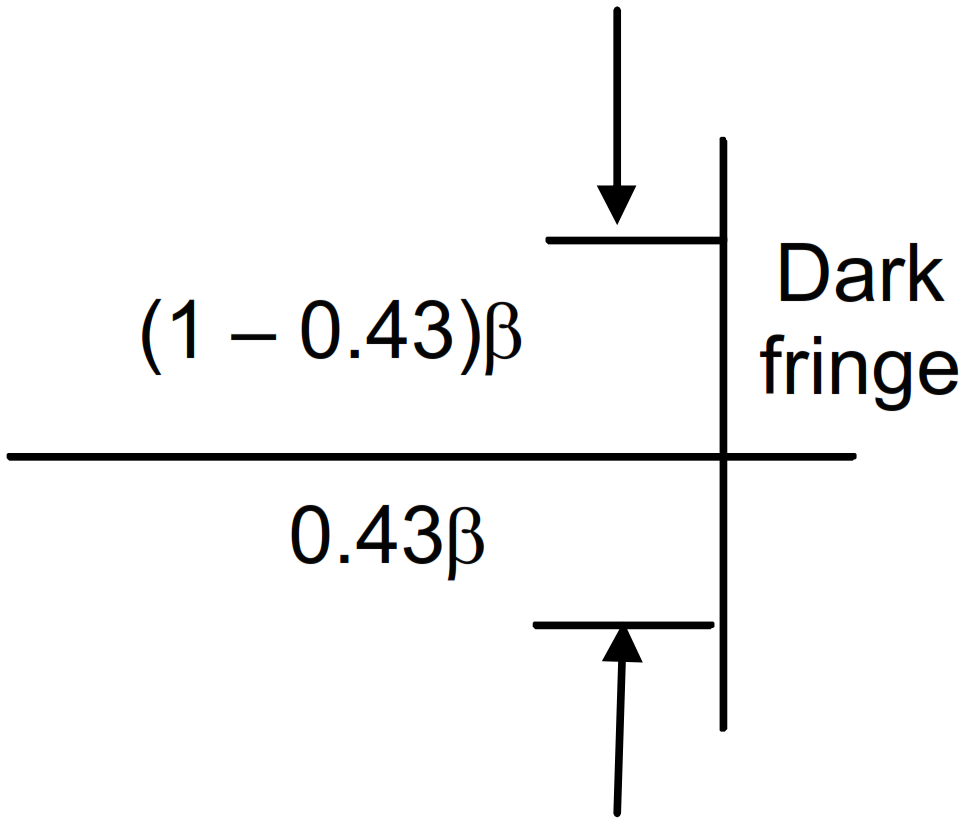
⇒ There are 25 fringes and 0.43 th of a fringe.
⇒ There are 13 bright fringes and 12 dark fringes and 0.43 th of a dark fringe.
So, position of first maximum on both sides will be given by,
$\therefore x = 0.43 \times 4.91 \times 10^{-4} = 0.021cm$
$x' = (1 - 0.43) \times 4.91 \times 10^{-4} = 0.028cm$ $($since, fringe width $= 4.91 \times 10^{-4}m)$
View full question & answer
Question 95 Marks
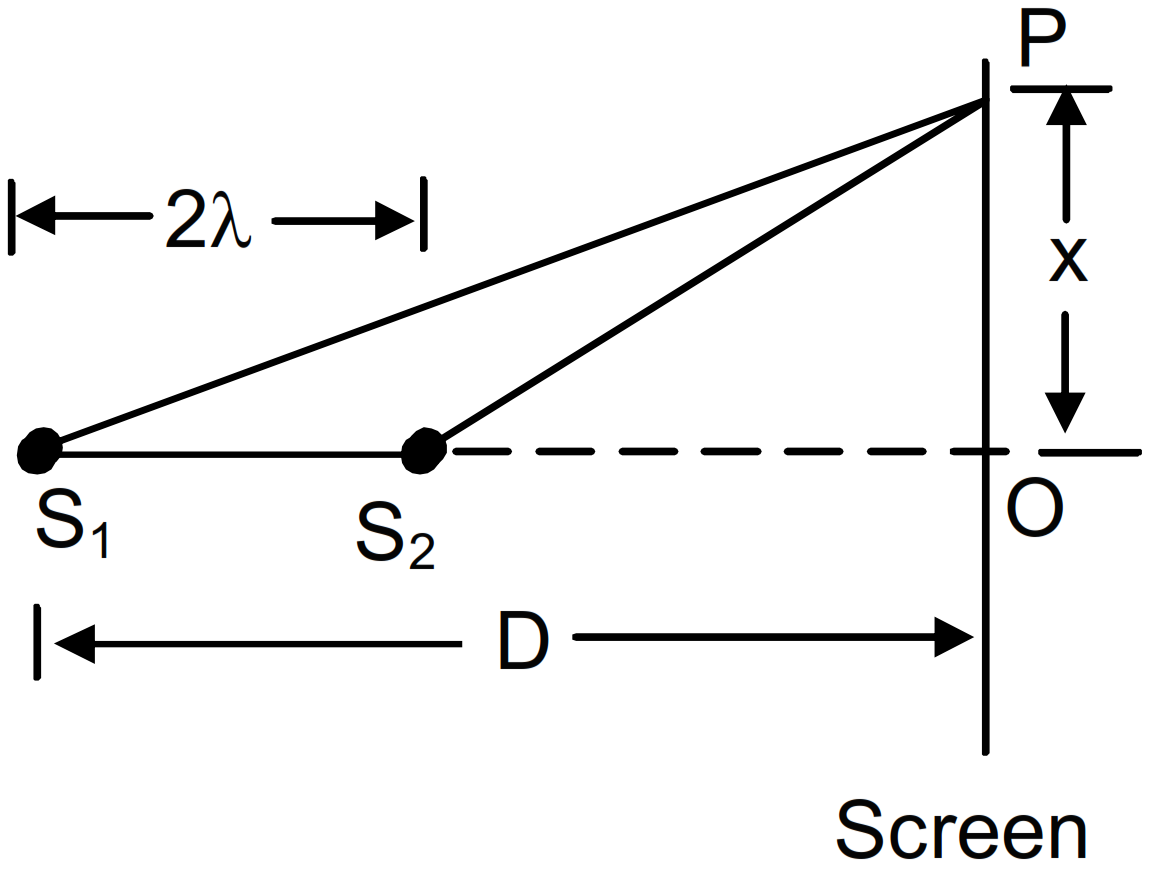
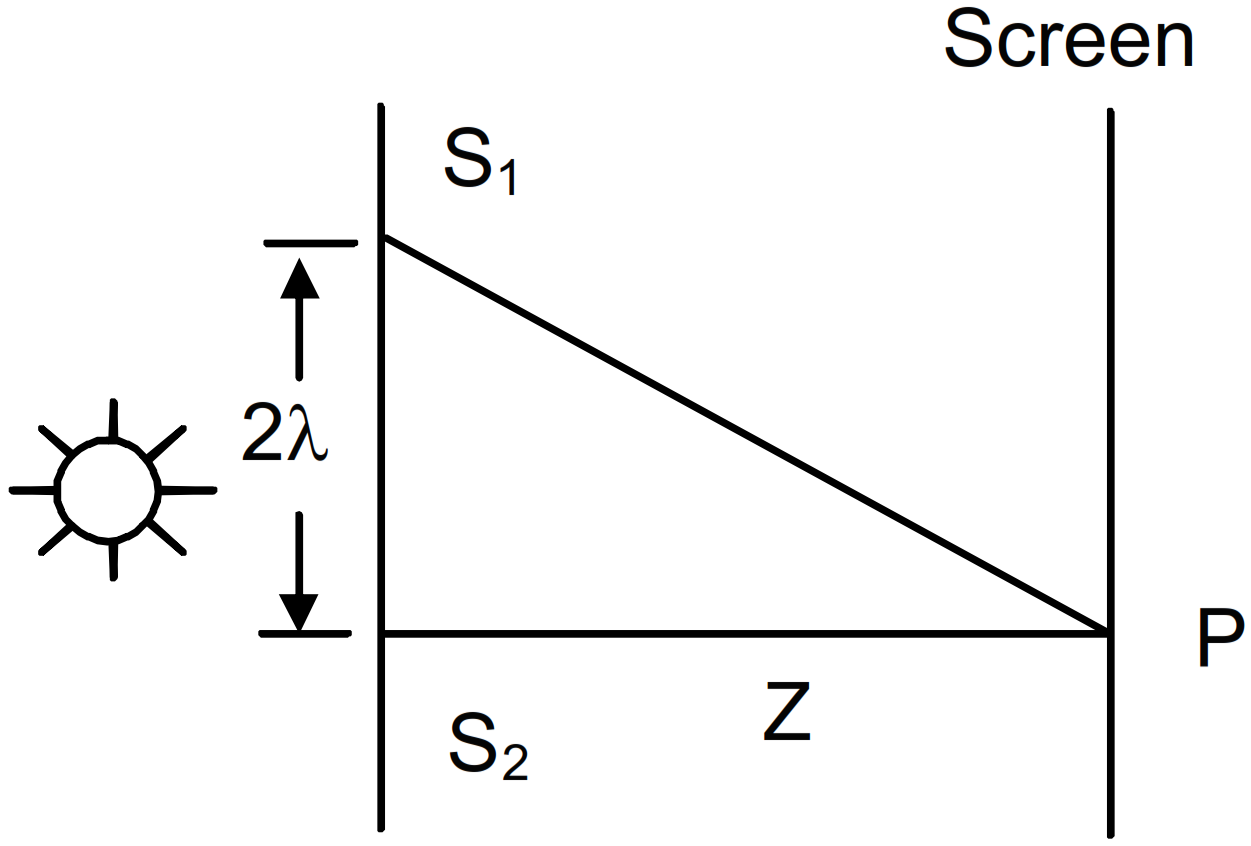
Two coherent point sources $S_1$ and $S_2$ vibrating in phase emit light of wavelength $\lambda$. The separation between the sources is $2\lambda$. Consider a line passing through $S_2$ and perpendicular to the line $S_1S_2$. What is the smallest distance from $S_2$ where a minimum of intensity occurs?
Answer
For minimum intensity

$\therefore\text{S}_1\text{P}-\text{S}_2\text{P}=\text{x}=(2\text{n}+1)\frac{\lambda}{2}$
From the figure, we get,
$\Rightarrow\sqrt{\text{X}^2+(2\lambda)^2}-\text{Z}=(2\text{n}+1)\frac{\lambda}{2}$
$\Rightarrow\text{Z}^2+4\lambda^2=\text{Z}^2+(2\text{n}+1)^2\frac{\lambda^2}{4}+\text{Z}(2\text{n}+1)\lambda$
$\Rightarrow\text{Z}=\frac{4\lambda^2-(2\text{n}+1)^2\Big(\lambda^2{4}\Big)}{(2\text{n}+1)\lambda}=\frac{16\lambda^2-(2\text{n}+1)^2\lambda^2}{4(2\text{n}+1)\lambda}\ ...(1)$
Putting, $\text{n}=0\Rightarrow\text{Z}=\frac{15\lambda}{4}$
$\text{n}=-1\Rightarrow\text{Z}=\frac{-15\lambda}{4}$
$\text{n}=1\Rightarrow\text{Z}=\frac{7\lambda}{12}$
$\text{n}=2\Rightarrow\text{Z}=\frac{-9\lambda}{20}$
$\therefore\text{Z}=\frac{7\lambda}{12}$ is the smallest distance for which there will be minimum intensity.
View full question & answer
Question 105 Marks
In a Young's double slit interference experiment the fringe pattern is observed on a screen placed at a distance D from the slits. The slits are separated by a distance d and are illuminated by monochromatic light of wavelength $\lambda$. Find the distance from the central point where the intensity falls to,
  1. Half the maximum.
  2. One fourth of the maximum.
Answer
  1. When intensity is half the maximum $\frac{\text{I}}{\text{I}_\text{max}}=\frac{1}{2}$
$\Rightarrow\frac{4\text{a}^2\cos^2\big(\frac{\phi}{2}\big)}{4\text{a}^2}=\frac{1}{2}$

$\Rightarrow\cos^2\Big(\frac{\phi}{2}\Big)=\frac{1}{2}\Rightarrow\cos\Big(\frac{\phi}{2}\Big)=\frac{1}{\sqrt{2}}$

$\Rightarrow\frac{\phi}{2}=\frac{\pi}{4}\Rightarrow\phi=\frac{\pi}{2}$

$\Rightarrow$ Path difference, $\text{x}=\frac{\lambda}{4}$

$\Rightarrow\text{y}=\frac{\text{xD}}{\text{d}}=\frac{\lambda\text{D}}{4\text{d}}$
  1. When intensity is $\frac{1}{4}\text{th}$ of the maximum $\frac{\text{I}}{\text{I}_\text{max}}=\frac{1}{4}$
$\Rightarrow\frac{4\text{a}^2\cos^2\Big(\frac{\phi}{2}\Big)}{4\text{a}^2}=\frac{1}{4}$

$\Rightarrow\cos^2\Big(\frac{\phi}{2}\Big)=\frac{1}{4}\Rightarrow\cos\Big(\frac{\phi}{2}\Big)=\frac{1}{2}$

$\Rightarrow\frac{\phi}{2}=\frac{\pi}{3}\Rightarrow\phi=\frac{2\pi}{3}$

$\Rightarrow$ Path difference, $\text{x}=\frac{\lambda}{3}$

$\Rightarrow\text{y}=\frac{\text{xD}}{\text{d}}=\frac{\lambda\text{D}}{3\text{d}}$
View full question & answer
Question 115 Marks
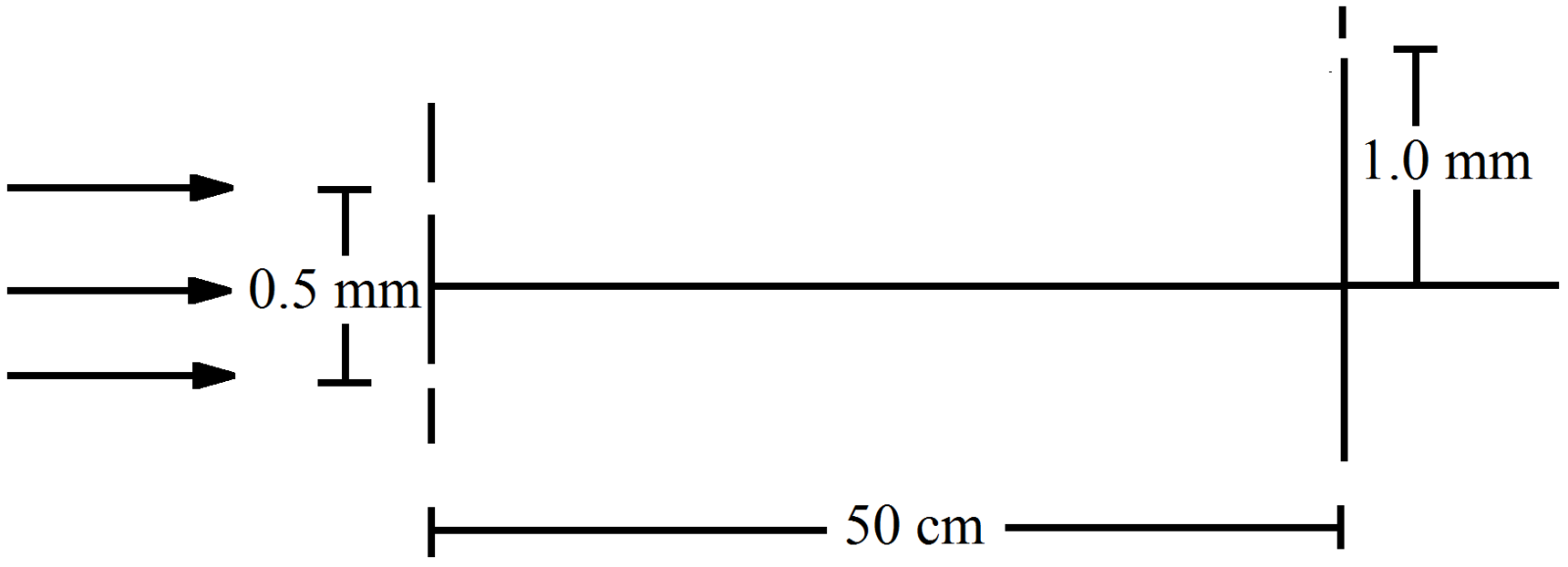
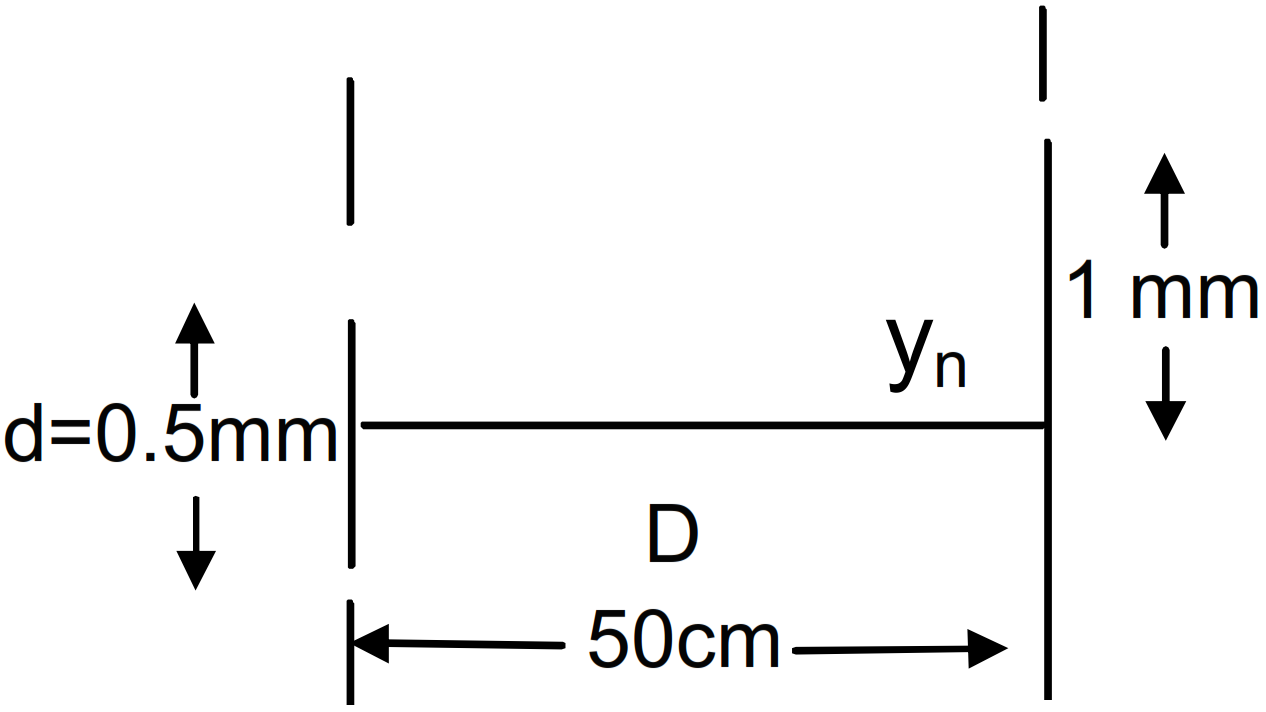
White coherent light (400nm - 700nm) is sent through the slits of a Young's double slit experiment (figure.) The separation between the slits is 0.5mm and the screen is 50cm away from the slits. There is a hole in the screen at a point 1.0mm away (along the width of the fringes) from the central line.
  1. Which wavelength (s) will be absent in the light coming from the hole?
  2. which wavelength (s) will have a strong intensity?
Answer


Given that, $\lambda= (400\text{nm to } 700\text{nm}),$ $d = 0.5mm = 0.5 \times 10^{-3}m,$
$D = 50cm = 0.5m$ and on the screen $y_n = 1mm = 1 \times 10^{-3}m$
  1. We know that for zero intensity (dark fringe)
$\text{y}_\text{n}=\Big(\frac{2\text{n}+1}{2}\Big)\frac{\lambda_\text{n}\text{D}}{\text{d}}$ where n = 0, 1, 2, ...
$\Rightarrow\lambda_\text{n}=\frac{2}{(2\text{n}+1)}\frac{\lambda_\text{n}\text{d}}{\text{D}}=\frac{2}{2\text{n}+1}\times\frac{10^{-3}\times0.5\times10^{-3}}{0.5}$
$\Rightarrow\frac{2}{(2\text{n}+1)}\times10^{-6}\text{m}=\frac{2}{(2\text{n}+1)}\times10^3\text{nm}$
If $\text{n}=1,\lambda_1=\Big(\frac{2}{3}\Big)\times1000=667\text{nm}$
If $\text{n}=1,\lambda_2=\Big(\frac{2}{5}\Big)\times1000=400\text{nm}$
So, the light waves of wavelengths 400nm and 667nm will be absent from the out coming light.
  1. For strong intensity (bright fringes) at the hole
$\text{y}_\text{n}=\frac{\text{n}\lambda_\text{n}\text{D}}{\text{d}}\Rightarrow\lambda_\text{n}=\frac{\text{y}_\text{n}\text{d}}{\text{nD}}$
When, $\text{n}=1,\lambda_1=\frac{\text{y}_\text{n}\text{d}}{\text{D}}$
$=\frac{10^{-3}\times0.5\times10^{-3}}{0.5}=10^{-6}\text{m}=1000\text{nm}.$
1000nm is not present in the range 400nm - 700nm
Again, where $\text{n}=2,\lambda_2=\frac{\text{y}_\text{n}\text{d}}{2\text{D}}=500\text{nm}$
So, the only wavelength which will have strong intensity is 500nm.
View full question & answer
Question 125 Marks
In a Young's double slit experiment, the separation between the slits = 2.0mm, the wavelength of the light = 600nm and the distance of the screen from the slits = 2.0m. If the intensity at the centre of the central maximum is $0.20W/ m^2,$ what will be the intensity at a point 0.5cm away from this centre along the width of the fringes?
Answer
Given that, $d = 2mm = 2 \times 10^{-3}m,$
$\lambda=600\text{nm}=6\times10^{-7}\text{m},$
$I_{max} = 0.20W/ m^2, D = 2m$
For the point, y = 0.5cm
We know, path difference $=\text{x}=\frac{\text{yd}}{\text{D}}$
$=\frac{0.5\times10^{-2}\times2\times10^{-3}}{2}=5\times10^{-6}\text{m}$
So, the corresponding phase difference is,$\phi=\frac{2\pi\text{x}}{\lambda}=\frac{2\pi\times5\times10^{-6}}{6\times10^{-7}}\Rightarrow\frac{50\pi}{3}=16\pi+\frac{2\pi}{3}$
$\Rightarrow\phi=\frac{2\pi}{3}$
So, the amplitude of the resulting wave at the point y = 0.5cm is,
$\text{A}=\sqrt{\text{r}^2+\text{r}^2+2\text{r}^2\cos(\frac{2\pi}{3})}$
$=\sqrt{\text{r}^2+\text{r}^2-\text{r}^2}=\text{r}$
$\frac{\text{I}}{\text{I}_\text{max}}=\frac{\text{A}^2}{(2\text{r})^2}$ [since, maximum amplitude = 2r]
$\Rightarrow\frac{\text{I}}{0.2}=\frac{\text{A}^2}{4\text{r}^2}=\frac{\text{r}^2}{4\text{r}^2}$
$\Rightarrow\text{I}=\frac{0.2}{4}=0.05\text{W/ m}^2.$
View full question & answer
Question 135 Marks
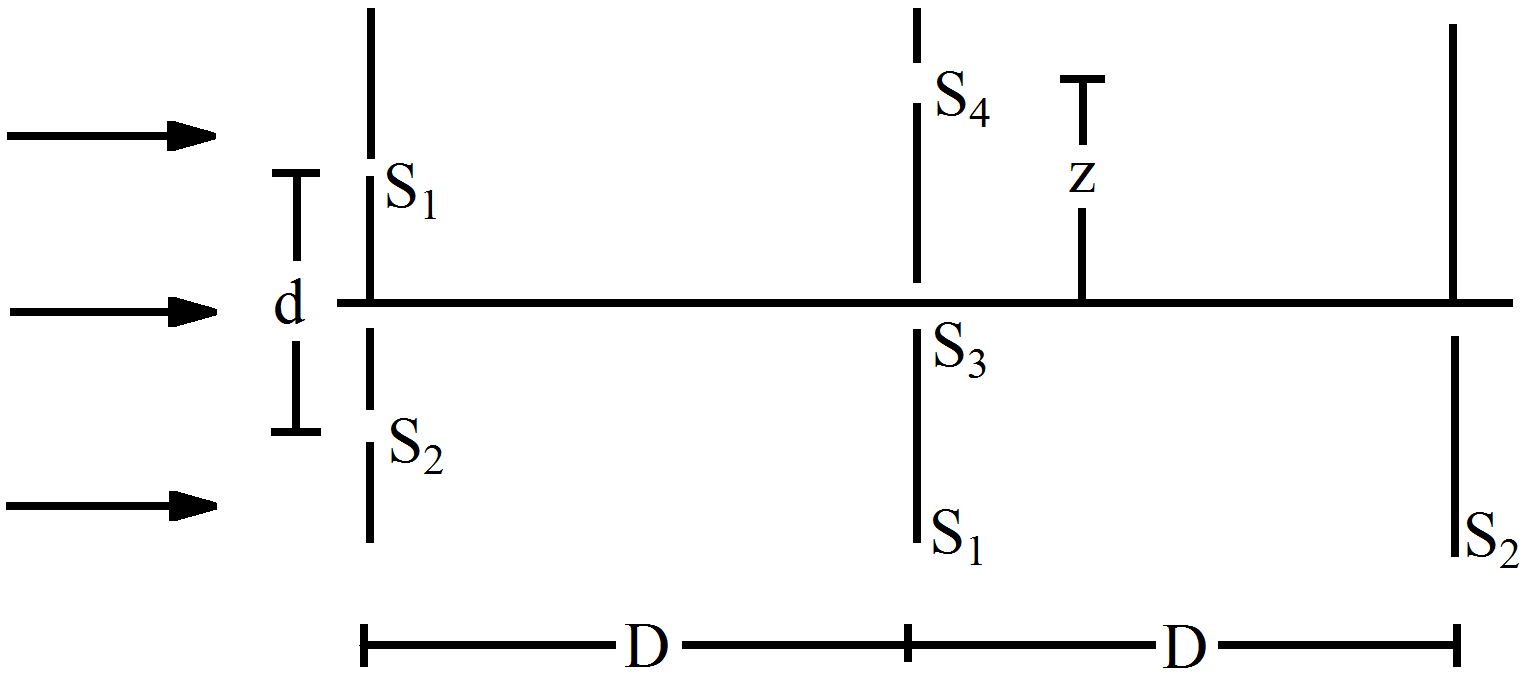
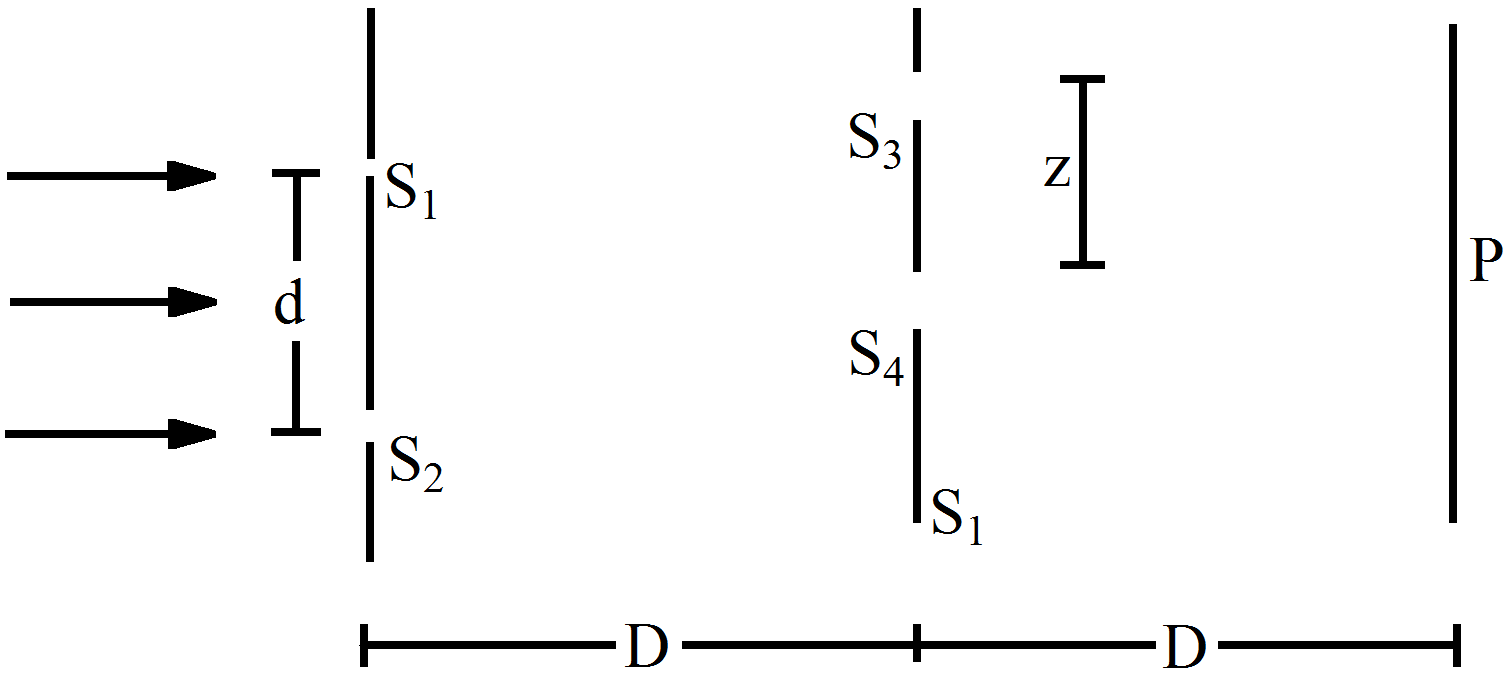
Consider the situation shown in figure (17-E6). The two slits $S_1$ and $S_2 $ p laced symmetrically around the central line are illuminated by a monochromatic light of wavelength $\lambda$. The separation between the slits is d . The light transmitted by the slits falls on a screen $E_1$ placed at a distance $D$ from the slits. The slit $\mathrm{S}_3$ is at the central line and the slit $S_4$ is at a distance $z$ from $S_3$. Another screen $\sum_2$ is placed a further distance $D$ away from $\sum_1$. Find the ratio of the maximum to minimum intensity observed on $\sum_2$, if $z$ is equal to,
  1. $\text{z}=\frac{\lambda\text{D}}{2\text{d}}$
  2. $\frac{\lambda\text{D}}{\text{d}}$
  3. $\frac{\lambda\text{D}}{4\text{d}}$
Answer

  1. When, $\text{z}=\frac{\lambda\text{D}}{2\text{d}},$ at $S_4$, minimum intensity occurs
⇒ Amplitude = 0,
At $S_3,$ path difference = 0
⇒ Maximum intensity occurs.
⇒ Amplitude = 2r.
So, on $\sum_2$ screen,
$\frac{\text{I}_\text{max}}{\text{I}_\text{min}}=\frac{(2\text{r}+0)^2}{(2\text{r}-0)^2}=1$
  1. When, $\text{z}=\frac{\lambda\text{D}}{2\text{d}},$ At $S_4,$ minimum intensity occurs.
⇒ Amplitude = 0.
At $S_3,$ path difference = 0
⇒ Maximum intensity occurs.
⇒ Amplitude = 2r.
So, on $\sum_2$ screen,
$\frac{\text{I}_\text{max}}{\text{I}_\text{min}}=\frac{(2\text{r}+2\text{r})^2}{(2\text{r}-0)^2}=\infty$
  1. When, $\text{z}=\frac{\lambda\text{D}}{2\text{d}},$, At $S_4,$ intensity $=\frac{\text{I}_\text{max}}{2}$
⇒ Amplitude $=\sqrt{2\text{r}}$
$\therefore$ At $S_3,$ intensity is maximum
⇒ Amplitude = 2r
$\therefore\frac{\text{I}_\text{max}}{\text{I}_\text{min}}=\frac{(2\text{r}+\sqrt{2\text{r}})^2}{(2\text{r}-\sqrt{2\text{r}})^2}=34.$
View full question & answer
Question 145 Marks
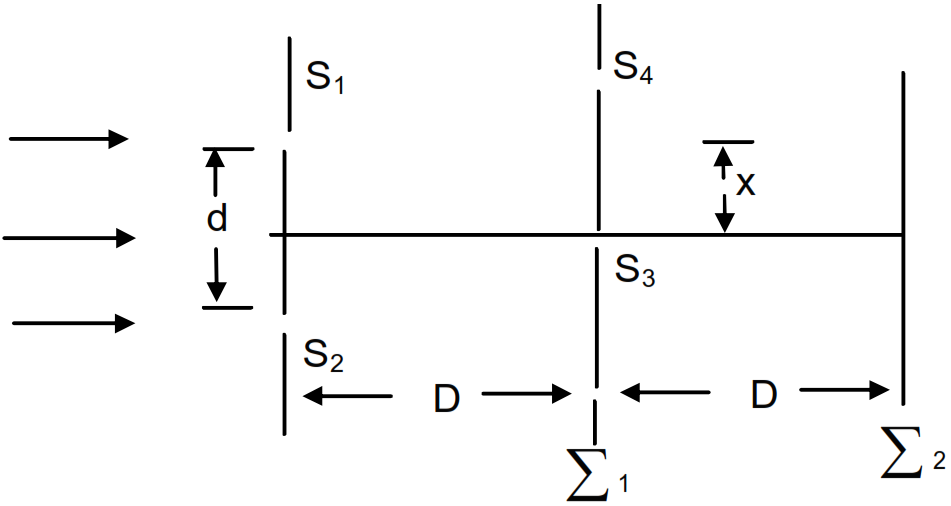
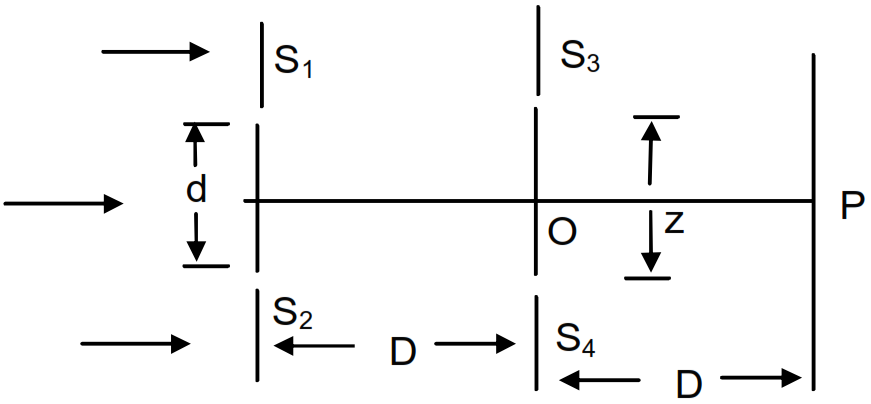
Consider the arrangement shown in figure. By some mechanism, the separation between the slits $S_3$ and $S_4$ can be changed. The intensity is measured at the point P which is at the common perpendicular bisector

of $S_1S_2$ and $S_3S_4.$ When $\text{z}=\frac{\text{D}\lambda}{2\text{d}},$ intensity measured at P is I. Find this intensity when z is equal to:
  1. $\frac{\text{D}\lambda}{\text{d}}$
  2. $\frac{3\text{D}\lambda}{2\text{d}}$
  3. $\frac{2\text{D}\lambda}{\text{d}}$
Answer

  1. When, $\text{z}=\frac{\text{D}\lambda}{\text{d}}$
So, $\text{OS}_3=\text{OS}_4=\frac{\text{D}\lambda}{2\text{d}}$
⇒ Dark fringe at $S_3$ and $S_4.$
$\Rightarrow At S_3,$ intensity at $S_3 = 0 \Rightarrow I_1 = 0$
At $S_4$, intensity at $S_4 = 0 \Rightarrow I_2 = 0$
At P, path difference = 0 ⇒ Phase difference = 0.
$\Rightarrow\text{I}=\text{I}_1+\text{I}_2+\sqrt{\text{I}_1\text{I}_2}\cos0^\circ=0+0+0=0$
⇒ Intensity at P = 0.
  1. Given that, when $\text{z}=\frac{\text{D}\lambda}{2\text{d}}$, intensity at P = I
Here, $\text{OS}_3=\text{OS}_4=\text{y}=\frac{\text{D}\lambda}{4\text{d}}$
$\therefore\phi=\frac{2\pi\text{x}}{\lambda}=\frac{2\pi}{\lambda}\times\frac{\text{yd}}{\text{D}}=\frac{2\pi}{\lambda}\times\frac{\text{D}\lambda}{4\text{d}}\times\frac{\text{d}}{\text{D}}=\frac{\pi}{2}.$
$\Big[$Since, x = path difference $=\frac{\text{yd}}{\text{D}}\Big]$
Let, intensity at $S_3$ and $S_4 = I'$
$\therefore$ At P, phase difference = 0
So, $\text{I}'+\text{I}'+2\text{I}'\cos0^\circ=\text{I}$
$\Rightarrow4\text{I}'=\text{I}\Rightarrow\text{I}'=\frac{1}{4}$
When, $\text{z}=\frac{3\text{D}\lambda}{2\text{d}},\Rightarrow\text{y}=\frac{3\text{D}\lambda}{4\text{d}}$
$\therefore\phi=\frac{2\pi\text{x}}{\lambda}=\frac{2\pi}{\lambda}\times\frac{\text{yd}}{\text{D}}=\frac{2\pi}{\lambda}\times\frac{3\text{D}\lambda}{4\text{d}}\times\frac{\text{d}}{\text{D}}=\frac{3\pi}{2}$
Let, I'' be the intensity at $S_3$ and $S_4$ when, $\phi=\frac{3\pi}{2}$
Now comparing,
$\frac{\text{I}"}{\text{I}}=\frac{\text{a}^2+\text{a}^2+2\text{a}^2\cos\Big(\frac{3\pi}{2}\Big)}{\text{a}^2+\text{a}^2+2\text{a}^2\cos\frac{\pi}{2}}=\frac{2\text{a}^2}{2\text{a}^2}=1$ $\Rightarrow\text{I}"=\text{I}'=\frac{\text{I}}{4}$
$\therefore$ Intensity at $\text{P}=\frac{\text{I}}{4}+\frac{\text{I}}{4}+2\times\Big(\frac{\text{I}}{4}\Big)\cos0^\circ=\frac{\text{I}}{2}+\frac{\text{I}}{2}=1$
  1. When $\text{z}=\frac{2\text{D}\lambda}{\text{d}}$
$\Rightarrow\text{y}=\text{OS}_3=\text{OS}_4=\frac{\text{D}\lambda}{\text{d} }$
$\therefore\phi=\frac{2\pi\text{X}}{\lambda}=\frac{2\pi}{\lambda}\times\frac{\text{yd}}{\text{D}}=\frac{2\pi}{\lambda}\times\frac{\text{D}\lambda}{\text{d}}\times\frac{\text{d}}{\text{D}}=2\pi.$
Let, I"' = intensity at $S_3$ and $S_4$ when, $\phi=2\pi.$
$\frac{\text{I}'''}{\text{I}'}=\frac{\text{a}^2+\text{a}^2+2\text{a}^2\cos2\pi}{\text{a}^2+\text{a}^2+2\text{a}^2\cos\frac{\pi}{2}}=\frac{4\text{a}^2}{2\text{a}^2}=2$
$\Rightarrow\text{I}'''=2\text{I}'=2\Big(\frac{\text{I}}{4}\Big)=\frac{\text{I}}{2}$
At $P, I_{resultant} =\frac{\text{I}}{2}+\frac{\text{I}}{2}+2\Big(\frac{\text{I}}{2}\Big)\cos0^\circ=\text{I}+\text{I}=2\text{I}$
So, the resultant intensity at P will be 2I.
View full question & answer