Questions

M.C.Q (1 Marks)

Take a timed test

16 questions · auto-graded multiple-choice test.

MCQ 11 Mark
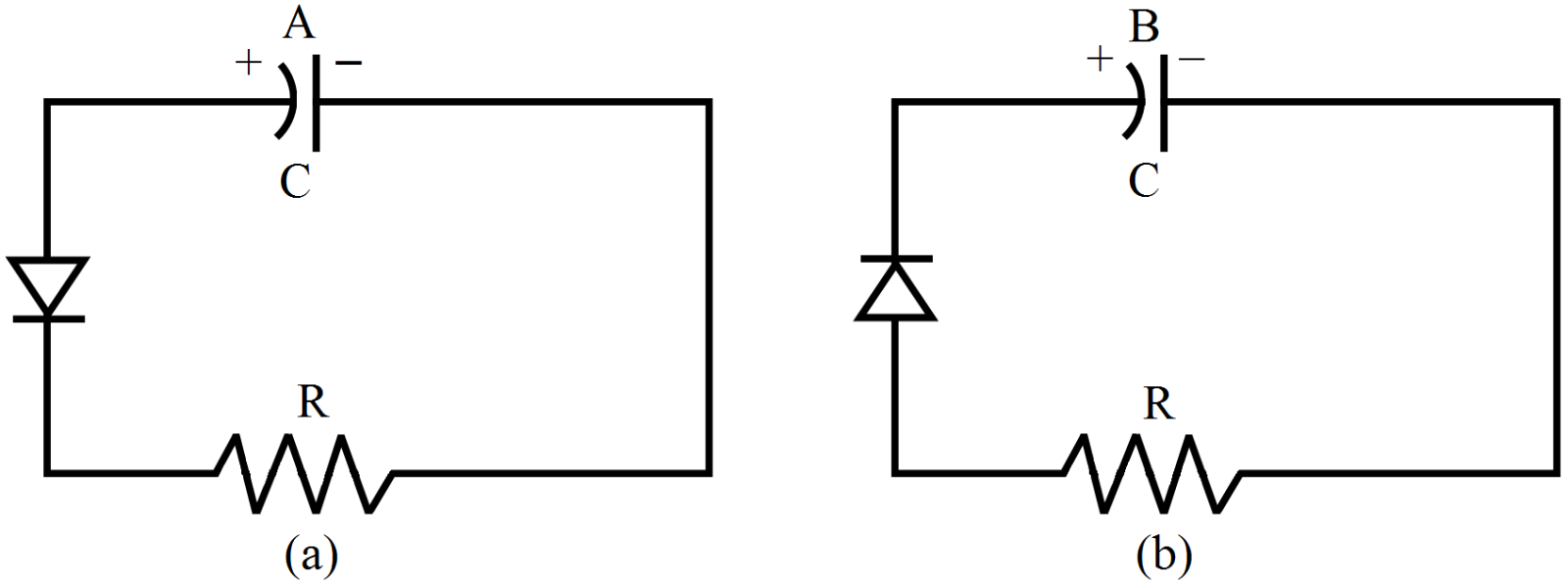
Two identical capacitors A and B are charged to the same potential V and are connected in two circuits at t = 0 as shown in figure. The charges on the capahltors at a time t = CR are, respectively:
  • A
    $\text{VC}, \text{VC}$
  • $\frac{\text{VC}}{\text{e}}, \text{VC}$
  • C
    $\text{VC}, \frac{\text{VC}}{\text{e}}$
  • D
    $\frac{\text{VC}}{\text{e}}, \frac{\text{VC}}{\text{e}}$
Answer
Correct option: B.
$\frac{\text{VC}}{\text{e}}, \text{VC}$
In circuit (a), the diode is forward biassed. So, it offers negligible resistance to the flow of current and can thus be replaced by a short circuit. Now, the capacitor charge will leak through the resistance and decay exponentially with time.

Capacitor charge $=\frac{\text{VC}}{\text{e}}$

In circuit (b), the diode is reverse biassed. So, it offers infinite resistance to the current flow and can thus be replaced by an open circuit. As the circuit is open now, no current can flow across the resistance. So, the charge in the capacitor cannot leak through the resistor.

Capacitor charge = VC

View full question & answer
MCQ 21 Mark
A semiconductor is doped with a donor impurity:
  • A
    The hole concentration increases.
  • B
    The hole concentration decreases.
  • The electron concentration increases.
  • D
    The electron concentration decreases.
Answer
Correct option: C.
The electron concentration increases.
When a semiconductor is doped with a donor type such as arsenic or phosphorous, which has five valence electrons, the donor atom replaces the Si or Ge atom. As a result, four out of the five electrons of the donor atom form a covalent bond by sharing an electron with four atoms of silicon. However, the fifth electron is free to move. Also, due to the breaking up of covalent bonds at room temperature, equal number of electrons and holes are produced. Thus, the total number of holes in the n-type semiconductor is less compared to the number of free electrons.
View full question & answer
MCQ 31 Mark
Electric conduction in a semiconductor takes place due to:
  • A
    Electrons only.
  • B
    Holes only.
  • Both electrons and holes.
  • D
    Neither electrons nor holes.
Answer
Correct option: C.
Both electrons and holes.
A hole is created in a semiconductor when a valence electron moves to the conduction band. When potential difference is applied across the semiconductor, the electron drifts opposite to the electric field applied, while the hole moves along the electric field. Therefore, electric conduction takes place in a semiconductor because of both electrons and holes.
View full question & answer
MCQ 41 Mark
The diffusion current in a p-n junction is:
  • A
    From the n-side to the p-side.
  • From the p-side to the n-side.
  • C
    From the n-side to the p-side if the junction is forward-biased and in the opposite direction if it is reverse-biased.
  • D
    From the p-side to the n-side if the junction is forward-biased and in the opposite direction if it is reverse-biased.
Answer
Correct option: B.
From the p-side to the n-side.
When a p‒n junction is formed then because of the difference in the concentration of charge carriers in the two regions, electrons from the n region move to the p region and holes from the p region move to the n region. Since the direction of the current is always opposite to the motion of electron, the direction of the current is from the p side to the n side.

Similarly, when the junction is forward biassed, the positive terminal of the battery is connected to the pside of the p‒n junction and the negative terminal of the battery is connected to the n side of the p‒njunction. As a result, electrons in the n side of the p‒n junction are repelled by the negative terminal of the battery and they move to the p side, where the positive terminal of the battery attracts them. Similarly, holes from the p side of the p‒n junction are repelled by the positive terminal of the battery and they move to the n side, where the negative terminal of the battery attracts them. Thus, they give diffusion current from the p side to the n side across the p‒n junction.

In reverse biassing, there is no flow of majority carriers across the junction; hence, there is not diffusion current. Here, the flow of majority carriers is opposed by the applied voltage.
View full question & answer
MCQ 51 Mark
A p-type semiconductor is:
  • A
    Positively charged.
  • B
    Negatively charged.
  • Uncharged.
  • D
    Uncharged at 0K but charged at higher ternperatures.
Answer
Correct option: C.
Uncharged.
A p-type semiconductor is formed by doping a pure semiconductor with a p-type material. As impurity atoms take the position of the germanium atom in a germanium crystal, three electrons of a p-type material form covalent bonds by sharing electrons with three neighbouring germanium atoms. However, the fourth covalent bond is left incomplete, with a want of one electron. This creates a hole. As the atom as a whole is neutral, the p-type material is also neutral.
View full question & answer
MCQ 61 Mark
If the two ends of a p-n junction are joined by a wire:
  • There will not be a steady current in the circuit.
  • B
    There will be a steady current from the n-side to the p-side.
  • C
    There 'will a steady current from the p-side. to the n-side.
  • D
    There may or may not be a current depending upon the resistance of the connecting wire.
Answer
Correct option: A.
There will not be a steady current in the circuit.
In a p‒n junction, current flows only if it is connected to the battery. If two ends of a p‒n junction are joined by a wire, then there will be diffusion and drift currents in the circuit and they will cancel each other. Hence, no current will flow in the circuit.
View full question & answer
MCQ 71 Mark
Let $n_p$ and $n_e$ be the number of holes and conduction electrons in an intrinsic semiconductor.
  • A
    $\text{n}_\text{p} > \text{n}_\text{e}$
     
  • B
    $\text{n}_\text{p} = \text{n}_\text{e}$
     
  • C
    $\text{n}_\text{p} < \text{n}_\text{e}$
     
  • $\text{n}_\text{p}\neq\text{n}_\text{e}$
Answer
Correct option: D.
$\text{n}_\text{p}\neq\text{n}_\text{e}$
Extrinsic semiconductors are formed by doping either an $n-$type material or a $p-$type material with a pure semiconductor, Thus, it may have more number of holes $($if the doping material is of p type$)$ or more number of electrons $($if the doping material is of n type$).$
View full question & answer
MCQ 81 Mark
A hole diffuses from the p-side to the n-side in a p-n junction. This means that.
  • A
    A bond ia broken on the n-side and the electron freed from the bond jumps to the conduction band.
  • B
    A conduction electron on the p-side jumps to a broken bond to complete it.
  • A bond is broken on the n-side and the electron freed from the bond jumps to a broken bond on the p-side to complete it.
  • D
    A bond is broken on the p-side and the electron freed from the bond jumps to a broken bond on the n-side to complete it.
Answer
Correct option: C.
A bond is broken on the n-side and the electron freed from the bond jumps to a broken bond on the p-side to complete it.
A hole diffuses from the p side to the n side in a p−n junction; that is, an electron moves from the n side to the p side. This implies that a bond is broken on the n side. As the electron travels towards the p side, which is rich in holes, it combines with a hole. A hole is created because of the deficiency of one electron. So, when an electron combines with a hole, it completes that bond.
View full question & answer
MCQ 91 Mark
Two identical p-ri junctions may be connected in series with a battery in three ways (figure). The potential difference across the two p-n. junctions are equal in:
  • A
    Circuit 1 and circuit 2.
  • Circuit 2 and circuit 3.
  • C
    Circuit 3 and circuit 1.
  • D
    Circuit 1 only.
Answer
Correct option: B.
Circuit 2 and circuit 3.
In circuit 1, one diode is forward biassed and the other diode is reverse biassed. The forward-biassed diode offers zero resistance (ideally) to the current flow, so it can be replaced by a short circuit. The voltage drop across the first diode will be zero. The second diode is reverse biassed, so it can be replaced by an open circuit; hence, the voltage drop across this diode will be maximum.

In circuit 2, both the diodes are forward biassed, so they can be replaced by short circuits; hence, the voltage drop across both of them will be minimum and equal.

In circuit 3, both the diodes are reverse biassed, so both can be replaced by open circuits; hence, the voltage drop across both of them will be maximum and equal.
View full question & answer
MCQ 101 Mark
When an impurity is doped into an intrinsic semiconductor, the conductivity of the semiconductor:
  • Increases.
  • B
    Decreases.
  • C
    Remains the same.
  • D
    Becomes zero.
Answer
Correct option: A.
Increases.
When an impurity (either a p-type atom or an n-type atom) is doped into an intrinsic semiconductor, it increases the number of charge carriers in the intrinsic semiconductor. As conductivity is directly related to the number of charge carriers, the conductivity of a semiconductor increases with doping.
View full question & answer
MCQ 111 Mark
The drift current in a p-ri junction is:
  • From the n-side to the p-side.
  • B
    From the p-side to the n-side.
  • C
    From the n-side to the p-side if the junction is forward-biased and in the opposite direction if it is reverse-biased.
  • D
    From the p-side to the n-side if the junction is forward-biased and in the opposite direction if it is reverse-biased.
Answer
Correct option: A.
From the n-side to the p-side.
After the diffusion of majority charge carriers across a p‒n junction, an electric field is set up because of the accumulation of immobile ions at the junction. These further oppose the motion of majority charge carriers across the junction. As a result, electrons from the p region start moving to the n region and holes from the n region start moving to the p region. This constitutes the drift current. As the direction of the current is opposite to the direction of the motion of the electrons, the direction of the drift current is from the n side to the p side.

In forward biasing, there is no movement of electrons from the p region to the n region and of holes from the n region to the p region. Hence, there is not drift current.
View full question & answer
MCQ 121 Mark
Diffusion current in a p-n junction is greater than the drift current in magnitude:
  • If the junction is forward-biased.
  • B
    If the junction is reverse-biased.
  • C
    If the junction is unbiased.
  • D
    In no case.
Answer
Correct option: A.
If the junction is forward-biased.
In the forward biassing of a p−n junction, the positive terminal of the battery is connected to the p side of the p−n junction and the negative terminal of the battery is connected to the n side of the p−n junction. As a result, electrons in the n side of the p−n junction are repelled by the negative terminal of the battery and move to the p side, where the positive terminal of the battery attracts the electrons. Similarly, holes from the p side of the p−n junction are repelled by the positive terminal of the battery and move to the nside, where the negative terminal of the battery attracts the holes. Thus, they give diffusion current across the p−n junction.

In case of reverse biassing, no conduction takes place across the junction because of the diffusion of majority carriers. Hence, there is no diffusion current.

If the junction is unbiased, then diffusion current is initially maximum. But at equilibrium, diffusion current becomes equal to drift current.
View full question & answer
MCQ 131 Mark
Let $\text{n}_\text{p}$ and $\text{n}_\text{e}$ be the number of holes and conduction electrons in an intrinsic semiconductor.
  • A
    $\text{n}_\text{p} > \text{n}_\text{e}$
  • $\text{n}_\text{p} = \text{n}_\text{e}$
  • C
    $\text{n}_\text{p} < \text{n}_\text{e}$
  • D
    $\text{n}_\text{p}\neq\text{n}_\text{e}$
Answer
Correct option: B.
$\text{n}_\text{p} = \text{n}_\text{e}$
As the intrinsic semiconductor is free from all impurities, the number of electrons is equal to the number of holes.
View full question & answer
MCQ 141 Mark
Let $\mathrm{i}_{\mathrm{E}}$, $\mathrm{i}_{\mathrm{C}}$ and $\mathrm{i}_{\mathrm{B}}$ represent the emitter current, the collector current and the base current respectively in a transistor. Then,
  • $\mathrm{i}_{\mathrm{C}}$ is slightly smaller than $\mathrm{i}_{\mathrm{E}}$.
  • B
    $\mathrm{i}_{\mathrm{C}}$ is slightly greater than $\mathrm{i}_{\mathrm{E}}$.
  • C
    $i_B$ is much smaller than $i_E$.
  • D
    $\mathrm{i}_{\mathrm{B}}$ is much greater than $\mathrm{i}_{\mathrm{E}}$.
Answer
Correct option: A.
$\mathrm{i}_{\mathrm{C}}$ is slightly smaller than $\mathrm{i}_{\mathrm{E}}$.

The highlighted parts could not be edited, as the meaning could not be understood. Also, please check the last line for logical accuracy. Only one option is given as correct, while the solution gives two correct options.
We know that in the transistor base is slightly doped, therefore when the majority carriers due to forward biasing of emitter base junction, feel the repulsive force from the battery and pass over to the base region. This gives the emitter current $i_E$.
As the base is thin and lightly doped, only few majority carriers of the emitter are neutralised at the base. This gives the base current.
Hence, base current $(i_B)$ is low.
The remaining majority carriers of the emitter pass to the collector and give collector current $i_C$.
Thus, we get the relation given below:
$i_E= i_B+ i_C$
Thus, because of the base, current $\mathrm{i}_{\mathrm{C}}$ is slightly smaller than $\mathrm{i}_{\mathrm{E}}$.

View full question & answer
MCQ 151 Mark
A semiconducting device is connected in a series circuit with a battery and a resistance. A current is found to pass through the circuit. If the polarity of the battery is reversed, the current drops to almost zero. the device may be:
  • A
    An intrinsic semiconductor.
  • B
    A p-type semiconductor.
  • C
    An n-type semiconductor.
  • A p-n junction.
Answer
Correct option: D.
A p-n junction.
As a p−n junction allows the flow of current in forward bias and stops the current in reverse bias (almost negligible reverse leakage current flows in the reverse-biassed p−njunction), the device should be a p−n junction. Other options are examples of semiconductors that allow moderate current to flow and that do not have any effect of changing the polarity of the battery.
View full question & answer
MCQ 161 Mark
An electric field is applied to a semiconductor. Let the number of charge carriers be $n$ and the average drift speed be $v$. If the temperature is increased,
  • A
    Both $n$ and $u$ will increase.
     
  • $n$ will increase but $v$ will decrease.
     
  • C
    $v$ will increase but $n$ will decrease.
     
  • D
    Both $n$ and $v$ will decrease.
Answer
Correct option: B.
$n$ will increase but $v$ will decrease.
 

As we increase the temperature, additional electron$‒$hole pairs are created in a semiconductor. As a result, the number of charge carriers increases.
Now, drift velocity $(v_d)$ is given by
$\text{vd}=\frac{-\text{eE}_\text{T}}{\text{m}}$
As the temperature increases, the relaxation time of charge carriers $(T)$ decreases. As a result, $v_d$ decreases.

View full question & answer