Question
Generate a complete, print-ready paper with questions like this in minutes — across 16+ boards, with answer keys.
| Column I | Column II |
| (i) Auxin | (a) Promotes fruit ripening |
| (ii) Gibberellin | (b) Involvement in seed germination |
| (iii) Cytokinin phototropism | (c) Regulates apical dominance and |
| (iv) Abscisic acid | (d) Induces stomatal closure during drought |
| (e) Stimulates cell division and shoot development |
| Column I | Column II |
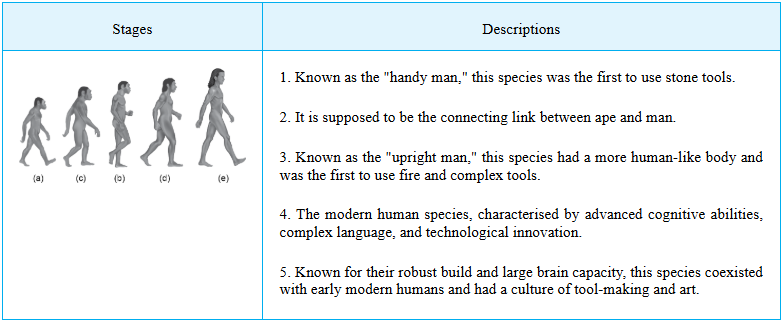
| (i) Neanderthal man | (a) Vestigial organ |
| (ii) Adaptive characters | (b) Darwin's theory |
| (iii) Natural selection | (c) 600 cc |
| (iv) Pinna | (d) 1400 cc |
| (e) Characters acquired during lifetime |
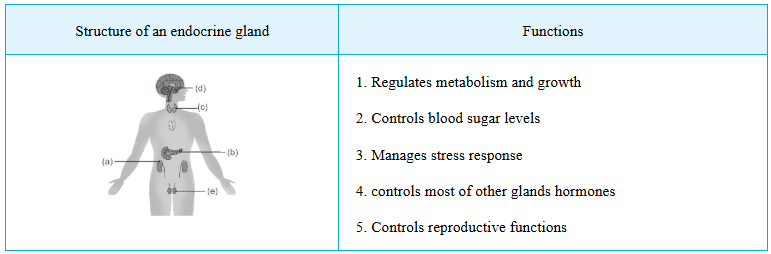
| Hormones | Secretary Gland |
| (i) Estrogen | (a) Thyroid |
| (ii) Testosterone | (b) Pancreas |
| (iii) Thyroxin | (c) Ovaries (Females) |
| (iv) Glucagon | (d) Testes (Male) |
| Column I | Column II |
| A. Turgid | (i) intake of mineral salts |
| B. Diffusion | (ii) a cell charged with water |
| C. Active transport | (iii) limiting membrane of a vacuole |
| D. Osmosis | (iv) movement of particles from higher to lower concentration |
| (v) movement of solvent across semi-permeable membrane |
| Column I | Column II |
| (i) Exosmosis | (a) The process by which roots absorb water from the soil. |
| (ii) Osmosis | (b) The concentration of the solution when lower than that of the cell sap. |
| (iii) Plasmolysis | (c) Two solutions which have equal osmotic pressure. |
| (iv) Hypotonic solution | (d) The shrinkage of protoplasm when the cell is kept in a hypertonic solution |
| (e) The exit or flow of water from the cell to the outer environment. |
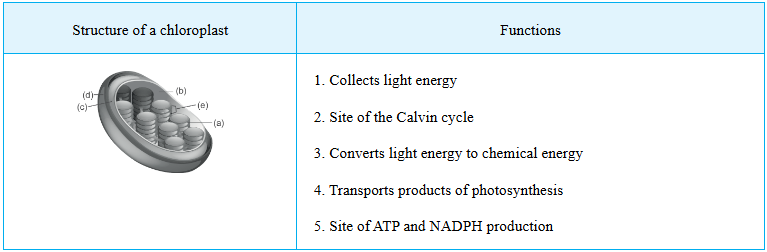
| Column I | Column II |
| (i) Grana | (a) Producers |
| (ii) Autotrophs | (b) Decomposers |
| (iii) By-products of photosynthesis | (c) Work rooms |
| (iv) Bacteria and fungi | (d) Glucose + oxygen |
| (e) Light reaction |
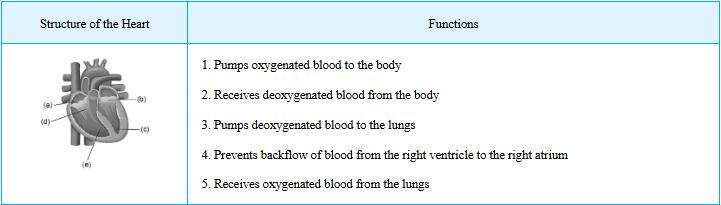
| Column I | Column II |
| (i) Coronary artery | (a) Largest artery |
| (ii) Aorta | (b) Blocking of coronary arteries. |
| (iii) Heart attack | (c) Sphygmomanometer |
| (iv) Blood pressure | (d) Largest vein |
| (e) Carry oxygenated blood to heart muscles. |