MCQ
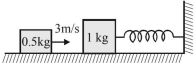
A $1\,kg$ mass is attached to a spring of force constant $600\,N / m$ and rests on a smooth horizontal surface with other end of the spring tied to wall as shown in figure. A second mass of $0.5\,kg$ slides along the surface towards the first at $3\,m / s$. If the masses make a perfectly inelastic collision, then find amplitude and time period of oscillation of combined mass.
  • $5\,cm , \frac{\pi}{10}\, s$
  • B
    $5\, cm , \frac{\pi}{5}\,s$
  • C
    $4\,cm , \frac{2 \pi}{5}\,s$
  • D
    $4\,cm , \pi / 3\,s$

Answer

Correct option: A.
$5\,cm , \frac{\pi}{10}\, s$
a
(a)

Applying linear momentum conservation,

$0.5 \times 3=(1+0.5) v \text { or } v =1 m / s$

By conversation of energy,

After collision

$\frac{1}{2}(1+0.5) v ^2=\frac{1}{2} kA ^2$

$\Rightarrow A =\sqrt{\frac{1.5}{ k }} \times v$

$\Rightarrow A =\sqrt{\frac{1.5}{600}} \times 1=\frac{1}{20} m =0.05 m$

$A =5 cm$

Time period of oscillation,

$T =2 \pi \sqrt{\frac{ m _1+ m _2}{ k }}=2 \pi \sqrt{\frac{1.5}{600}}=\frac{2 \pi}{20}=\frac{\pi}{10} s$

Need a full question paper?

Generate a complete, print-ready paper with questions like this in minutes — across 16+ boards, with answer keys.

Start Generating Free

Similar questions

What is the dimensional formula of $a b^{-1}$ in the equation $\left(\mathrm{P}+\frac{\mathrm{a}}{\mathrm{V}^2}\right)(\mathrm{V}-\mathrm{b})=\mathrm{RT}$, where letters have their usual meaning.
A cylinder with a movable piston contains air under a pressure $p_1$ and a soap bubble of radius $'r'$ . The pressure $p_2$ to which the air should be compressed by slowly pushing the piston into the cylinder for the soap bubble to reduce its size by half will be: (The surface tension is $\sigma $ , and the temperature $T$ is maintained constant)
A projectile is thrown with a velocity of $50\,\, ms^{^{-1}}$ at an angle of $53^o$ with the horizontal .Choose the incorrect statement
Two point objects of mass $2 x$ and $3 x$ are separated by a distance $r$. Keeping the distance fixed, how much mass should be transferred from $3 x$ to $2 x$, so that gravitational force between them becomes maximum?
Which of the diagrams in correctly shows the change in kinetic energy of an iron sphere falling freely in a lake having sufficient depth to impart it a terminal velocity?
For a simple pendulum the graph between $L$ and $T$ will be.
In Vander Waals equation $\left[ P +\frac{ a }{ V ^{2}}\right][ V - b ]= RT$; $P$ is pressure, $V$ is volume, $R$ is universal gas constant and $T$ is temperature. The ratio of constants $\frac{a}{b}$ is dimensionally equal to .................
$A$ hollow sphere of radius $R$ and mass $m$ is fully filled with water of mass $m$. It is rolled down a horizontal plane such that its centre of mass moves with a velocity $v$. If it purely rolls
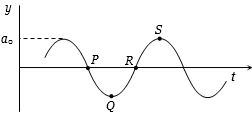
A wave motion has the function $y = {a_0}\sin (\omega \,t - kx)$. The graph in figure shows how the displacement $y$ at a fixed point varies with time $t$. Which one of the labelled points shows a displacement equal to that at the position $x = \frac{\pi }{{2k}}$ at time $t = 0$
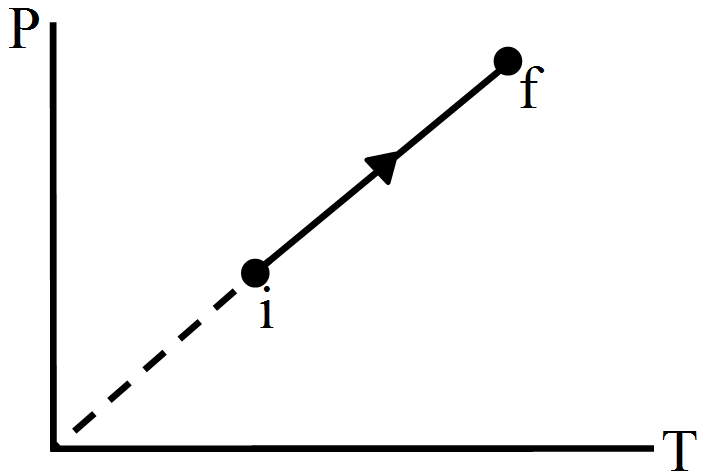
An ideal gas goes from the state i to the state fas shown in figure. The work done by the gas during the process: