A $20 \mathrm{~cm}$ long string, having a mass of $1.0 \mathrm{~g}$, is fixed at both the ends. The tension in the string is $0.5 \mathrm{~N}$. The string is set into vibrations using an external vibrator of frequency $100 \mathrm{~Hz}$. Find the separation (in $cm$) between the successive nodes on the string.
IIT 2009, Advanced
Download our app for free and get started
Velocity of wave in a string is $V =\sqrt{ } \frac{\overline{ T }}{\mu}$ where $T =$ tension in the string and $\mu=$ mass per unit length of the string. here, $T =0.5 N$ and $\mu=\frac{1 \times 10^{-3}}{20 \times 10^{-2}}=0.5 \times 10^{-2} \ kg / m$ thus, $v =\sqrt{\frac{0.5}{0.5 \times 10^{-2}}}=10 \ m / s$ Wavelength, $\lambda=\frac{ v }{ f }=\frac{10}{100}=0.1 \ m =10 \ cm$
$\therefore$ The separation between successive nodes $=\frac{\lambda}{2}=\frac{10}{2}=5\ cm$

Download our appand get started for free
Experience the future of education. Simply download our apps or reach out to us for more information. Let's shape the future of learning together!No signup needed.*
Similar Questions
- 1A driver in a car, approaching a vertical wall notices that the frequency of his car horn, has changed from $440\, Hz$ to $480 \,Hz ,$ when it gets reflected from the wall. If the speed of sound in air is $345 \,m / s ,$ then the speed of the car is $.......km/hr$View Solution
- 2A copper wire is held at the two ends by rigid supports. At $50^{\circ} C$ the wire is just taut, with negligible tension. If $Y=1.2 \times 10^{11} \,N / m ^2, \alpha=1.6 \times 10^{-5} /{ }^{\circ} C$ and $\rho=9.2 \times 10^3 \,kg / m ^3$, then the speed of transverse waves in this wire at $30^{\circ} C$ is .......... $m / s$View Solution
- 3When an air column at $15\,^oC$ and a tunning fork are sounded together then $4$ beats per second are produced, the frequency of the fork is less then that of air column. When the temperature falls to $10\,^oC$ , then the beat frequency decreases by one. The frequency of the fork will be ..... $Hz$ $[V_{sound}$ at $0\,^oC = 332\,m/s]$View Solution
- 4View SolutionQuality depends on
- 5Two sources of sound $A$ and $B$ produces the wave of $350 Hz$, they vibrate in the same phase. The particle $P$ is vibrating under the influence of these two waves, if the amplitudes at the point $P$ produced by the two waves is $0.3 mm$ and $0.4 mm,$ then the resultant amplitude of the point $P$ will be when $AP -BP = 25 cm$ and the velocity of sound is $350 m/sec$ .... $mm$View Solution
- 6On sounding tuning fork $A$ with another tuning fork $B$ of frequency $384 Hz, 6$ beats are produced per second. After loading the prongs of $A$ with some wax and then sounding it again with $B, 4$ beats are produced per second. What is the frequency of the tuning fork $A$ .... $Hz$View Solution
- 7A stone thrown into still water, creates a circular wave pattern moving radially outwards. If $r$ is the distance measured from the centre of the pattern. the amplitude of the wave aries asView Solution
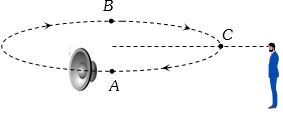
- 8A small source of sound moves on a circle as shown in the figure and an observer is standing on $O$. Let ${n_1},\;{n_2}$ and ${n_3}$be the frequencies heard when the source is at $A,\,B$ and $C$ respectively. ThenView Solution
- 9The relation between frequency $‘n’$ wavelength ‘$\lambda$’ and velocity of propagation $‘v’$ of wave isView Solution
- 10The displacement y of a particle in a medium can be expressed as: $y = {10^{ - 6}}\sin (100t + 20x + \pi /4)m,$ where $t$ is in second and $x$ in meter. The speed of wave is ... $m/s$View Solution