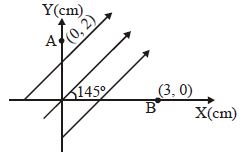
The election field in a region is given by $\vec E = (Ax + B)\hat i$ where $E$ is in $N\,C^{-1}$ and $x$ in meters. The values of constants are $A = 20\, SI\, unit$ and $B = 10\, SI\, unit$. If the potential at $x =1$ is $V_1$ and that at $x = -5$ is $V_2$ then $V_1 -V_2$ is.....$V$
JEE MAIN 2019, Medium


Download our appand get started for free
Experience the future of education. Simply download our apps or reach out to us for more information. Let's shape the future of learning together!No signup needed.*
Similar Questions
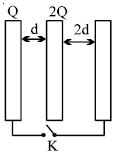
- 1Three large plates are arranged as shown. How much charge will flow through the key $k $ if it is closed?View Solution
- 2$64$ small drops of mercury, each of radius $ r$ and charge $q$ coalesce to form a big drop. The ratio of the surface density of charge of each small drop with that of the big drop isView Solution
- 3A capacitor stores $60\ \mu C$ charge when connected across a battery. When the gap between the plates is filled with a dielectric , a charge of $120\ \mu C$ flows through the battery. The dielectric constant of the material inserted is :View Solution
- 4A hollow metal sphere of radius $5\,\, cm$ is charged so that the potential on its surface is $10\,\, V$. The potential at the centre of the sphere is.....$V$View Solution
- 5A parallel plate capacitor of capacitance $5\,\mu F$ and plate separation $6\, cm$ is connected to a $1\, V$ battery and charged. A dielectric of dielectric constant $4$ and thickness $4\, cm$ is introduced between the plates of the capacitor. The additional charge that flows into the capacitor from the battery is........$\mu C$View Solution
- 6Between the plates of a parallel plate condenser, a plate of thickness ${t_1}$ and dielectric constant ${k_1}$ is placed. In the rest of the space, there is another plate of thickness ${t_2}$ and dielectric constant ${k_2}$. The potential difference across the condenser will beView Solution
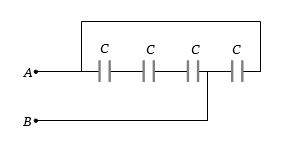
- 7The equivalent capacitance between $A$ and $B$ isView Solution
- 8Uniform electric field of magnitude $ 100$ $V/m$ in space is directed along the line $y$ $=$ $3$ $+$ $x$. Find .........$V$ the potential difference between point $A (3, 1)$ $ \&$ $ B$ $ (1, 3)$View Solution
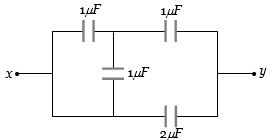
- 9Four capacitors are connected as shown in the figure. Their capacities are indicated in the figure. The effective capacitance between points $x$ and $y$ is (in $\mu F$)View Solution
- 10A uniform electric field of $400 \,v/m$ is directed $45^o$ above the $x$ - axis. The potential difference $V_A - V_B$ is -.....$V$View Solution