Three capacitors $2,\, 3$ and $6\ \mu F$ are joined in series with each other. What is the minimum effective capacitance......$\mu \,F$
Easy


Download our appand get started for free
Experience the future of education. Simply download our apps or reach out to us for more information. Let's shape the future of learning together!No signup needed.*
Similar Questions
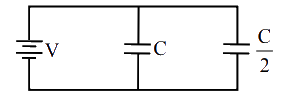
- 1Two condensers, one of capacity $C$ and other of capacity $C/2$ are connected to a $V-$ volt battery, as shown in the figure. The work done in charging fully both the condensers isView Solution
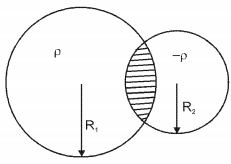
- 2Two non-conducting spheres of radii $R_1$ and $R_2$ and carrying uniform volume charge densities $+\rho$ and $-\rho$, respectively, are placed such that they partially overlap, as shown in the figure. At all points in the overlapping region: $Image$View Solution
$(A)$ the electrostatic field is zero
$(B)$ the electrostatic potential is constant
$(C)$ the electrostatic field is constant in magnitude
$(D)$ the electrostatic field has same direction
- 3View SolutionAn air capacitor is connected to a battery. The effect of filling the space between the plates with a dielectric is to increase
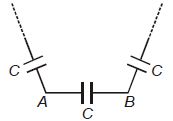
- 4On each side of a polygon of $n$ sides a capacitor of capacitance $C$ is placed as shown in figure. Equivalent capacitance across $A$ and $B$ isView Solution
- 5The ratio of momenta of an electron and an $\alpha$-particle which are accelerated from rest by a potential difference of $100\, volts$ isView Solution
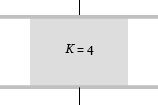
- 6Consider a parallel plate capacitor of $10\,\mu \,F$ (micro-farad) with air filled in the gap between the plates. Now one half of the space between the plates is filled with a dielectric of dielectric constant $4$, as shown in the figure. The capacity of the capacitor changes to.......$\mu \,F$View Solution
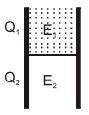
- 7A parallel plate capacitor has a dielectric slab of dielectric constant $K$ between its plates that covers $1 / 3$ of the area of its plates, as shown in the figure. The total capacitance of the capacitor is $C$ while that of the portion with dielectric in between is $C _1$. When the capacitor is charged, the plate area covered by the dielectric gets charge $Q_1$ and the rest of the area gets charge $Q_2$. Choose the correct option/options, igonoring edge effects.View Solution
$(A)$ $\frac{E_1}{E_2}=1$ $(B)$ $\frac{E_1}{E_2}=\frac{1}{K}$ $(C)$ $\frac{Q_1}{Q_2}=\frac{3}{K}$ $(D)$ $\frac{ C }{ C _1}=\frac{2+ K }{ K }$
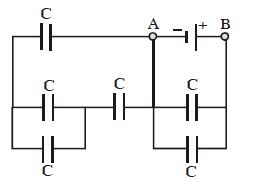
- 8Find equivalent capacitance between $A$ and $B$View Solution
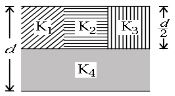
- 9A parallel-plate capacitor of area $A,$ plate separation $d$ and capacitance $C$ is filled with four dielectric materials having dielectric constants $K_1,K_2,K_3$ and $K_4$ as shown in the figure. If a single dielectric material is to be used to have the same capacitance $C$ in this capacitor, then its dielectric constant $K$ is given byView Solution
- 10Two identical capacitors, have the same capacitance $C$. One of them is charged to potential $V_1$ and the other to $V_2$. The negative ends of the capacitors are connected together. When the positive ends are also connected, the decrease in energy of the combined system isView Solution