MCQ
A balloon filled with helium $\left(32^{\circ} C \right.$ and $1.7\; atm$.) bursts. Immediately afterwards the expansion of helium can be considered as
  • A
    Irreversible isothermal
  • Irreversible adiabatic
  • C
    Reversible adiabatic
  • D
    Reversible isothermal

Answer

Correct option: B.
Irreversible adiabatic
b
Bursting of helium balloon is irreversible $\&$ adiabatic.

Need a full question paper?

Generate a complete, print-ready paper with questions like this in minutes — across 16+ boards, with answer keys.

Start Generating Free

Similar questions

A capillary tube is immersed vertically in water and the height of the water column is $x$. When this arrangement is taken into a mine of depth $d$, the height of the water column is $y$. If $R$ is the radius of earth, the ratio $\frac{x}{y}$ is
Two wires $A$ and $B$ of same material have radii in the ratio $2: 1$ and lengths in the ratio $4: 1$. The ratio of the normal forces required to produce the same change in the lengths of these two wires is .......
A piece of gold weighs $10 \,g$ in air and $9 \,g$ in water. What is the volume of cavity is ...... $cc$ (Density of gold $=19.3 \,g cm ^{-3}$ )
A particle is moving with constant speed in a circular path. When the particle turns by an angle $90^{\circ}$, the ratio of instantaneous velocity to its average velocity is $\pi: x \sqrt{2}$. The value of $x$ will be $.........$
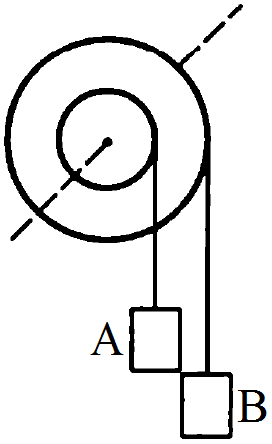
Figure shows a small wheel fixed coaxially on a bigger one of double the radius. The system rotates about the common axis. The strings supporting A and B do not slip on the wheels. If x and y be the distance travelled by A and B in the same time interval, then:
Two substances of densities ${\rho _1}$ and ${\rho _2}$ are mixed in equal volume and the relative density of mixture is $4$. When they are mixed in equal masses, the relative density of the mixture is $3$. The values of ${\rho _1}$ and ${\rho _2}$ are
Which one of the following statements is not true about the motion of a projectile?
Starting at temperature $300\; \mathrm{K},$ one mole of an ideal diatomic gas $(\gamma=1.4)$ is first compressed adiabatically from volume $\mathrm{V}_{1}$ to $\mathrm{V}_{2}=\frac{\mathrm{V}_{1}}{16} .$ It is then allowed to expand isobarically to volume $2 \mathrm{V}_{2} \cdot$ If all the processes are the quasi-static then the final temperature of the gas (in $\left. \mathrm{K}\right)$ is (to the nearest integer)
The temperature of equal masses of three different liquids ${x}, {y}$ and ${z}$ are $10^{\circ} {C}, 20^{\circ} {C}$ and $30^{\circ} {C}$ respectively. The temperature of mixture when ${x}$ is mixed with ${y}$ is $16^{\circ} {C}$ and that when ${y}$ is mixed with $z$ is $26^{\circ} {C}$. The temperature of mixture when $x$ and $z$ are mixed will be ...... $^{\circ} {C}$
If there is no external force acting on a non-rigid body, which of the following quantities must remain constant?