An object is cooled from $75°C$ to $65°C$ in $2$ minutes in a room at $30°C$ . The time taken to cool another object from $55°C$ to $45°C$ in the same room in minutes is
Medium


Download our appand get started for free
Experience the future of education. Simply download our apps or reach out to us for more information. Let's shape the future of learning together!No signup needed.*
Similar Questions
- 1Three discs $A, B$ and $C$ having radii $2\; m, 4\;m,$ and $6 \;m$, respectively are coated with carbon black on their outer surfaces. The wavelengths corresponding to maximum intensity are $300\; nm, 400\; nm$ and $500\; nm$, respectively. The power radiated by them are $Q_A,Q_B$ and $Q_C$ respectively.View Solution
- 2A long metallic bar is carrying heat from one of its ends to the other end under steady-state. The variation of temperature $\theta$ along the length $x$ of the bar from its hot end is best described by which of the following figures?View Solution
- 3View SolutionNewton's law of cooling is a special case of
- 4One end of a copper rod of length $1.0\;m$ and area of cross-section ${10^{ - 3}}$ is immersed in boiling water and the other end in ice. If the coefficient of thermal conductivity of copper is $92\;cal/m{\rm{ - }}s{{\rm{ - }}^o}C$ and the latent heat of ice is $8 \times {10^4}cal/kg$, then the amount of ice which will melt in one minute isView Solution
- 5The heat is flowing through a rod of length $50 cm$ and area of cross-section $5c{m^2}$. Its ends are respectively at ${25^o}C$ and ${125^o}C$. The coefficient of thermal conductivity of the material of the rod is $0.092 kcal/m×s×^\circ C$. The temperature gradient in the rod isView Solution
- 6Energy is being emitted from the surface of a black body at $127\,^oC$ temperature at the rate of $1.0 \times {10^6}\,J/s - {m^2}$. Temperature of the black body at which the rate of energy emission is $16.0 \times {10^6}\,J/s - {m^2}$ will be ......... $^oC$View Solution
- 7Rate of cooling at $600K$ , if surrounding temperature is $300K$ is $R$ . The rate of cooling at $900K$ isView Solution
- 8There is formation of layer of snow $x\,cm$ thick on water, when the temperature of air is $ - {\theta ^o}C$ (less than freezing point). The thickness of layer increases from $x$ to $y$ in the time $t$, then the value of $t$is given byView Solution
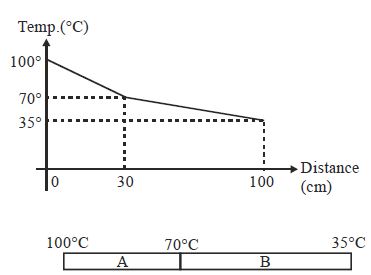
- 9Two different rods $A$ and $B$ are kept as shown in figure. The variation of temperature of different cross sections is plotted in a graph shown in figure. The ratio of thermal conductivities of $A$ and $B$ isView Solution
- 10A hot body, obeying Newton's law of cooling is cooling down from its peak value $80\,^oC$ to an ambient temperature of $30\,^oC$ . It takes $5\, minutes$ in cooling down from $80\,^oC$ to $40\,^oC$. ........ $\min.$ will it take to cool down from $62\,^oC$ to $32\,^oC$ ? (Given $ln\, 2\, = 0.693, ln\, 5\, = 1.609$)View Solution