Question
A block is resting on a piston which is moving vertically with a simple harmonic motion of period 1sec. At what amplitude of motion will the block and the piston seperate? What is the maximum velocity of the piston at this amplitude?

Answer

We know that $\text{y}=\text{a}\sin\omega\text{t}$

$\therefore$ Velocity of the block $=\frac{\text{dy}}{\text{dt}}=\text{a}\omega\cos\omega\text{t}$

Acceleration of the block

$=\frac{\text{d}^2\text{y}}{\text{dt}^2}=\omega^2\sin\omega\text{t}$

$=-\omega\text{y}$

For maximum acceleration y = a

$\therefore\Big(\frac{\text{d}^2\text{y}}{\text{dt}^2}\Big)_\text{max}$

$=-\omega\text{a}$

The block will be separated form the piston when

$\omega^2\text{a}=\text{g}$

$=\text{a}=\frac{\text{g}}{\omega}$

$=\Big(\therefore\frac{2\pi}{\text{T}}\Big)$

$=\text{a}=\frac{\text{gT}^2}{4\pi^2}$

According to the given problem T = 1sec.

$\therefore\text{a}=\frac{\text{g}}{4\pi^2}$

$=\frac{9.8}{4\times(3.14)^2}$

$=0.248\text{m/ sec}^2$

At this amplitude, the maximum velocity of the block will be

$\omega\text{a}=\frac{2\pi}{\text{T}}$

$\frac{2\times3.14\times.0.248}{1}$

$=1.56\text{m/ sec}$

Need a full question paper?

Generate a complete, print-ready paper with questions like this in minutes — across 16+ boards, with answer keys.
Start Generating Free

Similar questions

A steel rod (Y = 2.0 × 1011N m-2, and $\alpha$ = 10-50 C-1) of length 1m and area of cross-section 1cm 2 is heated from 0°C to 200°C, without being allowed to extend or bend. What is the tension produced in the rod?
  1. Define isothermal process. Derive an expression for work done during isothermal process.
  2. A refrigerator is to remove heat from the eatables kept inside at 10°C. Calculate the coefficient of performance if room temperature is 36°C.
An electron and a proton are detected in a cosmic ray experiment, the first with kinetic energy 10keV, and the second with 100keV. Which is faster, the electron or the proton? Obtain the ratio of their speeds. (electron mass = 9.11 × 10⁻³¹kg, proton mass = 1.67 × 10⁻²⁷kg, 1eV = 1.60 × 10⁻¹⁹J).
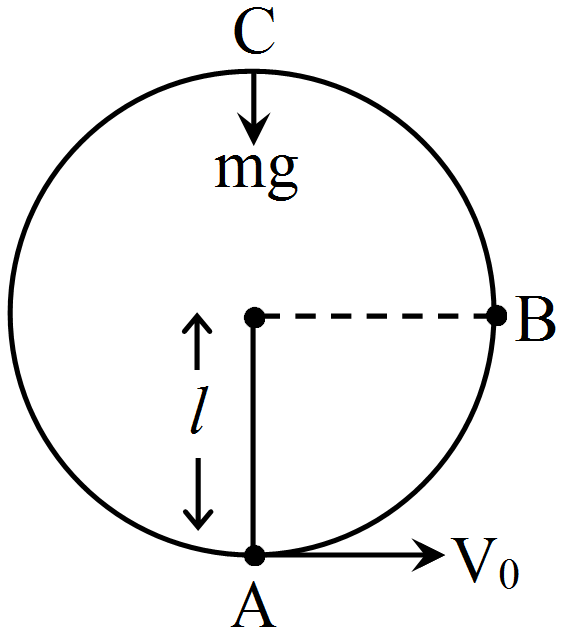
A bob of mass m is suspended by a light string of length l. It is imparted a horizontal velocity vo at the lowest point A so that it completes a semi-circular trajectory in the vertical plane with the string becoming slack only on reaching the topmost point C. This is shown in the figure.
Obtain an expression for:
  1. Horizontal velocity v.
  2. The speed at point B and C.
  3. The ratio of the kinetic energies$\bigg(\frac{\text{K}_\text{B}}{\text{K}_\text{C}}\bigg)$ at B and C.
  4. Comment on the nature of the trajectory of the bob after it reaches the point C.

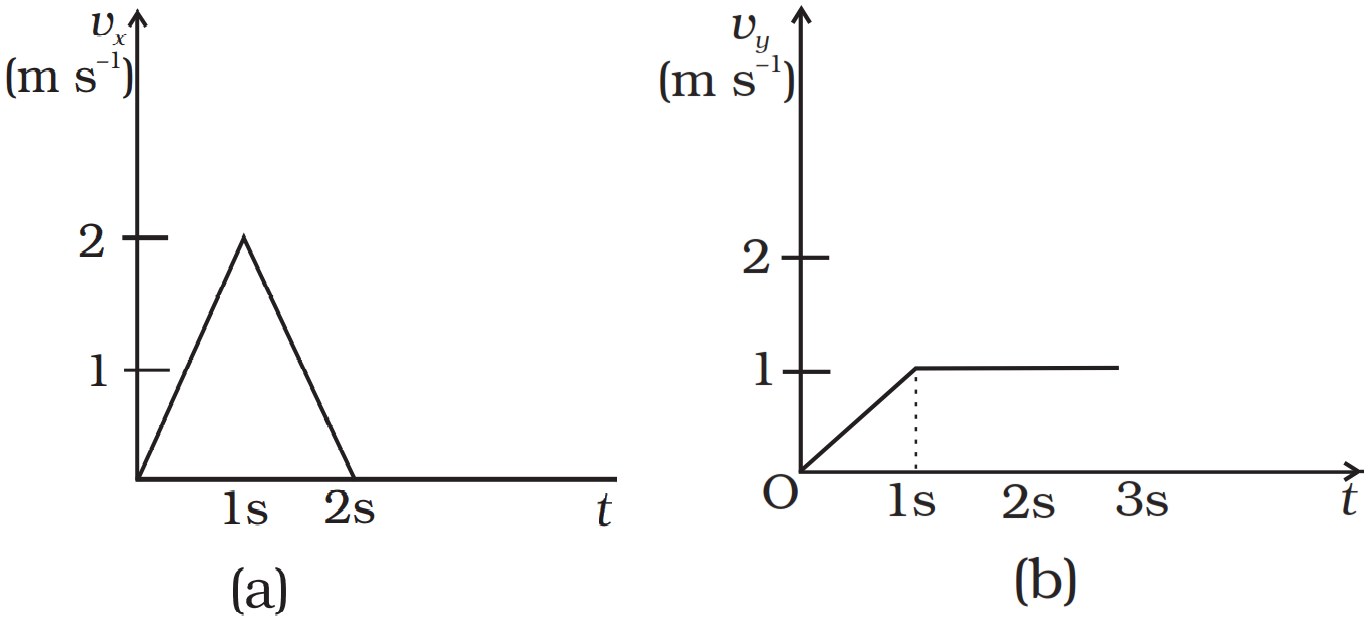
(vx, t),and(vy, t ) diagrams for a body of unit mass. Find the force as a function of time.

An ammeter is to be constructed that can read currents up to 2.0A. If the coil has resistance of $25\Omega$ and takes 1mA for full-scale deflection, what should be the resistance of the shunt used?
State Bernoulli's theorem. Using it how can you explain the functioning of a venturimeter to find velocity of flow of liquid through a tube?
A capacitance C, a resistance R and an emf $\in$ are connected in series at t = 0. What is the maximum value of (a) the potential difference across the resistor (b) the current in the circuit (c) the potential difference across the capacitor (d) the energy stored in the capacitor (e) the power delivered by the battery and (f) the power converted into heat?
The conductivity of an intrinsic samiconductor depends on temperature as $\sigma=\sigma_0\text{ e}^{\frac{-\Delta\text{E}}{2\text{kT}}}$ where $\sigma_0$ is a constant. Find the temperature at which the conductivity pf an intrinsic germanium semiconductor will be double of its value at T = 300K. Assume that the gap for germanium is 0.650eV and remains constant as the temperature is increased.
Estimate the fraction of molecular volume to the actual volume occupied by oxygen gas at STP. Take the diameter of an oxygen molecule to be $3\mathring{\text{A}}$