A block of mass $m$ is moving with a constant acceleration a on a rough plane. If the coefficient of friction between the block and ground is $\mu $, the power delivered by the external agent after a time $t$ from the beginning is equal to
Medium
Download our app for free and get started
$F-f=\mathrm{ma}$
$F=f+\mathrm{ma}$
Power $(\mathrm{P})=\mathrm{Fv}=(\mathrm{f}+\mathrm{ma}) \mathrm{v}=(\mu \mathrm{mg}+\mathrm{ma})$ at

Download our appand get started for free
Experience the future of education. Simply download our apps or reach out to us for more information. Let's shape the future of learning together!No signup needed.*
Similar Questions
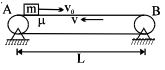
- 1With what minimum velocity should block be projected from left end $A$ towards end $B$ such that it reaches the other end $B$ of conveyer belt moving with constant velocity $v$. Friction coefficient between block and belt is $\mu$ .View Solution
- 2If ${\mu _s},\,{\mu _k}$ and ${\mu _r}$ are coefficients of static friction, sliding friction and rolling friction, thenView Solution
- 3A marble block of mass $2\, kg$ lying on ice when given a velocity of $6\, m/s$ is stopped by friction in $10s$. Then the coefficient of friction is-View Solution
- 4A disc with a flat small bottom beaker placed on it at a distance $R$ from its center is revolving about an axis passing through the center and perpendicular to its plane with an angular velocity $\omega$. The coefficient of static friction between the bottom of the beaker and the surface of the disc is $\mu$. The beaker will revolve with the disc ifView Solution
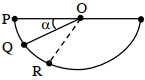
- 5A ball is released from rest from point $P$ of a smooth semi-spherical vessel as shown in figure. The ratio of the centripetal force and normal reaction on the ball at point $Q$ is $A$ while angular position of point $Q$ is $\alpha$ with respect to point $P$. Which of the following graphs represent the correct relation between $A$ and $\alpha$ when ball goes from $Q$ to $R$ ?View Solution
- 6A bullet of mass $0.1\,kg$ moving horizontally with speed $400\,ms ^{-1}$ hits a wooden block of mass $3.9\,kg$ kept on a horizontal rough surface. The bullet gets embedded into the block and moves $20\,m$ before coming to rest. The coefficient of friction between the block and the surface is $........$ $\left(\text { Given } g=10 \,ms ^2\right. \text { ) }$View Solution
- 7A given object takes $n$ times the time to slide down $45^{\circ}$ rough inclined plane as it takes the time to slide down an identical perfectly smooth $45^{\circ}$ inclined plane. The coefficient of kinetic friction between the object and the surface of inclined plane is :View Solution
- 8A block rests on a rough inclined plane making an angle of ${30^o}$ with the horizontal. The coefficient of static friction between the block and the plane is $0.8$. If the frictional force on the block is $10 \,N$, the mass of the block (in kg) is (take $g = 10\,\,m/{s^2})$View Solution
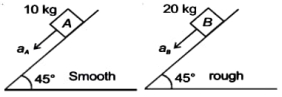
- 9The ratio of acceleration of blocks $A$ placed on smooth incline with block $B$ placed on rough incline is $2: 1$. The coefficient of kinetic friction between block $B$ and incline is .........View Solution
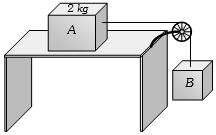
- 10The coefficient of static friction, ${\mu _s},$ between block $A$ of mass $2\, kg$ and the table as shown in the figure is $0.2$. ........ $kg$ would be the maximum mass value of block $B$ so that the two blocks do not move. The string and the pulley are assumed to be smooth and massless. $(g = 10\,m/{s^2})$View Solution