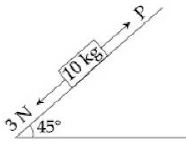
A block of mass $10\, kg$ is kept on a rough inclined plane as shown in the figure. A force of $3\, N$ is applied on the block. The coefficient of static friction between the plane and the block is $0.6$. What should be the minimum value of force $P$, such that the block does not move downward? (take $g = 10\, ms^{-2}$) ........ $N$
JEE MAIN 2019, Medium


Download our appand get started for free
Experience the future of education. Simply download our apps or reach out to us for more information. Let's shape the future of learning together!No signup needed.*
Similar Questions
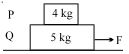
- 1$10\, kg$ block is placed as shown, if $F = 50$ newton find friction force ............ $N$View Solution
- 2A block of mass $50 \,kg$ can slide on a rough horizontal surface. The coefficient of friction between the block and the surface is $0.6$. The least force of pull acting at an angle of $30^°$ to the upward drawn vertical which causes the block to just slide is ........ $N$View Solution
- 3A block of mass $M$ is being pulled along rough horizontal surface. The coefficient of friction between the block and the surface is $\mu $. If another block of mass $M/2$ is placed on the block and it is again pulled on the surface, the coefficient of friction between the block and the surface will beView Solution
- 4An object of mass $1 \,kg$ moving on a horizontal surface with initial velocity $8 \,m / s$ comes to rest after $10 \,s$. If one wants to keep the object moving on the same surface with velocity $8 \,m / s$ the force required is ...... $N$View Solution
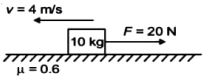
- 5A block of mass $10 kg$ is moving on a rough surface as shown in figure. The frictional force acting on block is ...... $N$View Solution
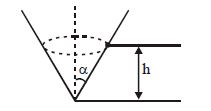
- 6A particle is describing circular motion in a horizontal plane in contact with the smooth inside surface of a fixed right circular cone with its axis vertical and vertex down. The height of the plane of motion above the vertex is $h$ and the semivertical angle of the cone is $\alpha $ . The period of revolution of the particleView Solution
- 7A piece of ice slides down a rough inclined plane at $\theta=45^{\circ}$ inclination in twice the time that it takes to slide down an identical but frictionless inclined plane. What is the coefficient of friction between ice and incline ?View Solution
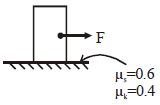
- 8A $60\, kg$ body is pushed with just enough force to start it moving across a floor and the same force continues to act afterwards. The coefficient of static friction and sliding friction are $0.5$ and $0.4$ respectively. The acceleration of the body is ........ $m/{s^2}$View Solution
- 9A conveyor belt is moving at a constant speed of $2\, ms^{-1}$. A box is gently dropped on it. The coefficient of friction between them is $\mu = 0.5$. The distance that the box will move relative to belt before coming to rest on it, (taking $g = 10\, ms^{-2}$) is ........ $m$.View Solution
- 10The coefficient of friction between $4kg$ and $5\, kg$ blocks is $0.2$ and between $5kg$ block and ground is $0.1$ respectively. Choose the correct statementsView Solution