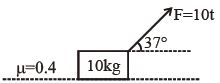
A block of mass $50 \,kg$ can slide on a rough horizontal surface. The coefficient of friction between the block and the surface is $0.6$. The least force of pull acting at an angle of $30^°$ to the upward drawn vertical which causes the block to just slide is ........ $N$
Medium
Download our app for free and get started
(d) For limiting condition $f = \mu R$
$F\sin 30^\circ = \mu (mg - F\cos 30^\circ )$,
By solving $F = 294.3\;N$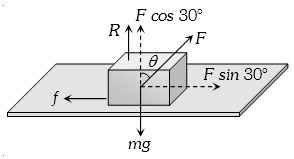

Download our appand get started for free
Experience the future of education. Simply download our apps or reach out to us for more information. Let's shape the future of learning together!No signup needed.*
Similar Questions
- 1A block of mass $M = 5\,kg$ is resting on a rough horizontal surface for which the coefficient of friction is $0.2$. When a force $F = 40\,\,N$ is applied, the acceleration of the block will be ........ $m/\sec^2$ $(g = 10\,\,m/{\sec^2})$View Solution
- 2A person with his hands in his pockets is skating on ice at the velocity of $10 \,m/s$ and describes a circle of radius $50\, m$. What is his inclination with verticalView Solution
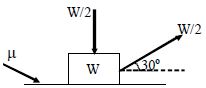
- 3A block of weight $W$ is kept on a rough horizontal surface (friction coefficient $\mu$). Two forces $W/2$ each are applied as shown in the figure. Choose the $CORRECT$ statement :-View Solution
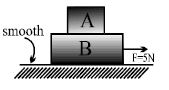
- 4In the shown arrangement mass of $A = 1\,\,kg$ mass of $B = 2\,\,kg.$ Coefficient of friction between $A $ and $B = 0.2.$ There is no friction between $B$ and ground. The frictional force exerted by $A$ on $B$ equals toView Solution
- 5A box is lying on an inclined plane what is the coefficient of static friction if the box starts sliding when an angle of inclination is $60^o $View Solution
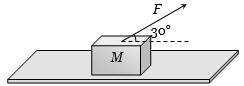
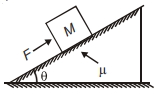
- 6A block (mass $=M kg$ ) is placed on a rough inclined plane. A force $F$ is applied parallel to the inclined (as shown in figure) such that it just starts moving upward. The value of $F$ isView Solution
- 7An inclined plane is bent in such a way that the vertical cross-section is given by $y =\frac{ x ^{2}}{4}$ where $y$ is in vertical and $x$ in horizontal direction. If the upper surface of this curved plane is rough with coefficient of friction $\mu=0.5,$ the maximum height in $cm$ at which a stationary block will not slip downward is............$cm$View Solution
- 8A conveyor belt is moving at a constant speed of $2\, ms^{-1}$. A box is gently dropped on it. The coefficient of friction between them is $\mu = 0.5$. The distance that the box will move relative to belt before coming to rest on it, (taking $g = 10\, ms^{-2}$) is ........ $m$.View Solution
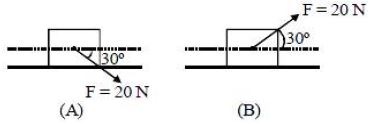
- 9A block of mass $5\, kg$ is $(i)$ pushed in case $(A)$ and $(ii)$ pulled in case $(B)$, by a force $F = 20\, N$, making an angle of $30^o$ with the horizontal, as shown in the figures. The coefficient of friction between the block and floor is $\mu = 0.2$. The difference between the accelerations of the block, in case $(B)$ and case $(A)$ will be ........ $ms^{-2}$ .$(g = 10\, ms^{-2})$View Solution
- 10View SolutionA force acts on a block as shown in figure. Find time when block loses contact with surface.