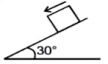
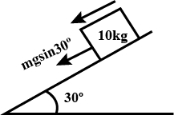
A block of mass $10 \,kg$ is released on rough incline plane. Block start descending with acceleration $2 \,m / s ^2$. Kinetic friction force acting on block is ..... $N$ (take $g=10 \,m / s ^2$ )
Medium


Download our appand get started for free
Experience the future of education. Simply download our apps or reach out to us for more information. Let's shape the future of learning together!No signup needed.*
Similar Questions
- 1View SolutionThe limiting value of static friction between two contact surfaces is ...........
- 2A heavy body of mass $25\, kg$ is to be dragged along a horizontal plane $\left( {\mu = \frac{1}{{\sqrt 3 }}} \right).$ The least force required is ........ $kgf$View Solution
- 3A body of mass $10\, kg$ is lying on a rough plane inclined at an angle of $30^o$ to the horizontal and the coefficient of friction is $0.5$. the minimum force required to pull the body up the plane is ........ $N$View Solution
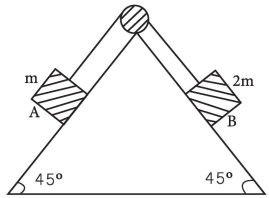
- 4Consider the diagram shown below in which two masses of $m$ and $2 m$ are placed on a fixed triangular wedge. The coefficient of friction between block $A$ and the wedge is $2 / 3$, while that for block $B$ and the wedge is $1 / 3$View Solution
- 5A wooden block of mass $M$ resting on a rough horizontal surface is pulled with a force $F$ at an angle $\phi $ with the horizontal. If $\mu $ is the coefficient of kinetic friction between the block and the surface, then acceleration of the block isView Solution
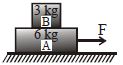
- 6Two blocks $A$ and $B$ of masses $6\, kg$ and $3\, kg$ rest on a smooth horizontal surface as shown in the figure. If coefficient of friction between $A$ and $B$ is $0.4$, the maximum horizontal force which can make them without separation is ........ $N$View Solution
- 7A disc with a flat small bottom beaker placed on it at a distance $R$ from its center is revolving about an axis passing through the center and perpendicular to its plane with an angular velocity $\omega$. The coefficient of static friction between the bottom of the beaker and the surface of the disc is $\mu$. The beaker will revolve with the disc ifView Solution
- 8$A$ block of mass $M$ is placed on $a$ horizontal surface and it is tied with an inextensible string to $a$ block of mass, as shown in figure. A block of mass $m_0$ is also placed on $M$ If friction force exists between the block $M$ and the block $m_0$ and not between the block $M$ and the horizontal surface, then the minimum value of $\mu$ for which the block m remains stationary isView Solution

- 9The maximum acceleration of $5\, kg$ block ...... $m/s^2$View Solution
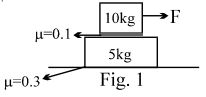
- 10A force $F = Kt$ (where $t$ is the time in seconds and $K = 2\, N/s$) is applied on $2 \,kg$ block at $t = 0$ as shown in the figure. The displacement of $8\ kg$ block till the time when $2\, kg$ block start slipping on $8\,kg$ block will be (coefficient of friction between $2\,kg$ block and $8\, kg$ block is $0.2$ and between $8\, kg$ block and surface is zero,View Solution
$g = 10m/s^2)$