A block of mass $200\, g$ executing $SHM$ under the influence of a spring of spring constant $K=90\, N\,m^{-1}$ and a damping constant $b=40\, g\,s^{-1}$. The time elapsed for its amplitude to drop to half of its initial value is ...... $s$ (Given $ln\,\frac{1}{2} = -0.693$)
Medium


Download our appand get started for free
Experience the future of education. Simply download our apps or reach out to us for more information. Let's shape the future of learning together!No signup needed.*
Similar Questions
- 1View SolutionIdentify correct statement among the following
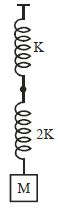
- 2Two springs of force constant $K$ and $2K$ are connected to a mass as shown below. The frequency of oscillation of the mass isView Solution
- 3The function ${\sin ^2}(\omega t)$ representsView Solution
- 4The phase difference between two $SHM\,\,$ ${y_1}\, = \,10\,\sin \,\left( {10\pi t\, + \,\frac{\pi }{3}} \right)$ and ${y_2}\, = \,12\,\sin \,\left( {8\pi t\, + \,\frac{\pi }{4}} \right)$ at $t = 0.5\,s$ itView Solution
- 5The equation of $SHM$ is given as:View Solution
$x = 3\,sin\, 20\pi t + 4\, cos\, 20\pi t$ ,
where $x$ is in $cms$ and $t$ is in $seconds$ . The amplitude is ..... $cm$
- 6The distance covered by a particle undergoing $SHM$ in one time period is (amplitude $= A$)View Solution
- 7A particle is executing simple harmonic motion with a time period $T.$ At time $t = 0$, it is at its position of equilibrium. The kinetic energy-time graph of the particle will look likeView Solution
- 8When the potential energy of a particle executing simple harmonic motion is one-fourth of its maximum value during the oscillation, the displacement of the particle from the equilibrium position in terms of its amplitude $a$ isView Solution
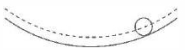
- 9A ball is rolling without slipping in a spherical shallow bowl (radius $R$ ) as shown in the figure and is executing simple harmonic motion. If the radius of the ball is doubled, then the time period of oscillationView Solution
- 10A particle undergoing simple harmonic motion has time dependent displacement given by $x(t)\, = \,A\,\sin \,\frac{{\pi t}}{{90}}$. The ratio of kinetic to potential energy $o$ the particle at $t=210\,s$ will beView Solution