MCQ
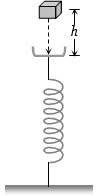
A block of mass m initially at rest is dropped from a height $h$ on to a spring of force constant $k$. the maximum compression in the spring is $x$ then
  • A
    $mgh = \frac{1}{2}k{x^2}$
  • $mg(h + x) = \frac{1}{2}k{x^2}$
  • C
    $mgh = \frac{1}{2}k{(x + h)^2}$
  • D
    $mg(h + x) = \frac{1}{2}k{(x + h)^2}$

Answer

Correct option: B.
$mg(h + x) = \frac{1}{2}k{x^2}$
b
(b) Change in gravitational potential energy
$=$ Elastic potential energy stored in compressed spring
$ \Rightarrow mg(h + x) = \frac{1}{2}k{x^2}$

Need a full question paper?

Generate a complete, print-ready paper with questions like this in minutes — across 16+ boards, with answer keys.

Start Generating Free

Similar questions

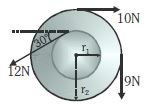
In the following figure $r_1$ and $r_2$ are $5\, cm$ and $30\, cm$ respectively. If the moment of inertia of the wheel is $5100\, kg-m^2$ then its angular acceleration will be
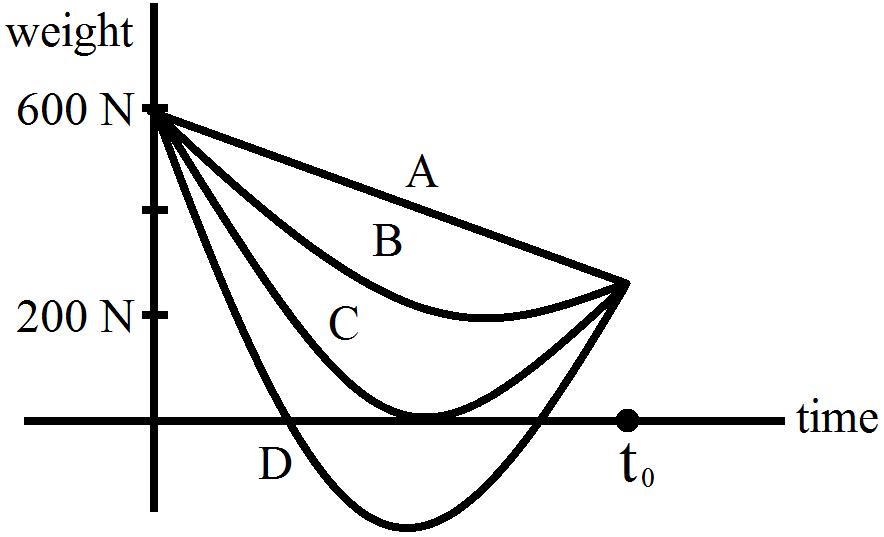
Suppose, the acceleration due to gravity at the earth's surface is $10 \mathrm{~ms}^{-2}$ and at the surface of Mars it is $4.0 \mathrm{~ms}^{-2}$. A $60 \ kg$ passenger goes from the earth to the Mars in a spaceship moving with a constant velocity. Neglect all other objects in the sky. Which part of best represents the weight $($net gravitational force$)$ of the passenger as a function of time?
In uniform circular motion
A particle at the end of a spring executes simple harmonic motion with a period ${t_1}$, while the corresponding period for another spring is ${t_2}$. If the period of oscillation with the two springs in series is $T$, then
The speed of a motor increases from $1200$ rpm to $1800$ rpm in $20s.$ How many revolutions does it make during these second?
If $\sigma$ be the surface tension, the work done in breaking a big drop of radius R in n drops of equal radius is
$A$ system of $N$ particles is free from any external forces. Which of the following must be true for the sum of the magnitudes of the momenta of the individual particles in the system?
A heavy body of mass $25\, kg$ is to be dragged along a horizontal plane $\left( {\mu  = \frac{1}{{\sqrt 3 }}} \right).$ The least force required is ........ $kgf$ 
Two sound waves of slightly different frequencies propagating in the same direction produce beats due to:
A flat plate of area $0.1 \,m ^2$ is placed on a flat surface and is separated from it by a film of oil $10^{-5} \,m$ thick whose coefficient of viscosity is $1.5 N \,sm s ^{-2}$. The force required to cause the plate to slide on the surface at constant speed of $1 \,mm s ^{-1}$ is ............ $N$