A block of mass $m$ is placed on a surface with a vertical cross section given by $y = \frac{{{x^3}}}{6}$ If the coefficient of friction is $0.5$,the maximum height above the ground at which the block can be placed without slipping is:
JEE MAIN 2014, Difficult
Download our app for free and get started
$ \tan \theta =\mu \frac{d y}{d x}=\frac{x^2}{2}(\text { from question })$
$ \text { coefficient of friction } \mu=0.5$
$ \therefore 0.5=\frac{x^2}{2}$
$ \Rightarrow x= \pm 1$
$ \text { Now }, y=\frac{x^3}{6}=\frac{1}{6} m$
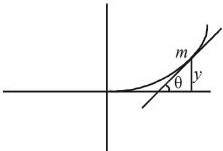
$ \text { coefficient of friction } \mu=0.5$
$ \therefore 0.5=\frac{x^2}{2}$
$ \Rightarrow x= \pm 1$
$ \text { Now }, y=\frac{x^3}{6}=\frac{1}{6} m$

Download our appand get started for free
Experience the future of education. Simply download our apps or reach out to us for more information. Let's shape the future of learning together!No signup needed.*
Similar Questions
- 1View SolutionThe limiting friction between two bodies in contact is independent of
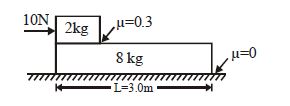
- 2Determine the time in which the smaller block reaches other end of bigger block in the figure. $(g = 10\ m s^{-2})$ .......... $\sec$View Solution
- 3A car is moving on a plane inclined at $30^{\circ}$ to the horizontal with an acceleration of $10\, {ms}^{-2}$ parallel to the plane upward. A bob is suspended by a string from the roof of the car.The angle in degrees which the string makes with the vertical is ...... . (Take ${g}=10\, {ms}^{-2}$ )View Solution
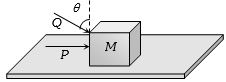
- 4A block of mass $m$ lying on a rough horizontal plane is acted upon by a horizontal force $P$ and another force $Q$ inclined at an angle $\theta $ to the vertical. The block will remain in equilibrium, if the coefficient of friction between it and the surface isView Solution
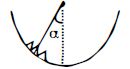
- 5An insect crawls up a hemispherical surface very slowly. The coefficient of friction between the insect and the surface is $1/3$. If the line joining the centre of the hemispherical surface to the insect makes an angle $\alpha $ with the vertical, the maximum possible value of $\alpha $ so that the insect does not slip is given byView Solution
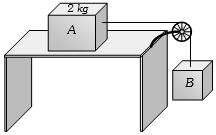
- 6The coefficient of static friction, ${\mu _s},$ between block $A$ of mass $2\, kg$ and the table as shown in the figure is $0.2$. ........ $kg$ would be the maximum mass value of block $B$ so that the two blocks do not move. The string and the pulley are assumed to be smooth and massless. $(g = 10\,m/{s^2})$View Solution
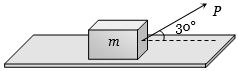
- 7A body of mass m rests on horizontal surface. The coefficient of friction between the body and the surface is $\mu .$ If the mass is pulled by a force $P$ as shown in the figure, the limiting friction between body and surface will beView Solution
- 8The force required just to move a body up an inclined plane is double the force required just to prevent the body from sliding down. If $\mu $ is the coefficient of friction, the inclination of plane to the horizontal isView Solution
- 9The coefficient of friction between two surfaces is $\mu = 0.8$.The tension in the string shown in the figure is ........ $N$View Solution
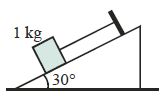
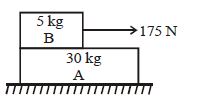
- 10Block $A$ of mass $30\, kg$ . is resting on a frictionless floor. Another block $B$ of mass $5\, kg$ is resting on it as shown in the figure. The coefficient of static friction between the blocks is $0.4$ while kinetic friction is $0.3$. If a horizontal force of $175\, N$ is applied to block $B$ , then the acceleration of the block $A$ will be ........ $m/s^2$ $(g = 10\, m/s^2 )$View Solution