A block of weight $1 \,N$ rests on an inclined plane of inclination $\theta$ with the horizontal. The coefficient of friction is $\mu$ The minimum force that has to be applied parallel to the inclined plane to make the body just move up the plane is
Easy
Download our app for free and get started
(d)
Given $m g=1 \,N$
To just move the body up
$F=\text { friction force }+\text { gravitation force }$
$=\mu m g \cos \theta+m g \sin \theta$
$=\mu \cos \theta+\sin \theta$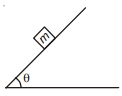

Download our appand get started for free
Experience the future of education. Simply download our apps or reach out to us for more information. Let's shape the future of learning together!No signup needed.*
Similar Questions
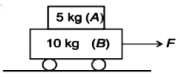
- 1If acceleration of $A$ is $2 \,m / s ^2$ which is smaller than acceleration of $B$ then the value of frictional force applied by $B$ on $A$ is ......... $N$View Solution
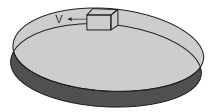
- 2A smooth circular groove has a smooth vertical wall as shown in figure. A block of mass $m$ moves against the wall with a speed $v$. Which of the following curve represents the correct relation between the normal reaction on the block by the wall $( N )$ and speed of the block $(v)$ ?View Solution
- 3A block of mass $m$ is stationary on a rough plane of mass $M$ inclined at an angle $\theta$ to the horizontal, while the whole set up is accelerating upwards at an acceleration $\alpha$. If the coefficient of friction between the block and the plane is $\mu$, then the force that the plane exerts on the block isView Solution
- 4On a rough horizontal surface, a body of mass $2 \,kg$ is given a velocity of $10 \,m/s$. If the coefficient of friction is $0.2$ and $g = 10\, m/{s^2}$, the body will stop after covering a distance of ........ $m$View Solution
- 5The maximum speed that can be achieved without skidding by a car on a circular unbanked road of radius $R$ and coefficient of static friction $\mu $, isView Solution
- 6Two blocks $A$ and $B$ are released from the top of a rough inclined plane so that $A$ slides along the plane and $B$ falls down freely. Which will have higher velocity on reaching the ground ?View Solution
- 7A sphere of mass $m$ is set in motion with initial velocity $v_o$ on a surface on which $kx^n$ is the frictional force with $k$ and $n$ as the constants and $x$ as the distance from the point of start. Find the distance in which sphere will stopView Solution
- 8A body of mass $2 \,kg$ is kept by pressing to a vertical wall by a force of $100\, N$. The coefficient of friction between wall and body is $0.3.$ Then the frictional force is equal to ........ $N$View Solution
- 9A stone of mass of $16\, kg$ is attached to a string $144 \,m$ long and is whirled in a horizontal circle. The maximum tension the string can withstand is $16$ Newton. The maximum velocity of revolution that can be given to the stone without breaking it, will be ....... $ms^{-1}$View Solution
- 10Two masses $M$ and $m$ are attached to a vertical axis by weightless threads of combined length $l$. They are set in rotational motion in a horizontal plane about this axis with constant angular velocity $\omega $. If the tensions in the threads are the same during motion, the distance of $M$ from the axis isView Solution