MCQ
A body is executing simple harmonic motion with an angular frequency $2\,rad/s$. The velocity of the body at $20\, mm$ displacement, when the amplitude of motion is $60\, mm$, is ...... $mm/s$
  • A
    $40$
  • B
    $60$
  • $113$
  • D
    $120$

Answer

Correct option: C.
$113$
c
(c) $v = \omega \sqrt {({a^2} - {y^2})} = 2\sqrt {{{60}^2} - {{20}^2}}  = 113\,mm/s$.

Need a full question paper?

Generate a complete, print-ready paper with questions like this in minutes — across 16+ boards, with answer keys.
Start Generating Free

Similar questions

A $2 \,kg$ mass starts from rest on an inclined smooth surface with inclination $30^°$ and length $2\, m$. ...... $m$ will it travel before coming to rest on a frictional surface with frictional coefficient of $0.25$
A mouse jumps off from the $15$ th floor of a high-rise building and lands $12 \,m$ from the building. Assume that, each floor is of $3 \,m$ height. The horizontal speed with which the mouse jumps is closest to ...............$km /h$
The gravitational force ${F_g}$ between two objects does not depend on
A rocket is launched straight up from the surface of the earth. When its altitude is one fourth of the radius of the earth, its fuel runs out and therefore it coasts. The minimum velocity which the rocket must have when it starts to coast if it is to escape from the gravitational pull of the earth is ...... $km/s$   [escape velocity on surface of earth is $11.2\,km/s$]
A balloon rises from rest with a constant acceleration $g/8$. A stone is released from it when it has risen to height $h$. The time taken by the stone to reach the ground is
Two cylinders $A$ and $B$ fitted with pistons contain equal amounts of an ideal diatomic gas at $300 K$ . The piston of $A$ is free to move while that of $B$  is held fixed. The same amount of heat is given to the gas in each cylinder. If the rise in temperature of the gas in $A$ is $30 K$ , then the rise in temperature of the gas in $B$ is ..... $K$
In damped oscillations, damping force is directly proportional to speed of oscillator. If amplitude becomes half of its maximum value in $1 \,s$, then after $2 \,s$ amplitude will be $\left(A_0-\right.$ initial amplitude)
Which of the diagrams in correctly shows the change in kinetic energy of an iron sphere falling freely in a lake having sufficient depth to impart it a terminal velocity?
The specific heat capacity of a substance is temperature dependent and is given by the formula $C=k T$, where $k$ is a constant of suitable dimensions in $SI$ units, and $T$ is the absolute temperature. If the heat required to raise the temperature of $1 \ kg$ of the substance from $-73^{\circ} C$ to $27^{\circ} C$ is $n k$, the value of $n$ is. . . . . .[Given: $0 K =-273^{\circ} C$.]
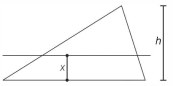
Which one of the following four graphs best depict the variation with $x$ of the moment of inertia $I$ of a uniform triangular lamina about an axis parallel to its base at a distance $x$ from it?