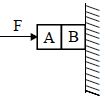
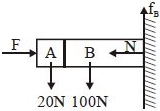
Given in the figure are two blocks $A$ and $B$ of weight $20\, N$ and $100\, N$, respectively. These are being pressed against a wall by a force $F$ such that the system does not slide as shown. If the coefficient of friction between the blocks is $0.1$ and between block $B$ and the wall is $0.15$, the frictional force applied by the wall on block $B$ is ........ $N$
Medium


Download our appand get started for free
Experience the future of education. Simply download our apps or reach out to us for more information. Let's shape the future of learning together!No signup needed.*
Similar Questions
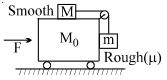
- 1Imagine $a$ situation in which the horizontal surface of block $M_0$ is smooth and its vertical surface is rough with $a$ coefficient of friction $\mu$ In above problem, the value $(s)$ of $F$ for which $M$ and $m$ are stationary with respect to $M_0 mg$View Solution
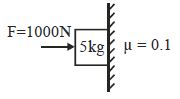
- 2For the given figure, if block remains in equilibrium position then find frictional force between block and wall ........ $N$View Solution
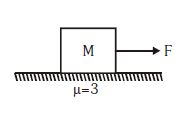
- 3A block of mass $M$ placed on rough surface of coefficient of friction equal to $3$ . If $F$ is the $(4/5)$ of the minimum force required to just move. Find out the force exerted by ground on the blockView Solution
- 4A coin placed on a rotating table just slips when it is placed at a distance of $1\,cm$ from the center. If the angular velocity of the table in halved, it will just slip when placed at a distance of from the centre $............\,cm$View Solution
- 5A block of mass $2 \,kg$ rests on a rough inclined plane making an angle of $30°$ with the horizontal. The coefficient of static friction between the block and the plane is $ 0.7$. The frictional force on the block is ....... $N$.View Solution
- 6A car having a mass of $1000\, kg$ is moving at a speed of $30\, metres/sec$. Brakes are applied to bring the car to rest. If the frictional force between the tyres and the road surface is $5000$ newtons, the car will come to rest in ........ $\sec$View Solution
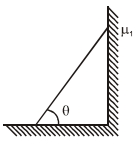
- 7In the figure, a ladder of mass $m$ is shown leaning against a wall. It is in static equilibrium making an angle $\theta$ with the horizontal floor. The coefficient of friction between the wall and the ladder is $\mu_1$ and that between the floor and the ladder is $\mu_2$. The normal reaction of the wall on the ladder is $N_1$ and that of the floor is $N_2$. If the ladder is about to slip, thenView Solution
$Image$
$(A)$ $\mu_1=0 \mu_2 \neq 0$ and $N _2 \tan \theta=\frac{ mg }{2}$
$(B)$ $\mu_1 \neq 0 \mu_2=0$ and $N_1 \tan \theta=\frac{m g}{2}$
$(C)$ $\mu_1 \neq 0 \mu_2 \neq 0$ and $N _2 \tan \theta=\frac{ mg }{1+\mu_1 \mu_2}$
$(D)$ $\mu_1=0 \mu_2 \neq 0$ and $N _1 \tan \theta=\frac{ mg }{2}$
- 8Consider a car moving along a straight horizontal road with a speed of $72\, km/h$. If the coefficient of kinetic friction between the tyres and the road is $0.5,$ the shortest distance in which the car can be stopped is ........ $m$ .$[g = 10\,m{s^{ - 2}}]$View Solution
- 9A vehicle of mass $200\,kg$ is moving along a levelled curved road of radius $70\,m$ with angular velocity of $0.2\,rad / s$. The centripetal force acting on the vehicle is $.........\,N$View Solution
- 10Determine the maximum acceleration in $m/s^2$ of the train in which a box lying on its floor will remain stationary, given that the co-efficient of static friction between the box and the train’s floor is $0.15.$View Solution