Question
A body rotating at $20 \ \text{rad/s}$ is acted upon by a constant torque providing it a deceleration of $2\ce{rad/s}^2$. At what time will the body have kinetic energy same as the initial value if the torque continues to act?

Answer

Initial angular velocity $= 20 \ce{ rad/s}$
Therefore $\alpha=2\text{ rad/s}^2$
$\Rightarrow\text{t}_1=\frac{\omega_2}{\alpha_1}=\frac{20}{2}=10\text{ sec}$
Therefore $10\sec$ it will come to rest.
Since the same torque is continues to act on the body it will produce same angular acceleration and since the initial kinetic energy $=$ the kinetic energy at a instant.
So initial angular velocity $=$ angular velocity at that instant Therefore time require to come to that angular velocity,$\Rightarrow\text{t}_2=\frac{\omega}{\alpha_2}=\frac{20}{2}=10\text{ sec}$
therefore time required $= t_1 + t_2 = 20\ \sec$.

Need a full question paper?

Generate a complete, print-ready paper with questions like this in minutes — across 16+ boards, with answer keys.

Start Generating Free

Similar questions

A coil of inductance 5.0mH and negligible resistance is connected to the oscillator of the previous problem. Find the peak currents in the circuit for $\omega=100\text{s}^{-1},500\text{s}^{-1},1000\text{s}^{-1}.$
Can an electromagnetic wave be deflected by an electric field or a magnetic field?
Indium antimonide has a band gap of 0.23eV between the valence and the conduction band. Find the temperature at which kT equals the band gap.
When we stir a liquid vigorously, it becomes warm. Is it a reversible process?
A person looks at different trees in an open space with the following details. Arrange the trees in decreasing order of their apparent sizes.
Tree Height(m) Distance form the eye(m)
A 2.8 50
B 2.5 80
C 1.8 70
D 2.8 100
  1. In what way is diffraction from each slit related to the interference pattern in a double slit experiment?
  2. Two wavelengths of sodium light $590\ nm$ and $596\ nm$ are used, in turn, to study the diffraction taking place at a single slit of aperture $2 \times 10^{–4} m$. The distance between the slit and the screen is $1.5 \ m$. Calculate the separation between the positions of the first maxima of the diffraction pattern obtained in the two cases.
A small conducting sphere (radius r ) is placed concentrically inside a larger conducting hollow sphere of radius $R$. The big and small spheres are charged with $Q$ and $q(Q>q)$ respectively and kept separate from each other. Calculate the potential difference between the spheres.
Figure shows a light rod of length l rigidly attached to a small heavy block at one end and a hook at the other end. The system is released from rest with the rod in a horizontal position. There is a fixed smooth ring at a depth h below the initial position of the hook and the hook gets into the ring as it reaches there. What should be the minimum value of h so that the block moves in a complete circle about the ring?
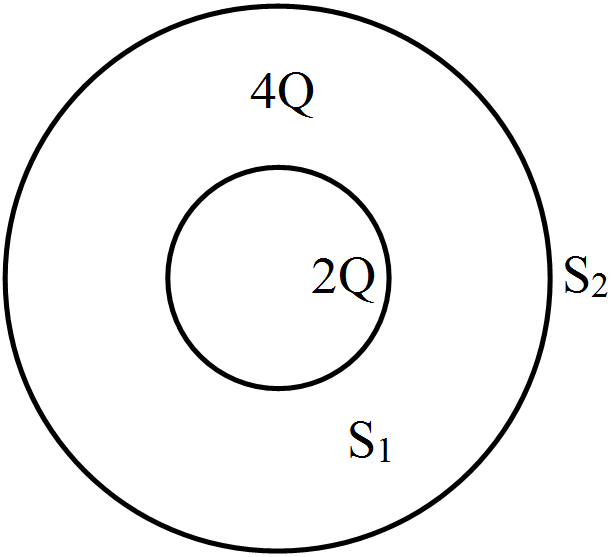
Consider two hollow concentric spheres, $S_1$ and $S_2,$ enclosing charges $2Q$ and $4Q$ respectively as shown in the figure.
  1. Find out the ratio of the electric flux through them.
  2. How will the electric flux through the sphere $S_1$ change if a medium of dielectric constant $'\epsilon_\text{r}\ '$ is introduced in the space inside $S_1$ in place of air? Deduce the necessary expression.
A current$-$carrying circular coil of $100$ turns and radius $5.0\ cm$ produces a magnetic field of $6.0 \times 10^{-5}T$ at its centre. Find the value of the current.