A capacitor $C$ is charged to a potential difference $V$ and battery is disconnected. Now if the capacitor plates are brought close slowly by some distance :
Advanced
Download our app for free and get started
For parallel plates capacitor, $C=\frac{A \epsilon_{0}}{d}, V=\frac{Q d}{A \epsilon_{0}}$
Thus capacitance is inversely proportional to separation $(d)$ between the plate and potential is proportional to the separation $(d).$
After disconnect the battery, the capacitor would maintain its charge indefinitely and if there some leakage current, capacitance will discharge very slowly.
As the energy $U=\frac{1}{2} C V^{2},$ so the energy is proportional to separation $(d)$ between the plates.
Thus when the plates are brought close, the energy of the capacitor will decrease.

Download our appand get started for free
Experience the future of education. Simply download our apps or reach out to us for more information. Let's shape the future of learning together!No signup needed.*
Similar Questions
- 1View SolutionThepoints resembling equal potentials are
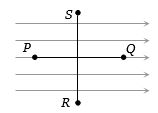
- 2Consider an infinite matrix of capacitors as shown in the figure. The effective capacitance between point $A$ and $B$ will beView Solution
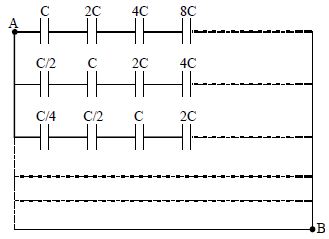
- 3View SolutionThe capacity of a parallel plate capacitor increases with the
- 4Three identical capacitors are given a charge $Q$ each and they are then allowed to discharge through resistance $R_1, R_2\,$ and $\,R_3$. Their charges, as a function of time shown in the graph below. The smallest of the three resistance isView Solution
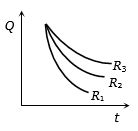
- 5Two identical particles of mass m carry a charge $Q$ each. Initially one is at rest on a smooth horizontal plane and the other is projected along the plane directly towards first particle from a large distance with speed $v.$ The closest distance of approach beView Solution
- 6An electric charge ${10^{ - 3}}\,\mu \,C$ is placed at the origin $(0, 0)$ of $X -Y$ co-ordinate system. Two points $A$ and $B$ are situated at $\left( {\sqrt {2\,} \,,\,\,\sqrt 2 } \right)$ and $(2, 0)$ respectively. The potential difference between the points $A$ and $B$ will be......$volt$View Solution
- 7The energy of a charged capacitor is given by the expression ($q$= charge on the conductor and $C$ = its capacity)View Solution
- 8Change $Q$ on a capacitor varies with voltage $V$ as shown in the figure, where $Q$ is taken along the $X$-axis and $V$ along the $Y$-axis. The area of triangle $OAB$ representsView Solution
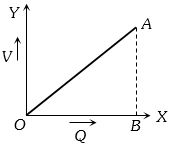
- 9Three concentric metallic spherical shell $A, B$ and $C$ or radii $a, b$ and $c$ $(a < b < c)$ have surface charge densities $- \sigma , + \sigma ,$ and $- \sigma $ respectively. The potential of shell $A$ is :View Solution
- 10When a proton is accelerated through $1\,V$, then its kinetic energy will be.....$eV$View Solution