A capacitor of $20\,\mu F$ is charged to $500\;volts$ and connected in parallel with another capacitor of $10\,\mu F$ and charged to $200\;volts$. The common potential is.......$volts$
Medium


Download our appand get started for free
Experience the future of education. Simply download our apps or reach out to us for more information. Let's shape the future of learning together!No signup needed.*
Similar Questions
- 1View SolutionA parallel plate capacitor after charging is kept connected to a battery and the plates are pulled apart with the help of insulating handles. Now which of the following quantities will decrease?
- 2Two identical positive charges are placed on the $y$-axis at $y=-a$ and $y=+a$. The variation of $V$ (electric potential) along $x$-axis is shown by graphView Solution
- 3Two capacitors $C_1$ and $C_2$ are charged to $120\ V$ and $200\ V$ respectively. It is found that connecting them together the potential on each one can be made zero. ThenView Solution
- 4View SolutionTwo identical conductors of copper and aluminium are placed in an identical electric fields. The magnitude of induced charge in the aluminium will be
- 5Four charges of $1\ \mu C, 2\ \mu C, 3\ \mu C,$ and $- 6\ \mu C$ are placed one at each corner of the square of side $1\,m$. The square lies in the $x-y$ plane with its centre at the origin.View Solution
- 6View SolutionIn the circuit shown in figure, four capacitors are connected to a battery. A capacitor is connected to a battery. The force of attraction between the plates when the separation between them is halved
- 7A capacitor of capacitance $9 n F$ having dielectric slab of $\varepsilon_{ r }=2.4$ dielectric strength $20\, MV / m$ and $P.D. =20 \,V$ then area of plates is ....... $\times 10^{-4}\, m ^{2}$View Solution
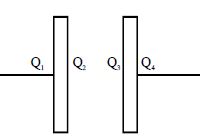
- 8In an insulated parallel-plate capacitor of capacitance $C$, the four surfaces have charges $Q_1, Q_2, Q_3$ and $Q_4$ as shown. The potential difference between the plate isView Solution
- 9Each plate of a parallel plate capacitor has a charge $q$ on it. The capacitor is now connected to a battery. Now,View Solution
- 10Three plates of common surface area $A$ are connected as shown. The effective capacitance will beView Solution