Four charges of $1\ \mu C, 2\ \mu C, 3\ \mu C,$ and $- 6\ \mu C$ are placed one at each corner of the square of side $1\,m$. The square lies in the $x-y$ plane with its centre at the origin.
Diffcult
Download our app for free and get started
Electric field at origin= sum of electric field due to individual charges
Then,
option $C$ is correct because electric field is not zero along z-axis as a every point the potential
equals sum of potential due to individual charges which can never be zero.
Then,
option $C$ is correct because electric field is not zero along z-axis as a every point the potential
equals sum of potential due to individual charges which can never be zero.

Download our appand get started for free
Experience the future of education. Simply download our apps or reach out to us for more information. Let's shape the future of learning together!No signup needed.*
Similar Questions
- 1If an electron moves from rest from a point at which potential is $50\, volt$ to another point at which potential is $70\, volt$, then its kinetic energy in the final state will beView Solution
- 2The diagram shows a small bead of mass $m$ carrying charge $q$. The bead can freely move on the smooth fixed ring placed on a smooth horizontal plane. In the same plane a charge $+Q$ has also been fixed as shown. The potential atthe point $P$ due to $+Q$ is $V$. The velocity with which the bead should projected from the point $P$ so that it can complete a circle should be greater thanView Solution

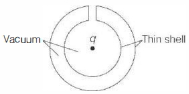
- 3A positive charge $q$ is placed at the centre of a neutral hollow cylindrical conducting shell with its cross-section as shown in the figure below. Which one of the following figures correctly indicates the induced charge distribution on the conductor? (Ignore edge effects)View Solution
- 4The ratio of momenta of an electron and an $\alpha$-particle which are accelerated from rest by a potential difference of $100\, volts$ isView Solution
- 5$S_1$ and $S_2$ are two equipotential surfaces on which the potentials are not equal. Which of the statement is incorrect ?View Solution
- 6The diameter of each plate of an air capacitor is $4\,cm$. To make the capacity of this plate capacitor equal to that of $20\,cm$ diameter sphere, the distance between the plates will beView Solution
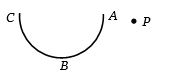
- 7In the following diagram the work done in moving a point charge from point $P$ to point $A$, $B$ and $C$ is respectively as $W_A$, $W_B$ and $W_C$ , thenView Solution
- 8Seven capacitors, each of the capacitance $2\,\mu F$, are to be connected in a configuration to obtain an effective capacitance of $\left( {\frac{6}{{13}}} \right)\,\mu F$. Which of the combinations, shown in figures below, will achieve the desired value ?View Solution
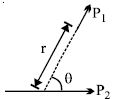
- 9View SolutionTwo short electric dipoles are placed as shown. The energy of electric interaction between these dipoles will be
- 10View SolutionA parallel plate air-core capacitor is connected across a source of constant potential difference. When a dielectric plate is introduced between the two plates then :