MCQ
A Carnot’s engine is made to work between $200°C$ and $0°C$ first and then between $0°C$ and $-200°C.$ The ratio of efficiencies of the engine in the two cases is
- A$1.73 : 1$
- ✓$1:1.73$
- C$1:1$
- D$1:2$
Generate a complete, print-ready paper with questions like this in minutes — across 16+ boards, with answer keys.
$\vec{F}_{\text {rot }}=\vec{F}_{\text {in }}+2 m\left(\vec{v}_{\text {rot }} \times \vec{\omega}\right)+m(\vec{\omega} \times \vec{r}) \times \vec{\omega},$
where $\vec{v}_{\text {rot }}$ is the velocity of the particle in the rotating frame of reference and $\bar{r}$ is the position vector of the particle with respect to the centre of the disc.
Now consider a smooth slot along a diameter of a disc of radius $R$ rotating counter-clockwise with a constant angular speed $\omega$ about its vertical axis through its center. We assign a coordinate system with the origin at the center of the disc, the $x$-axis along the slot, the $y$-axis perpendicular to the slot and the $z$-axis along the rotation axis $(\vec{\omega}=\omega \hat{k})$. A sm a $1$ block of mass $m$ is gently placed in the slot at $\vec{r}=(R / 2) \hat{i}$ at $t=0$ and is constrained to move only along the slot.
(Image)
($1$) The distance $r$ of the block at time $t$ is
($A$) $\frac{R}{4}\left(e^{\omega t}+e^{-\omega t}\right)$ ($B$) $\frac{R}{2} \cos \omega t$ ($C$) $\frac{R}{4}\left(e^{2 \omega t}+e^{-2 \omega t}\right)$
($D$) $\frac{F}{2} \cos 2 \omega t$
($2$) The net reaction of the disc on the block is
($A$) $\frac{1}{2} m \omega^2 R\left(e^{2 \omega t}-e^{-2 \omega t}\right) \hat{j}+m g \hat{k}$
($B$) $\frac{1}{2} m \omega^2 R\left(e^{\omega t}-e^{-a t t}\right) j+m g k$
($C$) $-m \omega^2 R \cos \omega t \hat{j}-m g \hat{k}$
($D$) $m \omega^2 R \sin \omega t \hat{j}-m g \hat{k}$
Give the answer quetioin ($1$) ($2$)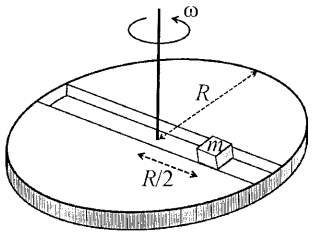
Reason : Sound waves in air are longitudinal in nature.