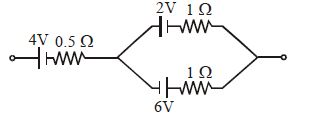
A cell of $e.m.f.$ $1.5\,V$ having a finite internal resistance is connected to a load resistance of $2\,\Omega $. For maximum power transfer the internal resistance of the cell should be ............. $ohm$
Easy
Download our app for free and get started
(c) For maximum power, external resistance $=$ internal resistance.

Download our appand get started for free
Experience the future of education. Simply download our apps or reach out to us for more information. Let's shape the future of learning together!No signup needed.*
Similar Questions
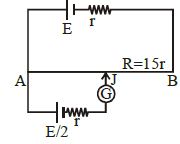
- 1The potentiometer wire $AB$ is $600\,\, cm$ long at what distance from $A$ should the Jockey $J$ touch the wire to get zero deflection in the galvanomenter ................ $\mathrm{cm}$View Solution
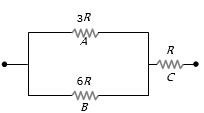
- 2The three resistances $A, B$ and $C$ have values $3R, 6R$ and $R$ respectively. When some potential difference is applied across the network, the thermal powers dissipated by $A, B$ and $C$ are in the ratioView Solution
- 3Consider the following two statements.View Solution
$(A)$ Kirchhoff's junction law follows from the conservation of charge.
$(B)$ Kirchhoff's loop law follows from the conservation of energy.
Which of the following is correct ?
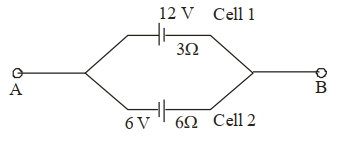
- 4Two cells are connected between points $A$ and $B$ as shown. Cell $1$ has emf of $12\,V$ and internal resistance of $3\,\Omega$. Cell $2$ has emf of $6\,V$ and internal resistance of $6\,\Omega$. An external resistor $R$ of $4\,\Omega$ is connected across $A$ and $B$. The current flowing through $R$ will be $.............A$.View Solution
- 5If six identical cells each having an $e.m.f.$ of $6\,V$ are connected in parallel, the $e.m.f.$ of the combination is ................ $V$View Solution
- 6A car battery of $e.m.f$. $12\,V$ and internal resistance $5 \times {10^{ - 2}}\,\Omega $, receives a current of $60\; A$ from external source, then terminal voltage of battery isView Solution
- 7View SolutionA thick wire is stretched so that its length become two times. Assuming that there is no change in its density, then what is the ratio of change in resistance of wire to the initial resistance of wire
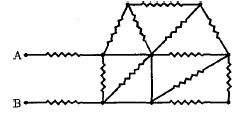
- 8In the given circuit all resistances are of value $R\,ohm$ each. The equivalent resistance between $A$ and $B$ isView Solution
- 9The effective resistance of two resistors in parallel is $\frac{{12}}{7}\,\Omega $. If one of the resistors is disconnected the resistance becomes $4$ $\Omega$. The resistance of the other resistor is.............. $\Omega$View Solution
- 10Find the net emf of the three batteries shown in figure ................ $\mathrm{V}$View Solution