Question
A certain buffer is made by mixing sodium formate and formic acid in water. With the help of equations explain how this buffer neutralizes addition of a small amount of an acid or a base?

Answer

$\text{HCOONa}\xrightarrow{\ \ \ \ \ \ \ \ \ \ }\text{HCOO}^-+\text{Na}^+$
$\text{HCOOH}\rightleftharpoons\text{HCOO}^-+\text{H}^+$
HCOO- is common ion in the above acidic buffer. When small amount of H+ ions is added, these H+ ions combine with HCOO- which are in excess to form HCOOH back and [H+]remains practically same, so pH remains constant. When small amount of OH- ions are added, OH- ions will take up H+ and association of HCOOH will increase so as to maintain concentration of H+ ions. So, pH is not affected.

Need a full question paper?

Generate a complete, print-ready paper with questions like this in minutes — across 16+ boards, with answer keys.
Start Generating Free

Similar questions

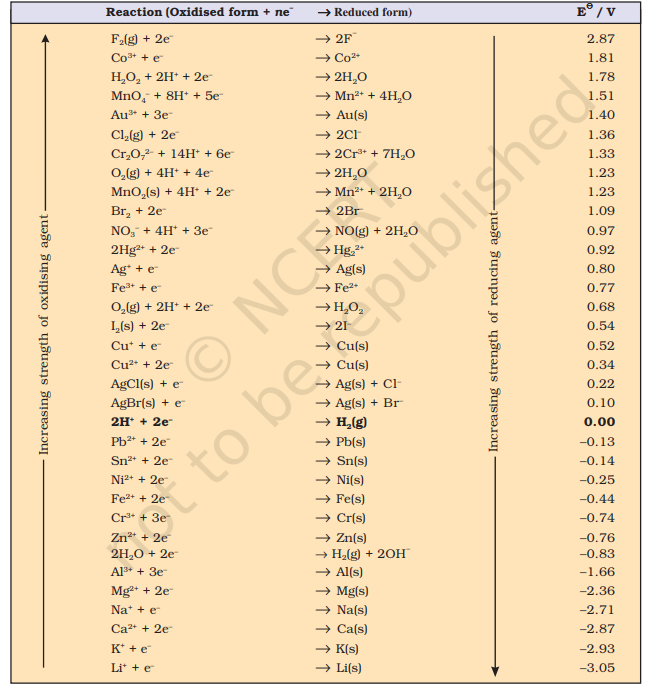
Using the standard electrode potentials given in the Table, predict if the reaction between the following is feasible:

Fe3+(aq) and I-(aq).
Chlorophyll, the green colouring matter of plants contains 2.68% magnesium by weight. Calculate the number of magnesium atoms in 2.00g of chlorophyll (Atomic mass of Mg = 24).
The arrangement of orbitals on the basis of energy is based upon their (n + l) value. Lower the value of (n + l), lower is the energy. For orbitals having same values of (n + l), the orbital with lower value of n will have lower energy.

  1. Based upon the above information, arrange the following orbitals in the increasing order of energy.
  1. 1s, 2s, 3s, 2p
  2. 4s, 3s, 3p, 4d
  3. 5p, 4d, 5d, 4f, 6s
  4. 5f, 6d, 7s, 7p
  1. Based upon the above information, solve the questions given below:
  1. Which of the following orbitals has the lowest energy?

4d, 4f, 5s, 5p

  1. Which of the following orbitals has the highest energy?

5p, 5d, 5f, 6s, 6p

  1. Explain, why Be2 molecule does not exist by using molecular orbital theory.
  2. Describe the state of hybridization in PCI5 Why are the axial bonds longer as compared to equatorial bonds?
Depict the galvanic cell in which the reaction $Zn ( s )+2 Ag ^{+}( aq ) \longrightarrow Zn ^{2+}( aq )+2 Ag ( s )$ takes place, Further show:
i. which of the electrode is negatively charged,
ii. the carriers of the current in the cell, and
iii. individual reaction at each electrode.
Use the following data to calculate the $\Delta\text{G}^{\circ}$ for the reaction in which PF5(g) forms from PF3(g) and F2(g) at 298K.

PF3(g) + F2(g) → PF5(g)

$\begin{matrix}\Delta \text{H}^{\circ}_{f} & -919 \text{kJ mol}^{-1} & 0 & -1577 \text{kJ} \text{ K}^{-1} \text{mol}^{-1} \ \\\text{S}^{\circ}& 273 & 203 & 301 \end{matrix}$

The following techniques are used to quantitatively estimate extra elements in organic compound. Identify the name of the method and the element estimated by this method.
  1. A known mass of an organic compound is heated with fuming HNO3 in presence of AgNO3.
  2. Organic compound is heated with dry copper oxide in atmosphere of CO2.
  3. Organic compound is heated with conc. H2SO4.
According to de Broglie, matter should exhibit dual behaviour, that is both particle and wave like properties. However, a cricket ball of mass 100g does not move like a wave when it is thrown by a bowler at a speed of 100km/h. Calculate the wavelength of the ball and explain why it does not show wave nature.
0.3780g of an organic chloro compound gave 0.5740g of silver chloride in Carius estimation. Calculate the percentage of chlorine present in the compound.
100 mL of a liquid is contained in an insulated container at a pressure of 1 bar. The pressure is steeply increased to 100 bar. The volume of the liquid is decreased by 1 mL at this constant pressure. Find $\Delta H$ and $\Delta U$.