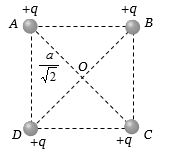
Charges of $ + \frac{{10}}{3} \times {10^{ - 9}}C$ are placed at each of the four corners of a square of side $8\,cm$. The potential at the intersection of the diagonals is
Medium
Download our app for free and get started
(b) Potential at the centre $O$, $V = 4 \times \frac{1}{{4\pi {\varepsilon _0}}}.\frac{Q}{{a/\sqrt 2 }}$
where $Q = \frac{{10}}{3} \times {10^{ - 9}}C$ and $a = 8\,cm\, = \,\,8 \times {10^{ - 2}}m$
So $V = 5 \times 9 \times {10^9} \times \frac{{\frac{{10}}{3} \times {{10}^{ - 9}}}}{{\frac{{8 \times {{10}^{ - 2}}}}{{\sqrt 2 }}}}$$ = 1500\sqrt 2 \,volt$
where $Q = \frac{{10}}{3} \times {10^{ - 9}}C$ and $a = 8\,cm\, = \,\,8 \times {10^{ - 2}}m$
So $V = 5 \times 9 \times {10^9} \times \frac{{\frac{{10}}{3} \times {{10}^{ - 9}}}}{{\frac{{8 \times {{10}^{ - 2}}}}{{\sqrt 2 }}}}$$ = 1500\sqrt 2 \,volt$

Download our appand get started for free
Experience the future of education. Simply download our apps or reach out to us for more information. Let's shape the future of learning together!No signup needed.*
Similar Questions
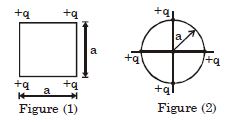
- 1Consider the configuration of a system of four charges each of value $+q$ . The work done by external agent in changing the configuration of the system from figure $(1)$ to figure $(2)$ isView Solution
- 2The capacity of an air condenser is $2.0\, \,\mu F$. If a medium is placed between its plates. The capacity becomes $ 12\, \,\mu F$. The dielectric constant of the medium will beView Solution
- 3View SolutionWhen a parallel plates capacitor is connected to a source of constant potential difference,
- 4Twenty seven drops of water of the same size are equally and similarly charged. They are then united to form a bigger drop. By what factor will the electrical potential changes.........$times$View Solution
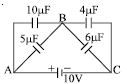
- 5In the circuit shown in figure, four capacitors are connected to a battery. The charge on the $5$ $\mu$$F$ capacitor is.......$ \mu C$View Solution
- 6View SolutionElectric potential of earth is taken to be zero because earth is a good
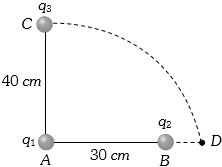
- 7Two charges ${q_1}$ and ${q_2}$ are placed $30\,\,cm$ apart, shown in the figure. A third charge ${q_3}$ is moved along the arc of a circle of radius $40\,cm$ from $C$ to $D$. The change in the potential energy of the system is $\frac{{{q_3}}}{{4\pi {\varepsilon _0}}}k$, where $k$ isView Solution
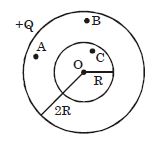
- 8A hollow conducting sphere of inner radius $R$ and outer radius $2R$ is given a charge $Q$ as shown in the figure, then the :View Solution
- 9Three charges $-q, Q$ and $-q$ are placed respectively at equal distances on a straight line. If the potential energy of the system of three charges is zero, then what is the ratio of $Q: q$ ?View Solution
- 10View SolutionA metallic rod is placed in a uniform electric field. Select the correct option.