A charged particle of mass $m$ and charge $q$ describes circular motion of radius $r$ in a uniform magnetic field of strength $B$. The frequency of revolution is
Easy
Download our app for free and get started
(a) Time period is given by $T = \frac{{2\pi m}}{{qB}}$
$==>$ Frequency $\nu = \frac{1}{T} = \frac{{qB}}{{2\pi m}}$
$==>$ Frequency $\nu = \frac{1}{T} = \frac{{qB}}{{2\pi m}}$

Download our appand get started for free
Experience the future of education. Simply download our apps or reach out to us for more information. Let's shape the future of learning together!No signup needed.*
Similar Questions
- 1A particle of specific charge $(q/m)$ is projected from the origin of coordinates with initial velocity $[ui - vj]$. Uniform electric magnetic fields exist in the region along the $+y$ direction, of magnitude $E$ and $B.$ The particle will definitely return to the origin once ifView Solution
- 2A long straight wire of radius $a$ carries a steady current $I.$ The current is uniformly distributed over its cross-section. The ratio of the magnetic fields $B$ and $B',$ at radial distances $\frac{a}{2}$ and $2a$ respectively, from the axis of the wire isView Solution
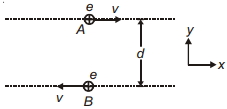
- 3Two protons $A$ and $B$ move parallel to the $x$-axis in opposite directions with equal speeds $v$. At the instant shown, the ratio of magnetic force and electric force acting on the proton $A$ is ( $c=$ speed of light in vacuum)View Solution
- 4An ammeter whose resistance is $180\,\Omega $ gives full scale deflection when current is $2\, mA$. The shunt required to convert it into an ammeter reading $20\, mA$ (in $ohms$) isView Solution
- 5If a proton, deutron and $\alpha - $ particle on being accelerated by the same potential difference enters perpendicular to the magnetic field, then the ratio of their kinetic energies isView Solution
- 6Two concentric coils $X$ and $Y$ of radii $16 \,\,cm$ and $10 \,\,cm$ lie in the same vertical plane containing $N-S$ direction. $X$ has $20$ $turns$ and carries $16 \,\,A.$ $Y$ has $25$ $turns$ $\&$ carries $18\,A$. $X$ has current in anticlockwise direction and $Y$ has current in clockwise direction for an observer, looking at the coils facing the west. The magnitude of net magnetic field at their common centre isView Solution
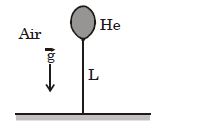
- 7A light balloon filled with helium of density $\rho_{He}$ is tied to a light string of length $L.$ The string is tied to the ground forming an "inverted" simple pendulum (figure). If the balloon is displaced slightly from equilibrium as in figure and released, the period of the motion is. Take the density of air to be $\rho_{air}$. Assume the air applies a buoyant force on the balloon but does not otherwise affect its motion.)View Solution
- 8A long solenoid has $100\,turns/m$ and carries current $i.$ An electron moves with in the solenoid in a circle of radius $2·30\,cm$ perpendicular to the solenoid axis. The speed of the electron is $0·046\,c$ ($c =$ speed of light). Find the current $i$ in the solenoid (approximate).....$A$View Solution
- 9A charge $+ Q$ is moving upwards vertically. It enters a magnetic field directed to the north. The force on the charge will be towardsView Solution
- 10A proton carrying $1\, Me V$ kinetic energy is moving in a circular path of radius $R$ in uniform magnetic field. What should be the energy of an $\alpha -$ particle to describe a circle of same radius in the same field ?........$MeV$View Solution