A charge $+ Q$ is moving upwards vertically. It enters a magnetic field directed to the north. The force on the charge will be towards
Easy


Download our appand get started for free
Experience the future of education. Simply download our apps or reach out to us for more information. Let's shape the future of learning together!No signup needed.*
Similar Questions
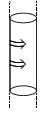
- 1A hollow cylinder having infinite length and carrying uniform current per unit length $\lambda$ along the circumference as shown. Magnetic field inside the cylinder isView Solution
- 2The resistance of a galvanometer is $50\, ohms$ and the current required to give full scale deflection is $100\,\mu A$. In order to convert it into an ammeter, reading upto $10\,A$, it is necessary to put a resistance ofView Solution
- 3Force on current carrying loop (Radius $= R$ ) in uniform magnetic $(B)$ field which is at an angle $30^{\circ}$ with the normal will beView Solution
- 4A square loop of side $l$ is kept in a uniform magnetic field $B$ such that its plane makes an angle $\alpha$ with $\vec{B}$. The loop carries a current $i$. The torque experienced by the loop in this position isView Solution
- 5Due to the flow of current in a circular loop of radius $R$, the magnetic induction produced at the centre of the loop is $B$. The magnetic moment of the loop is $({\mu _0} = {\rm{permeability}}\,{\rm{constant)}}$View Solution
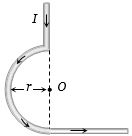
- 6In the figure, what is the magnetic field at the point $O$View Solution
- 7A long straight wire along the $z$-axis carries a current $I$ in the negative $z$ direction. The magnetic vector field $\mathop B\limits^ \to $ at a point having coordinates $(x, y)$ in the $z = 0$ plane isView Solution
- 8A proton (or charged particle) moving with velocity $v$ is acted upon by electric field $E$ and magnetic field $B$. The proton will move undeflected ifView Solution
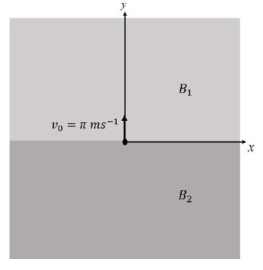
- 9In the xy-plane, the region $y >0$ has a uniform magnetic field $B_1 \hat{k}$ and the region $y<0$ has another uniform magnetic field $B_2 \hat{k}$. A positively charged particle is projected from the origin along the positive $y$-axis with speed $v _0=\pi m s ^{-1}$ at $t =0$, as shown in the figure. Neglect gravity in this problem. Let $t = T$ be the time when the particle crosses the $x$-axis from below for the first time. If $B_2=4 B_1$, the average speed of the particle, in $m s ^{-1}$, along the $x$-axis in the time interval $T$ is. . . . . .View Solution
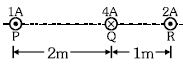
- 10Three long current carrying wires $P, Q$ and $R$ placed perpendicular to plane of the paper. Magnetic force per unit length on wire $'R'$ isView Solution