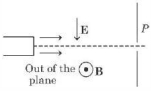
A collimated beam of charged and uncharged particles is directed towards a hole marked $P$ on a screen as shown below. If the electric and magnetic fields as indicated below are turned $ON$
KVPY 2020, Medium
Download our app for free and get started
$(c)$ The force on a charged particle moving in combined electric and magnetic field is
$F =q( E + v \times B )$
For given direction of $v$, the net force is in downward direction. So, no charge will be able to go through the hole $P$.
Hence, only neutral particle will go undeviated.

Download our appand get started for free
Experience the future of education. Simply download our apps or reach out to us for more information. Let's shape the future of learning together!No signup needed.*
Similar Questions
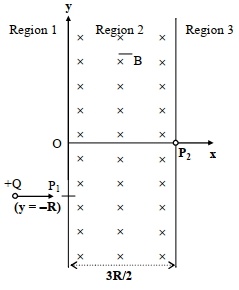
- 1A uniform magnetic field $B$ exists in the region between $x=0$ and $x=\frac{3 R}{2}$ (region $2$ in the figure) pointing normally into the plane of the paper. A particle with charge $+Q$ and momentum $p$ directed along $x$-axis enters region $2$ from region $1$ at point $P_1(y=-R)$. Which of the following option(s) is/are correct?View Solution
$[A$ For $B>\frac{2}{3} \frac{p}{QR}$, the particle will re-enter region $1$
$[B]$ For $B=\frac{8}{13} \frac{\mathrm{p}}{QR}$, the particle will enter region $3$ through the point $P_2$ on $\mathrm{x}$-axis
$[C]$ When the particle re-enters region 1 through the longest possible path in region $2$ , the magnitude of the change in its linear momentum between point $P_1$ and the farthest point from $y$-axis is $p / \sqrt{2}$
$[D]$ For a fixed $B$, particles of same charge $Q$ and same velocity $v$, the distance between the point $P_1$ and the point of re-entry into region $1$ is inversely proportional to the mass of the particle
- 2A ring of radius $R$, made of an insulating material carries a charge $Q$ uniformly distributed on it. If the ring rotates about the axis passing through its centre and normal to plane of the ring with constant angular speed $\omega $, then the magnitude of the magnetic moment of the ring isView Solution
- 3A galvanometer coil of resistance $50 \,\Omega$, show full deflection of $100\,\mu A$. The shunt resistance to be added to the galvanometer, to work as an ammeter of range $10\, mA$ isView Solution
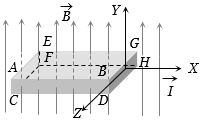
- 4A metallic block carrying current $I$ is subjected to a uniform magnetic induction $\overrightarrow B $ as shown in the figure. The moving charges experience a force $\overrightarrow F $ given by ........... which results in the lowering of the potential of the face ........ Assume the speed of the carriers to be $v$View Solution
- 5Two toroids $1$ and $2$ have total number of tums $200$ and $100 $ respectively with average radii $40\; \mathrm{cm}$ and $20 \;\mathrm{cm}$ respectively. If they carry same current $i,$ the ratio of the magnetic flelds along the two loops isView Solution
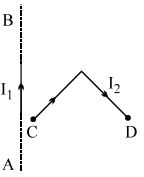
- 6In the figure shown a current $I_1$ is established in the long straight wire $AB$.Another wire $CD$ carrying current $I_2$ is placed in the plane of the paper. The line joining the ends of this wire is perpendicular to the wire $AB$. The force on the wire $CD$ is:View Solution
- 7View SolutionAssertion : The sensitivity of a moving coil galvanometer is increased by placing a suitable magnetic material as a core inside the coil.
Reason : Soft iron has high magnetic permeability and cannot be easily magnetized or demagnetized.
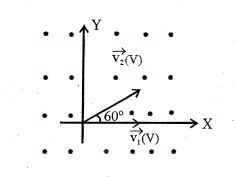
- 8Two charged particles of mass $m$ and charge $q$ each are projected from origin simultaneously with same speed $V$ in transverse magnetic field. If ${\vec r_1}$ and ${\vec r_2}$ are the position vectors of particles (with respect to origin) at $t = \frac{{\pi m}}{{qB}}$ then the value of ${\vec r_1}.{\vec r_2}$ at that time isView Solution
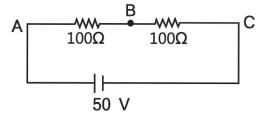
- 9Consider the diagram shown below. A voltmeter of resistance $150\,\Omega$ is connected across $A$ and $B$. The potential drop across $B$ and $C$ measured by voltmeter is $...........\,V$View Solution
- 10The resistance of a galvanometer coil is $R$. What is the shunt resistance required to convert it into an ammeter of range $4$ timesView Solution