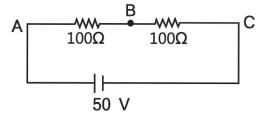
Consider the diagram shown below. A voltmeter of resistance $150\,\Omega$ is connected across $A$ and $B$. The potential drop across $B$ and $C$ measured by voltmeter is $...........\,V$
AIIMS 2015, Diffcult
Download our app for free and get started
(c)
When a voltmeter of resistance $150\,\Omega$ is connected across $A$ and $B$, the resistance across $A$ and $B$ will be
$R _{ ab }=\frac{150 \times 100}{150+100}=60\,\Omega$
Now the equivalent resistance of the circuit will be $R_{a c}=R_{a b}+R_{b c}=60+100=$ $160\,\Omega$
The current in the circuit will be $I=50 / 160=0.31\,A$
Thus, Potential drop across B and C will be $V _{ bc }= IR _{ bc }=(0.31)(100)=31\,V$

Download our appand get started for free
Experience the future of education. Simply download our apps or reach out to us for more information. Let's shape the future of learning together!No signup needed.*
Similar Questions
- 1A car of mass $1000\,kg$ negotiates a banked curve of radius $90\,m$ on a fictionless road. If the banking angle is $45^o$, the speed of the car is ......... $ms^{-1}$View Solution
- 2A galvanometer has $36\,\Omega $ resistance. If a $4\,\Omega $ shunt is added to this, the fraction of current that passes through the shunt isView Solution
- 3Due to the flow of current in a circular loop of radius $R$, the magnetic induction produced at the centre of the loop is $B$. The magnetic moment of the loop is $({\mu _0} = {\rm{permeability}}\,{\rm{constant)}}$View Solution
- 4A coil in the shape of an equilateral triangle of side $10\, {cm}$ lies in a vertical plane between the pole pieces of permanent magnet producing a horizontal magnetic field $20\, {mT}$. The torque acting on the coil when a current of $0.2\, {A}$ is passed through it and its plane becomes parallel to the magnetic field will be $\sqrt{{x}} \times 10^{-5} \,{Nm}$. The value of ${x}$ is ..... .View Solution
- 5A horizontal overhead power line is at a height of $4\,m$ from the ground and carries a current of $100\,A$ from east to west. The magnetic field directly below it on the ground is $(\mu _0 = 4\pi \times 10^{-7}\,TmA^{-1})$View Solution
- 6A charged particle with specific charge $S$ moves undeflected through a region of space containing mutually perpendicular uniform electric and magnetic fields $E$ and $B$ . When electric field is switched off, the particle will move in a circular path of radiusView Solution
- 7A galvanometer having a coil resistance $100 \;\Omega$ gives a full scale deflection when a current of $1 \;\mathrm{mA}$ is passed through it. What is the value of the resistance which can convert this galvanometer into a voltmeter giving full scale deflection for a potential difference of $10\; \mathrm{V} ?$......$k\Omega$View Solution
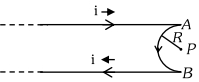
- 8A very long conducting wire is bent in a semicircular shape from $A$ to $B$ as shown in figure. The magnetic field at point $P$ for steady current configuration is given by:View Solution
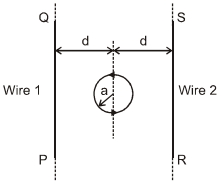
- 9The figure shows a circular loop of radius a with two long parallel wires (numbered $1$ and $2$) all in the plane of the paper. The distance of each wire from the centre of the loop is $d$. The loop and the wires are carrying the same current $I$. The current in the loop is in the counterclockwise direction if seen from above.$Image$View Solution
$1.$ When $d \approx$ a but wires are not touching the loop, it is found that the net magnetic filed on the axis of the loop is zero at a height $h$ above the loop. In that case
$(A)$ current in wire $1$ and wire $2$ is the direction $P Q$ and $R S$, respectively and $h \approx a$
$(B)$ current in wire $1$ and wire $2$ is the direction $PQ$ and $SR$, respectively and $h \approx a$
$(C)$ current in wire $1$ and wire $2$ is the direction $PQ$ and $SR$, respectively and $h \approx 1.2 a$
$(D)$ current in wire $1$ and wire $2$ is the direction $PQ$ and $RS$, resepectively and $h \approx 1.2 a$
$2.$ Consider $d \gg a$, and the loop is rotated about its diameter parallel to the wires by $30^{\circ}$ from the position shown in the figure. If the currents in the wires are in the opposite directions, the torque on the loop at its new position will be (assume that the net field due to the wires is constant over the loop)
$(A)$ $\frac{\mu_0 I^2 a^2}{d}$ $(B)$ $\frac{\mu_0 I^2 a^2}{2 d}$ $(C)$ $\frac{\sqrt{3} \mu_0 I^2 a^2}{d}$ $(D)$ $\frac{\sqrt{3} \mu_0 I^2 a^2}{2 d}$
Give the answer question $1$ and $2.$
- 10A moving coil galvanometer has $100$ turns and each turn has an area of $2.0 \mathrm{~cm}^2$. The magnetic field produced by the magnet is $0.01 \mathrm{~T}$ and the deflection in the coil is $0.05$ radian when a current of $10 \mathrm{~mA}$ is passed through it. The torsional constant of the suspension wire is $\mathrm{x} \times 10^{-5} \mathrm{~N}-\mathrm{m} / \mathrm{rad}$. The value of $\mathrm{x}$ is____.View Solution