A conducting sphere of radius $R$ is given a charge $Q.$ The electric potential and the electric field at the centre of the sphere respectively are
AIPMT 2014, Easy


Download our appand get started for free
Experience the future of education. Simply download our apps or reach out to us for more information. Let's shape the future of learning together!No signup needed.*
Similar Questions
- 1Three charged particles having charges $q,-2 q$ and $q$ are placed in a line at points $(-a, 0),(0,0)$ and $(a, 0)$ respectively. The expression for electric potential at $P(r, 0)$ for $r \gg a$ is ...............View Solution
- 2A parallel plate capacitor whose capacitance $C$ is $14\, pF$ is charged by a battery to a potential difference $V =12\, V$ between its plates. The charging battery is now disconnected and a porcelin plate with $k =7$ is inserted between the plates, then the plate would oscillate back and forth between the plates with a constant mechanical energy of $..........pJ$. (Assume no friction)View Solution
- 3The electric potential at the surface of an atomic nucleus $(Z = 50)$ of radius $9.0×{10^{ - 13}}\, cm$ isView Solution
- 4A capacitor $C$ is charged to a potential difference $V$ and battery is disconnected. Now if the capacitor plates are brought close slowly by some distance :View Solution
- 5The capacity of a parallel plate condenser is $15\,\mu \,F$, when the distance between its plates is $6 \,cm$. If the distance between the plates is reduced to $2\, cm$, then the capacity of this parallel plate condenser will be......$\mu \,F$View Solution
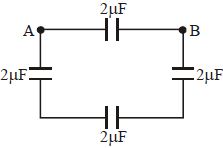
- 6The equivalent capacitance between the points $A$ and $B$ in the given diagram isView Solution
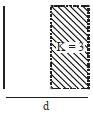
- 7A parallel plate capacitor with plate area $A$ and plate separation $d =2 \,m$ has a capacitance of $4 \,\mu F$. The new capacitance of the system if half of the space between them is filled with a dielectric material of dielectric constant $K =3$ (as shown in figure) will be .........$ \mu \,F$View Solution
- 8The distance between the circular plates of a parallel plate condenser $40\,mm$ in diameter, in order to have same capacity as a sphere of radius $1\;metre$ is....$mm$View Solution
- 9Two identical positive charges are placed at $x =\, -a$ and $x = a$ . The correct variation of potential $V$ along the $x-$ axis is given byView Solution
- 10If the potential of a capacitor having capacity of $6\,\mu F$ is increased from $10\, V$ to $20\, V$, then increase in its energy will beView Solution