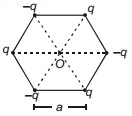
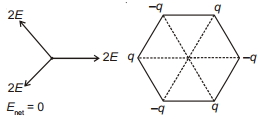
Six point charges are placed at the vertices of a regular hexagon of side $a$ as shown. If $E$ represents electric field and $V$ represents electric potential at $O$, then
Medium


Download our appand get started for free
Experience the future of education. Simply download our apps or reach out to us for more information. Let's shape the future of learning together!No signup needed.*
Similar Questions
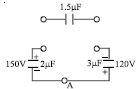
- 1Two capacitors of $2$ $\mu F$ and $3$ $\mu F$ are charged to $150$ $volt$ and $120$ $volt$ respectively. The plates of capacitor are connected as shown in the figure. A discharged capacitor of capacity $1.5$ $\mu F$ falls to the free ends of the wire. ThenView Solution
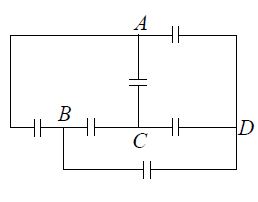
- 2Choose the correct statement for the given capacitor arrangement. (All the $6$ capacitor are of same capacitance)View Solution
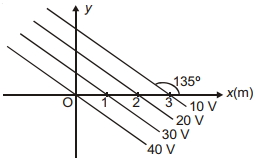
- 3View SolutionFigure shows a set of equipotential surfaces. The magnitude and direction of electric field that exists in the region is .........
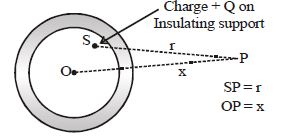
- 4The adjacent diagram shows a charge $+Q$ held on an insulating support $S$ and enclosed by a hollow spherical conductor. $O$ represents the centre of the spherical conductor. and $P$ is a point such that $OP = x $ and $SP = r$ . The electric field at point $P$ will beView Solution
- 5An $\alpha$ particle and a proton are accelerated from rest through the same potential difference. The ratio of linear momenta acquired by above two particals will be.View Solution
- 6A solid conducting sphere of radius $R_1$ is surrounded by another concentric hollow conducting sphere of radius $R_2$. The capacitance of this assembly is proportional toView Solution
- 7Choose the $CORRECT$ optionView Solution
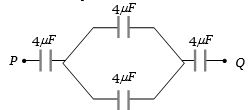
- 8Four condensers each of capacity $4\,\mu F$ are connected as shown in figure. ${V_P} - {V_Q} = 15\,volts$. The energy stored in the system is......$ergs$View Solution
- 9Assertion : If three capacitors of capacitances $C_1 < C_2 < C_3$ are connected in parallel then their equivalent capacitance $C_P > C_S$.View Solution
Reason : $\frac{1}{{{C_p}}} = \frac{1}{{{C_1}}} + \frac{1}{{{C_2}}} + \frac{1}{{{C_3}}}$
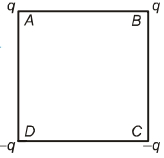
- 10Charges are placed on the vertices of a square as shown Let $\vec E$ be the electric field and $V$ the potential at the centre. If the charges on $A$ and $B$ are interchanged with those on $D$ and $C$ respectively, thenView Solution