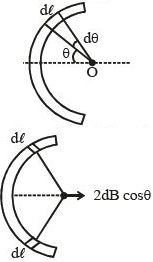
A current $I$ flows in an infinitely long wire with cross-section in the form of a semicircular ring of radius $R$. The magnitude of the magnetic induction along its axis is
Diffcult


Download our appand get started for free
Experience the future of education. Simply download our apps or reach out to us for more information. Let's shape the future of learning together!No signup needed.*
Similar Questions
- 1A $2\, MeV$ proton is moving perpendicular to a uniform magnetic field of $2.5\, tesla$. The force on the proton isView Solution
- 2A charge $q$ $coulomb$ moves in a circle at $n$ revolutions per second and the radius of the circle is $r$ $metre$. Then magnetic field at the centre of the circle isView Solution
- 3The current of $5 \mathrm{~A}$ flows in a square loop of sides $1$ $\mathrm{m}$ is placed in air. The magnetic field at the centre of the loop is $\mathrm{X} \sqrt{2} \times 10^{-7} \mathrm{~T}$. The value of $\mathrm{X}$ is____.View Solution
- 4Two thin long parallel wires, separated by a distance $d$ carry a current of $I$ $amp$ in the same direction. They willView Solution
- 5An electron is moving with a speed of ${10^8}\,m/\sec $ perpendicular to a uniform magnetic field of intensity $B$. Suddenly intensity of the magnetic field is reduced to $B/2$. The radius of the path becomes from the original value of $r$View Solution
- 6View SolutionIn a moving coil galvanometer, to make the field radial
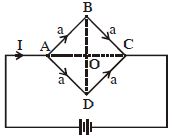
- 7Magnetic field at the centre $O$ of a square loop of side $'a'$ carrying current $I$ as shown in the figure isView Solution
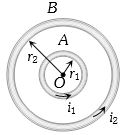
- 8$A$ and $B$ are two concentric circular conductors of centre $O$ and carrying currents ${i_1}$ and ${i_2}$ as shown in the adjacent figure. If ratio of their radii is $1 : 2$ and ratio of the flux densities at $O$ due to $A$ and $B$ is $1 : 3$, then the value of ${i_1}/{i_2}$ isView Solution
- 9A small coil of $N$ $turns$ has an effective area $A$ and carries a current $I$. It is suspended in a horizontal magnetic field $\overrightarrow B $ such that its plane is perpendicular to $\overrightarrow B $. The work done in rotating it by $180^\circ $ about the vertical axis isView Solution
- 10A parallel plate capacitor of area $60\, cm^2$ and separation $3\, mm$ is charged initially to $90\, \mu C$. If the medium between the plate gets slightly conducting and the plate loses the charge initially at the rate of $2.5\times10^{-8}\, C/s$, then what is the magnetic field between the plates ?View Solution